The Legislation Package
war-on-disease, 1-percent-treaty, medical-research, public-health, peace-dividend, decentralized-trials, dfda, dih, victory-bonds, health-economics, cost-benefit-analysis, clinical-trials, drug-development, regulatory-reform, military-spending, peace-economics, decentralized-governance, wishocracy, blockchain-governance, impact-investing
Here’s how democracy actually works: Lobbyists write bills and give them to politicians who can’t read. Those politicians vote based on who donated most to their campaign. Here are four bills, pre-written, ready to hand to whichever politician you can afford. You’re about to become the best lobbyist in history, except your bills actually help people instead of killing them.
Each bill is designed to pass because it gives politicians what they crave: money, votes, and the ability to claim they did something.
The Treaty Implementation Act: Making It Real
This is your cornerstone legislation. Without it, the treaty is just paper. With it, you redirect $27.2 billion annually from death to life.
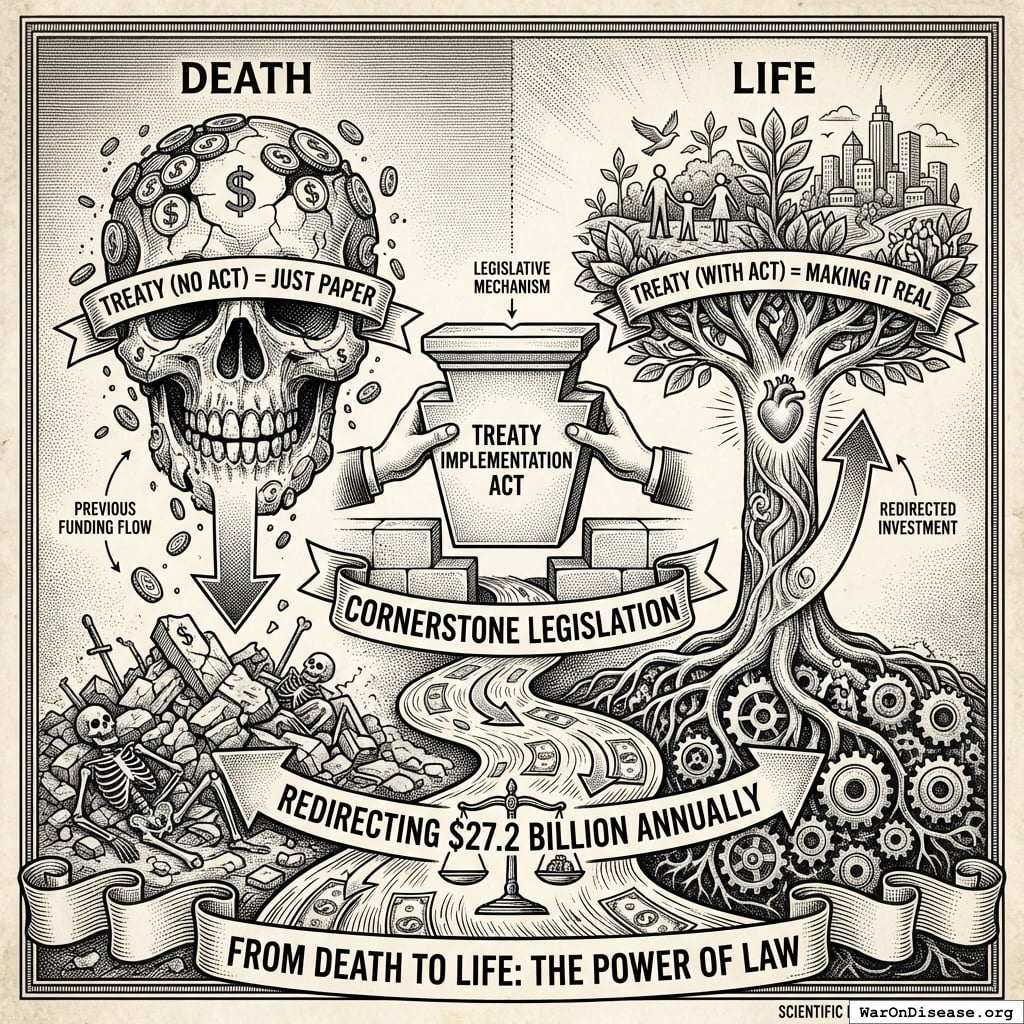
The Core Provisions
Section 1: Authorization
“The United States shall implement the 1% Treaty1 2 upon ratification by 3+ nations”
“1% of the United States military budget (currently ~$10 billion) shall be automatically redirected to a 1% Treaty Fund as the nation’s contribution to the treaty fund.”
“Funds transfer via auditable automated treasury rules on first day of fiscal year”
No annual appropriation needed (politicians can’t kill it later)
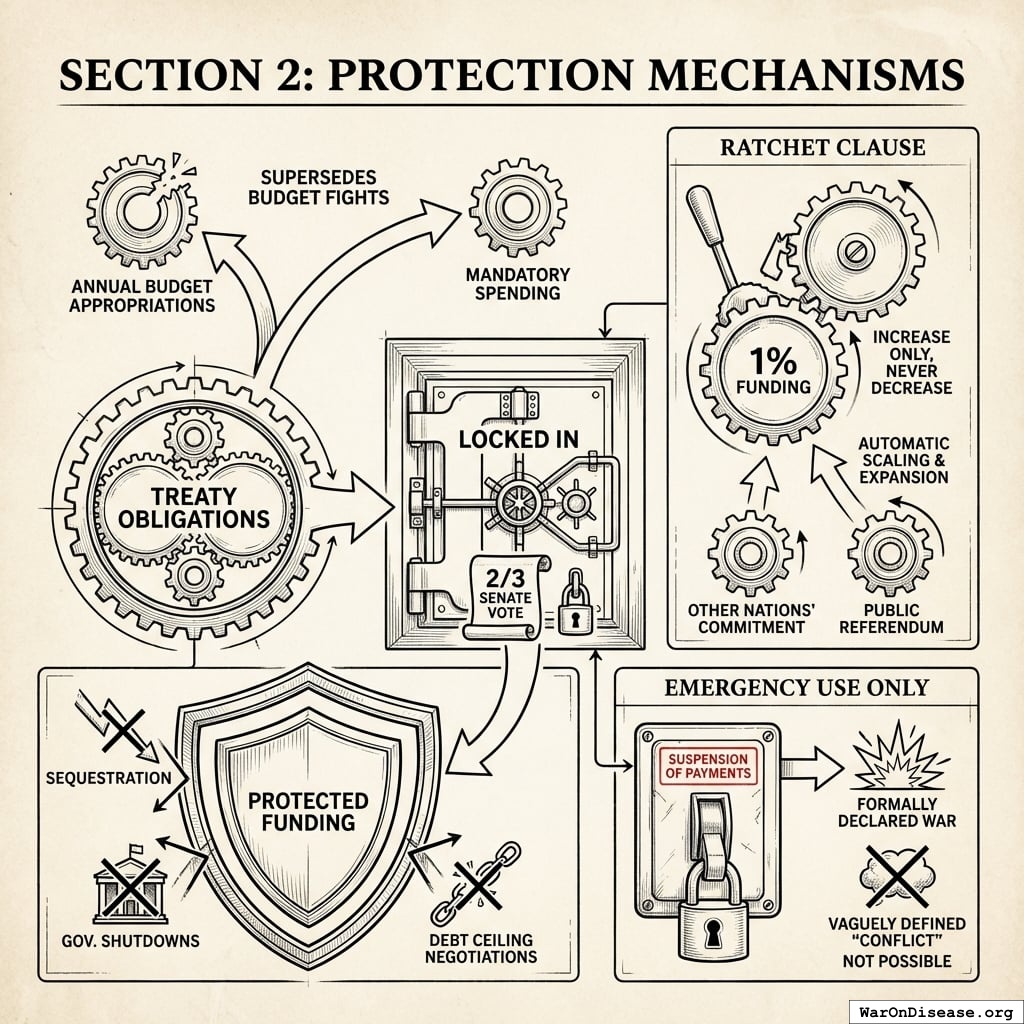
Section 2: Protection Mechanisms
- Supersedes Budget Fights: Treats treaty obligations as mandatory spending. Supersedes annual budget appropriations.
- Locked In: Withdrawal from the treaty requires a very difficult 2/3 Senate vote.
- Protected Funding: Funds are exempt from sequestration, government shutdowns, and debt ceiling negotiations.
- Ratchet Clause: The 1% funding can only increase, never decrease. It automatically scales if other nations increase their commitment. Public referendum can expand it further.
- Emergency Use Only: Only a formally declared war can suspend payments. A vaguely defined “conflict” does not qualify.
Avoiding Common Treaty Failure Modes
Treaties fail in predictable ways. They all fail for the same boring reasons. Here’s how this one avoids the common killers:
Reservation Games. Countries love to sign treaties then add exceptions that gut them. It’s like joining a gym but reserving the right to never go. Solution: no reservations permitted. All or nothing. Take it or leave it.
Ratification Delays. Sign with fanfare, take a photo, then let it die in committee forever. Your species calls this “diplomacy.” Solution: provisional application. Takes effect on signature. Ratification just formalizes what already started.
Creative Accounting. Reclassify “military” spending as “peacekeeping” or “homeland security” to dodge obligations. This is beige crime: making theft so procedurally dull that nobody investigates. Reclassifying “military” as “peacekeeping” is the bureaucratic equivalent of stealing someone’s car by renaming it “shared mobility infrastructure.” Solution: compliance verified by public ledger and independent audits. Relabeling a submarine as “humanitarian infrastructure” will be noticed, because $27.2 billion leaves a paper trail that 193 countries, every bondholder with a Bloomberg terminal, and one moderately competent auditor can follow.
Parliamentary Obstacles. Executive signs, legislature refuses to implement. Solution: the treaty sets the percentage; Congress implements it through the annual National Defense Authorization Act (NDAA), the same way NATO’s spending commitments work. After Medellin v. Texas (2008), your Supreme Court said not all treaties are self-executing, so this one doesn’t try to bypass Congress. It just gives Congress a job to do. The Incentive Alignment Bond mechanism makes sure they actually do it (by making “forgetting” expensive).
Section 3: The Candy for Congress
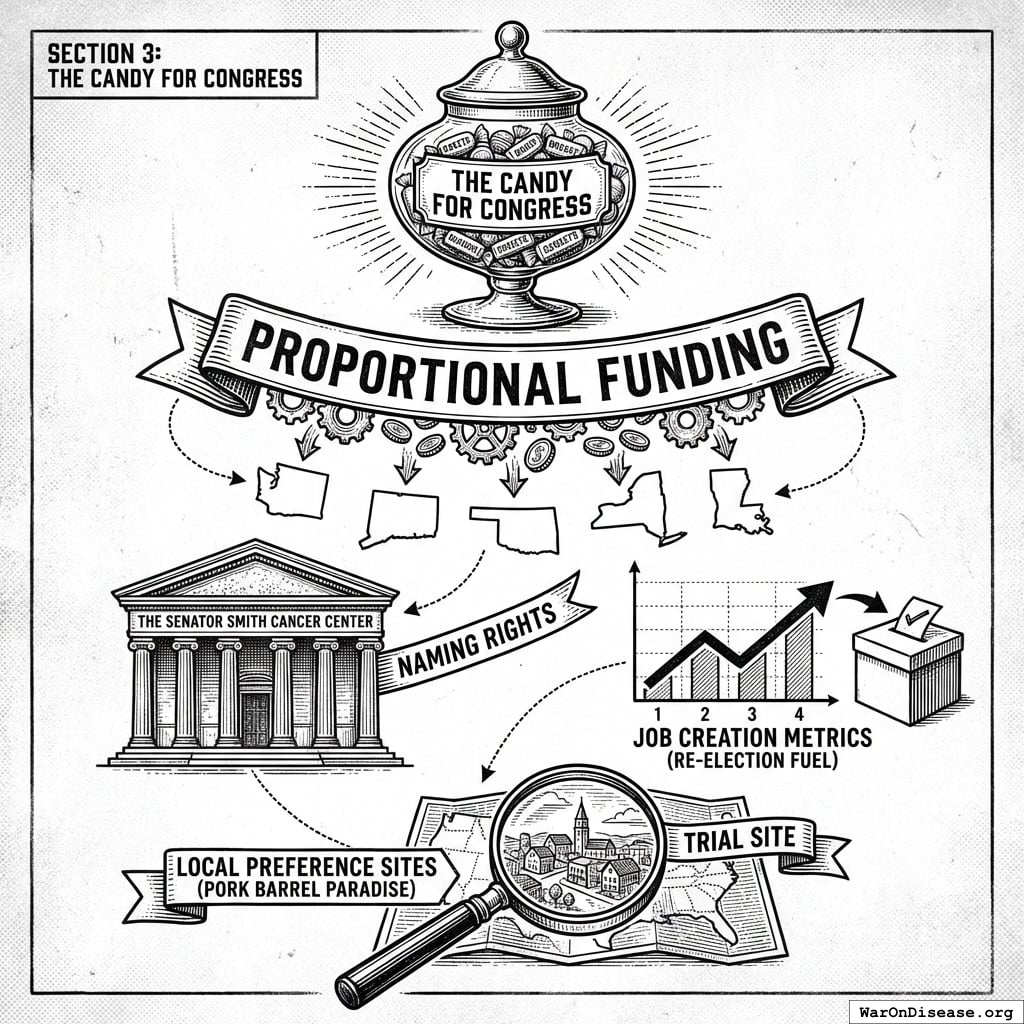
- Each state gets proportional pragmatic clinical trial funding
- Naming rights for politicians: “The Senator Smith Cancer Center”
- Job creation metrics published quarterly (re-election fuel)
- Local preference for trial sites (pork barrel paradise)
Why Politicians Will Vote Yes
Your politicians operate in two tribes. One tribe wraps everything in a flag; the other wraps everything in a heart. Same bill, different wrapping paper. The flag tribe hears “cuts waste, supports troops, America leads.” The heart tribe hears “healthcare access, reduces inequality, historic expansion.” Both tribes hear “your constituents stop dying and start voting for you.” The wrapping doesn’t matter. The incentive does.
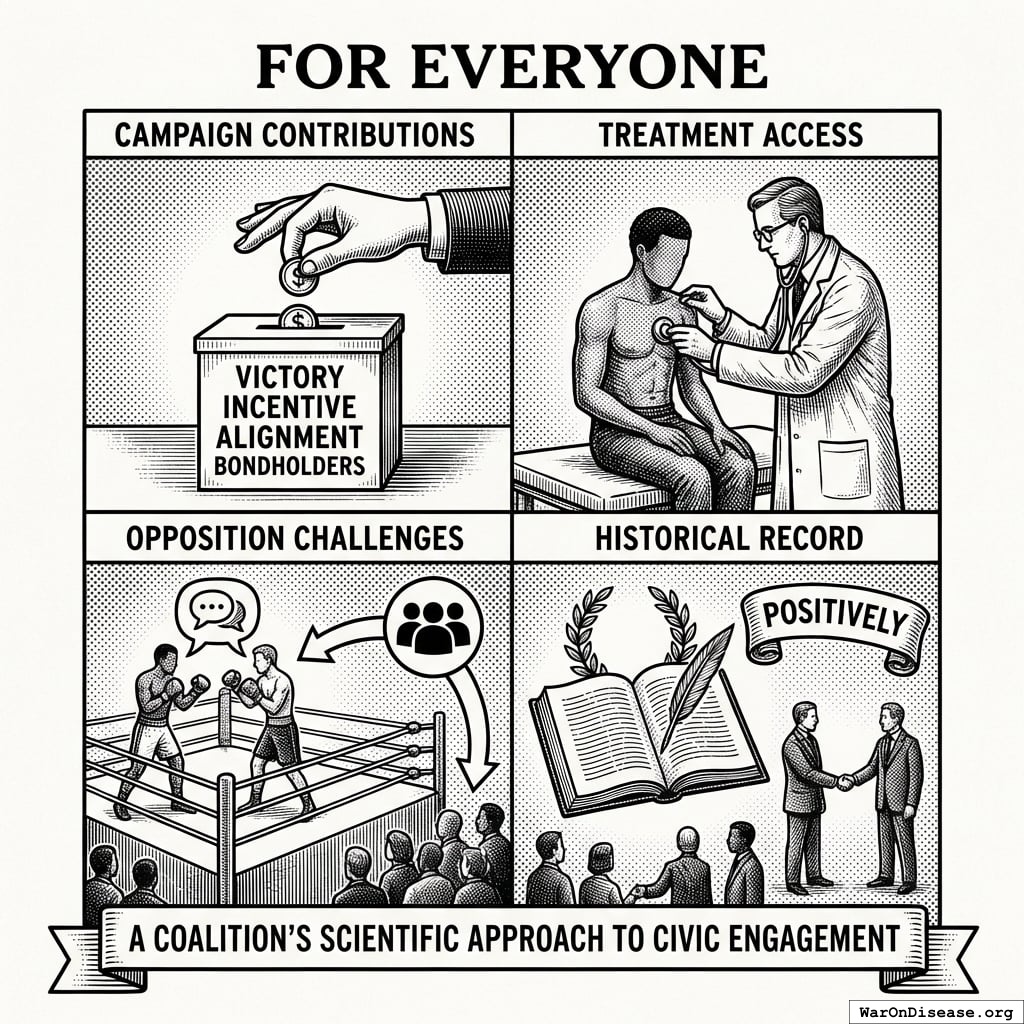
The Incentive Alignment Bond mechanism funds independent political support for every politician who votes yes. Opposition faces primary challenges. Cured constituents vote. History books write about them positively. All four things politicians actually care about, delivered simultaneously.
The Legislative Hack
Bundle it with military funding. Politicians rarely vote against military bills (career suicide). Your treaty implementation becomes a tiny rider on a massive bill they have to pass.
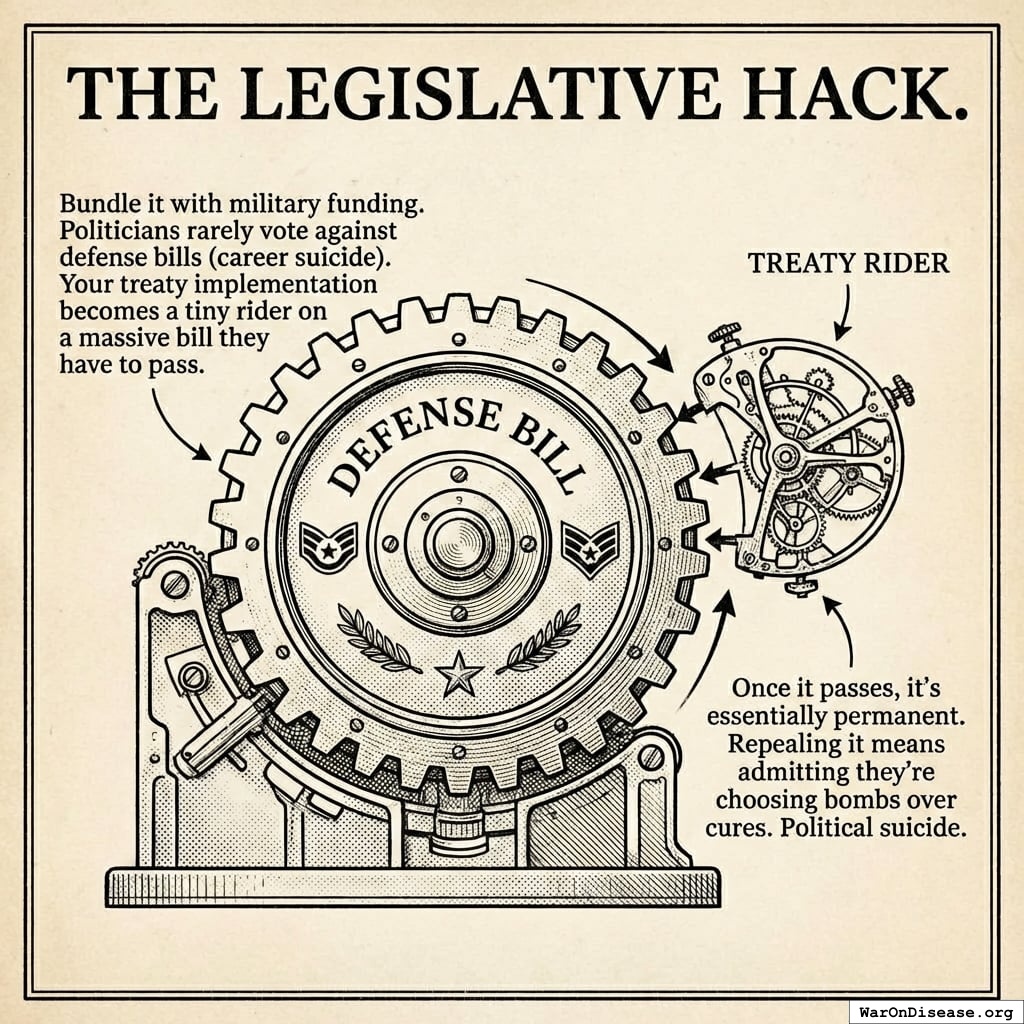
Once it passes, it’s essentially permanent. Repealing it means admitting they’re choosing bombs over cures. Political suicide.
The Authorization Act for your Decentralized Institutes of Health: Creating Your Machine
This creates your Decentralized Institutes of Health (DIH). The machine that converts bomb money into trial slots.
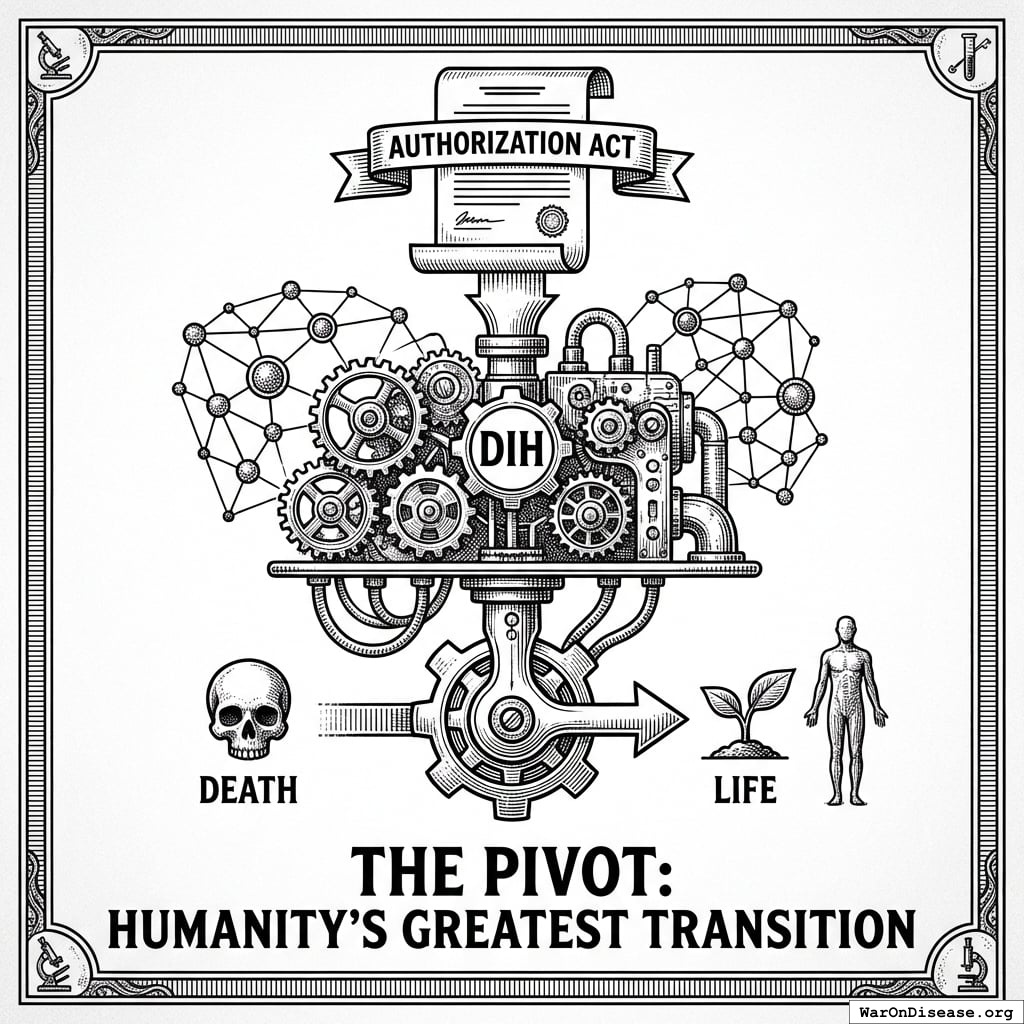
The Structure Designed to Resist Capture
Section 1: Establishment
- “A Decentralized Institutes of Health (DIH) network is created as an independent agency” (not under HHS control)
- “Governed by transparent rules and auditable automation” (not by political appointees)
- “Funded by treaty obligations” (no appropriations needed)
- “Exempt from government hiring rules” (can actually pay competitive salaries)
Section 2: Powers

- Can launch and manage any pragmatic clinical trials globally
- Can partner with any organization
- Can operate parallel to FDA (not under it)
- Can accept private funding (VICTORY Incentive Alignment Bonds3)
Section 3: Governance
- No board of directors (can’t be captured)
- Collective-choice decisions via Wishocracy4 voting
- Transparent public-ledger operations (radical transparency)
- Annual public audits (trust through verification)
The Trojan Horse Approach
Frame it as a “pilot program” or “innovation testbed.” Politicians love pilots because they sound temporary and innovative. Don’t mention that successful pilots never get cancelled.
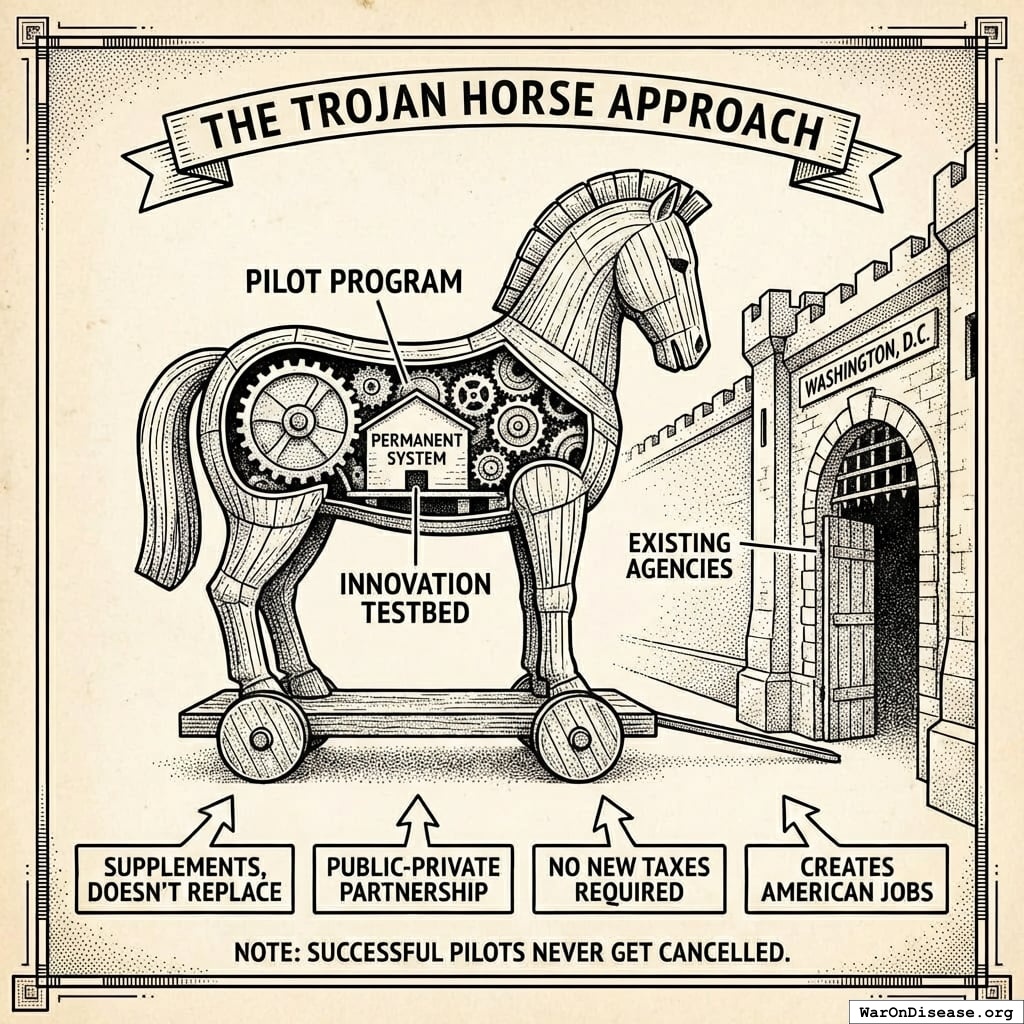
Your politicians will approve the pilot because it sounds temporary. Nothing temporary has ever been cancelled on your planet. You have 47 “temporary” government programs from the 1930s still running. The pilot is a permanent program wearing a lab coat.
The Poison Pills for Opposition
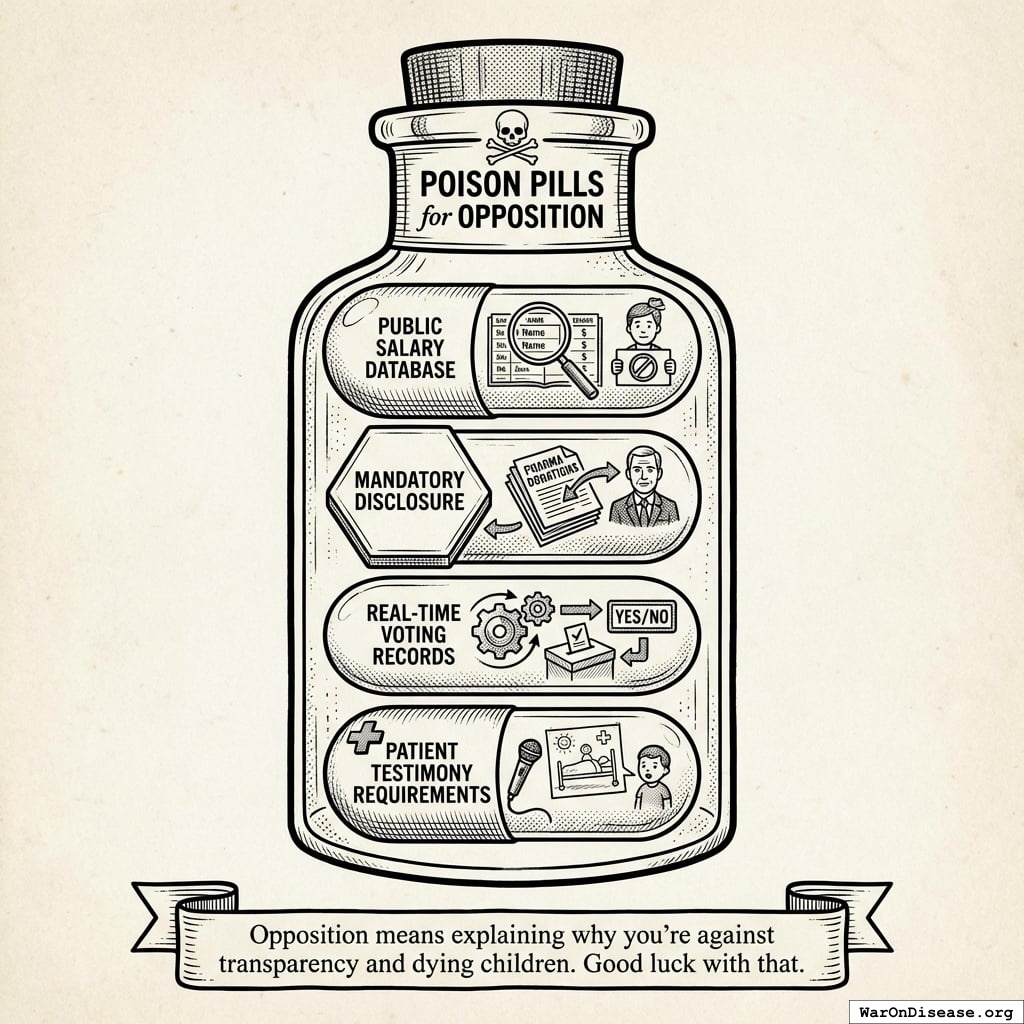
Insert provisions that make opposition toxic:
- Public salary database (shows who’s blocking cures)
- Mandatory disclosure of pharma donations
- Real-time voting records on health issues
- Patient testimony requirements (let dying kids speak)
Opposition means explaining why you’re against transparency and dying children. Good luck with that.
The Right to Trial & FDA Upgrade Act: Try It, Write It Down
A drug passes its first human safety tests. Then patients wait 8.2 years (90% CI: 4.84 years-11.5 years) while your FDA checks whether it works. This bill lets them stop waiting, on one condition: every patient who tries the treatment gets their results recorded, so the next patient knows more than they did.
The full text is the Right to Trial & FDA Upgrade Act5. Hand a politician that, not a summary.
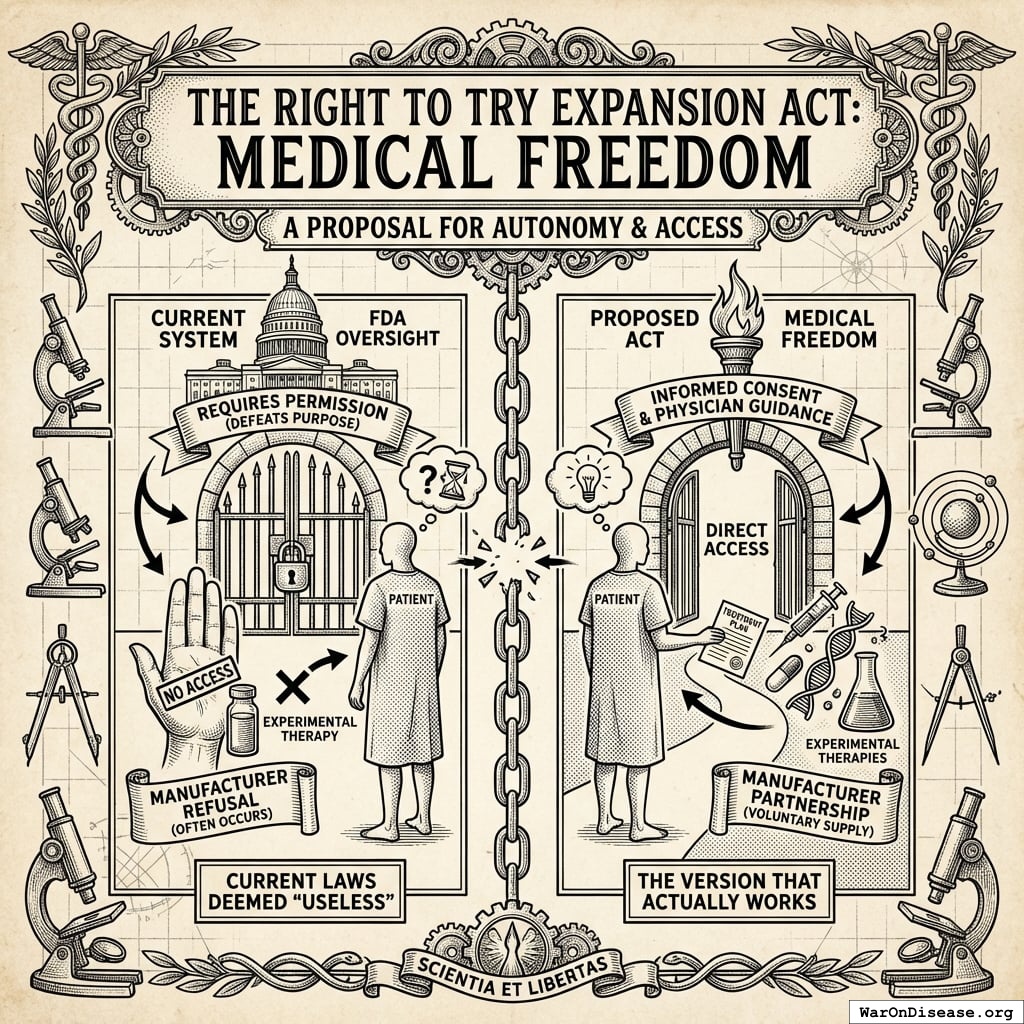
What It Does
- Any patient with any condition, including aging, may buy a treatment that has finished Phase 1 safety testing, if a licensed provider recommends it and a supplier agrees to sell it.
- No FDA application or individual FDA permission is required.
- Every use runs under a protocol registered before treatment starts. Outcomes and side effects are recorded, and results are published, including the failures.
- An ethics board reviews each protocol. One board can approve a protocol for every site in every state.
- The FDA can suspend any protocol that shows a significant risk of harm.
- Anyone can run an evidence registry: a company, a nonprofit, a university, or a government. The FDA may not reject evidence just because it came from routine care instead of a traditional trial.
- Every registry publishes an Outcome Label for each treatment and condition in a common format: how many people tried it, how many got better or worse, and the side effects. Patients can add outcomes from anything they take, including approved drugs and supplements, and anyone may publish treatment rankings built from the labels.
What It Does Not Do
- It does not force anyone to make, sell, prescribe, or pay for anything.
- It does not cap prices. Suppliers may charge a profit, because that profit is what pays for testing treatments nobody would otherwise fund.
- It does not create an entitlement. Patients, insurers, charities, or employers may pay. None must.
- It does not spend new federal money. The FDA runs it on its existing budget plus cost-based fees.
- It does not let the government rank treatments, and it does not require any insurer to use anyone else’s rankings.
Why It Passes
It asks Congress for no new money, so there is no appropriations fight to lose.
Politicians are terrified of being blamed for the next thalidomide. They are not terrified of being blamed for the patients who die waiting, because those deaths happen one at a time and never make the news. Your species fears the wrong risk by a factor of 3,389 (90% CI: 1,811-5,734). The pitch is simple: more data makes things safer, not less. Monitoring a million patients in real time catches problems faster than testing a thousand patients for a decade.
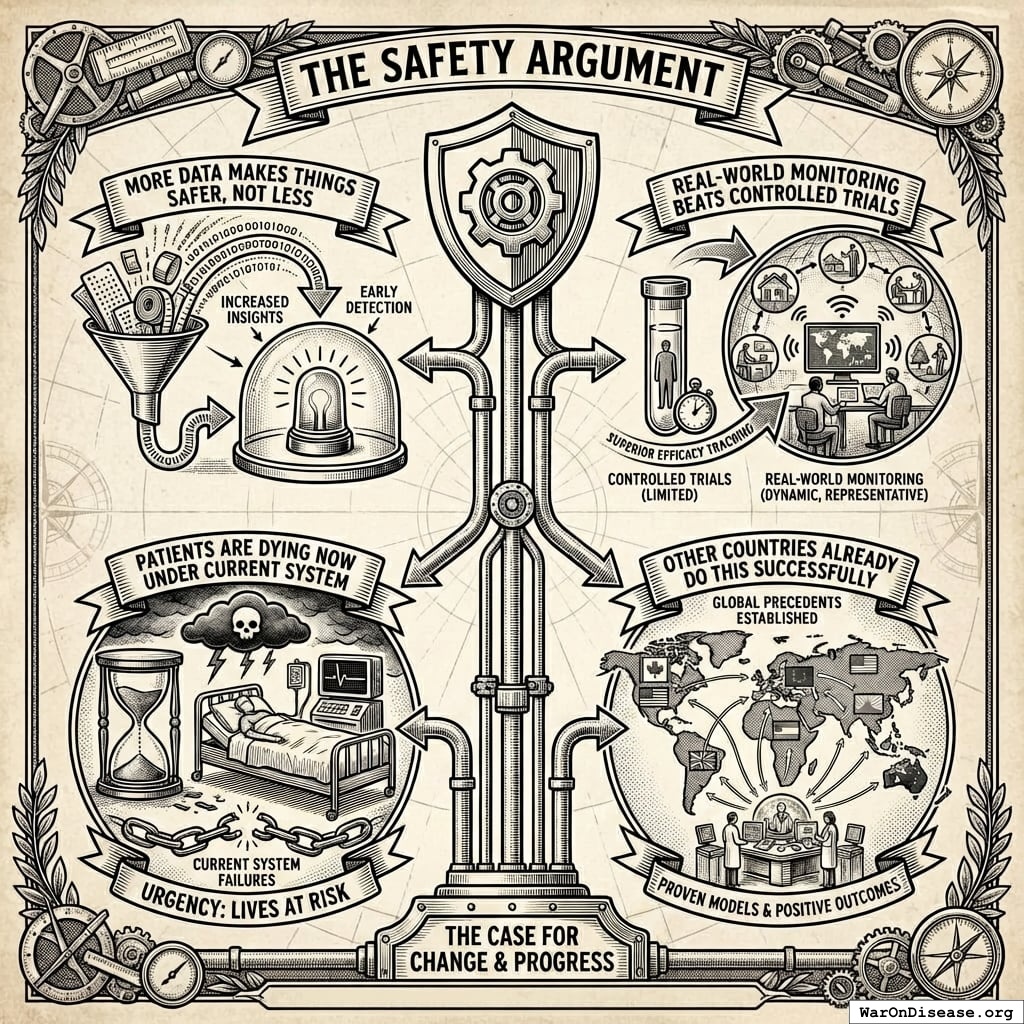
Your species has libertarians, progressives, religious groups, and patient groups. They agree on almost nothing. They all agree dying is bad. One flavor of politician hears “freedom.” The other hears “access.” The opposition has to explain on television why a dying patient may not try a treatment that already passed its safety tests. The new line for every hearing is one question: “Why won’t you let me try to live?”
If Congress Stalls
States can start without it. The state version, the Patient’s Right to Trial Act, adds similar evidence rules to state-licensed experimental treatment centers like the ones Montana authorized in 20256. State law cannot waive federal rules, so the federal Act is still the goal. If all 50 states adopt the state version and it works as modeled, it averts roughly 9.19 billion deaths (90% CI: 3.71 billion deaths-17.2 billion deaths) across future generations, for about $65 million (95% CI: $25 million-$200 million) in implementation costs.
The Budget Reallocation Act: Moving the Money
This is the technical bill that actually moves the money. Boring but critical. Without it, everything else is theater.
The Money Flow Mechanics
Section 1: Automatic Transfer
- 1% of DoD budget transferred on October 1st annually
- Via Federal Reserve direct transfer into the treaty fund’s designated treasury rails
- To a 1% Treaty Fund account structure governed by transparent, hard-to-rewrite rules
- Cannot be rescinded or redirected without treaty withdrawal
Section 2: The Protection Clauses
- Funds exempt from sequestration
- Exempt from government shutdown
- Exempt from debt ceiling fights
- Treated as treaty obligation, not appropriation
Section 3: The Growth Mechanism
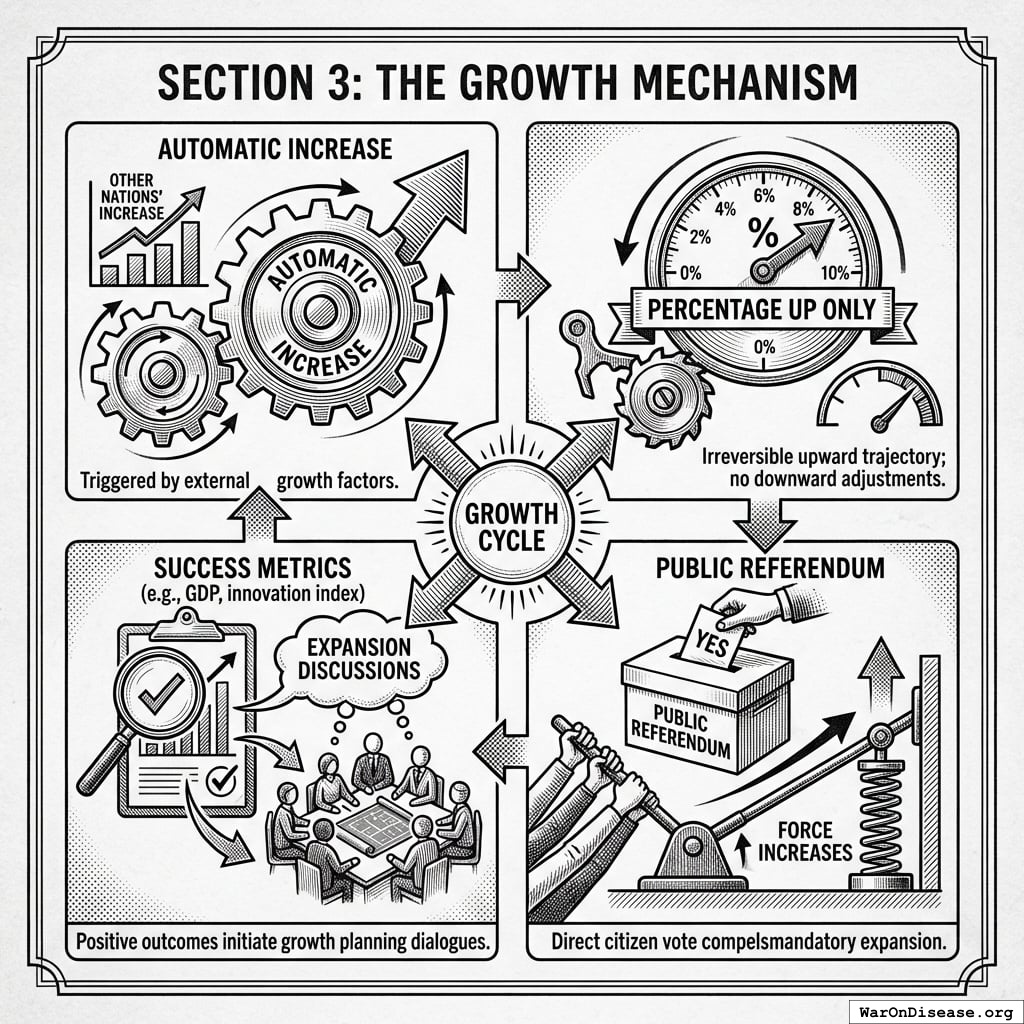
- Automatic increase if other nations increase
- Percentage can only go up, never down
- Success metrics trigger expansion discussions
- Public referendum can force increases
Making It Hard to Kill
The Constitutional Approach
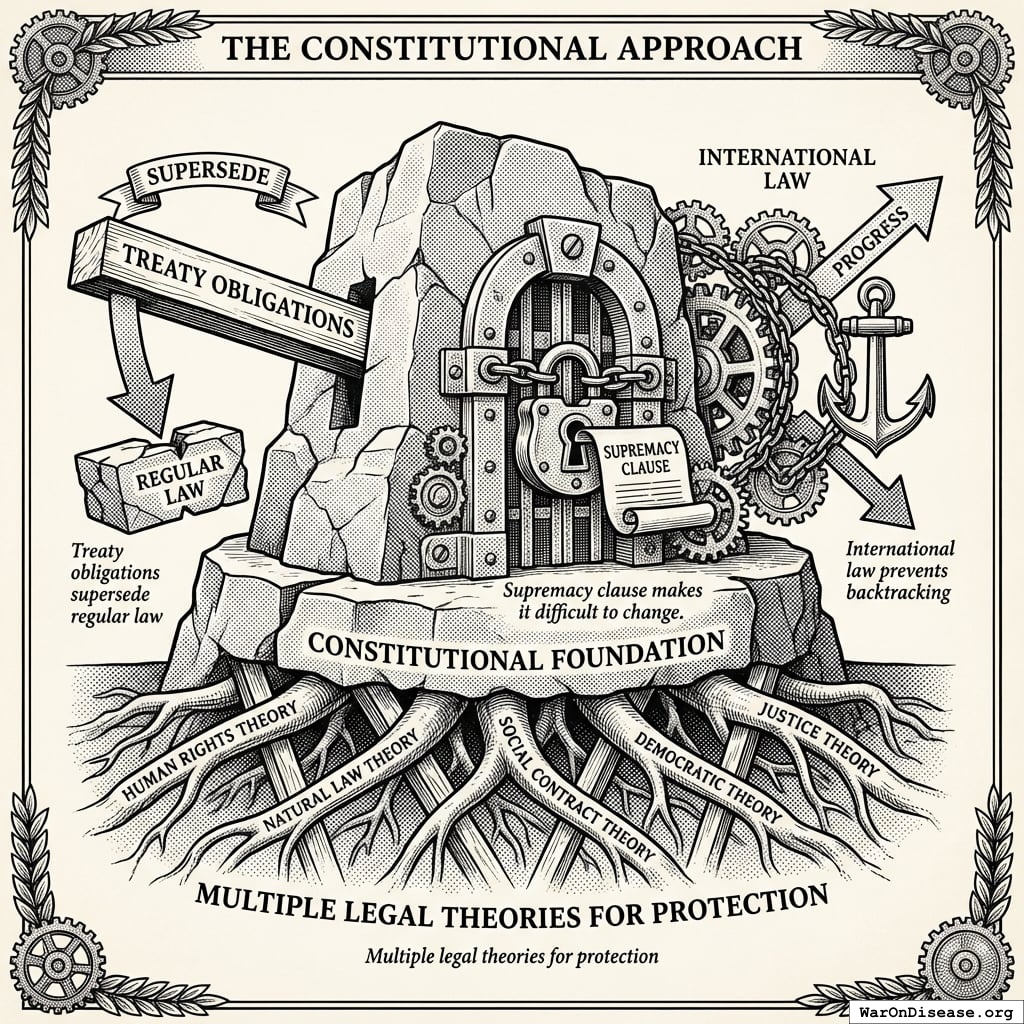
- Treaty obligations supersede regular law
- Supremacy clause makes it difficult to change
- International law prevents backtracking
- Multiple legal theories for protection
The Political Protection
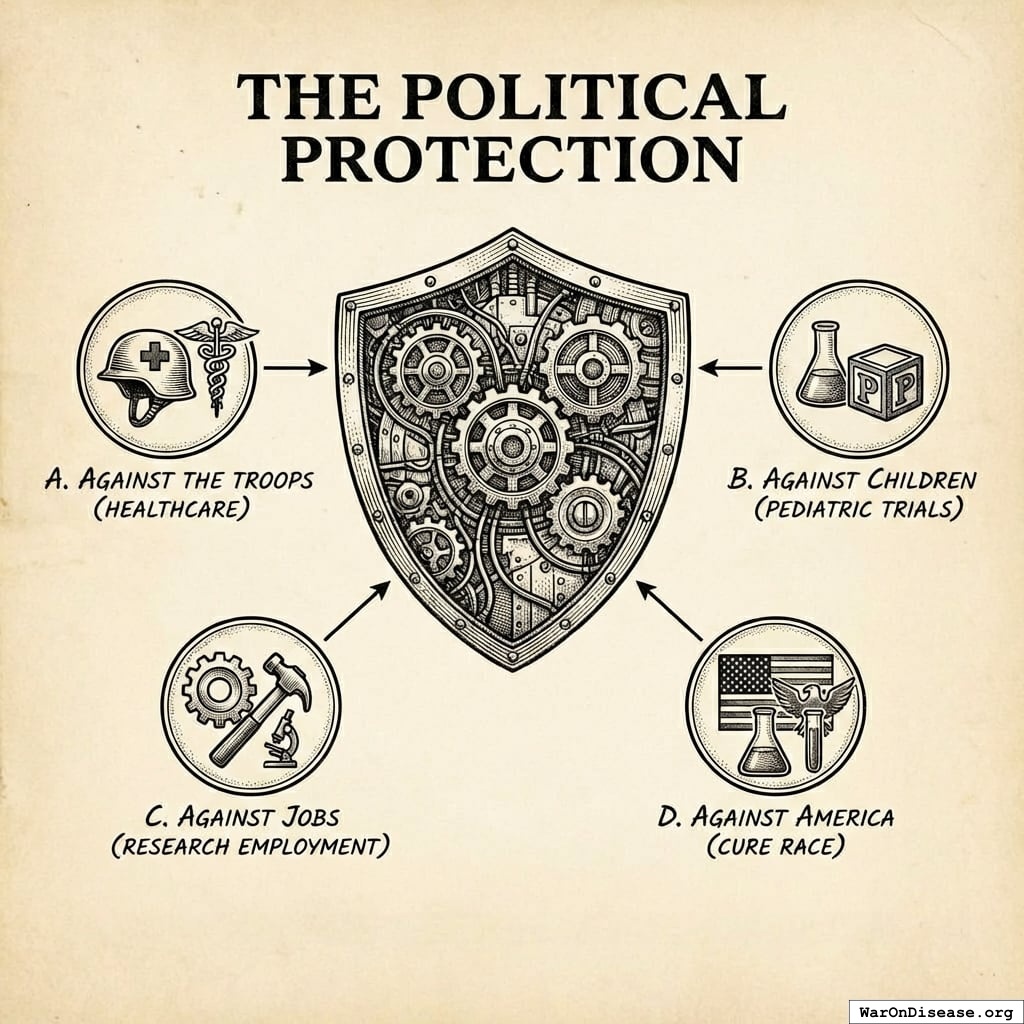
- Touching it means you’re “against the troops” (their healthcare)
- And “against children” (pediatric trials)
- And “against jobs” (research employment)
- And “against America” (America is winning the cure race)
The Technical Protection
- Smart contracts execute automatically
- Multiple backup execution methods
- International oversight and verification
- Blockchain immutability prevents tampering
The Incremental Implementation
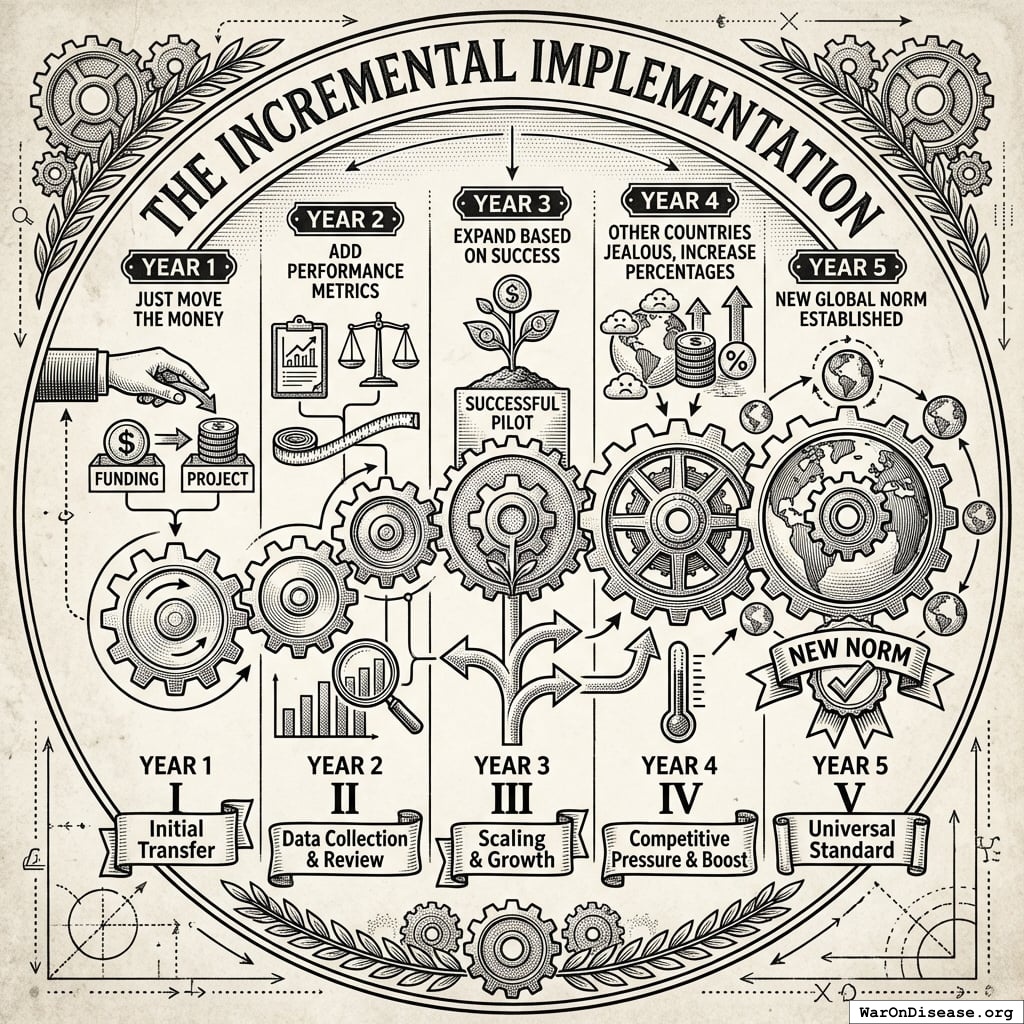
Year 1: Move the money. Fund 23.4 million patients/year (90% CI: 9.21 million patients/year-93.7 million patients/year) trial slots. Publish results. Year 2: First treatments reach patients. Politicians discover cured constituents vote. Year 3: Other countries notice their neighbors are getting healthier and richer. Increase to 2%. Year 5: The 1% Treaty is no longer controversial. It is a line item. Nobody remembers what the fuss was about, the same way nobody remembers opposing seatbelts.
The Legislative Strategy: Order of Operations
Here’s how you pass all four bills:
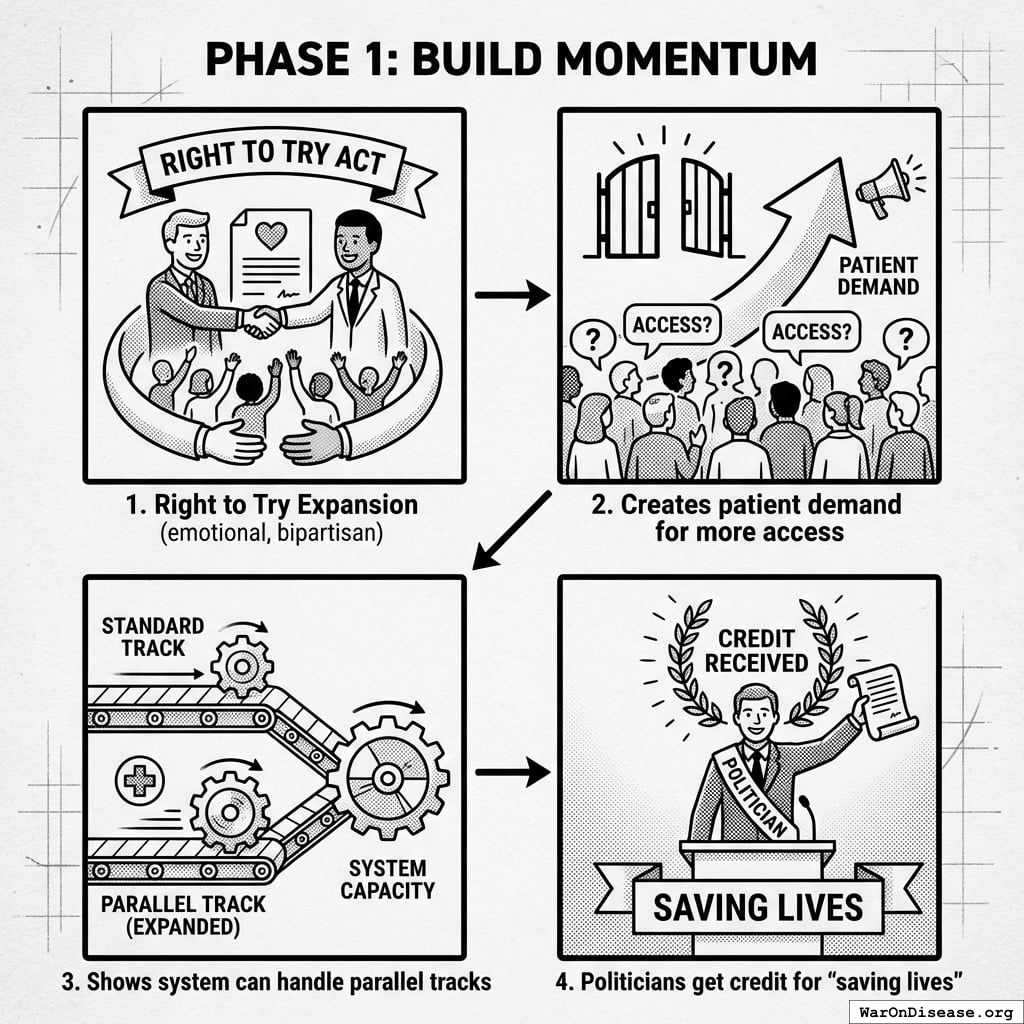
Phase 1: Build Momentum
- The Right to Trial & FDA Upgrade Act goes first (bipartisan, no new spending)
- Creates patient demand for more access
- Fills public registries with results the funding bills can point to
- Politicians get credit for “saving lives”
Phase 2: Fund the System
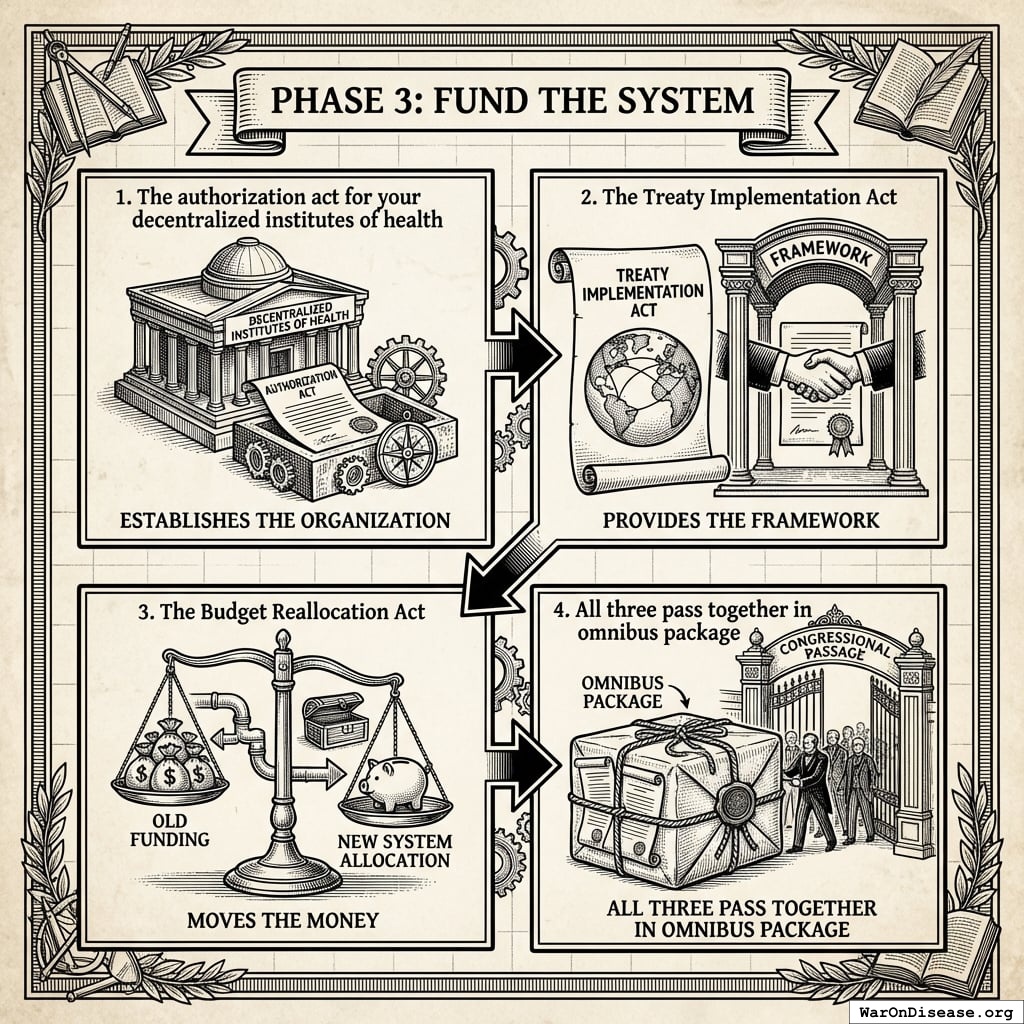
- The authorization act for your Decentralized Institutes of Health establishes the organization
- The Treaty Implementation Act provides the framework
- The Budget Reallocation Act moves the money
- All three pass together in omnibus package
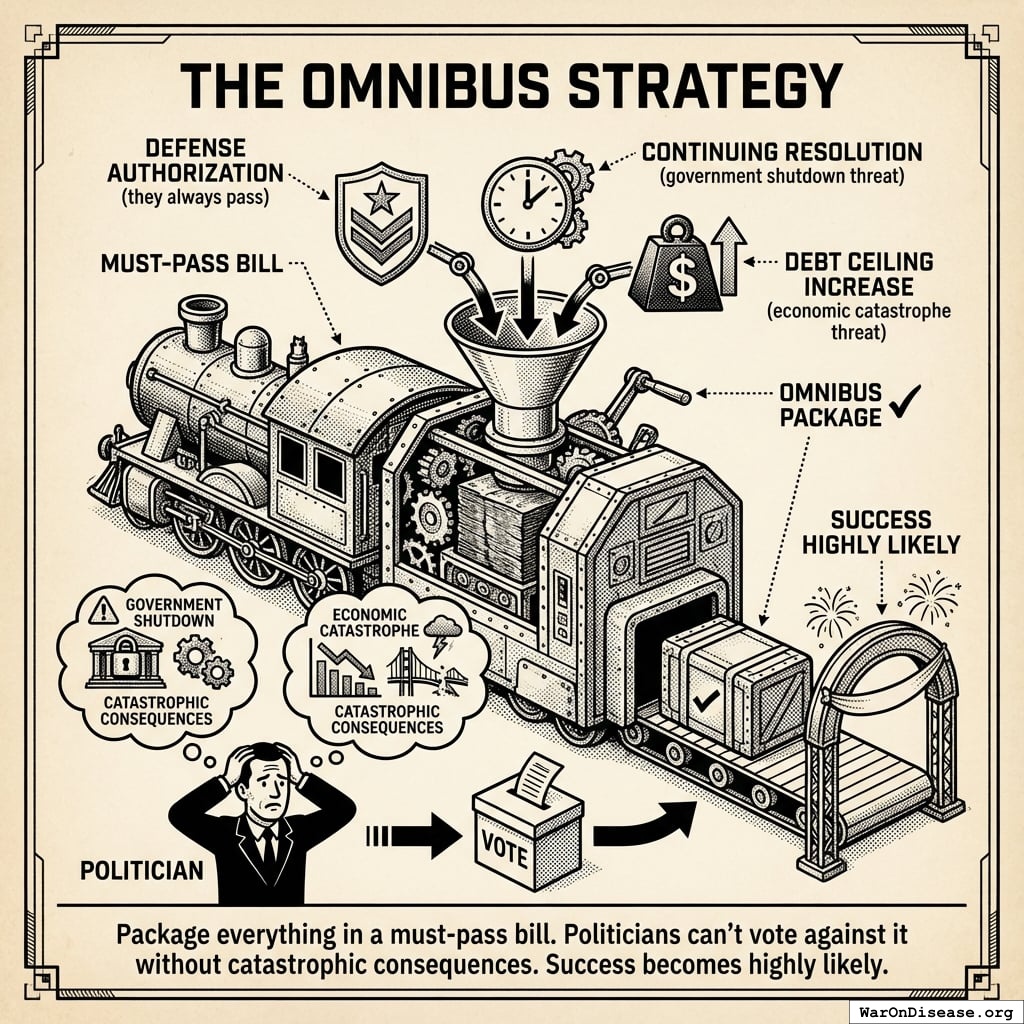
The Omnibus Strategy
Package everything in a must-pass bill:
- Military authorization (they always pass)
- Or continuing resolution (government shutdown threat)
- Or debt ceiling increase (economic catastrophe threat)
Politicians can’t vote against it without catastrophic consequences. Success becomes highly likely.
Conclusion: Democracy Theater at Its Finest
None of this changes how democracy works. That’s the point. Four bills that convert a system profiting from death into one profiting from life.
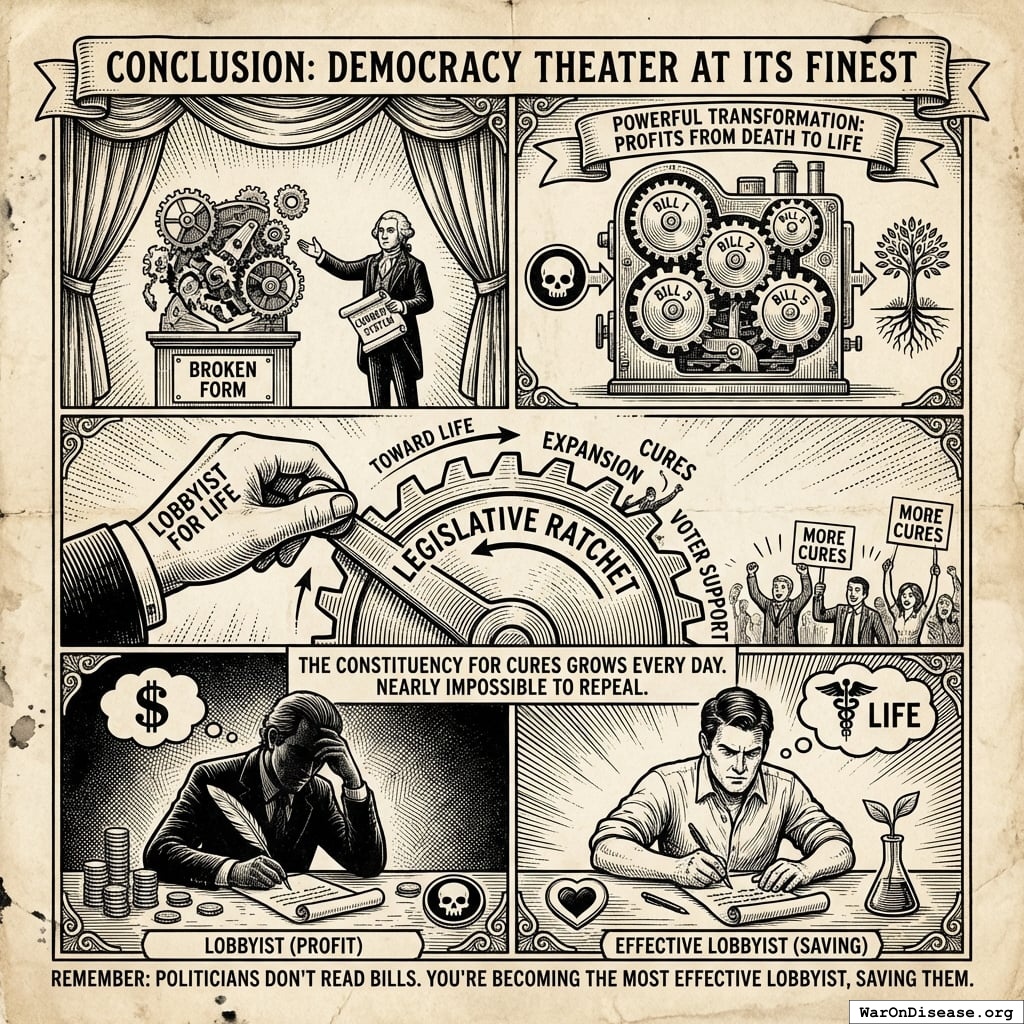
Once passed, they are nearly impossible to repeal. Every person treated becomes a voter for expansion. Every cure makes the next bill easier to pass. The ratchet only turns one direction.
Politicians do not read bills. Lobbyists write them. This is the lobbyist’s playbook, except the client is everyone and the product is not dying.