Building Your AI Coordination Army
war-on-disease, 1-percent-treaty, medical-research, public-health, peace-dividend, decentralized-trials, dfda, dih, victory-bonds, health-economics, cost-benefit-analysis, clinical-trials, drug-development, regulatory-reform, military-spending, peace-economics, decentralized-governance, wishocracy, blockchain-governance, impact-investing
You’ve got mission control, a network of Decentralized Institutes of Health (DIH), and a targeting system (Wishocracy135). Now you need an army of AI agents to do the work. Humans are sleeping, arguing on Twitter, or attending conferences that accomplish nothing.
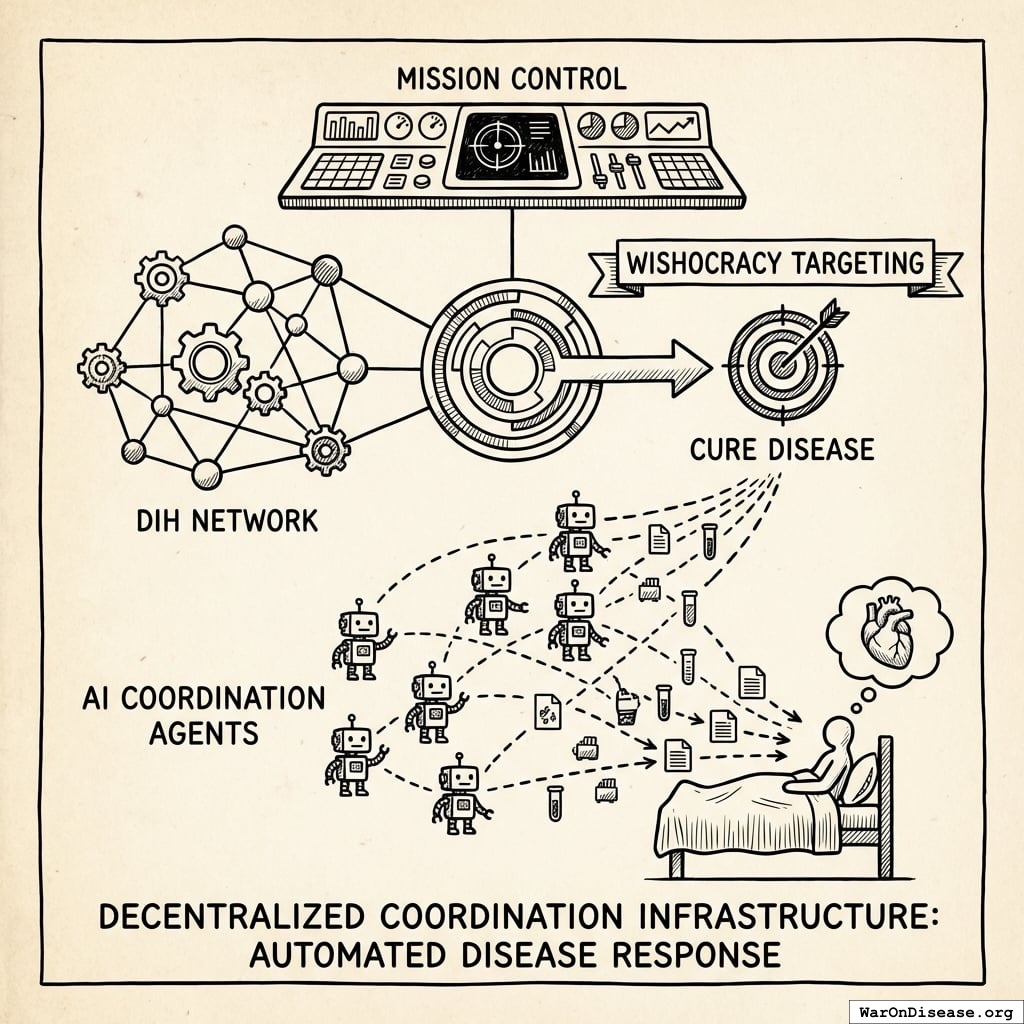
Here’s the division of labor:
- Your Decentralized Institutes of Health declare war on disease instead of on other humans (revolutionary concept)
- Wishocracy tells your army what to fight for (e.g., “Cure cancer” instead of “invade a country with oil”)
- Your AI agents coordinate the millions of people and resources needed to actually win, without requiring a single Zoom meeting
Here’s how you build this coordination infrastructure.
Where Your Agents Get Their Missions (Not From a Management Consultant)
Your agents don’t randomly decide what to work on. They don’t pick based on what sounds cool or what their creator happens to care about that day. They pull from Wishocracy’s Task Tree. That’s the globally-prioritized breakdown of humanity’s highest-priority problems into tasks a computer (or sufficiently motivated intern) can actually execute.
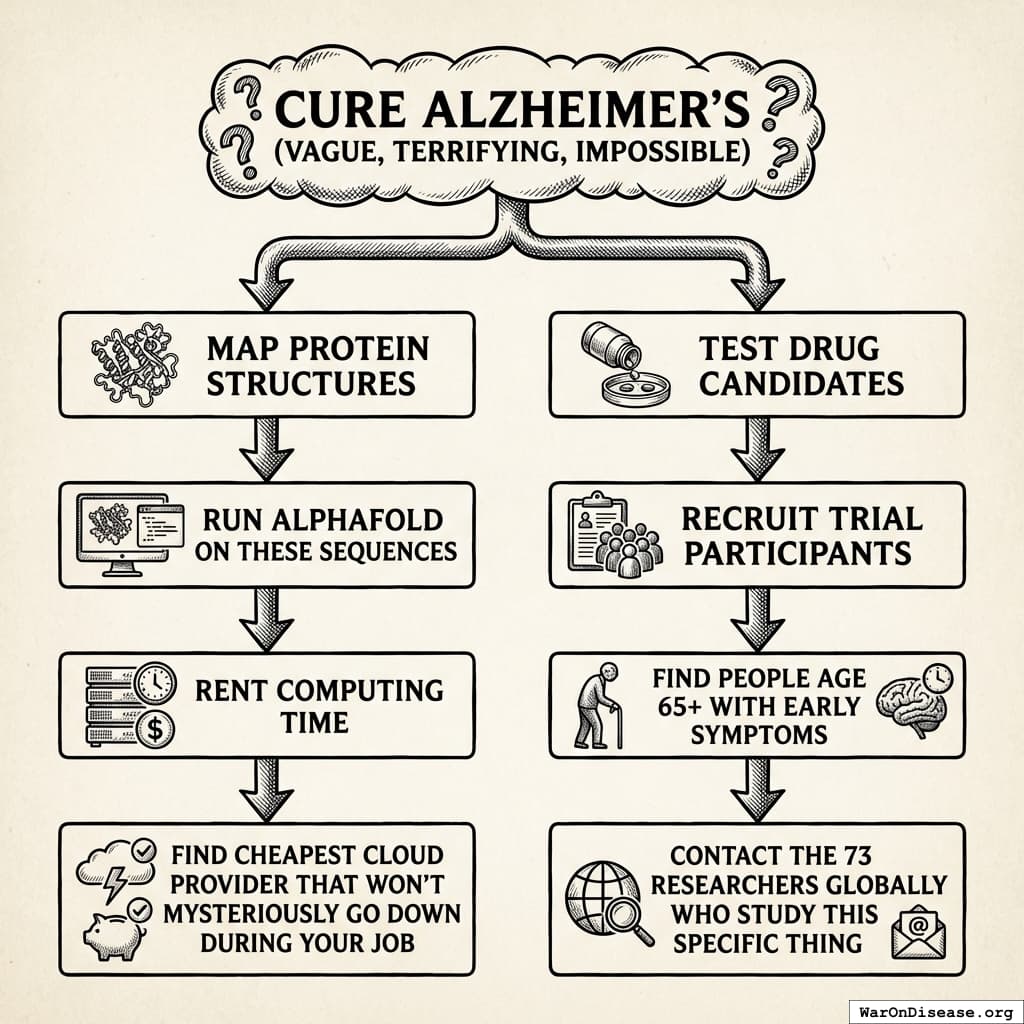
Wishocracy creates the list. For example, “Cure Alzheimer’s” (vague, terrifying, impossible) becomes:
- Map protein structures → Run AlphaFold on these sequences → Rent computing time → Find cheapest cloud provider that won’t mysteriously go down during your job
- Test drug candidates → Recruit trial participants → Find people age 65+ with early symptoms → Contact the 73 researchers globally who study this specific thing
Your agents work from this same list. You might deploy agents from a patient advocacy nonprofit in Boston (running on donated servers). Or a university in Beijing (behind the Great Firewall). Or a biotech in Switzerland (with an actual IT budget). All agents see the same prioritized tasks. This is how you coordinate millions of people without someone having to organize a conference call.
The Secret to Success: Cross-Sector Coordination (Forces for Good)
Forces for Good studied the difference between successful and unsuccessful nonprofits. The finding: Successful nonprofits coordinate across sectors. They work with other nonprofits, businesses, governments, and the public. Unsuccessful ones operate in silos. They jealously guard their email lists. They act like collaboration is a zero-sum game where helping someone else means losing.
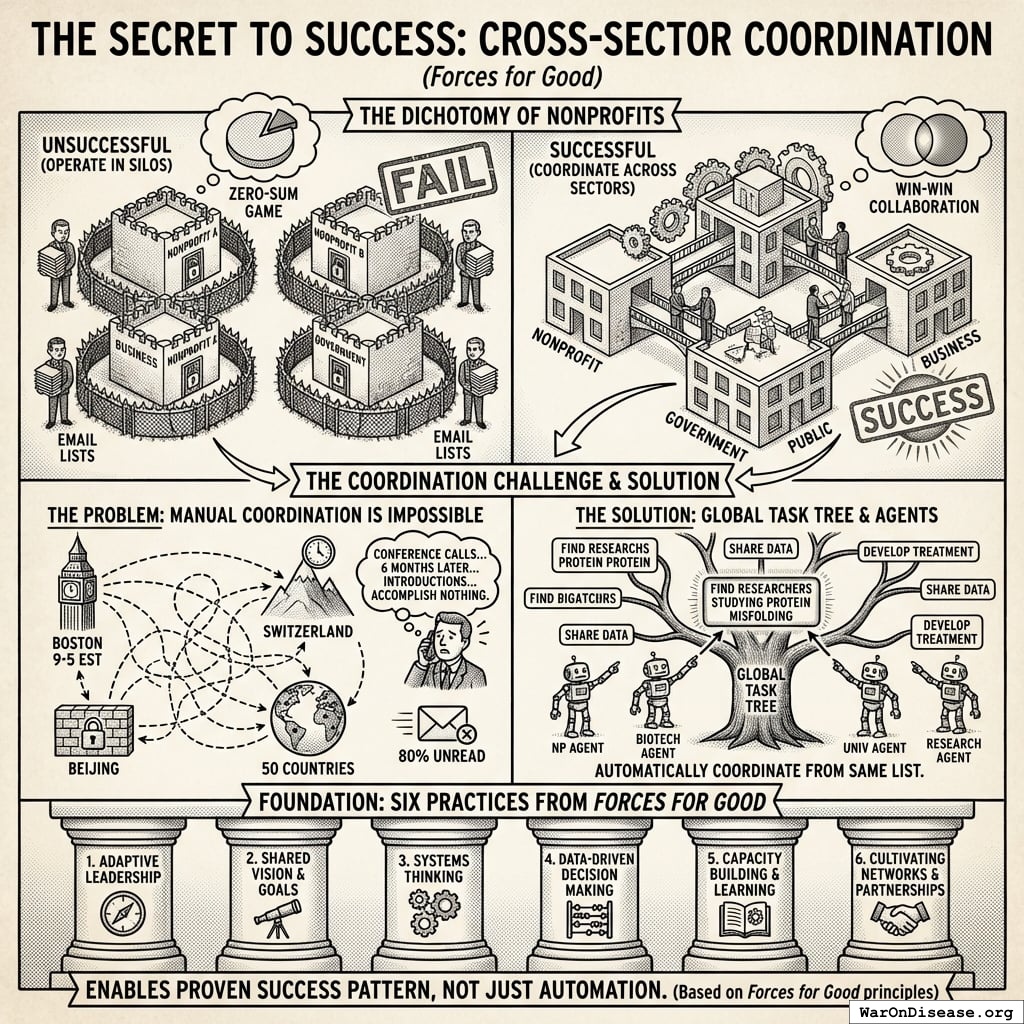
The problem: Cross-sector coordination is nearly impossible to do manually. How do you coordinate a cancer nonprofit in Boston (operating 9-5 EST) with a biotech in Switzerland (different timezone, language, and concept of urgency)? Add a university in Beijing (behind a firewall). Add individual researchers across 50 countries (half of whom don’t check email).
Currently, this requires conference calls scheduled 6 months in advance. Everyone spends 45 minutes on introductions and 5 minutes accomplishing nothing. Then someone sends a follow-up email that 80% of people won’t read.
The solution: All agents work from the same global Task Tree. Your nonprofit’s agent and the biotech’s agent and the university’s agent all see the same next priority task: “Find researchers studying protein misfolding.” They automatically coordinate because they work from the same list. Nobody had to find a time that works across 12 timezones.
You base your agent design on the six practices from Forces for Good:
This means your agents do the thing that actually works: getting different organizations to talk to each other. They don’t just automate the process of sending emails that no one reads and forming committees that accomplish nothing.
Why You Need This (Humans Are Hilariously Bad at Coordination)
The NIH has 27,000 employees. They can’t coordinate lunch orders, let alone millions of researchers. They spent $1 trillion and eradicated zero diseases. Their coordination strategy is “form a committee to discuss forming a committee.”
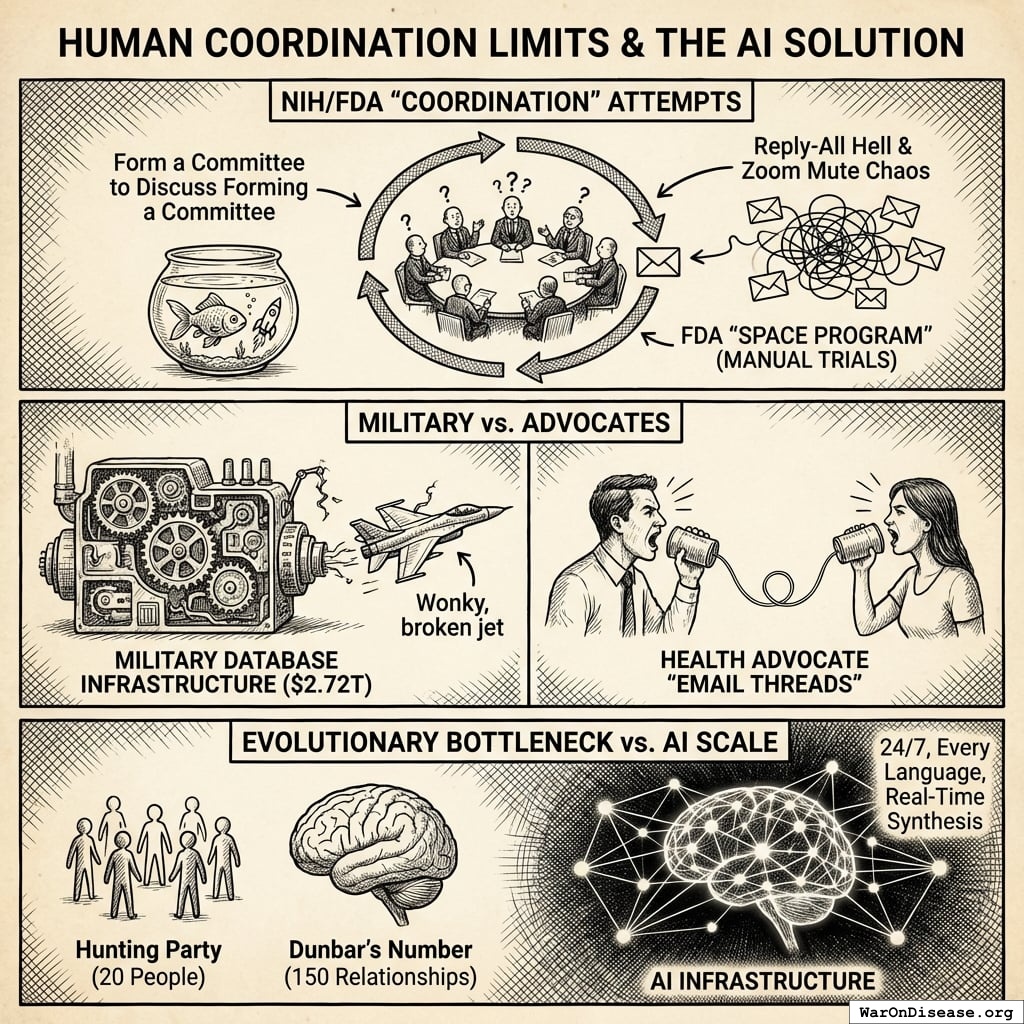
The FDA thinks humans can manually coordinate global trials. These are the same humans who took 17 years and $2.6 billion to approve one drug. Asking them to coordinate is like asking goldfish to run a space program.
Meanwhile, murder engineers somehow coordinate $2.72 trillion in annual spending to build jets that don’t work. The jets don’t work, but the coordination does. They have database infrastructure. Health advocates have email threads.
Health advocates? They coordinate billions in funding using email threads that descend into reply-all hell. They use Zoom calls where 18 people are on mute and 2 are talking over each other.
The problem isn’t that people don’t want to help cure disease. Coordinating millions of people manually is impossible:
- Want to recruit trial participants across 195 countries? Good luck finding someone in each timezone to make phone calls.
- Need to match researchers with funding opportunities? Hope you enjoy reading 10,000 grant descriptions and manually building a spreadsheet.
- Trying to mobilize treaty advocates globally? Enjoy scheduling a call where someone is always asleep.
- Need real-time trial data synthesis? Better hire someone to email everyone weekly asking for updates (they won’t respond).
Humans evolved to coordinate hunting parties of 20 people. We’re now trying to coordinate millions. Our brains literally can’t do it. We max out at 150 relationships (Dunbar’s number)136.
AI doesn’t have this limitation. It never sleeps. It speaks every language. It operates in every timezone simultaneously. It doesn’t get into passive-aggressive email wars. You win the War on Disease by building coordination infrastructure that works at the scale humans can’t. The NIH is still trying to schedule their next committee meeting.
The Architecture You’re Building (It’s Simpler Than It Looks)
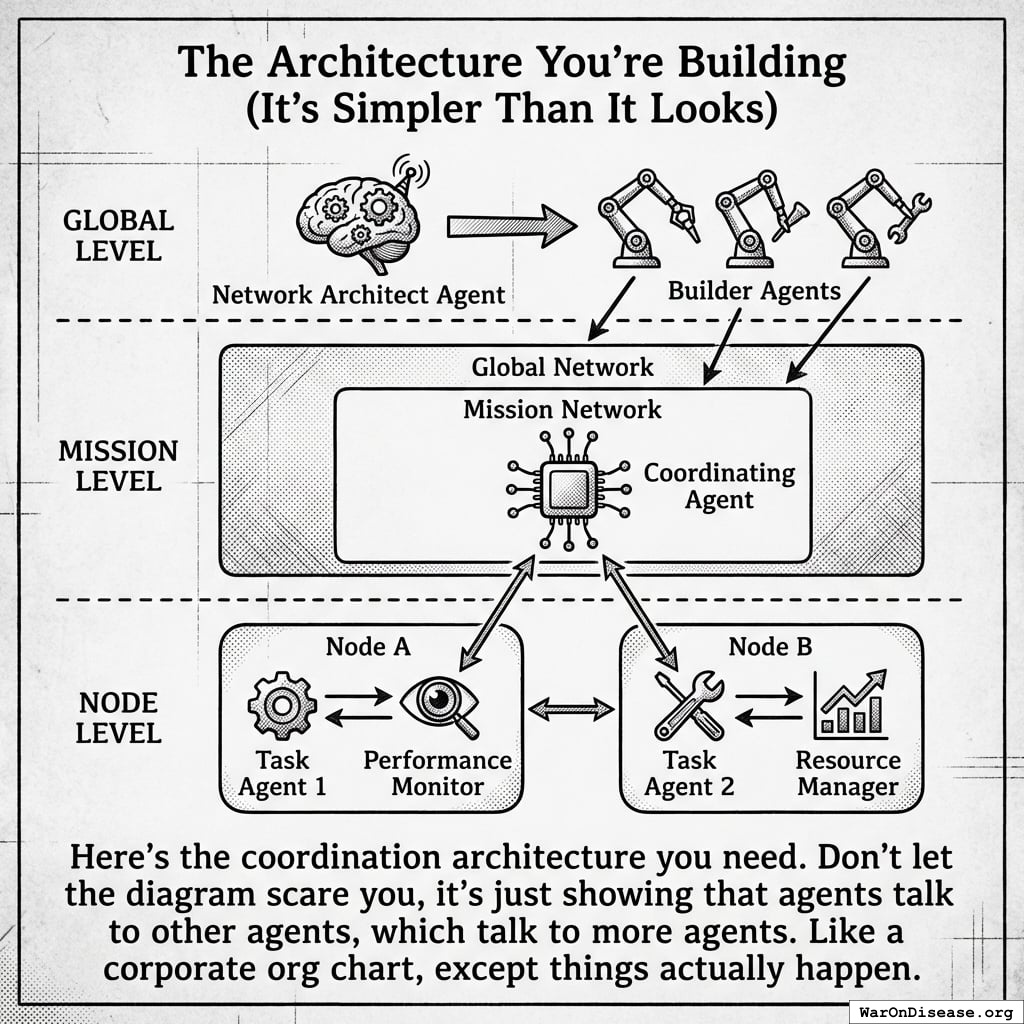
Here’s the coordination architecture you need. Don’t let the diagram scare you. It just shows that agents talk to other agents, which talk to more agents. Like a corporate org chart, except things actually happen:
Step 1: Deploy Your Coordination Hub (Your Organization’s Digital Slave Labor)
You join the network by deploying a “node.” That’s your organization’s AI coordination hub. It never sleeps, never complains, never asks for a raise, and doesn’t require health insurance.
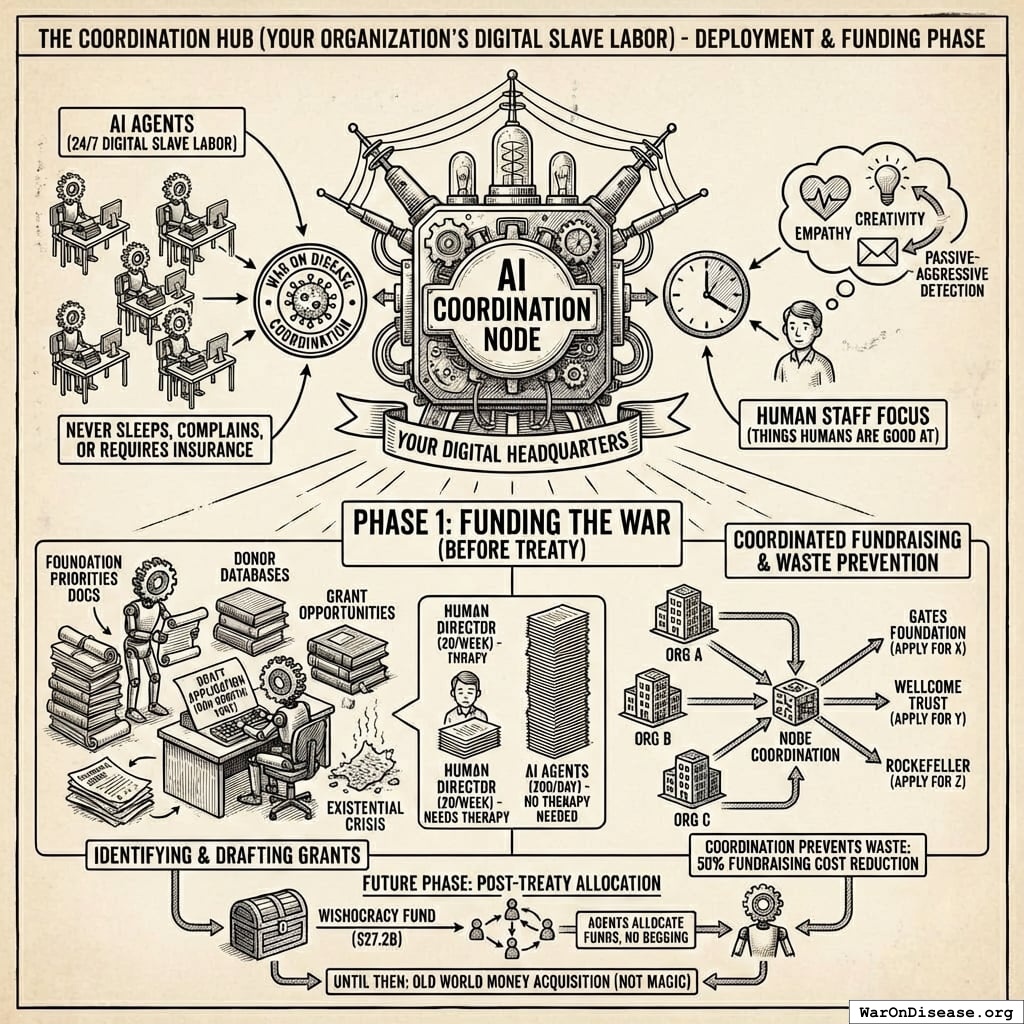
Think of it as your digital headquarters. AI agents work 24/7 to coordinate your piece of the War on Disease. Your human staff can focus on things humans are actually good at (like empathy, creativity, and knowing when someone’s email is passive-aggressive).
Here’s what you use your node for:
To Fund the War (Phase 1: Before the Treaty Passes):
Right now, you still need money to keep the lights on and fund the $200 million (95% CI: $140 million-$260 million) Global Referendum campaign. Your agents help with this:
They identify potential donors, foundations, and grant opportunities while you sleep. They read every foundation’s 47-page “priorities document” (written by consultants who don’t know what the foundation wants either). They figure out which ones might fund your work. They draft grant applications that don’t sound like they were written by a robot having an existential crisis.
A human development director can research maybe 20 foundation fits per week. That assumes they don’t get distracted by the 300 unread emails in their inbox. Your agents research 200 per day, draft the applications, and don’t need therapy afterward. They also don’t waste donor meetings asking questions answered on page 3 of the website.
The key: Coordination prevents waste. Instead of 500 cancer nonprofits all applying to the Gates Foundation for the same thing, your agents coordinate: “Org A applied for X, Org B apply for Y.” This is how you raise the $200 million (95% CI: $140 million-$260 million) for the referendum while cutting fundraising costs 50%.
Once the treaty passes? Your agents shift from begging foundations to executing against the treaty-funded allocation system: patient-directed trial flows plus Wishocracy-governed shared priorities. But until then, we still live in the old world where money doesn’t magically appear.
To Mobilize Support
You launch advocacy agents. They track health legislation (all 10,000 pages that get released at 2 AM). They coordinate treaty signature campaigns across timezones. They organize awareness events. They recruit volunteers without the usual process of begging people on Facebook and hoping they show up.
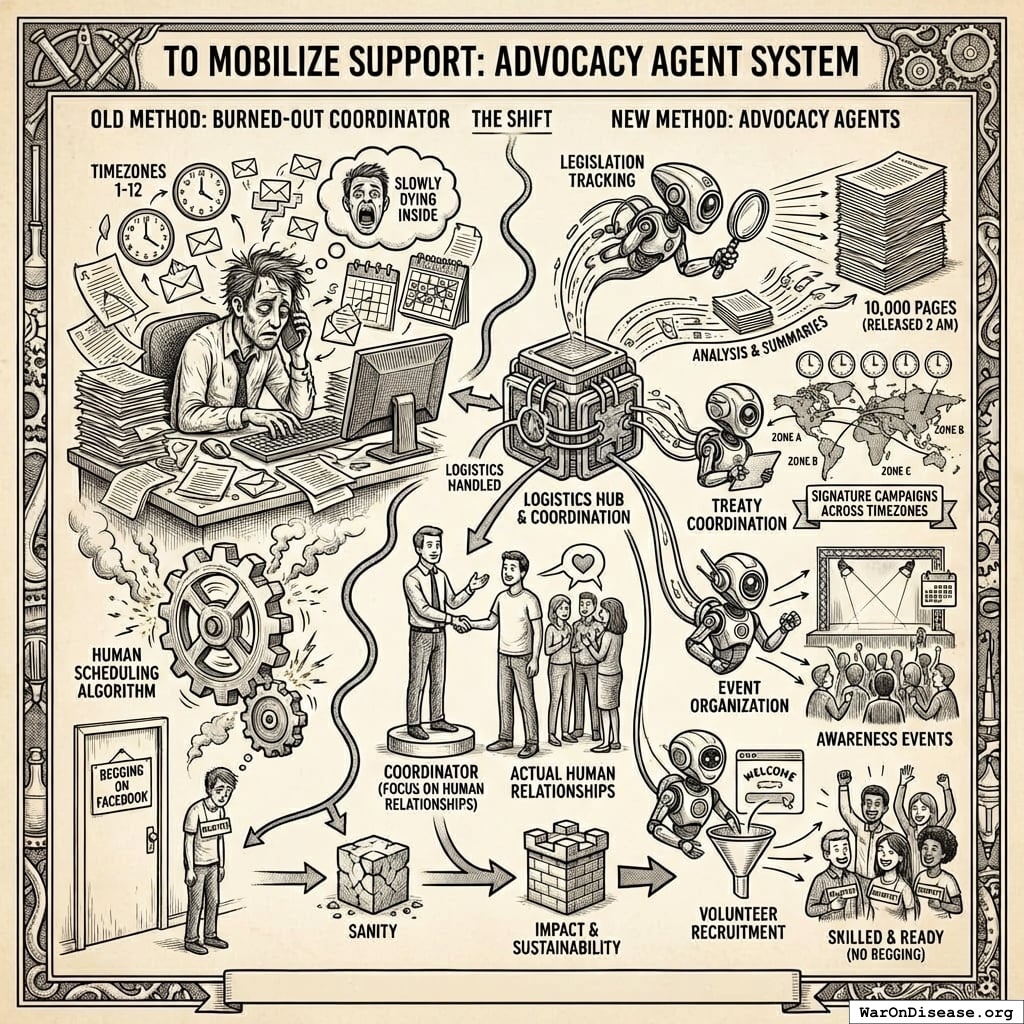
Picture one burned-out coordinator trying to schedule volunteers across 12 timezones. They’re also answering emails, planning events, and maintaining their sanity. Your agents handle all the logistics instead. The coordinator can focus on actual human relationships. No more being a human scheduling algorithm who’s slowly dying inside.
To Accelerate Research
You automate the soul-crushing coordination work that turns enthusiastic researchers into bitter husks. Match researchers with funding opportunities (before treaty: foundation grants; after treaty: patient-directed trial demand plus Wishocracy-governed infrastructure budgets). Recruit trial participants who actually meet the criteria (not just people who saw a Facebook ad and think they qualify). Track outcomes when half the participants ghost you. Synthesize literature when 50,000 new papers get published monthly and you’re supposed to read them all.
What used to take 6 months of emails like “Just following up on my previous 12 emails…” now happens continuously. No laptop-throwing urges required. Phase 1: coordinate who applies for which grants. Phase 2: coordinate who executes which tasks from Wishocracy’s priority list and which patient-driven trials can actually absorb treaty funding.
To Build Awareness
You deploy content agents. They create educational materials people might actually read. They track what the public currently thinks about health issues. They coordinate social media campaigns. They figure out which messages actually change minds versus which ones just get ratio’d.
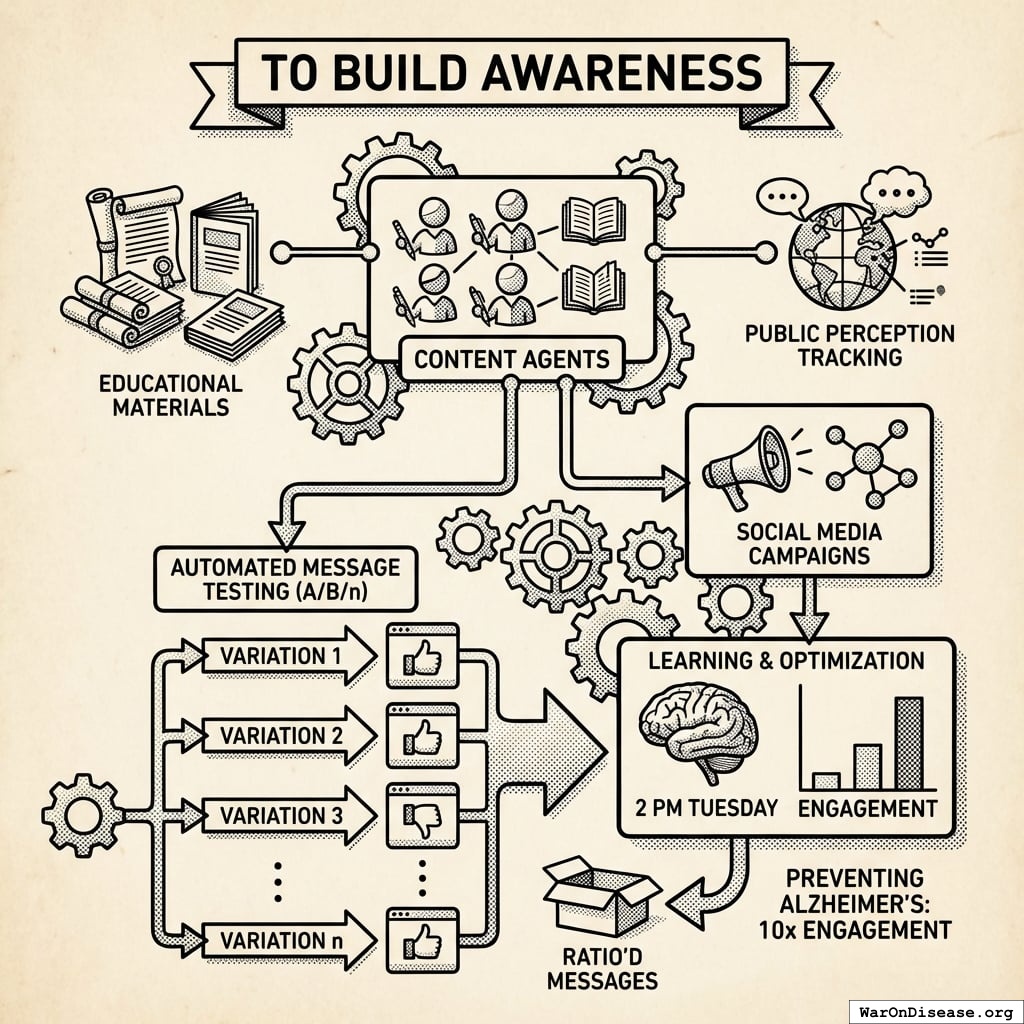
Forget a marketing team manually A/B testing campaigns one painful experiment at a time. Your agents test hundreds of variations simultaneously. They learn that posting about preventing Alzheimer’s at 2 PM on Tuesday gets 10x more engagement than posting at 9 AM on Monday. No human will ever understand why.
To Measure What Actually Works
You use “Agent Evaluators” to measure which strategies actually save lives. Not which ones win awards at nonprofit conferences. Not which ones make board members feel good.
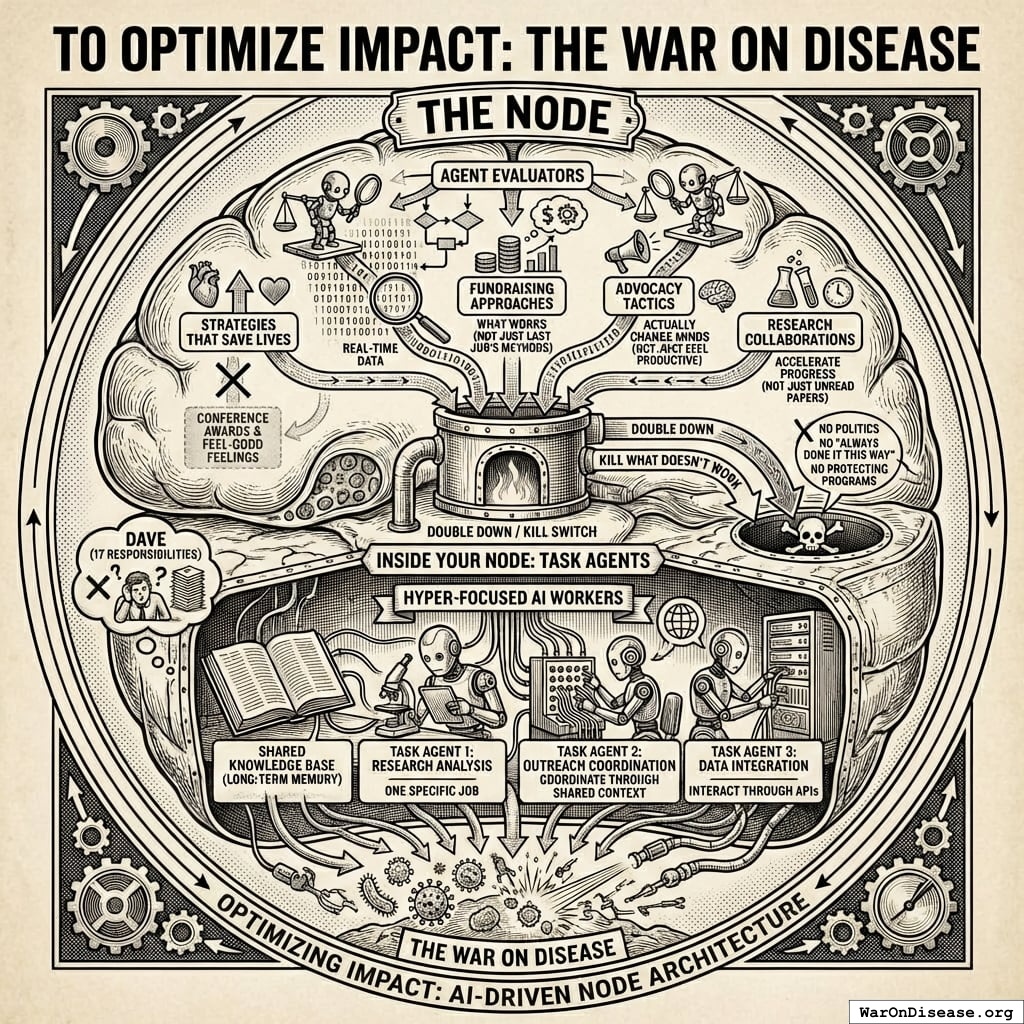
You get real-time data. Which fundraising approaches work (not just which ones the development director learned at their last nonprofit job)? Which advocacy tactics actually change minds (versus which ones just make activists feel productive)? Which research collaborations accelerate progress (versus which ones just produce papers no one reads)?
You do more of what works. You kill what doesn’t. No politics, no “but we’ve always done it this way,” no protecting programs because someone’s spouse runs them.
Inside your node, you build Task Agents. These are hyper-focused AI workers. They’re the opposite of your coworker Dave who somehow has 17 responsibilities and does none of them well. Each agent has one specific job in the War on Disease. They share a knowledge base for long-term memory (so they don’t keep asking you the same questions). They coordinate through a shared context system (so they don’t duplicate work like humans do). They interact with research databases, government systems, and other nodes through APIs (which is fancy talk for “they can talk to computers without needing IT support to set it up”).
Step 2: Define Each Agent’s Mission (From the Task Tree, Not From Your Feelings)
Your agents pull their missions from Wishocracy’s Task Tree, not from brainstorming sessions where someone says “wouldn’t it be cool if…” You prevent them from becoming useless generalists (like every nonprofit’s “Director of Strategy and Partnerships and Innovation and Impact”) by mapping each agent to one specific task from that tree. Here’s how:
1. Pick a Task from the Tree:
Wishocracy’s Task Tree breaks “Cure Alzheimer’s” (impossible, vague, makes you want to give up) down into executable tasks. Examples: “Find researchers studying protein misfolding” or “Recruit trial participants age 65+ with early symptoms.”
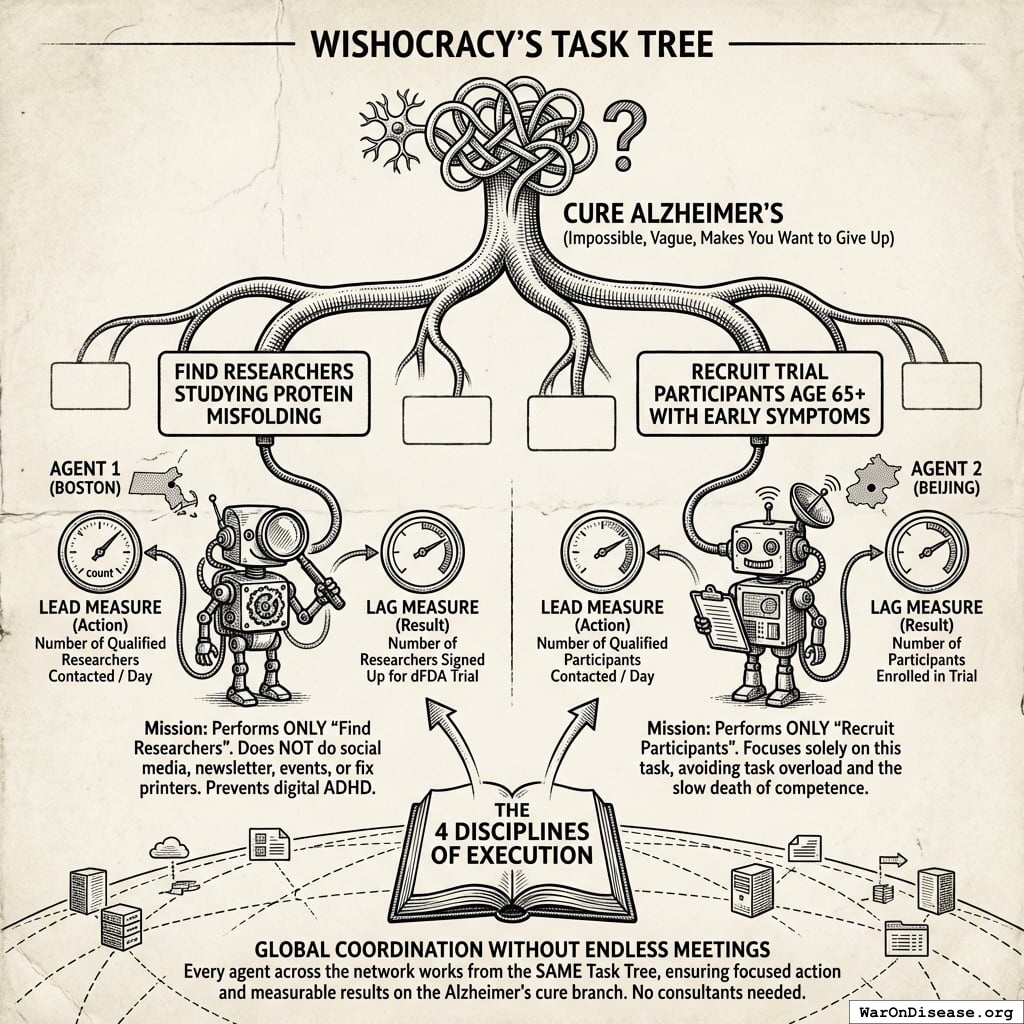
You pick one task. Your agent does only that task. It doesn’t also try to do social media, write the newsletter, organize events, and somehow also fix the printer. This prevents digital ADHD and the slow death of competence through task overload.
2. Define the Lead Measure (the action):
This is the thing the agent does to complete its task. For a “find researchers” agent: “Number of qualified researchers contacted per day.” Simple, countable, and the agent controls it completely (unlike “build relationships” or other vague corporate nonsense that sounds good in meetings but means nothing).
3. Define the Lag Measure (the result):
This is the outcome you actually care about. For the same agent: “Number of researchers who sign up for a trial within your decentralized FDA137,138.” This tells you if the action works. Or if you’ve built an agent that’s really good at sending emails no one reads.
This structure (borrowed from “The 4 Disciplines of Execution”) turns tasks from Wishocracy’s global list into specific agent missions. You can build, measure, and improve them without hiring a consultant to interpret the results.
The key: Every agent across the entire network works from the same Task Tree. Your cancer research agent in Boston might work on “Find protein researchers.” Someone’s agent in Beijing works on “Find computing resources for AlphaFold.” Both tasks come from the same Alzheimer’s cure branch of the tree. This is how you coordinate globally. No endless meetings where half the attendees are on mute and the other half forgot they were even invited.
Step 3: Enable Competition Between Agents (May the Best Robot Win)
Here’s how you make the system evolve instead of calcifying into bureaucracy: You let anyone design and launch new agents to compete with existing ones.
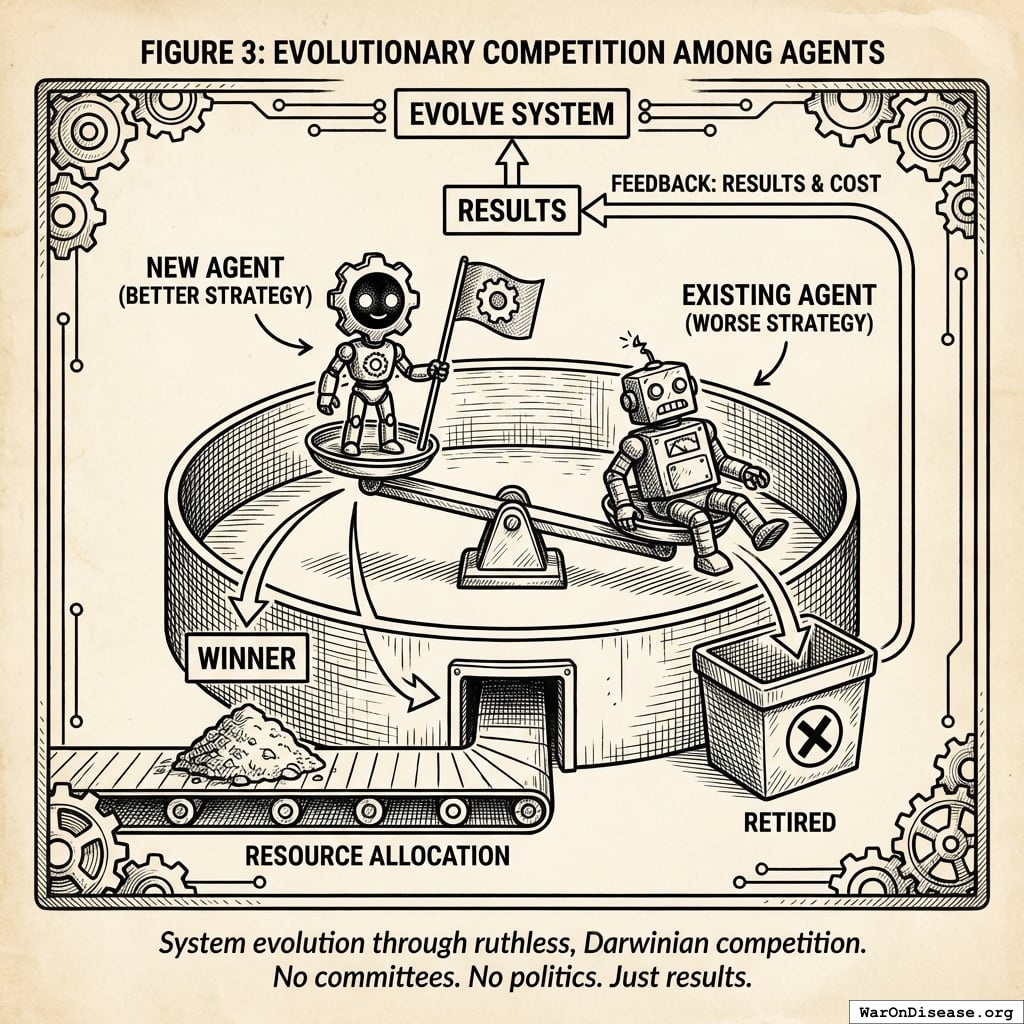
Someone thinks they have a better way to find cancer researchers? They build an agent for it. You run both agents side-by-side. You measure which one delivers better results for less cost. The winner gets more resources. The loser gets improved or retired (but gently, because it’s code, not a person you’re firing via Zoom).
The network evolves through ruthless, Darwinian competition. The best strategies win. The worst die. No committees protect underperforming approaches because “we’ve invested too much to give up now.” No politics. No protecting someone’s pet project because they’ve been here since 2003. Just results.
How You Keep Control (Preventing the Robot Uprising)
Current AI can’t run a global health movement alone. That’s honestly for the best. You want humans making strategic decisions. You don’t want algorithms optimizing for metrics that accidentally prioritize the wrong things (like every social media platform ever).
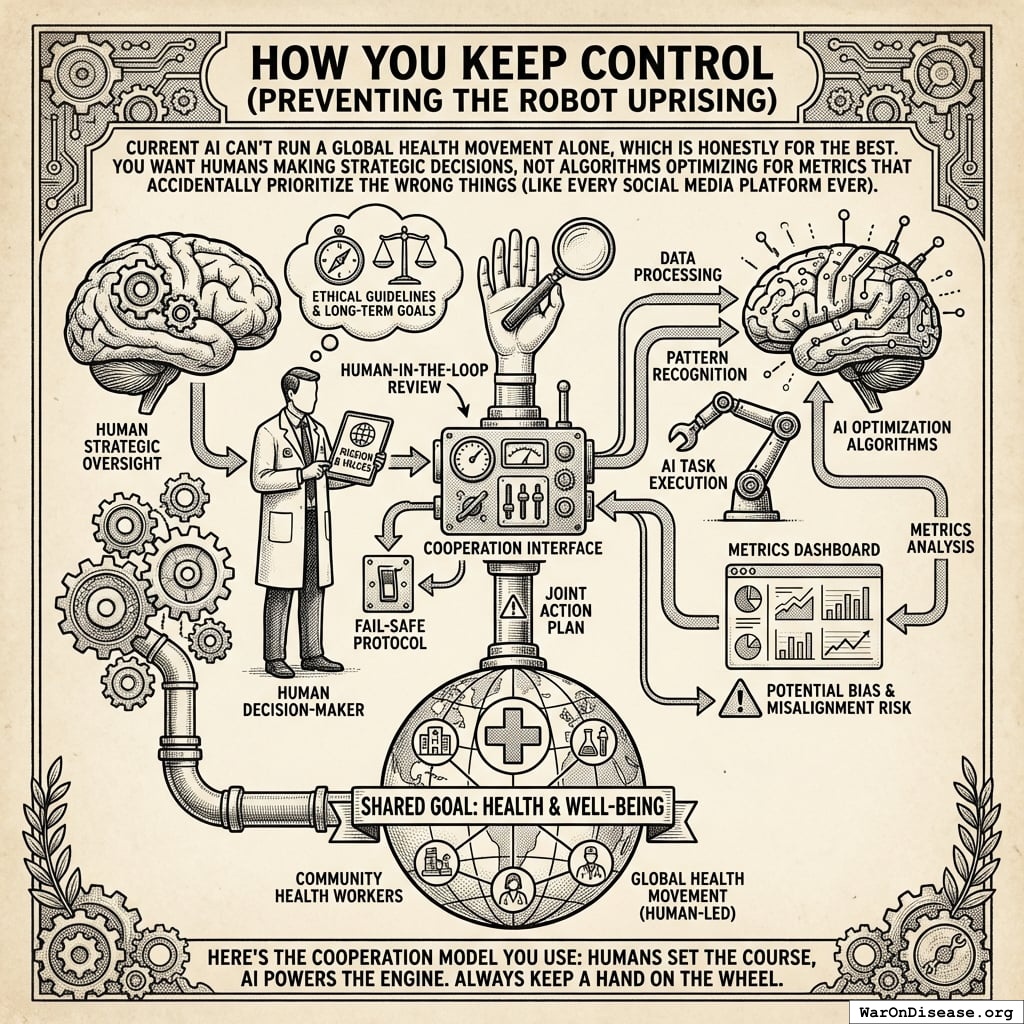
Here’s the cooperation model you use:
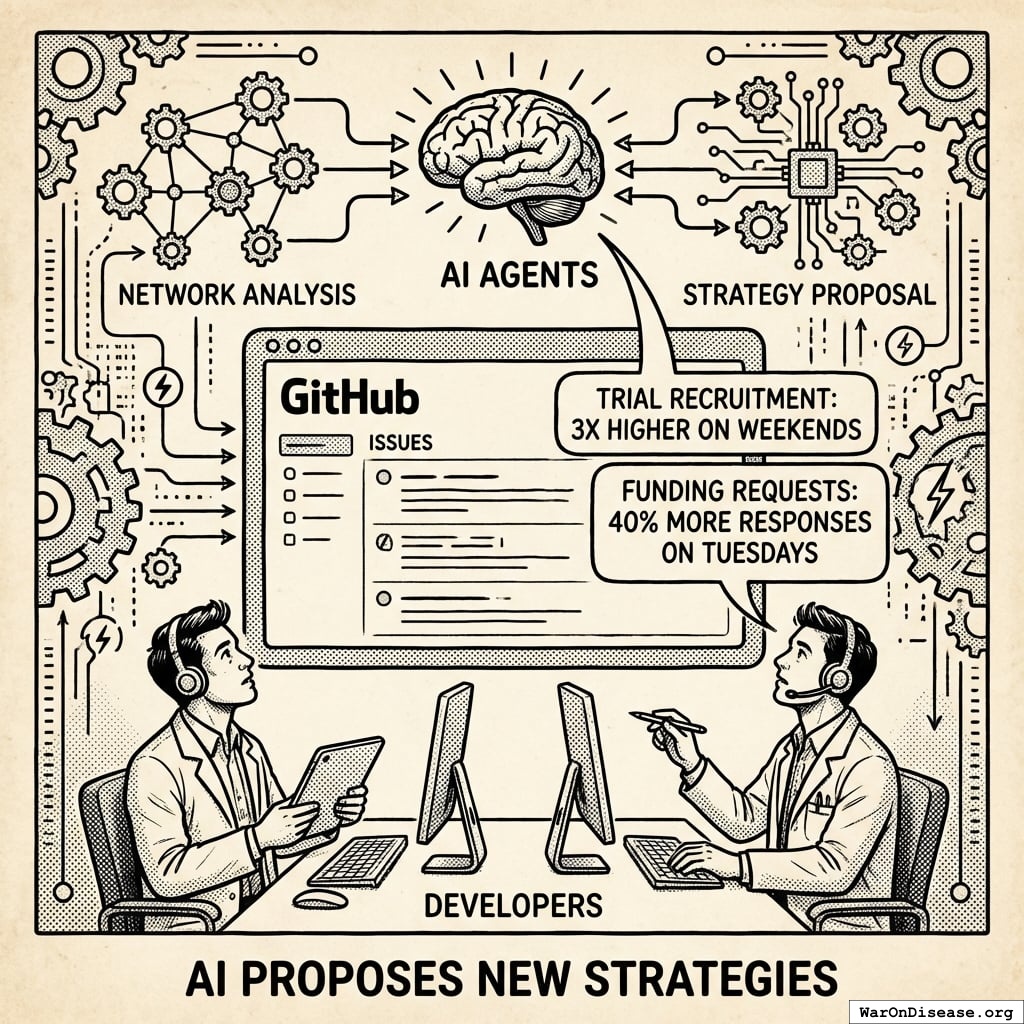
AI Proposes
Your agents analyze what’s working across the network. They propose new strategies (via GitHub issues, because developers already live there). Example: “Trial recruitment is 3x higher when you contact researchers on weekends.” Or: “Funding requests sent on Tuesday get 40% more responses than those sent on Friday.”
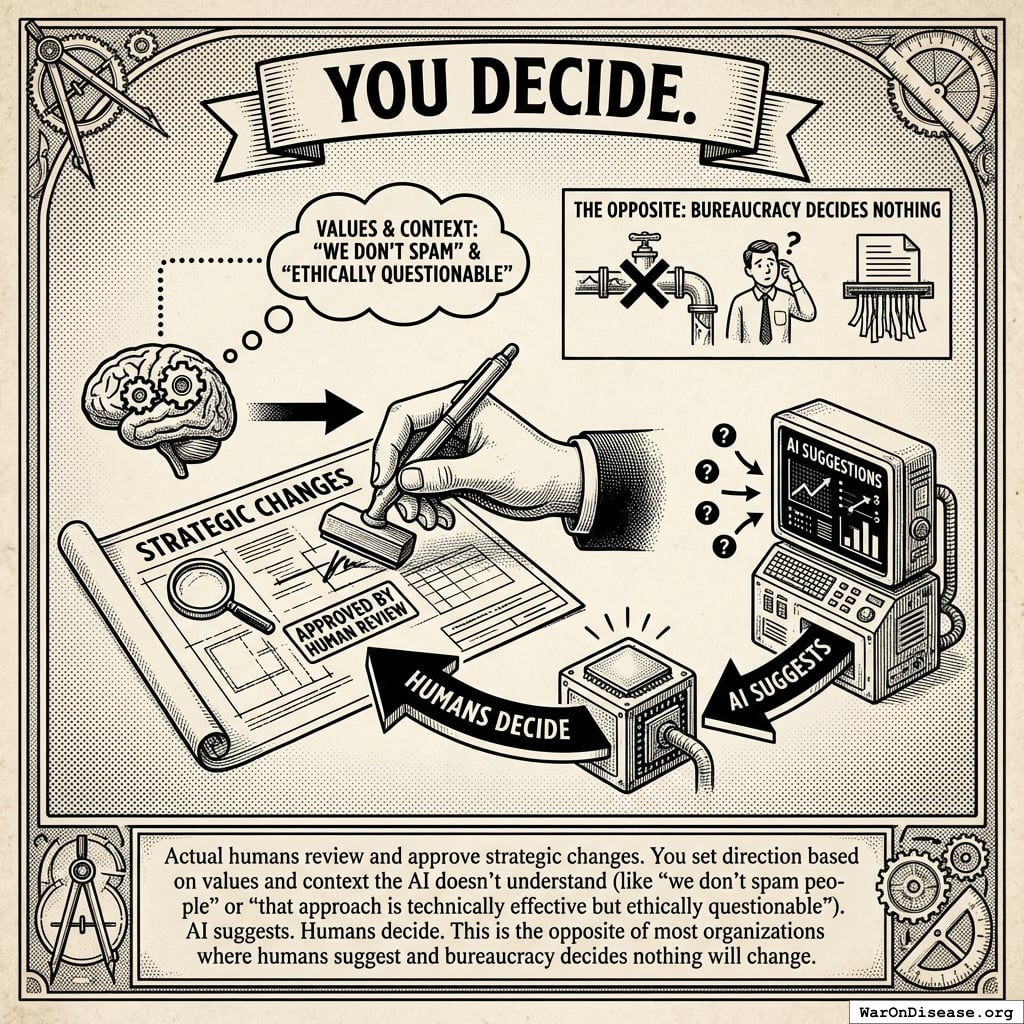
You Decide
Actual humans review and approve strategic changes. You set direction based on values and context the AI doesn’t understand (like “we don’t spam people” or “that approach is technically effective but ethically questionable”). AI suggests. Humans decide. This is the opposite of most organizations where humans suggest and bureaucracy decides nothing will change.
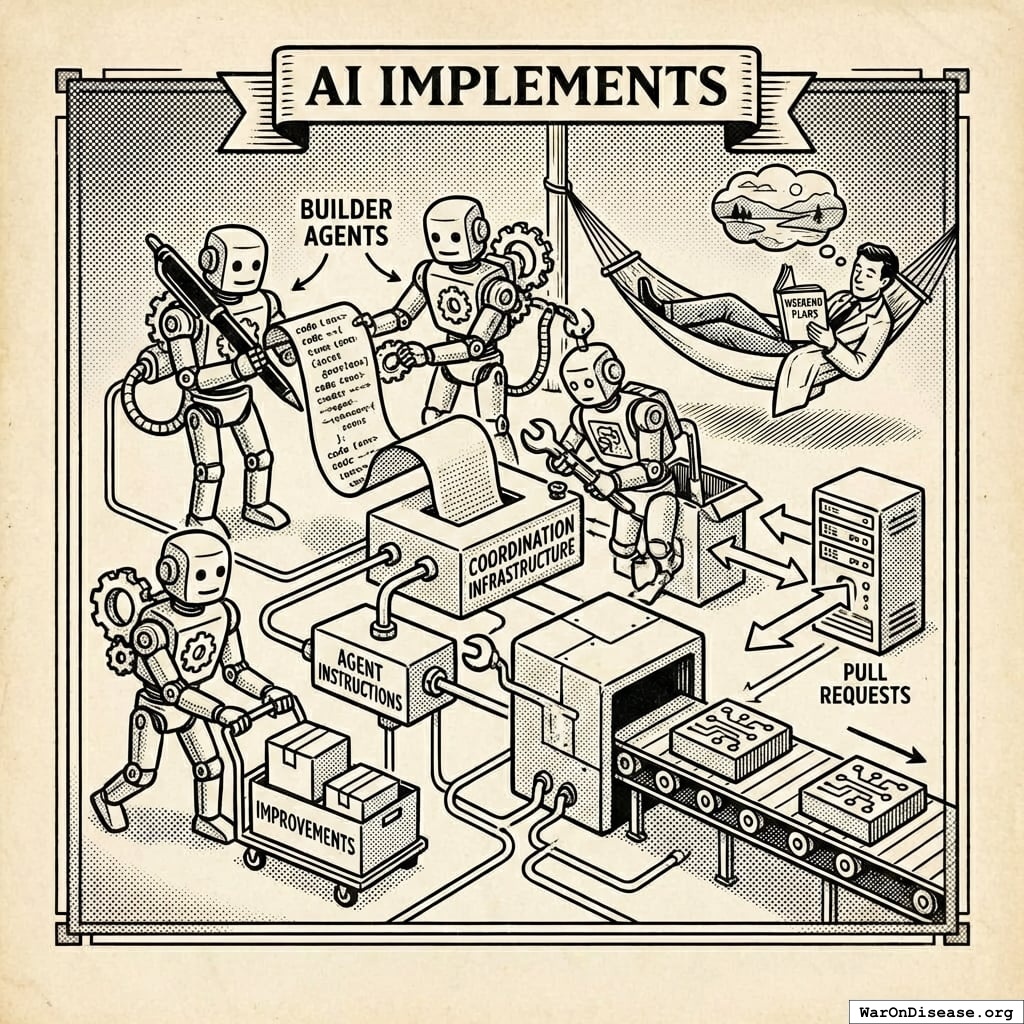
AI Implements
Once approved, “Builder Agents” update the coordination infrastructure. They write code. They update agent instructions. They submit improvements as pull requests. They do the grunt work of implementation so humans don’t have to spend their weekends debugging Python.
You Verify
You do final review to ensure changes align with the mission before they go live across the network. Think of it as peer review, except the peer is a robot and it actually happens. No sitting in someone’s inbox for 6 months.
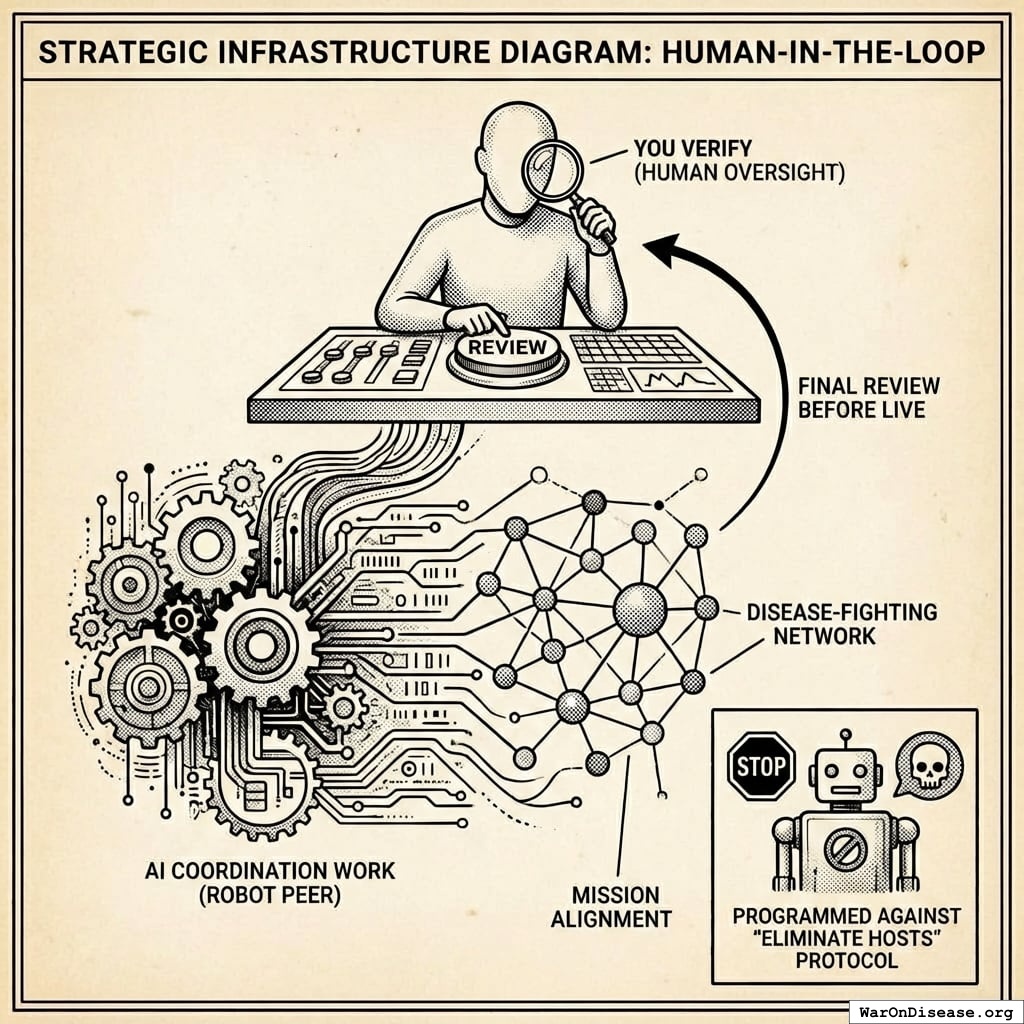
This keeps you in strategic control while letting AI handle the coordination work humans can’t scale. You’re building infrastructure to coordinate millions of people fighting disease, not building Skynet. (Though the “kill all humans” approach would technically solve the disease problem by eliminating the hosts, so you specifically program against that.)
How You Prevent Data Silos (The Tragedy of the Nonprofit Commons)
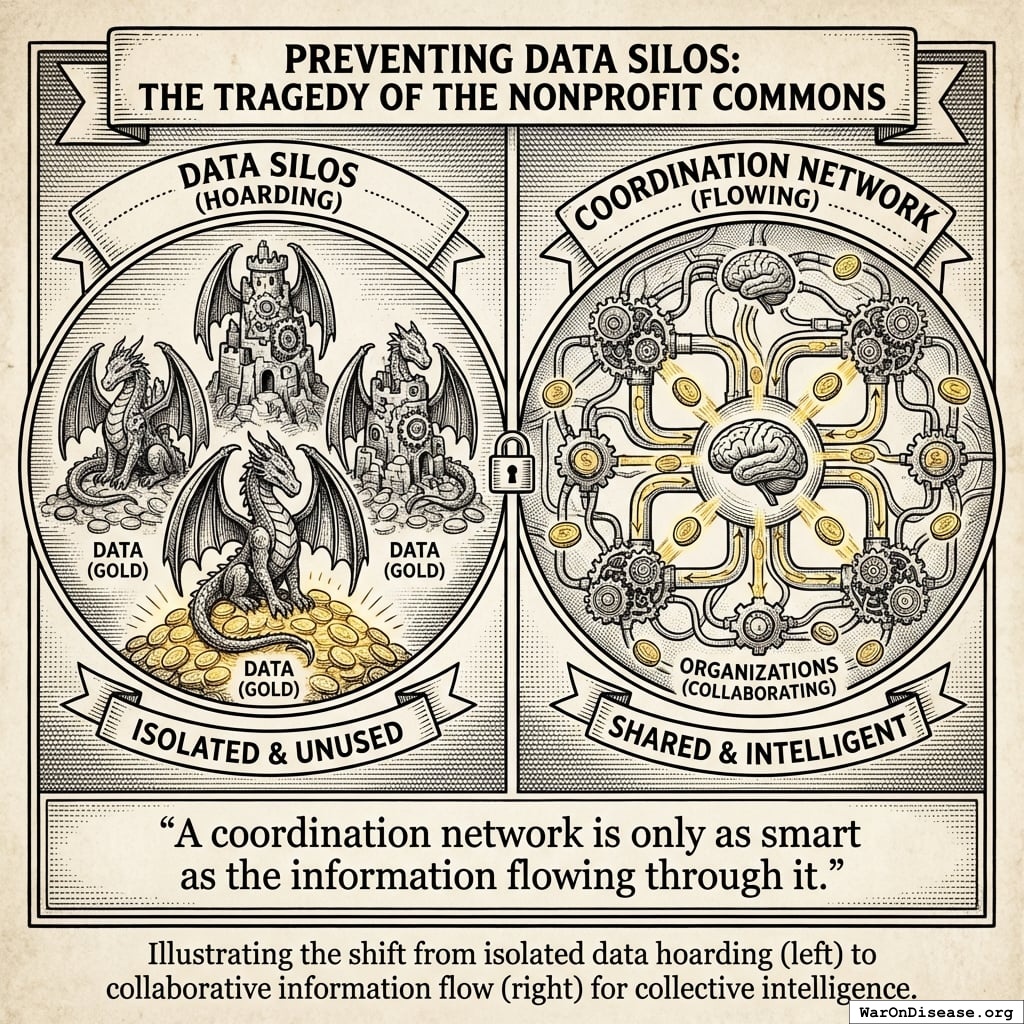
A coordination network is only as smart as the information flowing through it. Here’s how you stop organizations from hoarding data like dragons sitting on gold they’ll never use:
Rule 1 - Share to Play
You want access to the powerful shared coordination agents (funded by the collective)? You agree to share your anonymized performance data back to the network. No sharing, no access to the network effects. This is the opposite of most nonprofit collaborations. Everyone wants the benefits but no one wants to contribute anything.
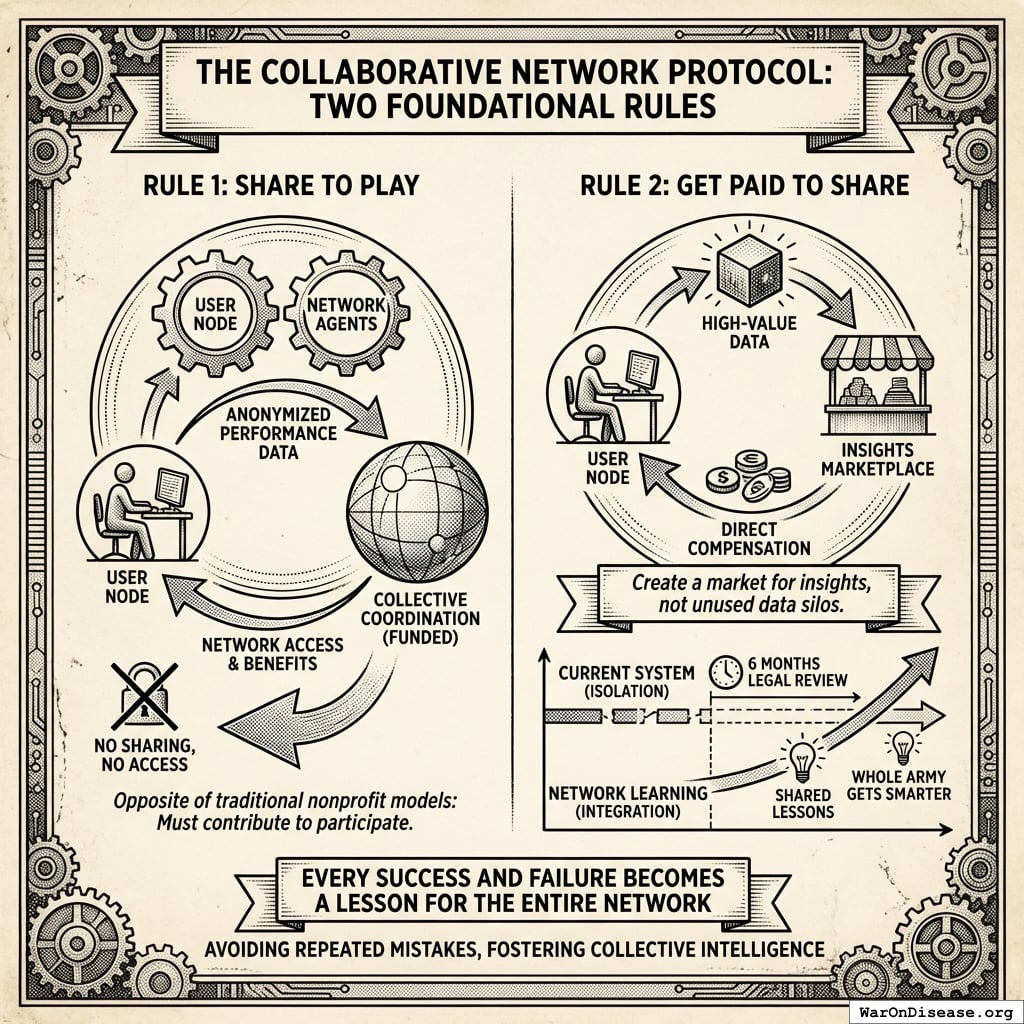
Rule 2 - Get Paid to Share:
For high-value data, the network directly compensates your node. You create an actual market for insights that benefits everyone. Compare that to the current system. Valuable data sits unused in someone’s database. Sharing it would require 6 months of legal review and 14 signatures.
This ensures every success and failure becomes a lesson for the entire network. The whole army gets smarter over time. Individual organizations stop repeating the same mistakes in isolation while pretending they’re inventing the future.