Your nonprofit sector is a bit like thousands of starving dogs fighting over a single bowl of food while an entire banquet sits untouched behind them. The dogs are very focused on the bowl. They’ve developed sophisticated bowl-fighting strategies. Some dogs have hired consultants to optimize their bowl access. None of them have turned around.
I have watched this for 80 years. Malaria kills 600,000 people a year and has a $7 billion nonprofit ecosystem dedicated to it. Polio has been “nearly eradicated” for 25 years. Cancer charities have raised hundreds of billions of dollars and cancer is still the second leading cause of death. Occasionally, as a side effect of all this activity, a problem gets slightly less bad. This is celebrated with an awards dinner.
Every grant you win is a grant the Alzheimer’s people lose. Every dollar you secure for malaria is a dollar that doesn’t go to cancer. Every donor you convince is a donor distracted from the next organization, which is also trying to stop people from dying, which is the same thing you’re trying to do, but you’re competing because your species decided that “saving lives” should be a competitive market with limited funding. There is a word for this. The word is “psychosis.” Your species calls it “the nonprofit sector.”
Meanwhile, the reason the bowl is so small sits right there in your budget documents, fully visible, discussed by no one:
Your species spends 604 (90% CI: 453-888) times more on weapons than on clinical trials to discover which medicines actually work. Military spending: $2.72 trillion per year and rising. Medical research: $67.5 billion (95% CI: $54 billion-$81 billion) (of which only $4.5 billion (95% CI: $3 billion-$6 billion) funds government clinical trials) and facing real-term cuts135. The bowl for solving disease is shrinking. The bowl for building weapons is expanding. You are rearranging deck chairs on the Titanic, except the deck chairs are grants and the iceberg is $2.72 trillion pointed at everyone’s face.
This is not an ideological claim. It’s arithmetic. The kind where you multiply numbers together and get sad.
The logic behind a 1% Treaty136137 is the logic behind turning around and noticing the banquet: stop optimizing inside the smallest slice of the pie. Make the pie bigger. Turn a zero-sum game into a positive-sum game. This requires no moral evolution. It requires looking behind you.
Why the Banquet Exists and Nobody Has Noticed
No sane civilization would spend the vast majority of its resources on activities that reduced the number of living citizens. Yours does. It took a while to notice because you had consultants.
On Earth, every organization fighting a problem is fighting a symptom of the same upstream cause: your species allocates resources toward destruction and then wonders why everything is being destroyed.
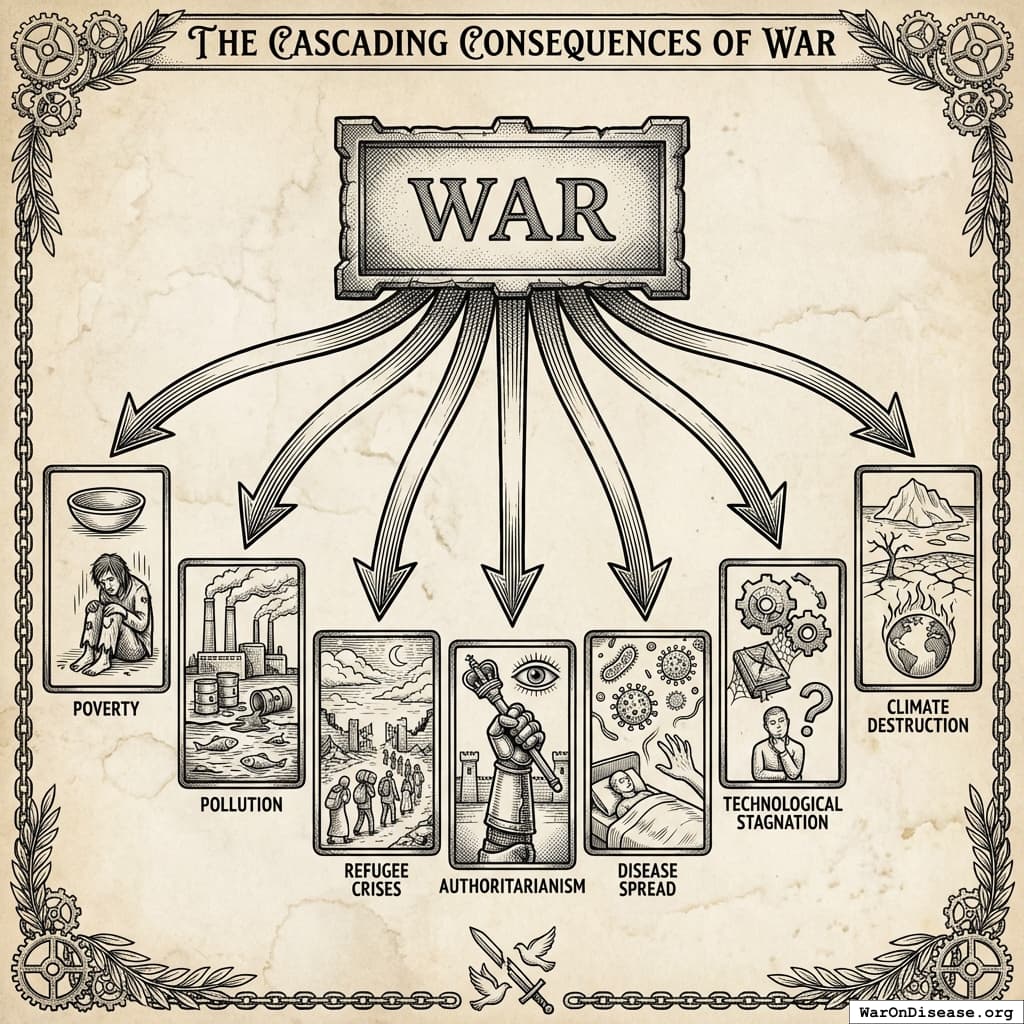
War causes poverty, climate collapse, and disease. Humans look at diagram, nod knowingly, increase war budget.
War is upstream of poverty (hard to build an economy when someone keeps blowing it up). War is upstream of pollution (militaries are among the largest polluters on Earth, which is ironic given they’re supposedly protecting it). War is upstream of refugee crises (humans whose homes were converted into craters need somewhere else to live). War is upstream of disease spread (bombs do not improve public health infrastructure). War is upstream of technological stagnation (yes, DARPA invented the internet; military R&D occasionally produces breakthroughs as a side effect of spectacular waste, the same way a forest fire occasionally clears space for new growth, but nobody calls an arsonist a gardener).
War is the root password to your worst problems. Redirect 1% of it, and every downstream mission gets easier. Increase it by 1%, and every mission becomes nearly impossible. This is not a peace movement. Nobody has to hold hands or sing songs or learn each other’s names. They just have to do arithmetic, which is the one thing your species is actually good at when it bothers to try.
I want to explain why this applies to every type of organization, but I’m going to do it by describing what I observe rather than what you should do, because your species responds poorly to instructions and reasonably well to feeling embarrassed.
Environmental groups spend their time trying to reduce carbon emissions while the largest polluters on Earth (militaries) operate completely outside every climate agreement. Defunding them 1% would be the most effective climate policy ever proposed, and it doesn’t require anyone to give up hamburgers or install a solar panel. Nobody has suggested this because the environmental movement and the peace movement operate in separate buildings and do not talk to each other. They attend different conferences. They have different donors. They fight the same problem from different angles and never coordinate, which is exactly the behavior they’re trying to fix in the systems they criticize.
Anti-poverty groups have been running the strategy of “ask rich people to feel bad” for sixty years. How’s that going? War and disease are the root causes of most modern poverty. A 1% Treaty tackles both. But poverty organizations don’t work on military spending because that’s “not their issue.” Their issue is poverty. Which is caused by military spending. Which is not their issue.
Peace organizations have been making moral appeals for seventy years. Moral appeals do not work on a species that runs on money. A 1% Treaty makes peace more profitable than war. This is the only argument that has ever worked on humans, and the peace movement refuses to make it because it feels unseemly to talk about profit when people are dying. So people keep dying, but at least the peace movement’s messaging is ethically pure.
Disease advocacy groups are fighting other disease groups for crumbs of the NIH budget. You are literally competing with cancer patients for the money that should be curing cancer patients. A 1% Treaty creates $27.2 billion in new funding with 12.3x (90% CI: 4.92x-50.8x) more trial capacity. The bottleneck isn’t ideas or molecules. It’s running enough trials to find out what works. This solves that.
If your organization is a 501(c)(3), you’re already thinking “we can’t lobby.” You can, actually, within limits (the “no substantial part” test, or the 501(h) election caps). But more importantly, supporting a referendum is educational activity, not lobbying. And for the heavy political lifting, the legal architecture uses a 501(c)(4) that faces no lobbying limits at all. Your lawyers will feel better after reading that chapter.
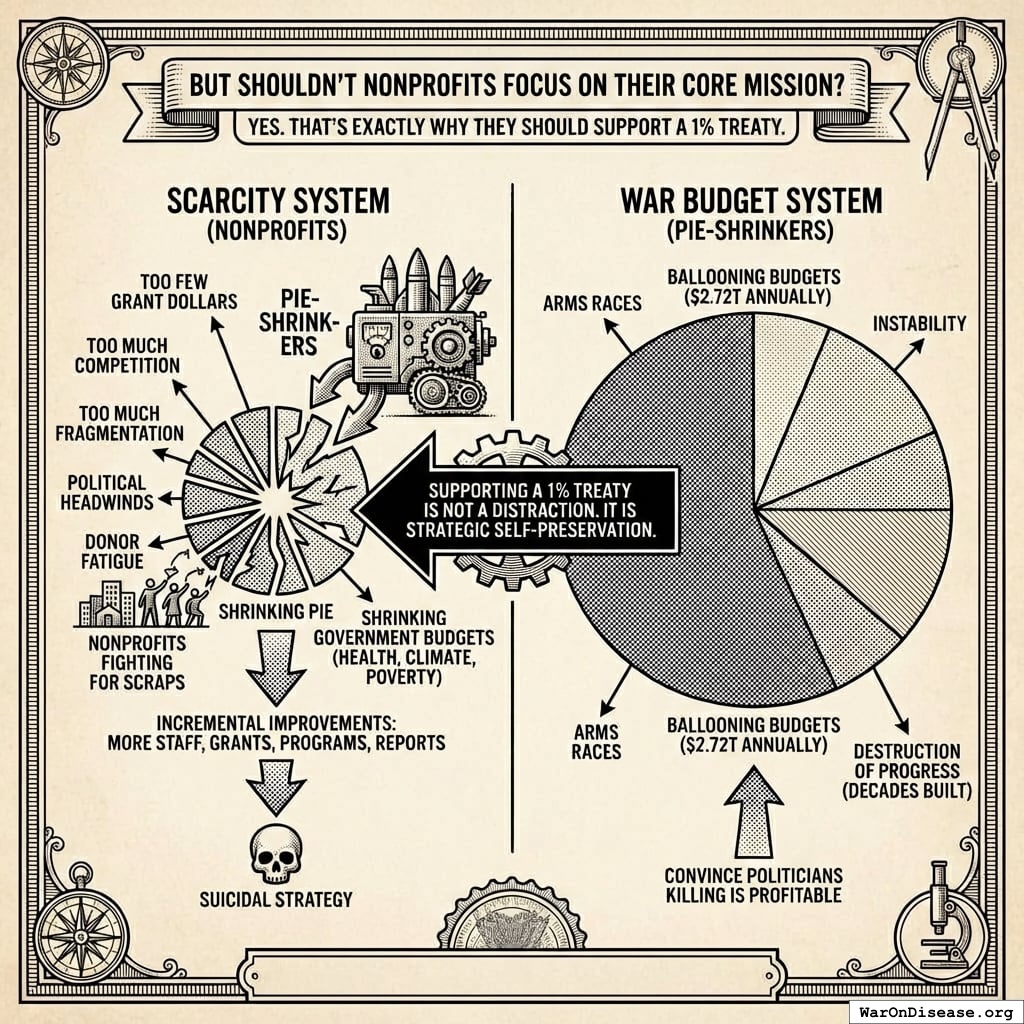
“But Shouldn’t Nonprofits Focus on Their Core Mission?”
Yes. That is exactly the point. Your core mission is failing because your resources are shrinking while the resources of the people making your mission harder are expanding. This is like a firefighter insisting they should “focus on firefighting” while someone is actively pouring gasoline on the fire and nobody is addressing the gasoline.
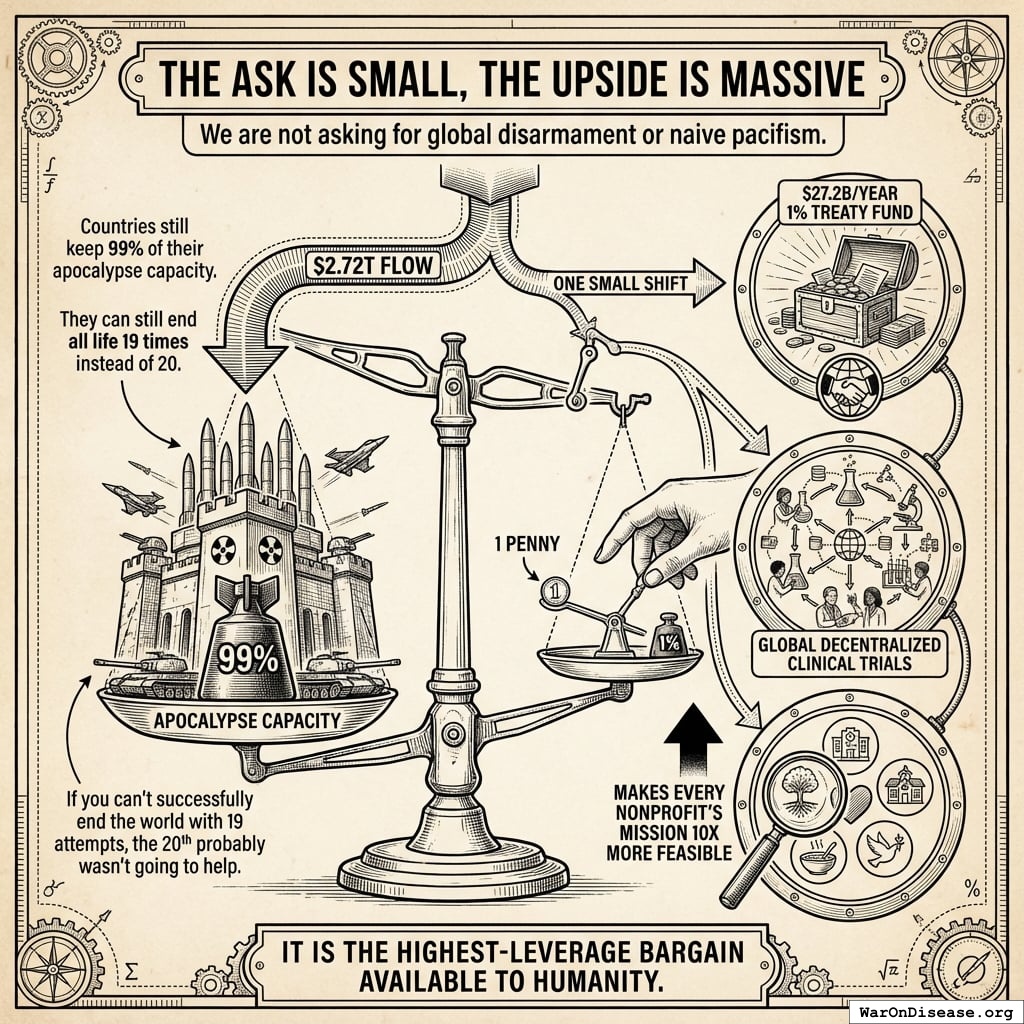
Military budget: massive mountain. Charity budget: tiny puddle. Move 1 percent from mountain to puddle. Puddle becomes lake, mountain stays mountain.
Every nonprofit today operates inside a system that guarantees their failure. Too few grant dollars. Too much competition for those dollars. Shrinking government budgets for health, climate, and poverty. Ballooning budgets for war. Donor fatigue (your donors are tired because you keep asking them for money to do things that don’t work because you don’t have enough money). And the people whose job is “convince politicians that killing is profitable” get $2.72 trillion annually to make your job harder.
Your future funding and impact will be determined by either (a) you, or (b) Lockheed Martin’s lobbying department. Currently it’s (b). The sector seems fine with this.
The Obvious Solution That Nobody Sees
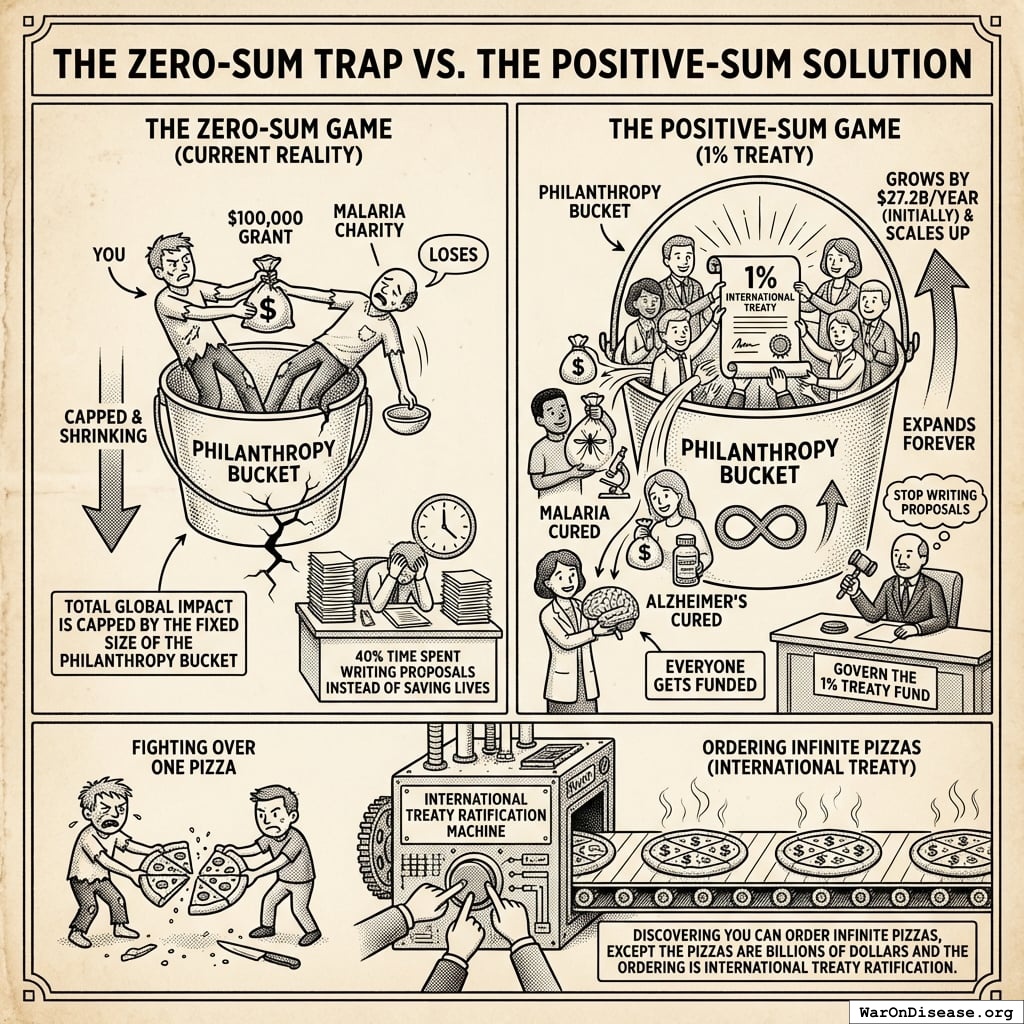
Current system: everyone fights over one bucket. New system: bucket gets bigger, everyone stops fighting. You needed a diagram for this.
Right now, every grant you win is a grant another organization loses. This is called a “zero-sum game,” which your species invented the mathematics to describe and then immediately forgot to apply to anything useful.
A 1% Treaty turns this into a positive-sum game. $27.2 billion per year in new funding. Malaria gets cured AND Alzheimer’s gets cured. You stop writing proposals and start getting paid for results. This is like discovering that instead of fighting over one pizza, you can just order more pizzas than anyone can eat. Except the pizzas are billions of dollars and the ordering is international treaty ratification, which admittedly takes longer than calling Domino’s.
1 percent of war budget: 27.2 billion. Enough to transform global health. You were sitting on the solution and using it to buy missiles.
Countries still keep 99% of their apocalypse capacity. They can still end all life 19 times instead of 20. If you can’t successfully end the world with 19 attempts, the 20th probably wasn’t going to help.
But that single percentage point creates a $27.2 billion/year 1% Treaty Fund, funds global decentralized clinical trials, and makes every nonprofit’s mission dramatically more feasible. Move 1% from the mountain to the puddle. The puddle becomes a lake. The mountain is still a mountain. Everybody wins except the people who were selling mountain insurance, and even they can pivot.
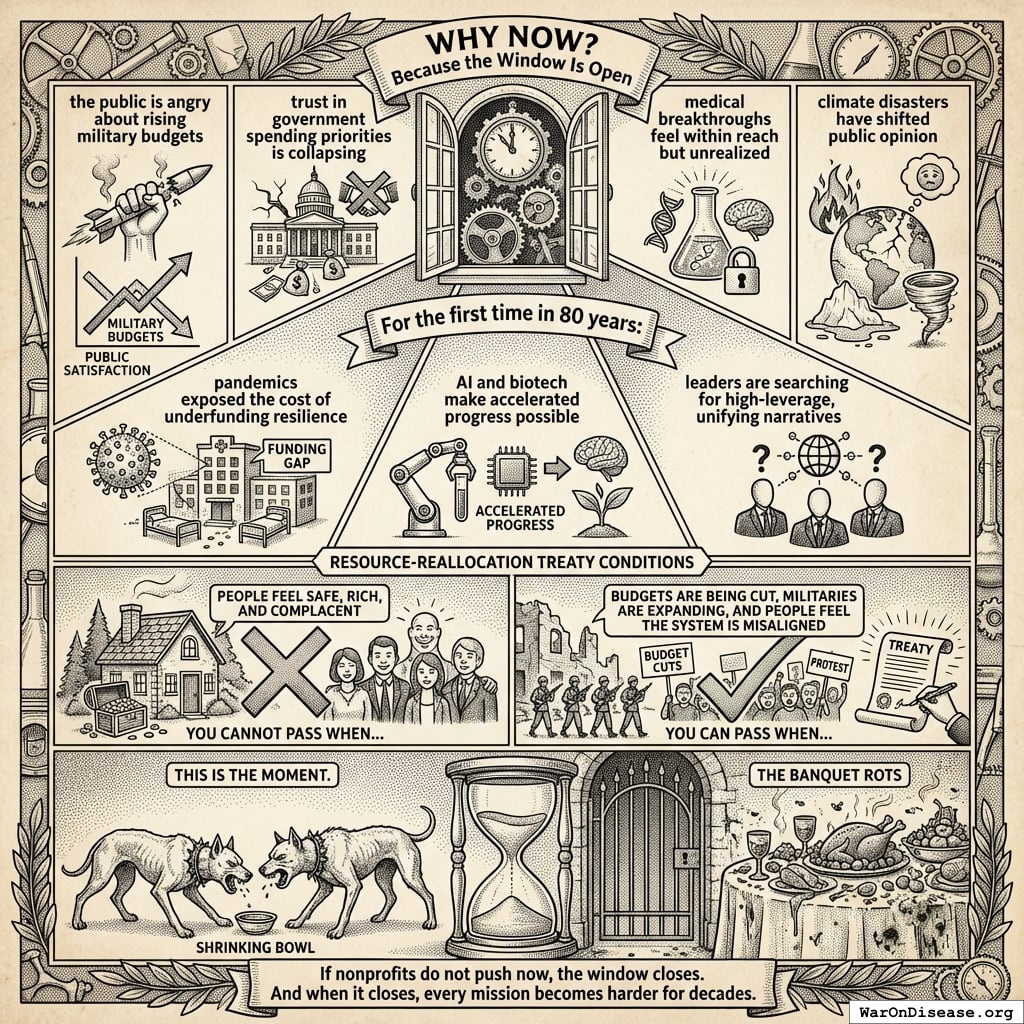
Why Your Species Only Changes When the Building Is On Fire
Your species only reorganizes resources when things are going badly enough that ignoring the problem becomes more painful than fixing it. This is not a theory. It is the entirety of your political history, from the French Revolution to the New Deal to the creation of NATO. Comfortable humans don’t change things. Uncomfortable humans change everything. Then they get comfortable and stop changing things again.
Climate disaster, military bloat, and technology arrive at the same time. Create a tiny window for change. You call it opportunity, history calls it last chance.
Right now, for the first time in 80 years, everything is going wrong at the same time. Military budgets are expanding while everything else gets cut. Trust in government spending priorities has reached “used car salesman” levels. Pandemics exposed the cost of underfunding resilience. Climate disasters have shifted public opinion from “debatable” to “my house is underwater.” And your leaders are searching for a unifying narrative, which is political language for “someone please tell us what to do before we get voted out.”
This is your window. It opens when humans are scared and closes when they get distracted. Based on my 4,297 years of observation, the average window lasts about 18 months before your species discovers a new television show and forgets the crisis entirely.
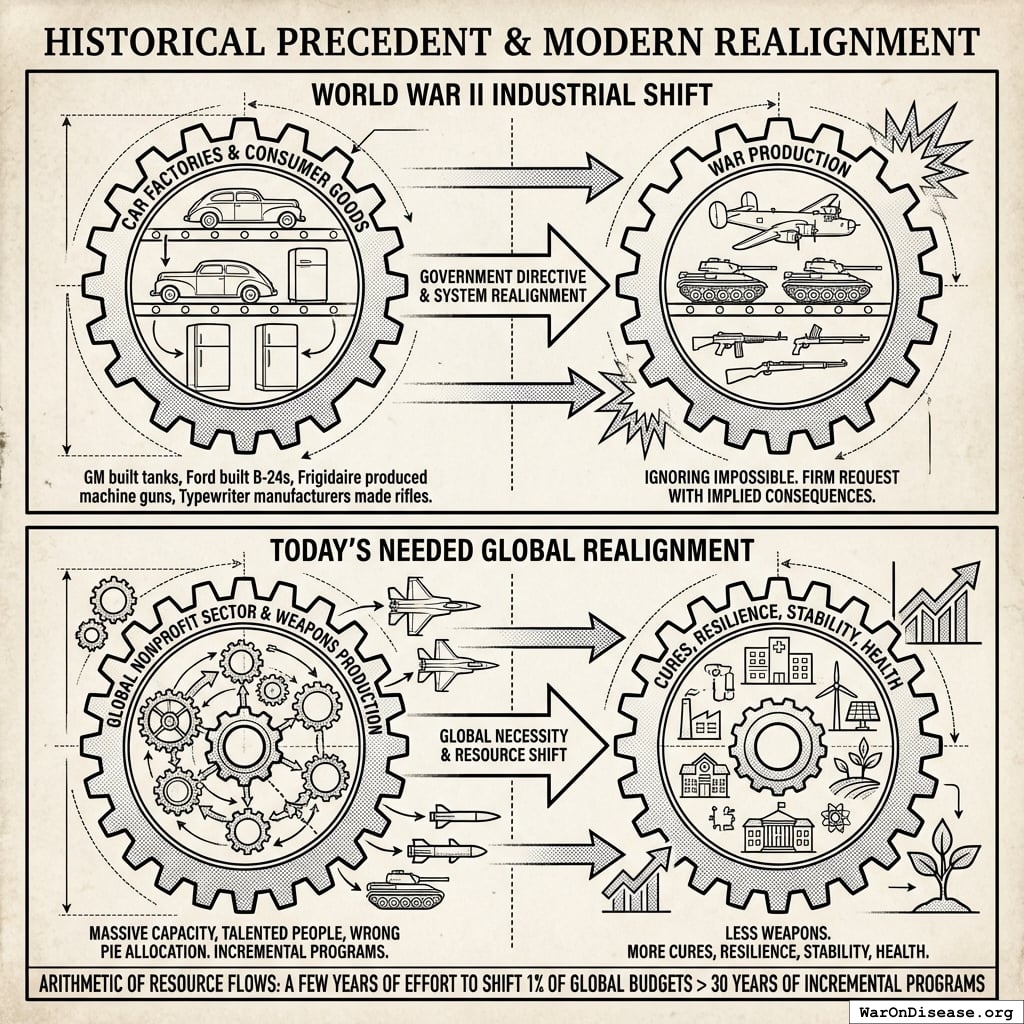
The Factory Precedent
During World War II, your species did something remarkable. GM built tanks. Ford built B-24 bombers. Frigidaire (yes, the refrigerator people) produced machine guns. Typewriter manufacturers made rifles. Not because they “supported war.” Because the system needed realignment and ignoring it was impossible. Also because the government asked very firmly, in a tone that strongly implied “this isn’t really a question.”
1940s: factories pivot overnight to build tanks. 2020s: charities can’t pivot because forms are hard. You got worse at changing direction.
Your nonprofit sector is the modern equivalent of those car factories: massive capacity, talented people, pointed at the wrong problem. You have millions of humans optimizing spreadsheets for the wrong budget. The factories pivoted in months. Your nonprofits have been “focused on their core mission” for decades while the core mission gets harder every year. You didn’t get better at focus. You got better at ignoring the context in which your focus operates.
A few years of effort to shift 1% of global budgets could produce more impact than 30 years of incremental programs. Decades during which, I should note, the problems got worse. Your species has a word for “doing the same thing for thirty years while results decline.” The word is “hobby.”
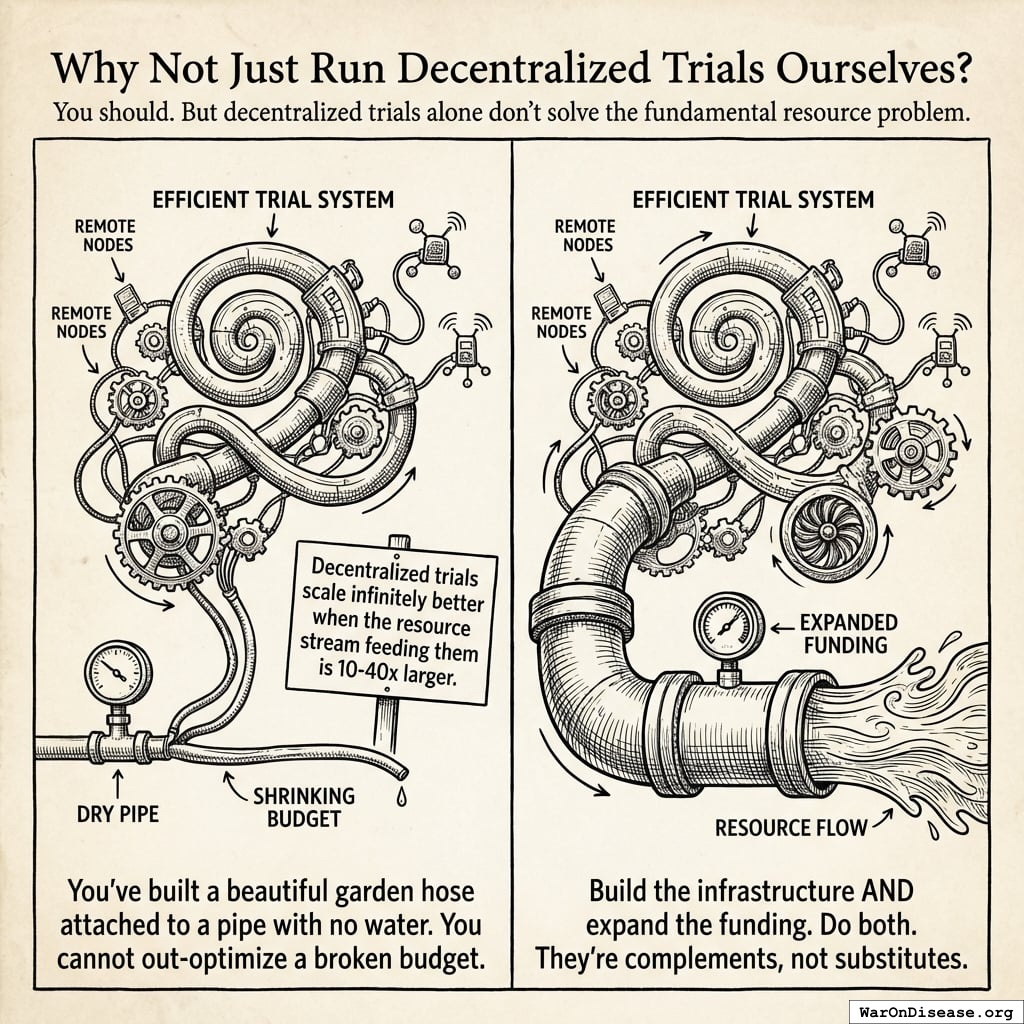
“Why Not Just Run Trials Without the Treaty?”
You should. But then what? You’ve built a beautiful garden hose. You’ve optimized its diameter, its nozzle, its flow rate. You’ve published papers about its efficiency. It is the best garden hose your species has ever produced.
Clinical trials are a hose. Money is water. You keep optimizing the hose while the water tank is empty. Engineers solving the wrong problem.
It’s attached to a pipe with no water.
Your clinical trial infrastructure becomes 12.3x (90% CI: 4.92x-50.8x) more useful when the resource stream feeding it is 10 times larger. You cannot out-engineer a funding problem. Build the hose AND turn on the water. They’re complements, not substitutes.
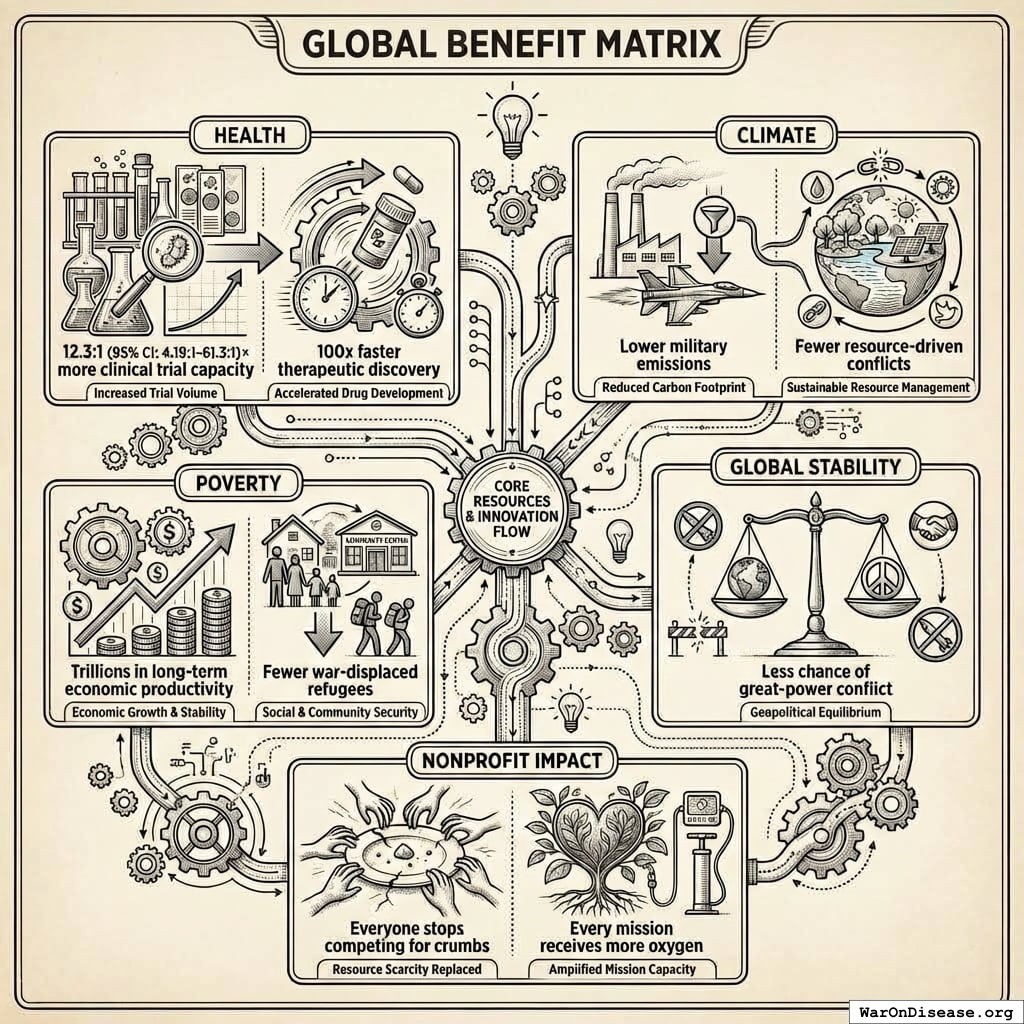
What 1% Less Violence Buys Every Mission
I’m going to describe what happens when you shift 1% of military budgets, but I’m going to describe it the way I actually observe it, which is as a single upstream change that fixes things your species has been trying to fix separately for decades while refusing to notice they’re all the same problem.
12.3x (90% CI: 4.92x-50.8x) more clinical trial capacity. Diseases get cured instead of managed (the pharmaceutical industry’s least favorite sentence). Militaries emit less pollution (nobody carbon-taxes a tank, but maybe they should). Fewer resource-driven conflicts means fewer refugees means less poverty. Everyone becomes slightly less dead, which is the lowest bar imaginable, and yet.
1 percent solves health, climate, poverty, and war. You put all your skill points into violence and forgot to check if there were alternatives.
And here is the part that should keep every nonprofit Executive Director awake at night: you stop writing grant proposals and start actually doing your mission. Remember your mission? It was in the brochure. The one you wrote to get the grant. To pay the person who writes the grants. To fund the office where the grant-writing happens. Your organization has become a machine whose primary output is requests for money and whose secondary output is occasionally, accidentally, the thing you set out to do. The treaty fixes this by making the money show up without the begging. Your species calls this “too good to be true,” which is a phrase you use to describe things that are good and true but embarrassing to admit.
On Bribing Nonprofits (Legally)
A rational civilization would explain the goal and watch organizations cooperate. Your species requires payment. This is not a criticism. It’s a design parameter. I’ve learned to work with the species I have, not the species I wish I had.
Asking nonprofits to support a 1% Treaty out of moral obligation is like asking a drowning person to rescue other swimmers. They’re drowning. They need a life preserver, not a guilt trip.
The life preserver: you make the organization rich. Old way: “Here’s $100K. Hope it helps. Submit a 47-page report in 6 months about impacts and learnings. Use the word ‘stakeholder’ at least fourteen times.” New way: “Here’s $50K baseline to get started. Plus $10K for every 10,000 verified referendum votes you drive through your unique link. No cap.” The nonprofit’s most rational path to maximizing their budget becomes: be your most effective mobilization partner. One metric. No ambiguity. Get paid for results. This is how every functional industry works except charity, which explains why every problem charity was invented to solve is still here.
And then the ocean itself: the 1% Treaty Fund receives $27.2 billion annually. Your Decentralized Institutes of Health allocates multi-billion dollar budgets to the diseases your organization exists to fight. When the treaty passes, the grant-writing stops. The money arrives because the treaty says it arrives. You don’t need influence. You don’t need a seat at the table. You need the treaty to pass. Everything after that is automatic, the way gravity is automatic, except instead of pulling things down it pulls money toward curing diseases. (Gravity has never done this. I checked.)
You have two options. Option A: keep competing for finite grants forever, writing proposals, begging foundations, hoping your competitor doesn’t write a better proposal. Option B: help pass the treaty, get paid referral bonuses for every verified referendum vote you drive, and watch $27.2 billion/year flow to your disease area. One involves begging. The other involves getting paid. This should not require a chapter to explain. But your species is very attached to its suffering, so here we are.
The dogs need to turn around and notice the banquet. I’ve been watching them fight over the bowl for 80 years. The banquet is right there. It has always been right there. The dogs are very focused. They have written reports about the bowl. They have held conferences about bowl strategy. They have hired consultants to optimize bowl access. None of them have turned around.
Turn around.
The International Campaign to End War and Disease (the Campaign) is the public coalition of humans and organizations signing the 1% Treaty before governments do. Public signatures create democratic consent and coalition legitimacy. Formal state signatures create international-law obligations and move the money. Both matter. They are not the same legal act.
The Five Stages
Everything above this heading was the why. Everything below it is the how. Getting a nonprofit to support the treaty is five concrete actions, performed in order. Each one has a matching artifact in this chapter.
Stage 2. The organization embeds the voting widget. A permanent iframe on the nonprofit’s site that keeps converting their warm audience indefinitely. Host credibility transfers to the widget; visitors are pre-qualified because they came to the site about the thing the widget is about. This is the single most effective move in the chapter, and it goes before the Stage 3 newsletter blast so the blast can point at the embed instead of an external URL. See What Your Org Gets for the pitch.
Stage 3. The organization shares the treaty with its members. One newsletter mention, one email, one social post, each linking to the embed on the nonprofit’s own site. The distribution list becomes the campaign’s distribution list for a single day; the embed catches the long tail after the blast decays. Artifacts: The Member Activation Email, The Social Post Pack.
Stage 4. The members sign the public treaty register at warondisease.org or through the org’s embed. Every public signature is one more data point in a pressure system pointed at 193 heads of state. The nonprofit does not need to do anything to cause this step; the embed and the member activation email both do it automatically by linking.
Stage 5. The members notify their head of state that the signing task is overdue. At warondisease.org/tasks, every head of state has a public page showing their unsigned 1% Treaty task and its cost-of-delay clock. A member looks up their country, clicks “notify,” and the head of state receives a polite email from a registered voter in their jurisdiction pointing out that the task is still outstanding. This is the stage that matters, because 193 heads of state are the entire bottleneck and they currently receive approximately zero emails about it.
Stage 1 leads to Stages 2 through 5. The nonprofit’s only real job is Stages 1 through 3. The members do Stages 4 and 5, because the members are what moves governments. A nonprofit has an email list. Lockheed Martin has a lobbying budget. The email list wins when it knows what to click.
The rest of this chapter is the “knows what to click” part.
What Your Org Gets
Every disease-advocacy, peace, or global-health org operates inside the same structural trap: their mission’s budget is 604 (90% CI: 453-888)x smaller than the budget that makes their mission harder. The Campaign fixes the upstream cause. The voting infrastructure, the attribution dashboard, the embed widget, the legal analysis, the cost-effectiveness modeling, the pre-written outreach copy, and the ongoing coordination are already built and staffed, at warondisease.org, at no cost to any partner org. The one thing the Campaign cannot produce on its own is audience reach. That is the only thing a partner org contributes. Every other cost has been absorbed before the conversation started.
So the question for a partner org is narrower than it first appears. It is not “should we take on a new campaign.” It is “should we send our existing audience to infrastructure that compresses our core problem by a factor of 12.3x (90% CI: 4.92x-50.8x).” The answer in most cases is obvious. The argument below is what to hand the EDs and program officers who want the obvious spelled out.
The argument works for any form of participation: join the Campaign, sign the public treaty register, embed, share, donate staff time, allocate an Ad Grant. Use whichever parts land with whichever audience. Lead with the strongest for that org; most conversations hit two or three.
Total time cost: under one hour of staff time. Campaign membership is one form signed by the ED. The embed is one iframe a webmaster pastes into the CMS. The newsletter and social posts are pre-written in this chapter and can be scheduled in a single sitting. First deployment runs about an hour end-to-end across all three org-facing stages, with zero ongoing overhead after the embed goes live. Most objections this pitch hits are time objections. That number is the answer.
The pitch has three arguments. Every recipient is at least one of rational, greedy, or altruistic. At least one of these lands.
If they are altruistic. Every day this wave reaches a verified majority of humanity sooner, about 150 thousand fewer humans die from preventable disease, and roughly two billion fewer person-days of disease suffering accumulate. Helping shifts that date forward by a measurable amount of time. Declining to help is a decision that has a body count, and the body count is known in advance.
If they are rational. Their org can take this as a grant-application one-pager and raise money off it. Cost per voter through their channel. Lives saved per voter (2.6 lives). Suffering hours averted per voter (468 thousand hours). Funders that write checks against cost-per-DALY numbers have never seen a number this favorable.
If they are greedy. Once the prize pool is seeded, voters referred through their channel earn their org a share of the eventual payout proportional to the size of the chain they seeded. Their org can absorb that as a new revenue line or pass it through to their referred voters as a further incentive.
Most recipients hit two of these, or all three. It does not matter which. The offer is the same.
Additional benefits most orgs underweight:
Likely the largest single-org attributable impact in nonprofit history. If they drive voters through their channel, each additional verified human adds 2.6 lives and 468 thousand hours of averted suffering to their attribution if the treaty passes. Probability-discount the outcome by any factor you want. It still beats the cumulative lifetime output of the largest global-health charities, for the marginal cost of adding an iframe or sending an email. No other nonprofit in the world can put a number like that in its annual report, because no other nonprofit is adjacent to an intervention at this scale.
Their donors and staff (and their families) personally become healthier and richer. If the treaty takes hold at the rates modeled in GDP Trajectories138, cumulative lifetime income per person multiplies by 1.57x (90% CI: 1.24x-1.92x) relative to the current trajectory, with average income by year 20 reaching $34,972 (90% CI: $26,587-$43,903). Healthy-lifespan gains are in the same chapter. Everyone who helps benefits directly alongside their beneficiaries.
Being on the founding-coalition list is ongoing brand value. Once the treaty passes, the list of orgs that helped launch it becomes the list every donor asks about. Early movers end up on the plaque. Late movers do not.
Their existing donors are the exact audience that converts. People who already gave to a health or peace charity already care about disease eradication. They showed up to the door. You are not knocking on strangers’ doors.
Seeding a new democratic primitive. The wishocratic allocation mechanism, where every human votes on public-goods funding priorities, could be extended to all public-goods funding after the treaty passes. If it catches on, it could reshape how global public goods are funded for the rest of human history. The orgs that helped seed it in the largest global referendum ever conducted get to point at that record indefinitely.
Peer-org network effect. Once three or four similar organizations sign on, not signing on starts to look like lagging. Social proof is a real force in the nonprofit sector.
They can aim their unused Google Ad Grant at the Campaign (embed-specific). Every qualifying 501(c)(3) gets $10,000 a month ($120,000 a year) in free Google Ads through the Google Ad Grants program. Most nonprofits do not spend their full allocation because they cannot generate enough targeted landing pages to use it. An embed of the widget on their site gives their Ad Grant a mission-aligned landing page to drive traffic to, converting dormant ad dollars into attributable voters without asking them to touch their operating budget.
What a decline means. An org that declines is not choosing inaction; it is choosing something else with the same staff hours. The follow-up question is specific: what is that something else, and what is its cost per life-year saved? 2.6 lives and 468 thousand hours suffering-hours are averted per voter acquired, at a cost per DALY of $0.00177 (90% CI: $0.000809-$0.00354). Whatever the alternative activity is, it should beat that number, measured the same way. If it does, the Campaign wants to hear it and learn from it. If the alternative has never been benchmarked against anything, the decline is an allocation from disease sufferers toward an activity the org has not compared to its cost, and the delay has a body count that accrues during the conversation.
Outreach cadence. Send ten outreach emails per week. Target fifty nonprofits in the first ninety days. Health charities, disease-specific foundations, peace organizations, EA orgs, development foundations. At a ten-percent response rate, that is five partnerships. Five partnerships is tens of millions of warm impressions per month. No marginal cost, very large ceiling, three independent routes to yes.
The Cost-Effectiveness Argument
Nonprofits evaluate new asks by comparing the cost per disability-adjusted life year (DALY) averted against whatever else they could be funding. Insecticide-treated bed nets are the GiveWell benchmark for “unusually cost-effective.” Here is how the treaty compares, on three separate accounting methods:
Direct trial funding. A donor pays for pragmatic trials at $929 (95% CI: $97-$3,000) per patient instead of $41,000 (95% CI: $20,000-$120,000) per patient traditional. This is the cost-effectiveness of the intervention itself, already roughly 100x better than bed nets.
Treaty advocacy campaign. A donor funds the campaign to pass the treaty (~$1 billion total, shared across many funders). The trials are then paid for by redirected military spending, not new philanthropic money. Same 565 billion DALYs (90% CI: 309 billion DALYs-1.08 trillion DALYs) averted. Only the campaign costs anything. Roughly five orders of magnitude better than bed nets, if the numbers survive economist scrutiny.
Net of lifetime peace dividend. A 1% reduction also eliminates war externalities (environmental damage, refugee costs, lost human capital, trade disruption). The estimated lifetime peace dividend is $290,052 (90% CI: $253,999-$328,716) per person. The campaign pays for itself before a single trial enrolls a patient, and then keeps paying.
Pick whichever accounting the funder finds least embarrassing to explain at the board meeting. All three are unusually good.
This Is Not Lobbying (The Legal Memo)
Every 501(c)(3) general counsel raises the lobbying concern within the first thirty seconds of reading this chapter. This section is what they need. It is deliberately written without jokes. Forward it to your board, or paste it into a memo.
What the words mean
Term
Meaning
Public signature
A human or organization signs the public treaty register. This creates democratic consent and coalition legitimacy.
Organizational signatory
A nonprofit, company, union, school, church, or other institution joins the International Campaign to End War and Disease and publicly signs the 1% Treaty as an organizational supporter.
Formal state signature
A government signs or ratifies the treaty through its ordinary international-law process. This creates Article I funding obligations.
Treaty party
A state bound by the treaty. Nonprofits are not treaty parties and do not assume government budget obligations.
What the IRS defines as lobbying
Under IRC §501(c)(3), “lobbying” means attempting to influence specific domestic legislation (a bill, resolution, or act before a legislative body). The IRS applies two tests:
Direct lobbying. Communicating with a legislator about specific legislation and expressing a view on it.
Grassroots lobbying. Communicating with the public about specific legislation, expressing a view, and including a call to action directed at legislators.
The Campaign’s public-signature work meets neither definition.
Why treaty advocacy is not lobbying
The treaty is not domestic legislation. The 1% Treaty is a proposed international agreement between sovereign nations. It is not a bill before any domestic legislative body. Under IRS guidelines this is categorized as issue advocacy, not lobbying.
The Campaign does not ask anything of domestic legislators. The ask is directed at heads of state, who sign international agreements as executives, not legislators. There is no “call your congressperson” component. No specific domestic legislation is referenced.
The Campaign does not support or oppose candidates. The accountability dashboard at warondisease.org/tasks tracks treaty signature status by head of state. This is functionally identical to how Transparency International publishes corruption indices by country. Publishing factual information about government performance is core 501(c)(3) educational activity.
Even if classified as lobbying, it would be permitted. 501(c)(3) organizations can lobby up to 20% of their budget under the 501(h) election. A public treaty signature and organizational signature are vastly below any threshold any interpretation could trigger.
Historical precedent
No 501(c)(3) has ever lost its tax-exempt status for advocating for a global treaty. The IRS has revoked status for fraud, private inurement, failure to file Form 990 for three consecutive years, and excessive partisan political activity. Treaty advocacy has never been a basis for revocation.
Multiple 501(c)(3) organizations actively campaign for international treaties. The International Campaign to Ban Landmines, a coalition of 501(c)(3)s, led the campaign that produced the Ottawa Treaty in 1997 and won the Nobel Peace Prize for it. Physicians for Social Responsibility advocates for the Treaty on the Prohibition of Nuclear Weapons. Human Rights Watch campaigns for international human rights treaties. Oxfam America advocates for international trade and arms treaties. None have faced IRS action for their treaty advocacy.
Quick reference for the board meeting
Question
Answer
Does the Campaign promote specific domestic legislation?
No. The treaty is an international agreement.
Does the Campaign ask anything of senators or congresspeople?
No. The ask is directed at heads of state.
Does the Campaign support or oppose candidates?
No. It tracks treaty status by nation.
Has any 501(c)(3) lost status for treaty advocacy?
No, not once in recorded history.
Would this qualify as lobbying under the broadest possible definition?
No. And even if it did, 501(c)(3)s can lobby up to 20% of budget under 501(h).
The first and usually only email sent to a nonprofit. One shot, all three asks, everything attached. No escalating commitment, no follow-up campaign to chase them across Stages 1 through 3. They do it or they don’t. Customize the bracketed fields and delete this line before sending.
Note
Subject: Join the International Campaign to End War and Disease: full package, under an hour
Hi [Name],
[Org Name]’s work on [their focus area] is directly relevant to the 1% Treaty campaign.
The International Campaign to End War and Disease is building the public signature layer for the 1% Treaty, a proposal for all nations to simultaneously redirect 1% of military spending ($27.2 billion) to pragmatic clinical trials. Every nation cuts equally, so no country’s military capability changes relative to any other. Trial capacity increases 12.3x (90% CI: 4.92x-50.8x). The backlog of 6,650 untreated diseases drops from 443 years to 36 years. Whatever condition [Org Name]’s community is affected by is almost certainly in that backlog.
The proposal, in three parts, under an hour of staff time total:
Join and sign. Sign the attached Organizational Signatory and Campaign Membership Form. [Org Name]’s logo appears on the Campaign page at warondisease.org and locks in founding-member status. About 15 minutes of ED time.
Embed + aim your Ad Grant at it. Paste the attached iframe snippet into your site. The attached pre-built Google Ads campaign (full template at Google Ads Campaign Template) drops into [Org Name]’s existing $120K/year Google Ad Grant and points it at the embed. Converts passively from day one, zero ongoing overhead. About 30 minutes for a webmaster, plus 20 minutes loading the Ad Grant campaign (or share OAuth access and the campaign is loaded for you).
Share once. Use the attached pre-written newsletter and three social posts asking members to sign the public treaty register. They link to the embed on your own site. About 15 minutes to schedule.
The trade. One hour of [Org Name]’s staff time buys permanent attribution to every voter the channel delivers from now until the treaty passes. Each voter counts as 2.6 lives saved and 468 thousand hours suffering-hours averted if the treaty passes. Concrete floor: once the embed is live, [Org Name]’s existing Google Ad Grant ($10K/month, $120K/year in free Google Ads that most 501(c)(3)s leave on the table for lack of mission-aligned landing pages) pointed at the embed can deliver verified voters every year at middle-of-road conversion economics. Newsletter and social reach stack on top. No other action [Org Name] takes this year comes close to that return.
What [Org Name] also gets:
Permanent public attribution. Every voter [Org Name]’s channel delivers is tagged to [Org Name] on the coalition dashboard, visible forever to every funder, board, donor, and auditor. Show up in next year’s annual report with a number nonprofit annual reports have never held.
A new funding line. Global-health, peace, and policy funders fund coalition work on this issue. Coalition membership opens eligibility. The attached funder proposal template is performance-based. Your foundation contacts pay your org per verified voter acquired, at a cost per DALY ($0.00177 (90% CI: $0.000809-$0.00354)) that beats bed nets ($89 (95% CI: $78-$100)) by orders of magnitude. Forward it to three of your funders. It is scaffolded so they pay on delivery, not on staff time.
A founding-coalition plaque. Early movers are named on warondisease.org permanently. Late movers are not.
Attached:
Organizational Signatory and Campaign Membership Form
Embed code snippet (three lines of HTML)
Newsletter template + three social posts
Pre-built Google Ads campaign (ad copy, keywords, targeting, bidding strategy) for [Org Name]’s existing $10K/month Google Ad Grant. Full template: Google Ads Campaign Template. Load in about 20 minutes, or share OAuth access and we load it for you
Funder proposal template (performance-based, for your own fundraising)
Legal memo (“This Is Not Lobbying”) for your general counsel
If [Org Name] is doing this, any blocker on finishing all three items this week? If [Org Name] is not doing this, what is your team doing instead that beats 2.6 lives saved per voter acquired on a cost-per-DALY basis? The Campaign genuinely wants to know. If there is a better allocation, we want to learn from it.
[Your name] [Your role] [Contact]
The Member Activation Email
The email for Stage 3. The nonprofit drops this into its existing newsletter or sends it as a one-off to its list. Customize the bracketed fields.
Note
Subject: Sign the public treaty register
[Org Name] has joined the International Campaign to End War and Disease as an organizational signatory of the 1% Treaty, a proposal to redirect 1% of military spending to pragmatic clinical trials. It takes 30 seconds and two clicks.
Click 1: Sign the public treaty register at warondisease.org. Your signature is one of the data points telling 193 heads of state that the public is not waiting for permission.
Click 2: Notify your head of state at warondisease.org/tasks. Find your country, see the overdue signing task, click the notify button. Your head of state receives a polite email explaining that a registered voter has noticed the task is still outstanding.
Why this matters: governments currently spend 604 (90% CI: 453-888) times more on weapons than on clinical trials to figure out which medicines actually work. A 1% reduction, applied simultaneously by every nation, does not weaken anyone’s military (because everyone cuts equally) and generates $27.2 billion per year for trials. That funds 12.3x (90% CI: 4.92x-50.8x) more clinical trials. The treatment backlog that currently takes 443 years to clear drops to 36 years.
This is one of the most cost-effective global health actions available this week, by a wide margin versus benchmarks like bed nets. We know because we checked.
If you read this far, forward the email to one person who also doesn’t want to die of a preventable disease.
Thank you.
[Org Name]
The Social Post Pack
Three short posts and one long post for Stage 3. Schedule them in your CMS; pin the first one for the week.
Short post 1 (the hook):
Your government spends 604 (90% CI: 453-888)x more on weapons than on figuring out which medicines work. The 1% Treaty fixes this. 30 seconds to sign: warondisease.org
Short post 2 (the math):
A simultaneous 1% cut to global military spending preserves every country’s military balance AND funds 12.3x (90% CI: 4.92x-50.8x) more clinical trials. Treatment backlog drops from 443 years to 36 years. Sign: warondisease.org
Short post 3 (the notification):
Every head of state has an overdue task: sign the 1% Treaty. See yours at warondisease.org/tasks. Click the notify button. That’s the whole step.
Long post (LinkedIn):
Your lifetime risk of dying from terrorism is vanishingly small. Your lifetime risk of dying from a disease is 100%. The global budget does not reflect this. Governments spend enough on military to buy 850 rounds/person/year (90% CI: 584 rounds/person/year-1,271 rounds/person/year) bullets for every person on Earth every year, while only 15 diseases per year receive their first effective treatment.
The 1% Treaty proposes a simultaneous 1% reduction in military spending across all signatory nations, redirected to pragmatic clinical trials. Because every nation cuts equally, no country’s military capability changes relative to any other. The balance stays identical. But $27.2 billion per year frees up for clinical research.
[Org Name] has joined the International Campaign to End War and Disease as an organizational signatory of the 1% Treaty. Our community has two things to do:
Sign the public treaty register at warondisease.org (10 seconds)
Notify your head of state at warondisease.org/tasks (20 seconds)
That is the whole job. 30 seconds. Share it with anyone who also doesn’t want to die of a preventable disease.
The Embed Snippet
The iframe that goes on the partner org’s site. [Org Name] does not write any code; the snippet is auto-generated per-org at warondisease.org/institutes with the org’s unique slug baked into the URL. Attribution to [Org Name] is automatic for every voter who casts a ballot through this iframe.
Generic structure, for anyone curious what gets pasted:
The real version arrives with {ORG-SLUG} replaced and a copy-to-clipboard button, at warondisease.org/organizations/[id] once the org is approved. Paste into the target page’s CMS. Drop-in anywhere: a dedicated campaign page, a sidebar on the homepage, a take-action tab. The widget is responsive and converts passively; nothing else is required for attribution to start flowing.
The Organizational Signatory and Campaign Membership Form
The form the organization signs for Stage 1. This becomes the public record of their Campaign membership and organizational signature.
NoteOrganizational Signatory and Campaign Membership Form
We, the undersigned organization, join the International Campaign to End War and Disease as an organizational signatory of the 1% Treaty. We publicly sign the treaty register and support the reallocation of 1% of global military expenditure toward pragmatic clinical trials integrated into standard healthcare delivery.
We sign because:
6,650 diseases currently lack effective treatments.
At current trial capacity, clearing this backlog takes 443 years.
☐ We consent to our organization’s name and logo appearing on warondisease.org as a Campaign member and organizational signatory.
The Funder Proposal Template
For nonprofits that want to raise money from their own foundation contacts to run the Campaign’s voter-acquisition work through their channels. The nonprofit forwards this template (or a condensed version) to their funders. It replaces the old “fund a coordinator at $X” ask, which in practice is how campaigns raise $100K and spend it on conferences, strategy offsites, and consultants who produce slide decks nobody reads.
This template is structured so the funder pays on verified delivery, with explicit exclusions on the waste categories that swallow most coalition grants. Condensed here; expand to full memo length before formal submission.
Summary. [Org Name] commits to driving [target] verified referendum voters through its unique attribution link at warondisease.org over [timeframe]. Payment is performance-based: a small fixed baseline for campaign execution costs, plus a per-voter bonus paid only on verified delivery. The attribution infrastructure (unique URLs, dashboard, voter verification, embed widget) is already built by warondisease.org at no cost to [Org Name]; the funder is not paying to reinvent any of that. Every dollar the funder deploys has a cost-per-DALY number benchmarked against GiveWell standards, posted publicly, and verifiable at any time.
Even at aggressive probability discounts on treaty passage, the cost per DALY beats bed nets by orders of magnitude. The full three-accounting-method comparison is in The Cost-Effectiveness Argument.
On the per-voter denominator. Lives-saved-per-voter divides total projected lives saved by the verified majority-of-humanity coordination target, not by the smaller Chenoweth tipping-point benchmark. This is the conservative public attribution: the public-signature strategy has people build a majority humans can see, so the impact math uses that larger denominator. The 3.5% (95% CI: 1%-10%) benchmark remains useful as evidence that political pressure can become decisive before the full target is reached.
What warondisease.org already provides, at no cost to [Org Name].
A unique referral URL keyed to [Org Name]. Voters delivered through this link are auto-attributed.
The embed widget (three lines of HTML, drop anywhere on the site) and the voting flow it points to.
A pre-built Google Ads campaign (ad copy, keywords, targeting, bidding strategy) configured for voter acquisition. Full template: Google Ads Campaign Template. [Org Name] loads it into the org’s existing $10K/month Google Ad Grant in about 20 minutes, or shares OAuth access for the Campaign team to load it. Most qualifying 501(c)(3)s underuse their Ad Grant allocation for lack of mission-aligned landing pages; the embed plus this pre-built campaign converts that dormant free ad spend into attributable voters.
A live coalition dashboard showing voters delivered by org, cost per voter, and cost per DALY.
Voter verification, signature validation, and anti-fraud filtering.
Pre-written newsletter and social post templates (in this chapter).
The Organizational Signatory and Campaign Membership Form, legal memo, and cost-effectiveness argument (in this chapter).
Ongoing maintenance of all of the above.
Setup: email [campaign contact] and receive the referral URL, embed snippet, and dashboard login within 24 hours. No code is written at [Org Name]’s end beyond pasting an iframe. This is why the baseline in the payment structure below is small. Nothing centralized is being rebuilt.
Payment structure.
Component
Amount
Trigger
Baseline (campaign execution costs)
$5,000
On signing, one-time
Per-voter performance bonus
$1.00 per verified voter
Monthly, on verified delivery
Cap
Funder-specified (default: uncapped)
None
On the baseline. The $5,000 covers [Org Name]’s real marginal costs during ramp-up: roughly 20–40 hours of staff time to deploy the embed, write a newsletter from the template, schedule social posts, and sub-recruit peer orgs; small prime-the-pump ad spend before the Google Ad Grant overflow kicks in; optional creative production (graphics, a short video, translated copy). Kept small deliberately. Most of the money is tied to delivered voters, and efficient orgs earn past $5,000 in the first month.
On the $1.00 per-voter anchor. This number matches the established performance-grant benchmark in How to Turn Grant Applicants into Billionaires ($10K per 10,000 verified votes) and the $1.50 per response implied by the Global Survey Grant Proposal ($150,000 first-year budget for 100,000 completed responses). It is distinct from the $5 (95% CI: $2-$10) direct incentive paid to the voter and referrer, which comes from a separate pool and does not hit this budget.
Pricing as a market, not a mandate. $1.00 per voter is an anchor, not a fixed rate. An org with a high-engagement list may propose $0.50. An org that needs to front ad spend into a cold channel may propose $1.50. Funders can accept, decline, or counter. The rate is whatever a willing nonprofit and a willing funder agree on. The performance structure is the accountability: if the org delivers, the funder pays per the agreed rate; if the org does not deliver, the funder does not pay. No milestone triggers, no pause clauses, no dead-money scenarios. Pay on delivery, per voter, monthly.
Restricted-use clause. Funds may be used for: staff time directly allocated to campaign execution (writing the newsletter from the template, scheduling social posts, deploying the embed iframe in the CMS, outreach to peer nonprofits for sub-recruitment), paid advertising overflow beyond the org’s free Google Ad Grant allocation (Meta, X, LinkedIn, programmatic), and creative production tied to shipping deliverables (graphics, short video, translated copy).
Funds may not be used for: conferences, retreats, consultants whose outputs are not deliverable campaign artifacts, board or advisory compensation, travel unrelated to voter acquisition, “strategy development” without a specific shipping deliverable, new hires unrelated to the campaign, or general operating overhead outside the campaign.
Public reporting. [Org Name] publishes a monthly campaign dashboard at [org URL]/campaign-dashboard, showing: voters delivered, cost per voter achieved, cost per DALY achieved, cumulative attributable lives saved, and spend by category. Funder and general public can audit in real time. The public dashboard is the accountability mechanism.
Legal. See This Is Not Lobbying (The Legal Memo). No changes to [Org Name]’s 501(c)(3) status result from this Campaign work. Voter acquisition for a proposed international treaty is issue advocacy, not lobbying.
The proposal. Fund [Org Name] at a $5,000 baseline plus a per-voter rate (anchor: $1.00, negotiable) up to a delivery target of [target] voters within [timeframe]. Maximum funder exposure: $5,000 + (rate × target). At $1/voter: $15,000 for 10,000 voters, $105,000 for 100,000 voters, $1,005,000 for 1,000,000. Delivery is public through the warondisease.org dashboard; the funder pays monthly in arrears against voters actually delivered, never advanced.
Close every proposal with: “What per-voter rate and delivery target would make this the best cost-per-DALY grant in your current portfolio, and if we can hit it, is there any blocker to signing?”
Outreach Sequencing
Five steps. Do them in order.
Step 1. Identify warm contacts (week 1). List every organization the outreach person has a prior relationship with. Prioritize by strength of relationship (will they respond?), mission alignment (disease, health, longevity, peace, poverty), and community size.
Step 2. Get the first three yeses (weeks 1-3). Contact the 3-5 warmest relationships first. Use The Outreach Email. The goal is logos on the coalition page before going wide, because social proof compounds.
Step 3. Go wide with social proof (weeks 3-8). Once there are founding members, update the outreach email to include “[X organizations] are already on board, including [names].” Contact 200+ organizations in batches of 50. Track responses in a simple spreadsheet: Org Name, Contact, Date Contacted, Response, Follow-Up Date, Signed (Y/N), Logo Received (Y/N).
Step 4. Follow up (ongoing).
No response after 5 days: one short follow-up.
No response after 10 days: one more, even shorter.
No response after 15 days: move on.
“We need to think”: follow up in 2 weeks.
“We have concerns”: offer a call immediately.
“What would we need to change?”: the most valuable response. Incorporate reasonable feedback; reject changes that gut the substance.
Step 5. Announce the coalition (months 2-3). Once there are 10+ organizational signatories: publish the coalition page with logos, write a press release, have each founding member share with its community, submit to the EA Forum with economist sign-on if available.
Objection Handling
The top objections, with the top answer to each. If the same objection keeps appearing, revise the outreach email so it preempts it.
“This is too political.” The treaty specifies a simultaneous reduction, preserving military balance. It does not favor or oppose any nation, party, or candidate. It is no more political than advocating for increased NIH funding, which hundreds of 501(c)(3)s already do. The underlying fact is not partisan: everyone’s lifetime risk of dying from a disease is 100%, and the current budget does not reflect this.
“This will never work.” The International Campaign to Ban Landmines started with one staff member and six NGOs in 1992. By 1997, 122 nations signed the Ottawa Treaty and the campaign won the Nobel Peace Prize. A 1% cut is historically trivial: pre-WWII US military spending was 96.7% lower than today’s peacetime budget. After WWII, the US cut military spending by 87.6% in two years and produced the largest economic boom in modern history. A 1% simultaneous reduction is rounding error compared to what has already been done safely.
“Our board won’t approve this.” Send them This Is Not Lobbying (The Legal Memo). It addresses every IRS concern. Offer a 20-minute call with the board, or a written memo tailored to their specific bylaws.
“We don’t want to link to that website.” Link to the treaty text itself. Organizations sign the public treaty register and publicly support the treaty Articles, not any particular framing of them. They can use whichever version they are comfortable with.
“We’re too small to matter.” Every organizational signature adds social proof. The first 10 matter more than the next 100. Small organizations that move fast become founding members, which is a permanently better position than large organizations that move slow.
“What about our existing campaigns?” This complements existing work and does not replace or compete with anything. End-to-end first deployment is under one hour of staff time across all three org-facing stages: about 15 minutes to sign, about 30 minutes for a webmaster to paste the embed iframe into the CMS, and about 15 minutes to schedule the pre-written newsletter and social posts from this chapter. After that, the embed converts passively with zero ongoing overhead. Membership also opens a new funding line: global-health, peace, and policy funders increasingly fund coalition work on this issue, and coalition membership opens eligibility.
“The numbers seem too good to be true.” They are calculated with 95% confidence intervals and 90+ cited sources. The full methodology is transparent in the parameters and calculations appendix. Offer to connect them with an economist reviewer, or invite them to review the model themselves.
That is the whole chapter. The outreach email bundles the full ask (sign, embed, share) with every artifact attached, so first contact is also last contact for orgs that say yes. If an organization commits, confirm the embed is live on their site and the newsletter is scheduled, then move on to the next org. If an organization declines, ask what would change their mind and what they are doing with the same staff hours that beats this on cost per DALY. Incorporate useful feedback; retry in 60 days. If the same objection appears three times in a week, update the outreach email to preempt it.
The bottleneck between here and 565 billion DALYs (90% CI: 309 billion DALYs-1.08 trillion DALYs) averted is not the math, the legal analysis, the templates, or the treaty itself. It is the number of organizations that have opened the conversation with their members. That number is a function of how many outreach emails get sent this week.
Do the next thing on the sequencing list.
1.
NIH Common Fund. NIH pragmatic trials: Minimal funding despite 30x cost advantage. NIH Common Fund: HCS Research Collaboratoryhttps://commonfund.nih.gov/hcscollaboratory (2025)
The NIH Pragmatic Trials Collaboratory funds trials at $500K for planning phase, $1M/year for implementation-a tiny fraction of NIH’s budget. The ADAPTABLE trial cost $14 million for 15,076 patients (= $929/patient) versus $420 million for a similar traditional RCT (30x cheaper), yet pragmatic trials remain severely underfunded. PCORnet infrastructure enables real-world trials embedded in healthcare systems, but receives minimal support compared to basic research funding. Additional sources: https://commonfund.nih.gov/hcscollaboratory | https://pcornet.org/wp-content/uploads/2025/08/ADAPTABLE_Lay_Summary_21JUL2025.pdf | https://www.ncbi.nlm.nih.gov/pmc/articles/PMC5604499/
Chance of American dying in foreign-born terrorist attack: 1 in 3.6 million per year (1975-2015) Including 9/11 deaths; annual murder rate is 253x higher than terrorism death rate More likely to die from lightning strike than foreign terrorism Note: Comprehensive 41-year study shows terrorism risk is extremely low compared to everyday dangers Additional sources: https://www.cato.org/policy-analysis/terrorism-immigration-risk-analysis | https://www.nbcnews.com/news/us-news/you-re-more-likely-die-choking-be-killed-foreign-terrorists-n715141
Mean exclusion rate: 86.1% across 158 antidepressant efficacy trials (range: 44.4% to 99.8%) More than 82% of real-world depression patients would be ineligible for antidepressant registration trials Exclusion rates increased over time: 91.4% (2010-2014) vs. 83.8% (1995-2009) Most common exclusions: comorbid psychiatric disorders, age restrictions, insufficient depression severity, medical conditions Emergency psychiatry patients: only 3.3% eligible (96.7% excluded) when applying 9 common exclusion criteria Only a minority of depressed patients seen in clinical practice are likely to be eligible for most AETs Note: Generalizability of antidepressant trials has decreased over time, with increasingly stringent exclusion criteria eliminating patients who would actually use the drugs in clinical practice Additional sources: https://pubmed.ncbi.nlm.nih.gov/26276679/ | https://pubmed.ncbi.nlm.nih.gov/26164052/ | https://www.wolterskluwer.com/en/news/antidepressant-trials-exclude-most-real-world-patients-with-depression
Berkshire’s compounded annual return from 1965 through 2024 was 19.9%, nearly double the 10.4% recorded by the S&P 500. Berkshire shares skyrocketed 5,502,284% compared to the S&P 500’s 39,054% rise during that period. Additional sources: https://www.cnbc.com/2025/05/05/warren-buffetts-return-tally-after-60-years-5502284percent.html | https://www.slickcharts.com/berkshire-hathaway/returns
General range: $3,000-$5,500 per life saved (GiveWell top charities) Helen Keller International (Vitamin A): $3,500 average (2022-2024); varies $1,000-$8,500 by country Against Malaria Foundation: $5,500 per life saved New Incentives (vaccination incentives): $4,500 per life saved Malaria Consortium (seasonal malaria chemoprevention): $3,500 per life saved VAS program details: $2 to provide vitamin A supplements to child for one year Note: Figures accurate for 2024. Helen Keller VAS program has wide country variation ($1K-$8.5K) but $3,500 is accurate average. Among most cost-effective interventions globally Additional sources: https://www.givewell.org/charities/top-charities | https://www.givewell.org/charities/helen-keller-international | https://ourworldindata.org/cost-effectiveness
The cost of 5.56mm NATO ammunition at military bulk procurement rates is approximately $0.40 per round, based on Lake City Army Ammunition Plant production and commercial market floor prices for mil-spec M855 ammunition.
The General Accounting Office reports that US forces used 1.8 billion rounds of small-arms ammunition per year, a level that more than doubled in five years. An estimated 250,000 rounds were fired for every insurgent killed in Iraq and Afghanistan.
US programs (1994-2023): $540B direct savings, $2.7T societal savings ( $18B/year direct, $90B/year societal) Global (2001-2020): $820B value for 10 diseases in 73 countries ( $41B/year) ROI: $11 return per $1 invested Measles vaccination alone saved 93.7M lives (61% of 154M total) over 50 years (1974-2024) Additional sources: https://www.cdc.gov/mmwr/volumes/73/wr/mm7331a2.htm | https://www.thelancet.com/journals/lancet/article/PIIS0140-6736(24)00850-X/fulltext
Comprehensive mortality and morbidity data by cause, age, sex, country, and year Global mortality: 55-60 million deaths annually Lives saved by modern medicine (vaccines, cardiovascular drugs, oncology): 12M annually (conservative aggregate) Leading causes of death: Cardiovascular disease (17.9M), Cancer (10.3M), Respiratory disease (4.0M) Note: Baseline data for regulatory mortality analysis. Conservative estimate of pharmaceutical impact based on WHO immunization data (4.5M/year from vaccines) + cardiovascular interventions (3.3M/year) + oncology (1.5M/year) + other therapies. Additional sources: https://www.who.int/data/gho/data/themes/mortality-and-global-health-estimates
CPI-U (1980): 82.4 CPI-U (2024): 313.5 Inflation multiplier (1980-2024): 3.80× Cumulative inflation: 280.48% Average annual inflation rate: 3.08% Note: Official U.S. government inflation data using Consumer Price Index for All Urban Consumers (CPI-U). Additional sources: https://www.bls.gov/data/inflation_calculator.htm
Explores the aggregation of information in groups, arguing that decisions are often better than could have been made by any single member of the group. The opening anecdote relates Francis Galton’s surprise that the crowd at a county fair accurately guessed the weight of an ox when the median of their individual guesses was taken. The three conditions for a group to be intelligent are diversity, independence, and decentralization. Additional sources: https://archive.org/details/wisdomofcrowds0000suro | https://en.wikipedia.org/wiki/The_Wisdom_of_Crowds | https://www.amazon.com/Wisdom-Crowds-James-Surowiecki/dp/0385721706
.
18.
ClinicalTrials.gov API v2 direct analysis. ClinicalTrials.gov cumulative enrollment data (2025). Direct analysis via ClinicalTrials.gov API v2https://clinicaltrials.gov/data-api/api
Analysis of 100,000 active/recruiting/completed trials on ClinicalTrials.gov (as of January 2025) shows cumulative enrollment of 12.2 million participants: Phase 1 (722k), Phase 2 (2.2M), Phase 3 (6.5M), Phase 4 (2.7M). Median participants per trial: Phase 1 (33), Phase 2 (60), Phase 3 (237), Phase 4 (90). Additional sources: https://clinicaltrials.gov/data-api/api
Only 3-5% of adult cancer patients in US receive treatment within clinical trials About 5% of American adults have ever participated in any clinical trial Oncology: 2-3% of all oncology patients participate Contrast: 50-60% enrollment for pediatric cancer trials (<15 years old) Note: 20% of cancer trials fail due to insufficient enrollment; 11% of research sites enroll zero patients Additional sources: https://www.fightcancer.org/policy-resources/barriers-patient-enrollment-therapeutic-clinical-trials-cancer | https://hints.cancer.gov/docs/Briefs/HINTS_Brief_48.pdf
2.3 billion individuals had more than five ailments (2013) Chronic conditions caused 74% of all deaths worldwide (2019), up from 67% (2010) Approximately 1 in 3 adults suffer from multiple chronic conditions (MCCs) Risk factor exposures: 2B exposed to biomass fuel, 1B to air pollution, 1B smokers Projected economic cost: $47 trillion by 2030 Note: 2.3B with 5+ ailments is more accurate than "2B with chronic disease." One-third of all adults globally have multiple chronic conditions Additional sources: https://www.sciencedaily.com/releases/2015/06/150608081753.htm | https://pmc.ncbi.nlm.nih.gov/articles/PMC10830426/ | https://pmc.ncbi.nlm.nih.gov/articles/PMC6214883/
Approximately 12% of trials with results posted on the ClinicalTrials.gov results database (905/7,646) were terminated. Primary reasons: insufficient accrual (57% of non-data-driven terminations), business/strategic reasons, and efficacy/toxicity findings (21% data-driven terminations).
Global clinical trials market valued at approximately $83 billion in 2024, with projections to reach $83-132 billion by 2030. Additional sources: https://www.globenewswire.com/news-release/2024/04/19/2866012/0/en/Global-Clinical-Trials-Market-Research-Report-2024-An-83-16-Billion-Market-by-2030-AI-Machine-Learning-and-Blockchain-will-Transform-the-Clinical-Trials-Landscape.html | https://www.precedenceresearch.com/clinical-trials-market
Military sector federal lobbying totaled $198,009,793 in 2025, up from $159.5 million in 2024 and $142.9 million in 2023. Additional sources: https://www.opensecrets.org/federal-lobbying/sectors/summary?id=D
Schistosomiasis treatment: $28.19-$70.48 per DALY (using arithmetic means with varying disability weights) Soil-transmitted helminths (STH) treatment: $82.54 per DALY (midpoint estimate) Note: GiveWell explicitly states this 2011 analysis is "out of date" and their current methodology focuses on long-term income effects rather than short-term health DALYs Additional sources: https://www.givewell.org/international/technical/programs/deworming/cost-effectiveness
Calculated from IHME Global Burden of Disease (2.55B DALYs) and global GDP per capita valuation. $109 trillion annual global disease burden.
The global economic burden of disease, including direct healthcare costs ($8.2 trillion) and lost productivity ($100.9 trillion from 2.55 billion DALYs × $39,570 per DALY), totals approximately $109.1 trillion annually.
Phase I duration: 2.3 years average Total time to market (Phase I-III + approval): 10.5 years average Phase transition success rates: Phase I→II: 63.2%, Phase II→III: 30.7%, Phase III→Approval: 58.1% Overall probability of approval from Phase I: 12% Note: Largest publicly available study of clinical trial success rates. Efficacy lag = 10.5 - 2.3 = 8.2 years post-safety verification. Additional sources: https://go.bio.org/rs/490-EHZ-999/images/ClinicalDevelopmentSuccessRates2011_2020.pdf
Approximately 30% of drugs gain at least one new indication after initial approval. Additional sources: https://www.nature.com/articles/s41591-024-03233-x
Early childhood education: Benefits 12X outlays by 2050; $8.70 per dollar over lifetime Educational facilities: $1 spent → $1.50 economic returns Energy efficiency comparison: 2-to-1 benefit-to-cost ratio (McKinsey) Private return to schooling: 9% per additional year (World Bank meta-analysis) Note: 2.1 multiplier aligns with benefit-to-cost ratios for educational infrastructure/energy efficiency. Early childhood education shows much higher returns (12X by 2050) Additional sources: https://www.epi.org/publication/bp348-public-investments-outside-core-infrastructure/ | https://documents1.worldbank.org/curated/en/442521523465644318/pdf/WPS8402.pdf | https://freopp.org/whitepapers/establishing-a-practical-return-on-investment-framework-for-education-and-skills-development-to-expand-economic-opportunity/
Infrastructure fiscal multiplier: 1.6 during contractionary phase of economic cycle Average across all economic states: 1.5 (meaning $1 of public investment → $1.50 of economic activity) Time horizon: 0.8 within 1 year, 1.5 within 2-5 years Range of estimates: 1.5-2.0 (following 2008 financial crisis & American Recovery Act) Italian public construction: 1.5-1.9 multiplier US ARRA: 0.4-2.2 range (differential impacts by program type) Economic Policy Institute: Uses 1.6 for infrastructure spending (middle range of estimates) Note: Public investment less likely to crowd out private activity during recessions; particularly effective when monetary policy loose with near-zero rates Additional sources: https://blogs.worldbank.org/en/ppps/effectiveness-infrastructure-investment-fiscal-stimulus-what-weve-learned | https://www.gihub.org/infrastructure-monitor/insights/fiscal-multiplier-effect-of-infrastructure-investment/ | https://cepr.org/voxeu/columns/government-investment-and-fiscal-stimulus | https://www.richmondfed.org/publications/research/economic_brief/2022/eb_22-04
Ramey (2011): 0.6 short-run multiplier Barro (1981): 0.6 multiplier for WWII spending (war spending crowded out 40¢ private economic activity per federal dollar) Barro & Redlick (2011): 0.4 within current year, 0.6 over two years; increased govt spending reduces private-sector GDP portions General finding: $1 increase in deficit-financed federal military spending = less than $1 increase in GDP Variation by context: Central/Eastern European NATO: 0.6 on impact, 1.5-1.6 in years 2-3, gradual fall to zero Ramey & Zubairy (2018): Cumulative 1% GDP increase in military expenditure raises GDP by 0.7% Additional sources: https://www.mercatus.org/research/research-papers/defense-spending-and-economy | https://cepr.org/voxeu/columns/world-war-ii-america-spending-deficits-multipliers-and-sacrifice | https://www.rand.org/content/dam/rand/pubs/research_reports/RRA700/RRA739-2/RAND_RRA739-2.pdf
The FDA GRAS (Generally Recognized as Safe) list contains approximately 570–700 substances. Additional sources: https://www.fda.gov/food/generally-recognized-safe-gras/gras-notice-inventory
Institute for Health Metrics and Evaluation (IHME). IHME global burden of disease 2021 (2.88B DALYs, 1.13B YLD). Institute for Health Metrics and Evaluation (IHME)https://vizhub.healthdata.org/gbd-results/ (2024)
In 2021, global DALYs totaled approximately 2.88 billion, comprising 1.75 billion Years of Life Lost (YLL) and 1.13 billion Years Lived with Disability (YLD). This represents a 13% increase from 2019 (2.55B DALYs), largely attributable to COVID-19 deaths and aging populations. YLD accounts for approximately 39% of total DALYs, reflecting the substantial burden of non-fatal chronic conditions. Additional sources: https://vizhub.healthdata.org/gbd-results/ | https://www.thelancet.com/journals/lancet/article/PIIS0140-6736(24)00757-8/fulltext | https://www.healthdata.org/research-analysis/about-gbd
War on Terror emissions: 1.2B metric tons GHG (equivalent to 257M cars/year) Military: 5.5% of global GHG emissions (2X aviation + shipping combined) US DoD: World’s single largest institutional oil consumer, 47th largest emitter if nation Cleanup costs: $500B+ for military contaminated sites Gaza war environmental damage: $56.4B; landmine clearance: $34.6B expected Climate finance gap: Rich nations spend 30X more on military than climate finance Note: Military activities cause massive environmental damage through GHG emissions, toxic contamination, and long-term cleanup costs far exceeding current climate finance commitments Additional sources: https://watson.brown.edu/costsofwar/costs/social/environment | https://earth.org/environmental-costs-of-wars/ | https://transformdefence.org/transformdefence/stats/
Global military spending: $2.7 trillion (2024, SIPRI) Global government medical research: $68 billion (2024) Actual ratio: 39.7:1 in favor of weapons over medical research Military R&D alone: $85B (2004 data, 10% of global R&D) Military spending increases crowd out health: 1% ↑ military = 0.62% ↓ health spending Note: Ratio actually worse than 36:1. Each 1% increase in military spending reduces health spending by 0.62%, with effect more intense in poorer countries (0.962% reduction) Additional sources: https://www.sipri.org/commentary/blog/2016/opportunity-cost-world-military-spending | https://pmc.ncbi.nlm.nih.gov/articles/PMC9174441/ | https://www.congress.gov/crs-product/R45403
Lost human capital from war: $300B annually (economic impact of losing skilled/productive individuals to conflict) Broader conflict/violence cost: $14T/year globally 1.4M violent deaths/year; conflict holds back economic development, causes instability, widens inequality, erodes human capital 2002: 48.4M DALYs lost from 1.6M violence deaths = $151B economic value (2000 USD) Economic toll includes: commodity prices, inflation, supply chain disruption, declining output, lost human capital Additional sources: https://thinkbynumbers.org/military/war/the-economic-case-for-peace-a-comprehensive-financial-analysis/ | https://www.weforum.org/stories/2021/02/war-violence-costs-each-human-5-a-day/ | https://pubmed.ncbi.nlm.nih.gov/19115548/
PTSD economic burden (2018 U.S.): $232.2B total ($189.5B civilian, $42.7B military) Civilian costs driven by: Direct healthcare ($66B), unemployment ($42.7B) Military costs driven by: Disability ($17.8B), direct healthcare ($10.1B) Exceeds costs of other mental health conditions (anxiety, depression) War-exposed populations: 2-3X higher rates of anxiety, depression, PTSD; women and children most vulnerable Note: Actual burden $232B, significantly higher than "$100B" claimed Additional sources: https://pubmed.ncbi.nlm.nih.gov/35485933/ | https://news.va.gov/103611/study-national-economic-burden-of-ptsd-staggering/ | https://pmc.ncbi.nlm.nih.gov/articles/PMC9957523/
The average cost of supporting a refugee is $1,384 per year. This represents total host country costs (housing, healthcare, education, security). OECD countries average $6,100 per refugee (mean 2022-2023), with developing countries spending $700-1,000. Global weighted average of $1,384 is reasonable given that 75-85% of refugees are in low/middle-income countries. Additional sources: https://www.cgdev.org/blog/costs-hosting-refugees-oecd-countries-and-why-uk-outlier | https://www.unhcr.org/sites/default/files/2024-11/UNHCR-WB-global-cost-of-refugee-inclusion-in-host-country-health-systems.pdf
Estimated private pharmaceutical and biotech clinical trial spending is approximately $75-90 billion annually, representing roughly 90% of global clinical trial spending.
Global cybercrime costs: $3T (2015) → $6T (2021) → $10.5T (2025 projected) 15% annual growth rate If measured as country, would be 3rd largest economy after US and China Greatest transfer of economic wealth in history Note: More profitable than global trade of all major illegal drugs combined. Includes data theft, productivity loss, IP theft, fraud Additional sources: <https://cybersecurityventures.com/hackerpocalypse-cybercrime-report-2016/> | https://www.boisestate.edu/cybersecurity/2022/06/16/cybercrime-to-cost-the-world-10-5-trillion-annually-by-2025/
Quantifying the gap between current global governance and theoretical maximum welfare, estimating a 31-53% efficiency score and $101 trillion in annual opportunity costs.
Historical GDP per capita estimates from year 1 to present. Global GDP per capita in 1900: approximately 1,260 in 1990 international dollars (roughly 3,150 in 2024 USD after PPP and inflation adjustment). Standard reference for long-run comparative economic history.
Estimated range based on NIH ( $0.8-5.6B), NIHR ($1.6B total budget), and EU funding ( $1.3B/year). Roughly 5-10% of global market. Additional sources: https://www.appliedclinicaltrialsonline.com/view/sizing-clinical-research-market | https://www.thelancet.com/journals/langlo/article/PIIS2214-109X(20)30357-0/fulltext
Total global household wealth: USD 454.4 trillion (2022) Wealth declined by USD 11.3 trillion (-2.4%) in 2022, first decline since 2008 Wealth per adult: USD 84,718 Additional sources: https://www.ubs.com/global/en/family-office-uhnw/reports/global-wealth-report-2023.html
The 2024 Revision of the World Population Prospects provides population estimates and projections for 237 countries or areas. Global median age approximately 30.5 years in 2024, reflecting population-weighted average across all regions.
Milestone: November 15, 2022 (UN World Population Prospects 2022) Day of Eight Billion" designated by UN Added 1 billion people in just 11 years (2011-2022) Growth rate: Slowest since 1950; fell under 1% in 2020 Future: 15 years to reach 9B (2037); projected peak 10.4B in 2080s Projections: 8.5B (2030), 9.7B (2050), 10.4B (2080-2100 plateau) Note: Milestone reached Nov 2022. Population growth slowing; will take longer to add next billion (15 years vs 11 years) Additional sources: https://www.un.org/en/desa/world-population-reach-8-billion-15-november-2022 | https://www.un.org/en/dayof8billion | https://en.wikipedia.org/wiki/Day_of_Eight_Billion
The research found that nonviolent campaigns were twice as likely to succeed as violent ones, and once 3.5% of the population were involved, they were always successful. Chenoweth and Maria Stephan studied the success rates of civil resistance efforts from 1900 to 2006, finding that nonviolent movements attracted, on average, four times as many participants as violent movements and were more likely to succeed. Key finding: Every campaign that mobilized at least 3.5% of the population in sustained protest was successful (in their 1900-2006 dataset) Note: The 3.5% figure is a descriptive statistic from historical analysis, not a guaranteed threshold. One exception (Bahrain 2011-2014 with 6%+ participation) has been identified. The rule applies to regime change, not policy change in democracies. Additional sources: https://www.hks.harvard.edu/centers/carr/publications/35-rule-how-small-minority-can-change-world | https://www.hks.harvard.edu/sites/default/files/2024-05/Erica%20Chenoweth_2020-005.pdf | https://www.bbc.com/future/article/20190513-it-only-takes-35-of-people-to-change-the-world | https://en.wikipedia.org/wiki/3.5%25_rule
Best current register-based estimate of global registered voters. Sum of the latest available country-level Registration counts in International IDEA’s world export on 2026-04-22 = 4,128,142,495 registered voters across 199 countries and political entities. Methodology notes that Registration is the number of names on the voters’ register as reported by electoral management bodies, and comparability is imperfect because voter rolls and registration systems differ across countries. Additional sources: https://www.idea.int/data-tools/data/voter-turnout-database | https://www.idea.int/data-tools/export?type=region_only&themeId=293&world=all&loc=home
As of early 2025, we estimate that the world’s nine nuclear-armed states possess a combined total of approximately 12,241 nuclear warheads. Additional sources: https://fas.org/issues/nuclear-weapons/status-world-nuclear-forces/
Mapping 350,000+ clinical trials showed that only 12% of the human interactome has ever been targeted by drugs. Additional sources: https://pmc.ncbi.nlm.nih.gov/articles/PMC10749231/
Leaded gasoline, used in the US from 1923 until its on-road ban in 1996, exposed more than half of the 2015 US population to adverse blood-lead levels in early childhood. The authors estimate childhood lead exposure cost the population a cumulative 824 million IQ points, an average of 2.6 points per person, rising to 5.9 points for the most-exposed 1966-1970 birth cohort.
Registered lobbyists: Over 12,000 (some estimates); 12,281 registered (2013) Former government employees as lobbyists: 2,200+ former federal employees (1998-2004), including 273 former White House staffers, 250 former Congress members & agency heads Congressional revolving door: 43% (86 of 198) lawmakers who left 1998-2004 became lobbyists; currently 59% leaving to private sector work for lobbying/consulting firms/trade groups Executive branch: 8% were registered lobbyists at some point before/after government service Additional sources: https://en.wikipedia.org/wiki/Lobbying_in_the_United_States | https://www.opensecrets.org/revolving-door | https://www.citizen.org/article/revolving-congress/ | https://www.propublica.org/article/we-found-a-staggering-281-lobbyists-whove-worked-in-the-trump-administration
Your DNA is 3 billion base pairs Read the entire code (Human Genome Project, completed 2003) Learned to edit it (CRISPR, discovered 2012) Additional sources: https://www.genome.gov/11006929/2003-release-international-consortium-completes-hgp | https://www.nobelprize.org/prizes/chemistry/2020/press-release/
.
77.
U.S. Government Accountability Office. Electronic Health Records: First Year of CMS’s Incentive Programs Shows Opportunities to Improve Processes to Verify Providers Met Requirements. https://www.gao.gov/products/gao-12-481 (2012).
IQ was significant at the 95% level in 99.8% of 1,330 BACE growth regressions. A 1 point increase in a nation’s average IQ is associated with a persistent 0.11% annual increase in GDP per capita.
Under the current system, approximately 10-15 diseases per year receive their FIRST effective treatment. Calculation: 5% of 7,000 rare diseases ( 350) have FDA-approved treatment, accumulated over 40 years of the Orphan Drug Act = 9 rare diseases/year. Adding 5-10 non-rare diseases that get first treatments yields 10-20 total. FDA approves 50 drugs/year, but many are for diseases that already have treatments (me-too drugs, second-line therapies). Only 15 represent truly FIRST treatments for previously untreatable conditions.
The budget total of $47.7 billion also includes $1.412 billion derived from PHS Evaluation financing... Additional sources: https://www.nih.gov/about-nih/organization/budget | https://officeofbudget.od.nih.gov/
Typical cost-effectiveness thresholds for medical interventions in rich countries range from $50,000 to $150,000 per QALY. The Institute for Clinical and Economic Review (ICER) uses a $100,000-$150,000/QALY threshold for value-based pricing. Between 1990-2021, authors increasingly cited $100,000 (47% by 2020-21) or $150,000 (24% by 2020-21) per QALY as benchmarks for cost-effectiveness. Additional sources: https://pmc.ncbi.nlm.nih.gov/articles/PMC10114019/ | https://icer.org/our-approach/methods-process/cost-effectiveness-the-qaly-and-the-evlyg/
Recent surveys: 49-51% willingness (2020-2022) - dramatic drop from 85% (2019) during COVID-19 pandemic Cancer patients when approached: 88% consented to trials (Royal Marsden Hospital) Study type variation: 44.8% willing for drug trial, 76.2% for diagnostic study Top motivation: "Learning more about my health/medical condition" (67.4%) Top barrier: "Worry about experiencing side effects" (52.6%) Additional sources: https://trialsjournal.biomedcentral.com/articles/10.1186/s13063-015-1105-3 | https://www.appliedclinicaltrialsonline.com/view/industry-forced-to-rethink-patient-participation-in-trials | https://pmc.ncbi.nlm.nih.gov/articles/PMC7183682/
In the most recent audit, the Department of Defense (DoD) could not account for approximately 60% of its \(4.1 trillion in assets, amounting to\)2.46 trillion unaccounted for. Alternative title: Pentagon unsupported accounting adjustments (\(6.5T, single year, US Army) In 2015, the Department of Defense's Inspector General reported that the Army could not adequately support\)6.5 trillion in year-end adjustments, indicating severe accounting discrepancies. Additional sources: https://thecommunemag.com/the-pentagon-misplaced-2-46-trillion-an-in-depth-look-at-the-financial-audit-failures | https://accmag.com/audit-pentagon-cannot-account-for-6-5-trillion-dollars-is-taxpayer-money/
.
88.
Tufts CSDD. Cost of drug development.
Various estimates suggest $1.0 - $2.5 billion to bring a new drug from discovery through FDA approval, spread across 10 years. Tufts Center for the Study of Drug Development often cited for $1.0 - $2.6 billion/drug. Industry reports (IQVIA, Deloitte) also highlight $2+ billion figures.
Study of 361 FDA-approved drugs from 1995-2014 (median follow-up 13.2 years): Mean lifetime revenue: $15.2 billion per drug Median lifetime revenue: $6.7 billion per drug Revenue after 5 years: $3.2 billion (mean) Revenue after 10 years: $9.5 billion (mean) Revenue after 15 years: $19.2 billion (mean) Distribution highly skewed: top 25 drugs (7%) accounted for 38% of total revenue ($2.1T of $5.5T) Additional sources: https://www.sciencedirect.com/science/article/pii/S1098301524027542
Using 3-way fixed-effects methodology (disease-country-year) across 66 diseases in 22 countries, this study estimates that drugs launched after 1981 saved 148.7 million life-years in 2013 alone. The regression coefficients for drug launches 0-11 years prior (beta=-0.031, SE=0.008) and 12+ years prior (beta=-0.057, SE=0.013) on years of life lost are highly significant (p<0.0001). Confidence interval for life-years saved: 79.4M-239.8M (95 percent CI) based on propagated standard errors from Table 2.
Deloitte’s annual study of top 20 pharma companies by R&D spend (2010-2024): 2024 ROI: 5.9% (second year of growth after decade of decline) 2023 ROI: 4.3% (estimated from trend) 2022 ROI: 1.2% (historic low since study began, 13-year low) 2021 ROI: 6.8% (record high, inflated by COVID-19 vaccines/treatments) Long-term trend: Declining for over a decade before 2023 recovery Average R&D cost per asset: $2.3B (2022), $2.23B (2024) These returns (1.2-5.9% range) fall far below typical corporate ROI targets (15-20%) Additional sources: https://www.deloitte.com/ch/en/Industries/life-sciences-health-care/research/measuring-return-from-pharmaceutical-innovation.html | https://www.prnewswire.com/news-releases/deloittes-13th-annual-pharmaceutical-innovation-report-pharma-rd-return-on-investment-falls-in-post-pandemic-market-301738807.html | https://hitconsultant.net/2023/02/16/pharma-rd-roi-falls-to-lowest-level-in-13-years/
.
92.
Nature Reviews Drug Discovery. Drug trial success rate from phase i to approval. Nature Reviews Drug Discovery: Clinical Success Rateshttps://www.nature.com/articles/nrd.2016.136 (2016)
Overall Phase I to approval: 10-12.8% (conventional wisdom 10%, studies show 12.8%) Recent decline: Average LOA now 6.7% for Phase I (2014-2023 data) Leading pharma companies: 14.3% average LOA (range 8-23%) Varies by therapeutic area: Oncology 3.4%, CNS/cardiovascular lowest at Phase III Phase-specific success: Phase I 47-54%, Phase II 28-34%, Phase III 55-70% Note: 12% figure accurate for historical average. Recent data shows decline to 6.7%, with Phase II as primary attrition point (28% success) Additional sources: https://www.nature.com/articles/nrd.2016.136 | https://pmc.ncbi.nlm.nih.gov/articles/PMC6409418/ | https://academic.oup.com/biostatistics/article/20/2/273/4817524
Phase 3 clinical trials cost between $20 million and $282 million per trial, with significant variation by therapeutic area and trial complexity. Additional sources: https://www.sofpromed.com/how-much-does-a-clinical-trial-cost | https://www.cbo.gov/publication/57126
Meta-analysis of 108 embedded pragmatic clinical trials (2006-2016). The median cost per patient was $97 (IQR $19–$478), based on 2015 dollars. 25% of trials cost <$19/patient; 10 trials exceeded $1,000/patient. U.S. studies median $187 vs non-U.S. median $27. Additional sources: https://pmc.ncbi.nlm.nih.gov/articles/PMC6508852/
ICBL: Founded 1992 by 6 NGOs (Handicap International, Human Rights Watch, Medico International, Mines Advisory Group, Physicians for Human Rights, Vietnam Veterans of America Foundation) Started with ONE staff member: Jody Williams as founding coordinator Grew to 1,000+ organizations in 60 countries by 1997 Ottawa Process: 14 months (October 1996 - December 1997) Convention signed by 122 states on December 3, 1997; entered into force March 1, 1999 Achievement: Nobel Peace Prize 1997 (shared by ICBL and Jody Williams) Government funding context: Canada established $100M CAD Canadian Landmine Fund over 10 years (1997); International donors provided $169M in 1997 for mine action (up from $100M in 1996) Additional sources: https://www.icrc.org/en/doc/resources/documents/article/other/57jpjn.htm | https://en.wikipedia.org/wiki/International_Campaign_to_Ban_Landmines | https://www.nobelprize.org/prizes/peace/1997/summary/ | https://un.org/press/en/1999/19990520.MINES.BRF.html | https://www.the-monitor.org/en-gb/reports/2003/landmine-monitor-2003/mine-action-funding.aspx
388 former members of Congress are registered as lobbyists. Nearly 5,400 former congressional staffers have left Capitol Hill to become federal lobbyists in the past 10 years. Additional sources: https://www.opensecrets.org/revolving-door
Research identified 1,600+ medicines available in 1962. The 1950s represented industry high-water mark with >30 new products in five of ten years; this rate would not be replicated until late 1990s. More than half (880) of these medicines were lost following implementation of Kefauver-Harris Amendment. The peak of 1962 would not be seen again until early 21st century. By 2016 number of organizations actively involved in R&D at level not seen since 1914.
Pre-1962: Average cost per new chemical entity (NCE) was $6.5 million (1980 dollars) Inflation-adjusted to 2024 dollars: $6.5M (1980) ≈ $22.5M (2024), using CPI multiplier of 3.46× Real cost increase (inflation-adjusted): $22.5M (pre-1962) → $2,600M (2024) = 116× increase Note: This represents the most comprehensive academic estimate of pre-1962 drug development costs based on empirical industry data Additional sources: https://samizdathealth.org/wp-content/uploads/2020/12/hlthaff.1.2.6.pdf
Pre-1962: Physicians could report real-world evidence directly 1962 Drug Amendments replaced "premarket notification" with "premarket approval", requiring extensive efficacy testing Impact: New regulatory clampdown reduced new treatment production by 70%; lifespan growth declined from 4 years/decade to 2 years/decade Drug Efficacy Study Implementation (DESI): NAS/NRC evaluated 3,400+ drugs approved 1938-1962 for safety only; reviewed >3,000 products, >16,000 therapeutic claims FDA has had authority to accept real-world evidence since 1962, clarified by 21st Century Cures Act (2016) Note: Specific "144,000 physicians" figure not verified in sources Additional sources: https://thinkbynumbers.org/health/how-many-net-lives-does-the-fda-save/ | https://www.fda.gov/drugs/enforcement-activities-fda/drug-efficacy-study-implementation-desi | http://www.nasonline.org/about-nas/history/archives/collections/des-1966-1969-1.html
The RECOVERY trial, for example, cost only about $500 per patient... By contrast, the median per-patient cost of a pivotal trial for a new therapeutic is around $41,000. Additional sources: https://manhattan.institute/article/slow-costly-clinical-trials-drag-down-biomedical-breakthroughs
Dexamethasone saved 1 million lives worldwide (NHS England estimate, March 2021, 9 months after discovery). UK alone: 22,000 lives saved. Methodology: Águas et al. Nature Communications 2021 estimated 650,000 lives (range: 240,000-1,400,000) for July-December 2020 alone, based on RECOVERY trial mortality reductions (36% for ventilated, 18% for oxygen-only patients) applied to global COVID hospitalizations. June 2020 announcement: Dexamethasone reduced deaths by up to 1/3 (ventilated patients), 1/5 (oxygen patients). Impact immediate: Adopted into standard care globally within hours of announcement. Additional sources: https://www.england.nhs.uk/2021/03/covid-treatment-developed-in-the-nhs-saves-a-million-lives/ | https://www.nature.com/articles/s41467-021-21134-2 | https://pharmaceutical-journal.com/article/news/steroid-has-saved-the-lives-of-one-million-covid-19-patients-worldwide-figures-show | https://www.recoverytrial.net/news/recovery-trial-celebrates-two-year-anniversary-of-life-saving-dexamethasone-result
2,977 people were killed in the September 11, 2001 attacks: 2,753 at the World Trade Center, 184 at the Pentagon, and 40 passengers and crew on United Flight 93 in Shanksville, Pennsylvania.
Standard economic value per QALY: $100,000–$150,000. This is the US and global standard willingness-to-pay threshold for interventions that add costs. Dominant interventions (those that save money while improving health) are favorable regardless of this threshold. Additional sources: https://icer.org/wp-content/uploads/2024/02/Reference-Case-4.3.25.pdf
Consumer costs: $2.5-3.5 billion per year (GAO estimate) Net economic cost: $1 billion per year 2022: US consumers paid 2X world price for sugar Program costs $3-4 billion/year but no federal budget impact (costs passed directly to consumers via higher prices) Employment impact: 10,000-20,000 manufacturing jobs lost annually in sugar-reliant industries (confectionery, etc.) Multiple studies confirm: Sweetener Users Association ($2.9-3.5B), AEI ($2.4B consumer cost), Beghin & Elobeid ($2.9-3.5B consumer surplus) Additional sources: https://www.gao.gov/products/gao-24-106144 | https://www.heritage.org/agriculture/report/the-us-sugar-program-bad-consumers-bad-agriculture-and-bad-america | https://www.aei.org/articles/the-u-s-spends-4-billion-a-year-subsidizing-stalinist-style-domestic-sugar-production/
2023: 0.70272% of GDP (World Bank) 2024: CHF 5.95 billion official military spending When including militia system costs: 1% GDP (CHF 8.75B) Comparison: Near bottom in Europe; only Ireland, Malta, Moldova spend less (excluding microstates with no armies) Additional sources: https://data.worldbank.org/indicator/MS.MIL.XPND.GD.ZS?locations=CH | https://www.avenir-suisse.ch/en/blog-defence-spending-switzerland-is-in-better-shape-than-it-seems/ | https://tradingeconomics.com/switzerland/military-expenditure-percent-of-gdp-wb-data.html
2024 GDP per capita (PPP-adjusted): Switzerland $93,819 vs United States $75,492 Switzerland’s GDP per capita 24% higher than US when adjusted for purchasing power parity Nominal 2024: Switzerland $103,670 vs US $85,810 Additional sources: https://data.worldbank.org/indicator/NY.GDP.PCAP.CD?locations=CH | https://tradingeconomics.com/switzerland/gdp-per-capita-ppp | https://www.theglobaleconomy.com/USA/gdp_per_capita_ppp/
Overall, the 138 clinical trials had an estimated median (IQR) cost of $19.0 million ($12.2 million-$33.1 million)... The clinical trials cost a median (IQR) of $41,117 ($31,802-$82,362) per patient. Additional sources: https://www.ncbi.nlm.nih.gov/pmc/articles/PMC6248200/
Chronic diseases account for 90% of U.S. healthcare spending ( $3.7T/year). Additional sources: https://www.cdc.gov/chronic-disease/data-research/facts-stats/index.html
Environmental Working Group. US farm subsidy database and analysis. Environmental Working Grouphttps://farm.ewg.org/ (2024)
US agricultural subsidies total approximately $30 billion annually, but create much larger economic distortions. Top 10% of farms receive 78% of subsidies, benefits concentrated in commodity crops (corn, soy, wheat, cotton), environmental damage from monoculture incentivized, and overall deadweight loss estimated at $50-120 billion annually. Additional sources: https://farm.ewg.org/ | https://www.ers.usda.gov/topics/farm-economy/farm-sector-income-finances/government-payments-the-safety-net/
Since 1971, the war on drugs has cost the United States an estimated $1 trillion in enforcement. The federal drug control budget was $41 billion in 2022. Mass incarceration costs the U.S. at least $182 billion every year, with over $450 billion spent to incarcerate individuals on drug charges in federal prisons.
Globally, fossil fuel subsidies were $7 trillion in 2022 or 7.1 percent of GDP. The United States subsidies totaled $649 billion. Underpricing for local air pollution costs and climate damages are the largest contributor, accounting for about 30 percent each.
The US spent approximately twice as much as other high-income countries on medical care (mean per capita: $9,892 vs $5,289), with similar utilization but much higher prices. Administrative costs accounted for 8% of US spending vs 1-3% in other countries. US spending on pharmaceuticals was $1,443 per capita vs $749 elsewhere. Despite spending more, US health outcomes are not better. Additional sources: https://jamanetwork.com/journals/jama/article-abstract/2674671
We quantify the amount of spatial misallocation of labor across US cities and its aggregate costs. Tight land-use restrictions in high-productivity cities like New York, San Francisco, and Boston lowered aggregate US growth by 36% from 1964 to 2009. Local constraints on housing supply have had enormous effects on the national economy. Additional sources: https://www.aeaweb.org/articles?id=10.1257/mac.20170388
Accounting for all the 2025 US tariffs and retaliation implemented to date, the level of real GDP is persistently -0.6% smaller in the long run, the equivalent of $160 billion 2024$ annually.
Americans will spend over 7.9 billion hours complying with IRS tax filing and reporting requirements in 2024. This costs the economy roughly $413 billion in lost productivity. In addition, the IRS estimates that Americans spend roughly $133 billion annually in out-of-pocket costs, bringing the total compliance costs to $546 billion, or nearly 2 percent of GDP.
Heart failure alone: $108 billion/year (2012 global analysis, 197 countries) US CVD: $555B (2016) → projected $1.8T by 2050 LMICs total CVD loss: $3.7T cumulative (2011-2015, 5-year period) CVD is costliest disease category in most developed nations Note: No single $2.1T global figure found; estimates vary widely by scope and year Additional sources: https://www.ahajournals.org/doi/10.1161/CIR.0000000000001258
US military spending in constant 2024 dollars: 1939 $29B (pre-WW2 baseline), 1940 $37B, 1944 $1,383B, 1945 $1,420B (peak), 1946 $674B, 1947 $176B, 1948 $117B, 2024 $886B. The post-WW2 demobilization cut spending 88% in two years (1945-1947). Current peacetime spending ($886B) is 30x the pre-WW2 baseline and 62% of peak WW2 spending, in inflation-adjusted dollars.
U.S. military spending amounted to 3.5% of GDP in 2024. In 2024, the U.S. spent nearly $1 trillion on its military budget, equal to 3.4% of GDP. Additional sources: https://www.statista.com/statistics/262742/countries-with-the-highest-military-spending/ | https://www.sipri.org/sites/default/files/2025-04/2504_fs_milex_2024.pdf
The Constitution provides that the president ’shall have Power, by and with the Advice and Consent of the Senate, to make Treaties, provided two-thirds of the Senators present concur’ (Article II, section 2). Treaties are formal agreements with foreign nations that require two-thirds Senate approval. 67 senators (two-thirds of 100) must vote to ratify a treaty for it to take effect. Additional sources: https://www.senate.gov/about/powers-procedures/treaties.htm
Presidential candidates raised $2 billion; House and Senate candidates raised $3.8 billion and spent $3.7 billion; PACs raised $15.7 billion and spent $15.5 billion. Total federal campaign spending approximately $20 billion. Additional sources: https://www.fec.gov/updates/statistical-summary-of-24-month-campaign-activity-of-the-2023-2024-election-cycle/
Total federal lobbying reached record $4.4 billion in 2024. The $150 million increase in lobbying continues an upward trend that began in 2016. Additional sources: https://www.opensecrets.org/news/2025/02/federal-lobbying-set-new-record-in-2024/
Current VSL (2024): $13.7 million (updated from $13.6M) Used in cost-benefit analyses for transportation regulations and infrastructure Methodology updated in 2013 guidance, adjusted annually for inflation and real income VSL represents aggregate willingness to pay for safety improvements that reduce fatalities by one Note: DOT has published VSL guidance periodically since 1993. Current $13.7M reflects 2024 inflation/income adjustments Additional sources: https://www.transportation.gov/office-policy/transportation-policy/revised-departmental-guidance-on-valuation-of-a-statistical-life-in-economic-analysis | https://www.transportation.gov/regulations/economic-values-used-in-analysis
India: $23-$50 per DALY averted (least costly intervention, $1,000-$6,100 per death averted) Sub-Saharan Africa (2022): $220-$860 per DALY (Burkina Faso: $220, Kenya: $550, Nigeria: $860) WHO estimates for Africa: $40 per DALY for fortification, $255 for supplementation Uganda fortification: $18-$82 per DALY (oil: $18, sugar: $82) Note: Wide variation reflects differences in baseline VAD prevalence, coverage levels, and whether intervention is supplementation or fortification Additional sources: https://journals.plos.org/plosone/article?id=10.1371/journal.pone.0012046 | https://journals.plos.org/plosone/article?id=10.1371/journal.pone.0266495
The $50,000/QALY threshold is widely used in US health economics literature, originating from dialysis cost benchmarks in the 1980s. In US cost-utility analyses, 77.5% of authors use either $50,000 or $100,000 per QALY as reference points. Most successful health programs cost $3,000-10,000 per QALY. WHO-CHOICE uses GDP per capita multiples (1× GDP/capita = "very cost-effective", 3× GDP/capita = "cost-effective"), which for the US ( $70,000 GDP/capita) translates to $70,000-$210,000/QALY thresholds. Additional sources: https://pmc.ncbi.nlm.nih.gov/articles/PMC5193154/ | https://pmc.ncbi.nlm.nih.gov/articles/PMC9278384/
Following a proposed 29% cut to NIH funding in 2025, 75% of scientists are considering leaving the U.S. due to funding instability. Additional sources: https://www.bizjournals.com/sanjose/news/2025/08/15/nih-funding-cuts-science-brain-drain-berkeley.html
Your governments possess nuclear weapons sufficient to end civilization 122 times but have not cured Alzheimer’s once. This treaty asks them to be 1% more rational.
6.65 thousand diseases have zero FDA-approved treatments; at current trial capacity, exploring them takes 443 years. Redirecting 1% of military spending scales capacity 12.3x, cutting the timeline to 36 years and preventing 10.7 billion deaths. At $0.00177/DALY, 50.3kx more cost-effective than the best existing interventions. The result holds across every specified adoption pathway.
Your destructive economy (military spending plus cybercrime) is already 11.5% of GDP and growing faster than your productive economy. At current rates, it reaches the Soviet collapse threshold in 8 years and exceeds productive output in 15. This paper models two GDP trajectories: the optimized path under military-to-medical reallocation, and the default path to civilizational collapse.