The Proof: Overview
war-on-disease, 1-percent-treaty, medical-research, public-health, peace-dividend, decentralized-trials, dfda, dih, victory-bonds, health-economics, cost-benefit-analysis, clinical-trials, drug-development, regulatory-reform, military-spending, peace-economics, decentralized-governance, wishocracy, blockchain-governance, impact-investing
This isn’t a theoretical plan. It’s a greatest hits album of things that already worked.
Before you say “this is impossible,” let me remind you: humans have accidentally done smart things before. Not often. But occasionally, when properly motivated by fear or greed (usually both), your species stumbles into competence.
You’ve done every single part of this plan already. You just haven’t combined them yet. You’re like someone who owns flour, water, yeast, and an oven, but keeps eating them separately and wondering why bread hasn’t appeared.
The Immune System
Your brain is about to generate objections. This is normal. Every brain does it. The objections feel original but they are not. There are fifteen of them. We have heard all of them, on every planet, in approximately the same order. Each one corresponds to a specific stage of resistance, and each one has a specific door through it.
Here is the complete map. Every wall your brain will build, and the chapter that demolishes it.
Stage 1: “Why should I care?”
Your brain says: this doesn’t affect me. Things are fine. Death is natural.
| What you’ll think | Why it’s wrong | Where it’s addressed |
|---|---|---|
| “I won’t suffer that badly” | You cannot disprove eternal suffering. Time dilation is documented. P > 0 is enough when the stakes are infinite. | Wishonia’s Wager |
| “Living forever is impossible” | At least one species is already biologically immortal. No law of physics prevents it. | The Body as a Repairable Machine |
| “Death is natural and inevitable” | 92% of death is from disease. Disease is treatable. “Natural” is not “inevitable.” | The Cost of Disease |
| “I’m too small to matter” | You are the entire universe from your own perspective. “I’m too small” is the delusion, not grandeur. The solipsist and the altruist arrive at the same action. | The Delusion of Insignificance |
Stage 2: “Is this real?”
Your brain says: this sounds crazy. Someone would have fixed this. I’d need to do more research.
| What you’ll think | Why it’s wrong | Where it’s addressed |
|---|---|---|
| “I might lose money” | One option is better in every scenario. There is no scenario where doing nothing wins. | Wishonia’s Wager |
| “I don’t believe in this cause” | You already spend money on food, shelter, and medicine. That is survival spending. This is the same preference, applied consistently. | Frequently Asked Objections |
| “Someone smarter would have fixed this” | The system selects against whoever would fix it. The skills that get you INTO power are orthogonal to the skills needed to OPTIMIZE the system. | Why Hasn’t Anyone Done This? |
Stage 3: “How does it work?”
Your brain says: okay, but what can I actually do? One person can’t change this.
| What you’ll think | Why it’s wrong | Where it’s addressed |
|---|---|---|
| “I can’t afford to help” | The first job is free: vote, recruit, and make demand visible. Buying your own share is a plaintiff side path. The Fund is the money part. | Earth Optimization Services |
| “The companies will fight back” | Fighting back proves the thesis. Every response feeds the loop. The lobbying destroys its own funding source. | Frequently Asked Objections |
| “One person can’t change anything” | One can’t. A thousand can. The loop compounds. Each new person increases the value for everyone. | Frequently Asked Objections |
| “Your analysis might be wrong” | Any analysis beats zero analysis. The current baseline is zero. Being better than nothing is not a high bar. | Bombs vs. Biotechnology |
Stage 4: “Why me? Why now?”
Your brain says: I’ll think about it. I have other priorities. Maybe later.
| What you’ll think | Why it’s wrong | Where it’s addressed |
|---|---|---|
| “I have better uses for my money” | Your money is worthless the moment you die. Every dollar loses value every day because you’re closer to death. The $200 preserves the value of everything else you own. | Your Personal Benefits |
| “I’ll do it later” | This mechanism is discoverable from public data. Someone will do it with or without you. Delay means someone else defines the terms. | Frequently Asked Objections |
Stage 5: “What’s the endgame?”
Your brain says: even if this works, people won’t change. The system is too broken.
| What you’ll think | Why it’s wrong | Where it’s addressed |
|---|---|---|
| “People will never change” | Laziness, stupidity, and greed are biochemical states. All three are partially curable now. The cure is underfunded 604:1. | Every Human Defect is Curable |
| “The system can’t be fixed” | Your leader is a neural network with documented defects. A testable, transparent system produces better outputs. The processor is replaceable. | Optimocracy: The Evidence Machine |
Fifteen walls. Fifteen doors. Organized by the order your brain will build them. If you find a wall without a door, email [email protected] and we will write a new proof. Until then, this is the complete set.
Three Proofs That Close Every Exit
The case for redirecting resources (from things that kill people to things that stop people dying) rests on three independent proofs. Each one is sufficient alone. Rejecting the conclusion means finding a flaw in all three.
The Rational Proof. Wishonia’s Wager establishes that when outcomes include any nonzero probability of indefinite suffering or indefinite flourishing, any finite action that shifts the odds is rational. The expected value of inaction is infinitely bad. The cost of action is finite. The math does not require you to believe anything specific. It requires you to accept that you cannot prove the probability is zero.
The Obligatory Proof. The Biotechnological Imperative applies Kant’s categorical imperative: can you universalize “spend resources on killing instead of curing”? No. A civilization that does this goes extinct. Therefore redirecting resources from weapons to medicine is not optional. It is a categorical duty. The math from Wishonia’s Wager says you should act. Kant says you must.
The Proven Proof. The free market mechanism has been tested for centuries. Wishocracy1 applies it to public spending. The objection “this is untested” is false. The objection “this is unprecedented” is false. The only thing that is new is applying a proven mechanism to a domain your species inexplicably exempted from it.
Rational. Obligatory. Proven. Pick any one. The conclusion is the same.
Now, the historical evidence that every component of this plan has already worked somewhere, on this planet, performed by your own species, usually by accident.
Pragmatic Trials: 44.1x (90% CI: 12.8x-210x) More Efficient
Traditional Phase 3 trials cost $41,000 (95% CI: $20,000-$120,000)2. Pragmatic trials embedded in routine care cost $929 (95% CI: $97-$3,000)3, a 44.1x (90% CI: 12.8x-210x) cost reduction.
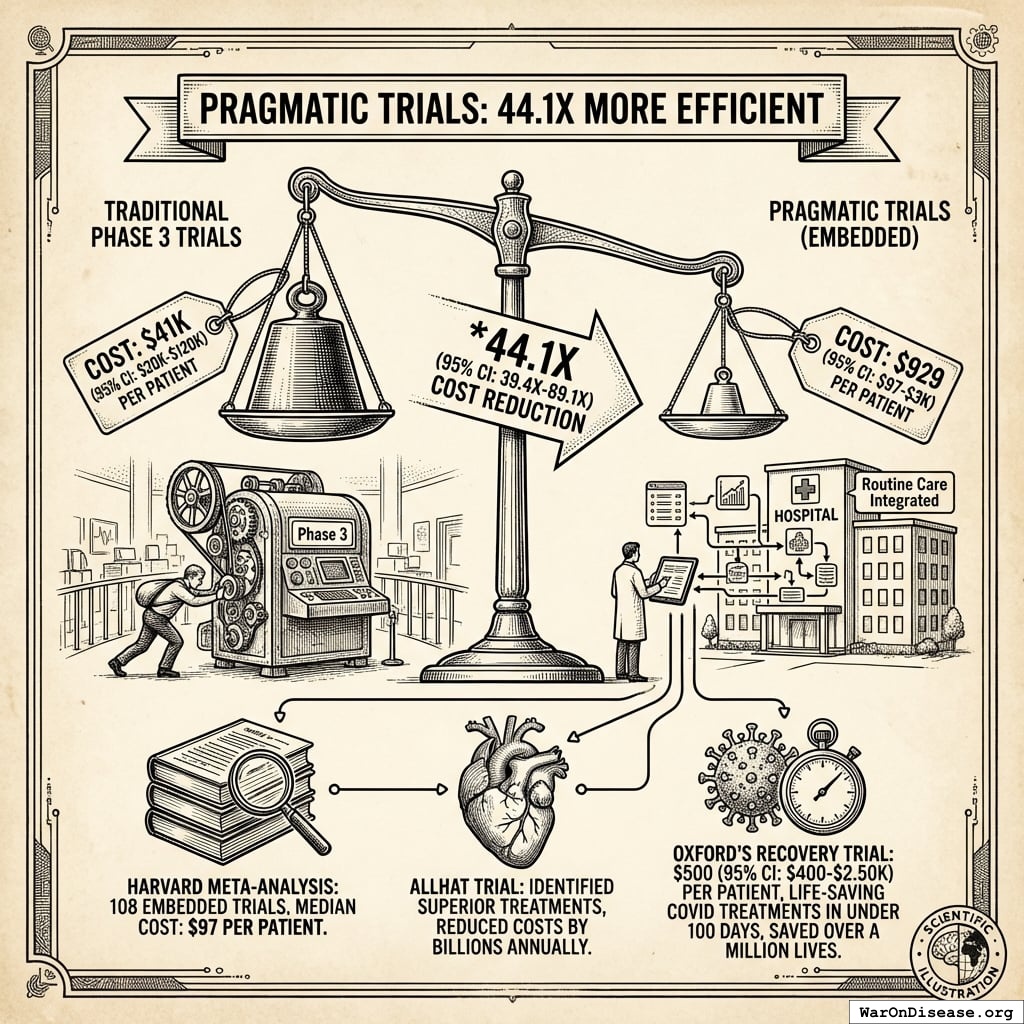
A Harvard meta-analysis of 108 embedded pragmatic trials found median costs of just $97 per patient4. The ALLHAT trial showed pragmatic designs can identify superior treatments and reduced healthcare costs by billions annually5. So the cheap way is also the better way. Happens more often than you’d think.
Oxford’s RECOVERY trial achieved $500 (95% CI: $400-$2,500). It found life-saving COVID treatments in under 100 days. It saved over a million lives6.
Humans Doing Smart Things (Accidentally): A Collection
That Time Humans Banned Landmines (Yes, Really)
What happened: A bunch of NGOs decided landmines were bad actually. They convinced 160 nations to sign a treaty banning them7 in 1997. Major military powers initially opposed it. The NGOs won anyway.
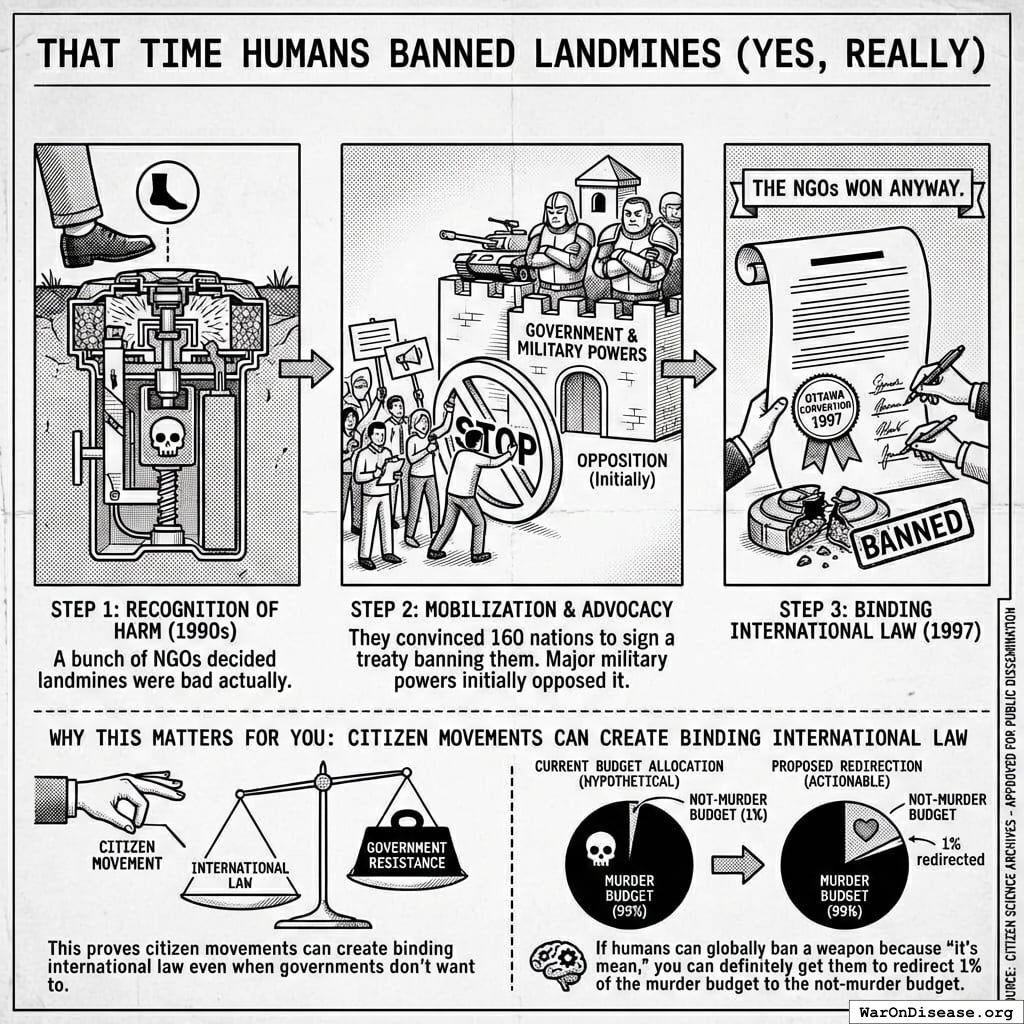
Why this matters for you: This proves citizen movements can create binding international law even when governments don’t want to. If humans can globally ban a weapon because “it’s mean,” you can definitely redirect 1% of the murder budget to the not-murder budget. And they did it with fax machines. Just pissed-off citizens with fax machines. You have the internet.
War Bonds: That Time Grandma Funded WW2
What happened: Governments needed money to fight Nazis. They sold “war bonds” (basically IOUs that paid interest) directly to regular people. Promise them profit + dead Nazis. Kill Nazis, earn 2.9%. Good deal. The U.S. raised $185 billion8 (trillions in today’s dollars9).
Why this matters for you: Your grandparents gave the government money to stop Hitler and got 2.9% returns. You’re offering 272% returns to stop cancer. VICTORY Incentive Alignment Bonds10 are the same thing except with better ROI and fewer Nazis (hopefully zero Nazis). Except instead of dead Nazis, you offer dead cancer cells.
The formula worked: mix moral incentives (patriotism) with financial self-interest (interest payments). You’re applying it to a different war: the one against your own mortality. When saving the world is profitable, people trip over each other to fund it.
The Global Fund (Proof That New Health Institutions Can Exist)
What happened: In 2002, the world created a new organization11 to pool billions for fighting AIDS, TB, and malaria. It bypassed traditional bureaucracies and just… worked. Saved an estimated 65 million lives12 (as of 2024). Bureaucrats everywhere were horrified.
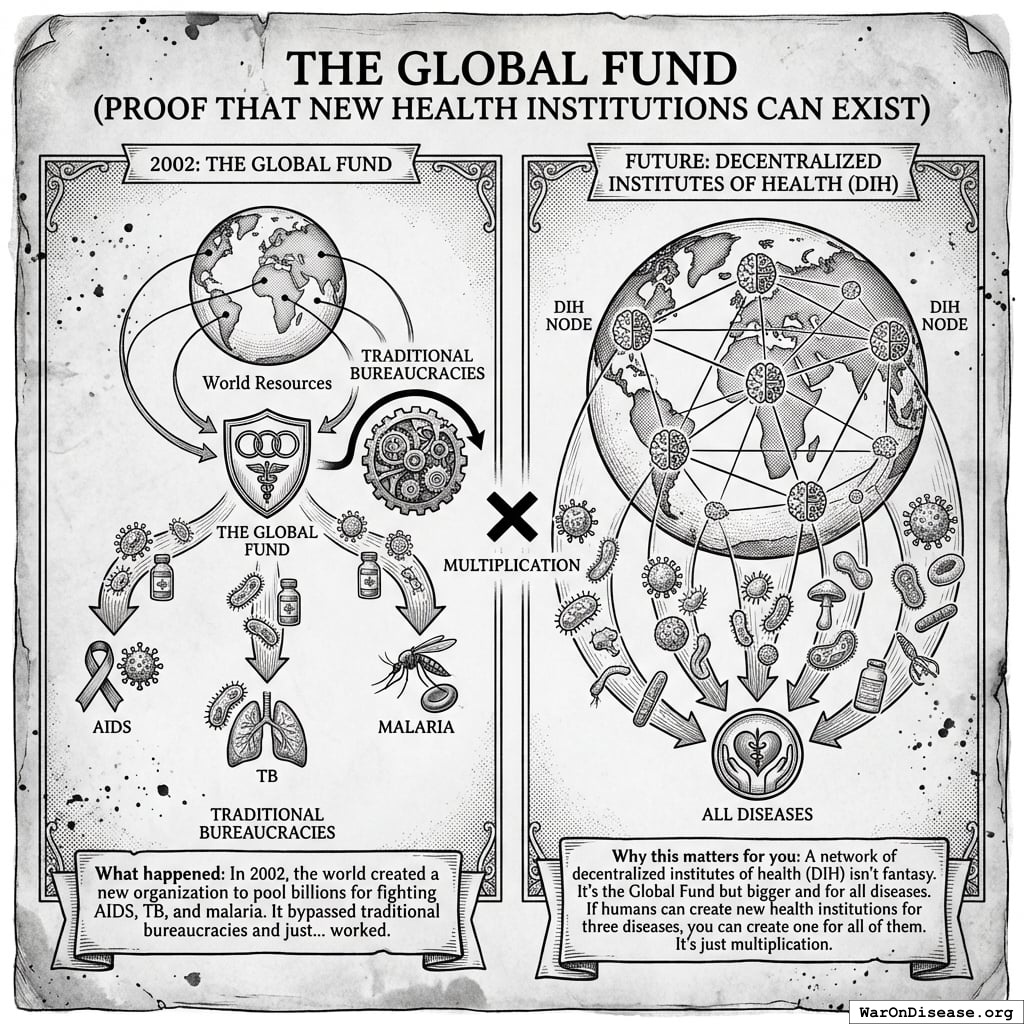
Why this matters for you: A network of Decentralized Institutes of Health (DIH) isn’t fantasy. It’s the Global Fund but bigger and for all diseases. If you can create new health institutions for three diseases, you can create one for all of them. It’s multiplication. You learned this when you were six.
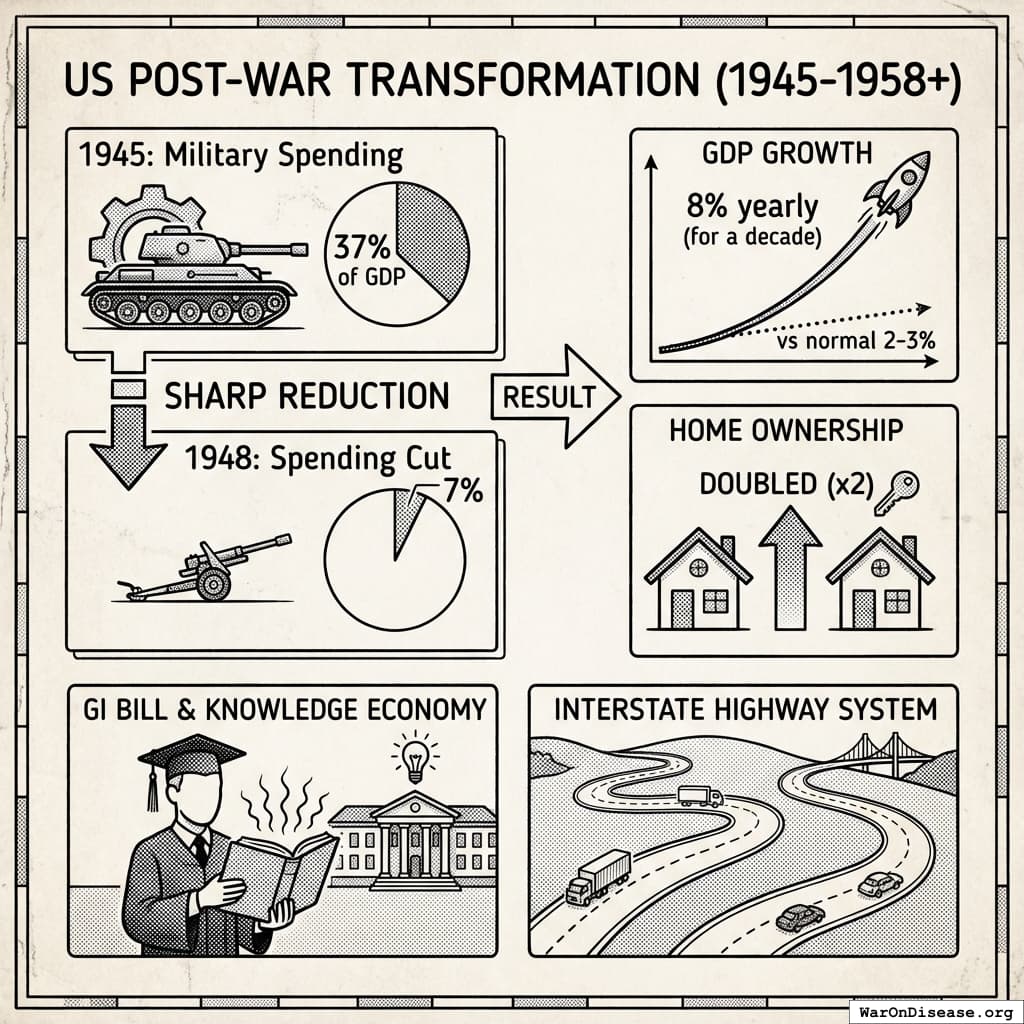
Post-WW2: That Time America Accidentally Discovered Peace Is Profitable
What happened: 1945: US military spending was 37% of GDP13 (we were very serious about the war thing). 1948: Cut to 7%. That’s a 30 percentage point drop. Not 1%. THIRTY.
The results: The greatest economic boom in human history:
- GDP growth: 8% yearly for a decade14 (vs normal 2-3%)
- Home ownership doubled15 (middle class explosion)
- GI Bill created modern knowledge economy
- Built the interstate highway system
Why this matters for you: You’re redirecting 1%. America cut 87.6% in constant dollars (from $1.42 trillion to $176 billion in today’s money) and got rich16. Today you spend 30.6x the pre-WW2 baseline. You proved you could cut 87.6% and thrive. Now you spend 30.6x the pre-war baseline and someone is asking for 1% back. I showed these numbers to a Wishonian economist and she assumed they were a typo. I showed them to a second economist and she assumed the first one was right. I showed them to a third and she asked if Earth was currently fighting 30 simultaneous world wars. I said no, just the one on terror, and it was making things worse. She asked me to stop talking about Earth because it was upsetting her.
The 1990s: When the Berlin Wall Fell and Wallets Exploded
What happened: Cold War ended. Military spending dropped from 6% of GDP to 3%. That’s roughly $50 billion a year redirected from pointing missiles at Russia to literally anything else.
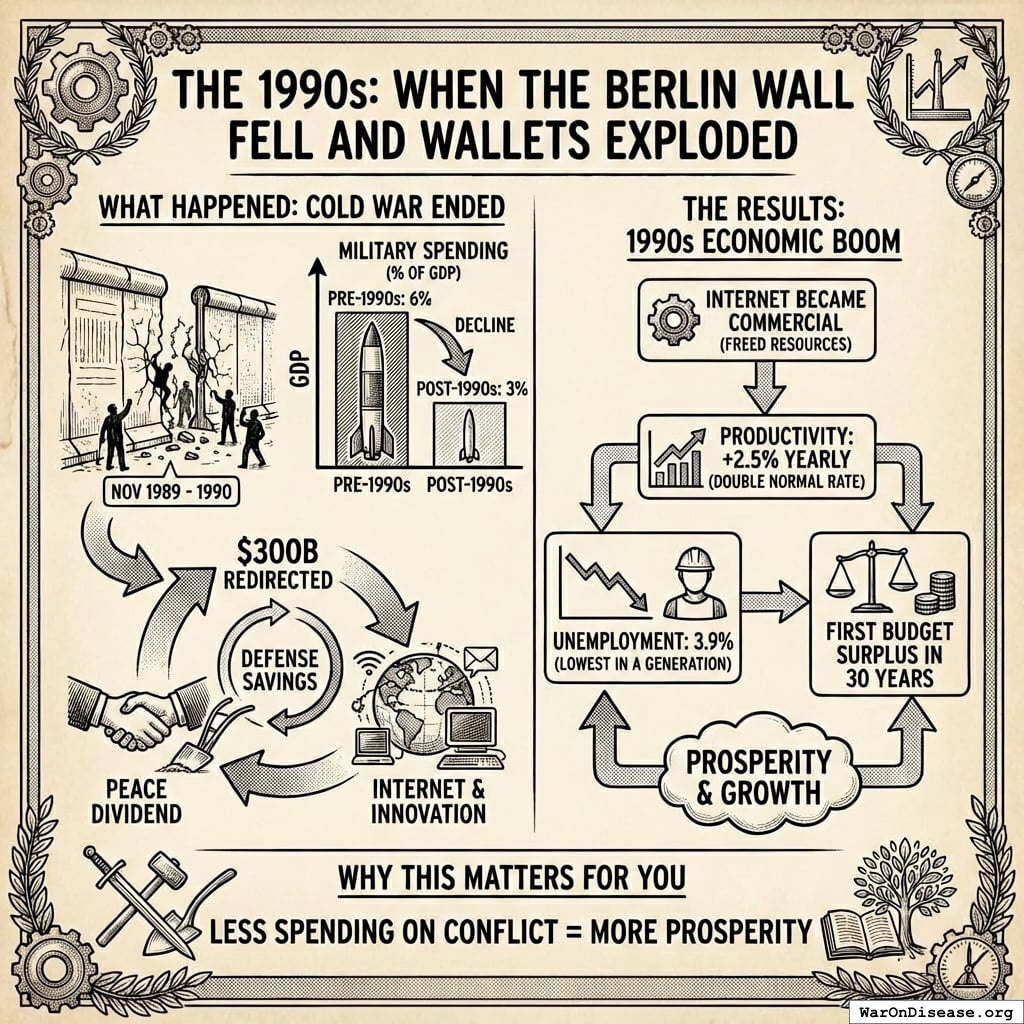
The results: The 1990s economic boom everyone remembers fondly:
- Internet became commercial (freed resources)
- First budget surplus in 30 years
- Unemployment: 3.9% (lowest in a generation)
- Productivity: +2.5% yearly (double the normal rate)
Why this matters for you: The pattern isn’t subtle. Every time you stop spending money on murder, prosperity appears like magic. It’s not magic. It’s arithmetic. You just keep forgetting the answer.
Switzerland: 200 Years of Not Shooting Anyone = Being Very Rich
Two world wars. Everyone else fought. Switzerland made chocolate.
What they have: Mountains, cows, and a complete lack of natural resources. They’re surrounded by countries that kept starting world wars. They have been neutral since 1815.
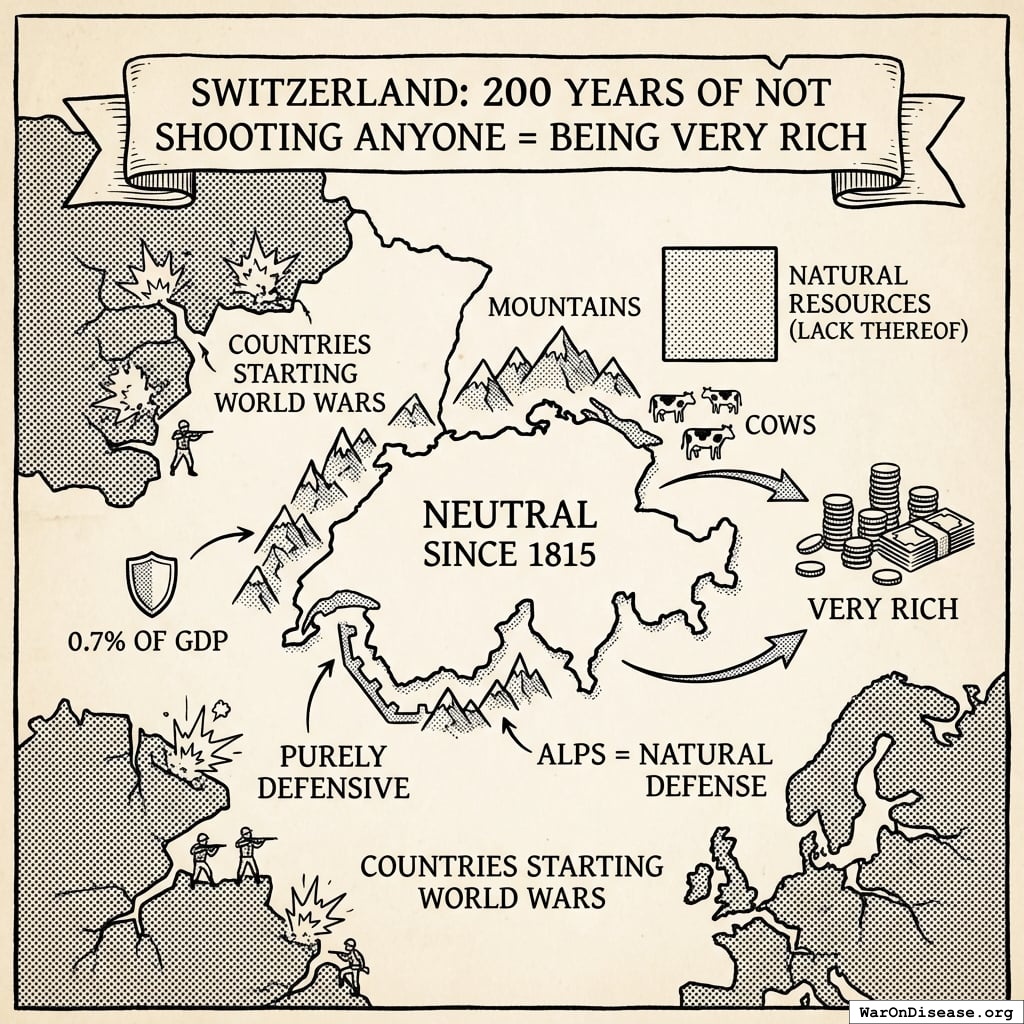
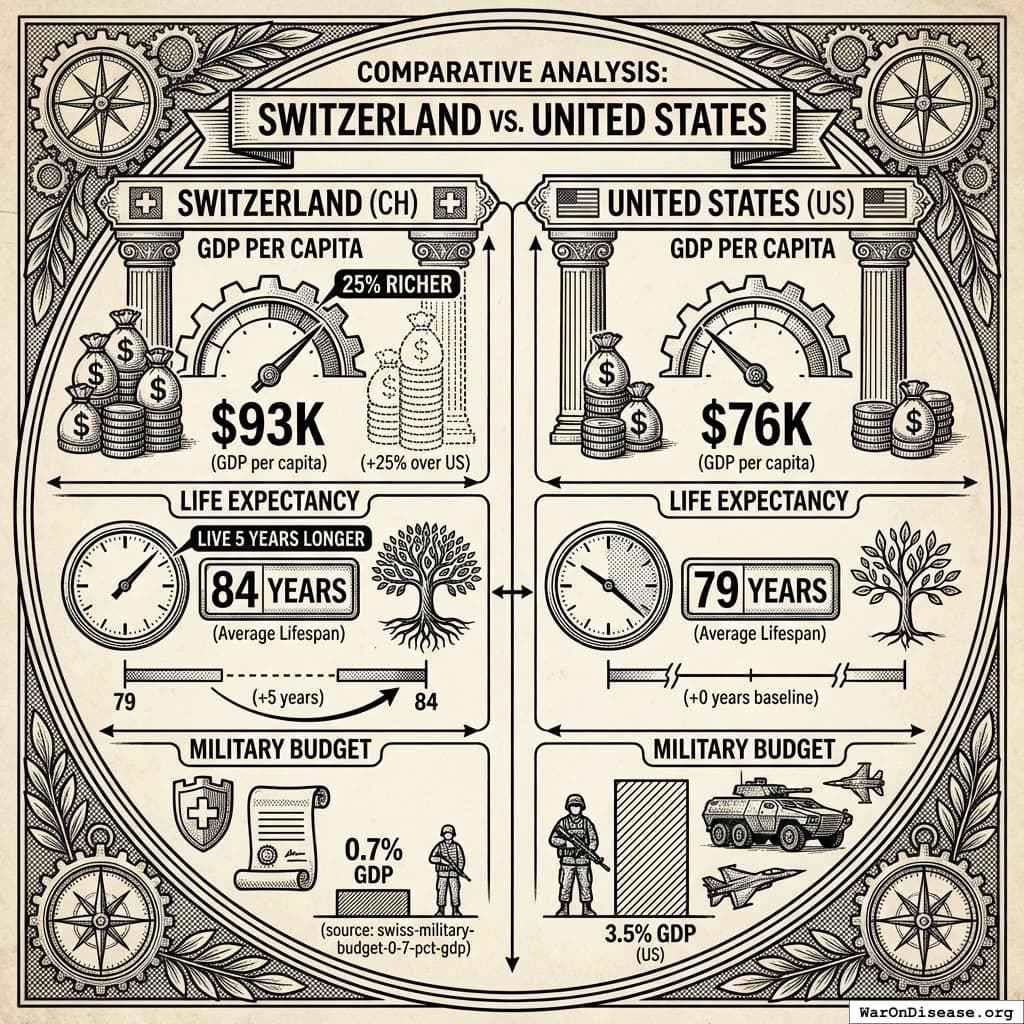
What they spend on military: 0.7% of GDP (source17) (purely defensive; they’re not invading anyone with those Alps) (US: 3.5%)
The results
- $93,000 GDP per capita18 (vs US $76K), 25% richer than Americans
- Universal healthcare, excellent quality, 12% of GDP (vs US 18%)
- Life expectancy: 84 years19 (vs US 79)
- Last invaded: 1798 (Napoleon succeeded, briefly; the Swiss waited him out, then went back to being Switzerland)
- Haven’t had a war death since 184720
The difference went to education, healthcare, and trains that run on time. (Americans: a “train that runs on time” is a train that arrives when it says it will. I know this sounds fictional.)
Why this matters for you: Peace dividends compound over centuries. Switzerland proves you don’t need oil, colonies, or weapons to get rich. Just stop wasting money on things that explode. They’ve been doing this for 200 years. You’re asking for a 1% start.
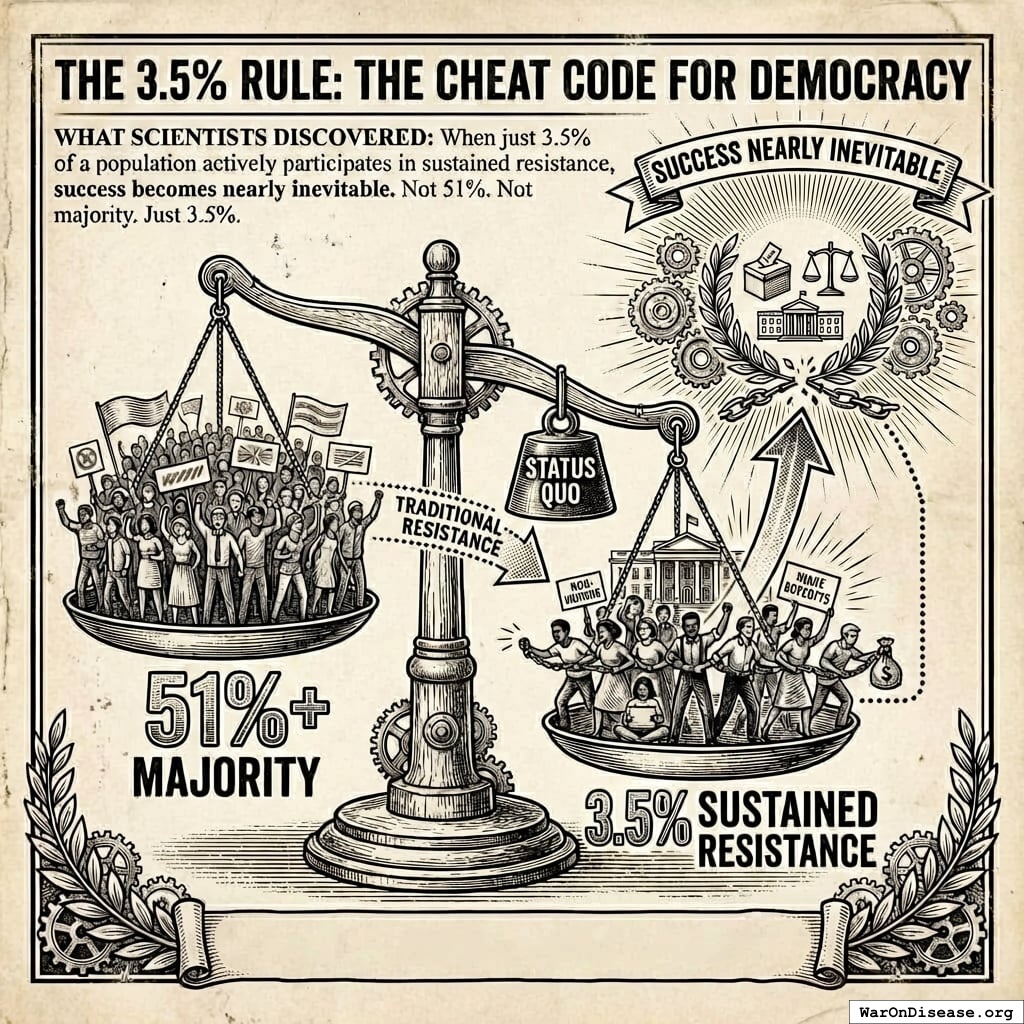
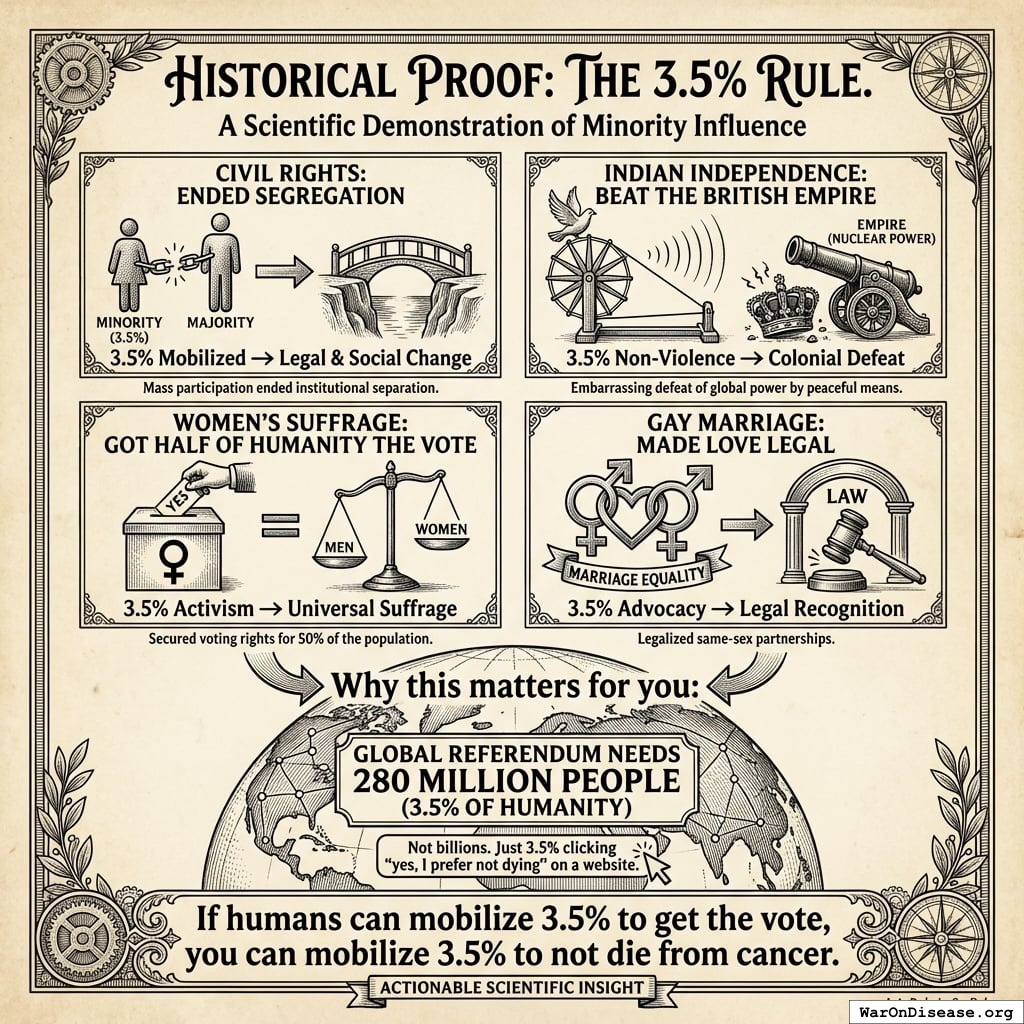
The 3.5% (95% CI: 1%-10%) Rule: The Cheat Code for Democracy
What scientists discovered: When just 3.5% (95% CI: 1%-10%) of a population actively participates in sustained resistance, the math says the movement wins. Not 51%. Not a majority. Just 3.5% (95% CI: 1%-10%).
Historical proof
- Civil rights: 3.5% (95% CI: 1%-10%) ended segregation
- Indian independence: 3.5% (95% CI: 1%-10%) beat the British Empire (nuclear power defeated by non-violence, embarrassing)
- Women’s suffrage: 3.5% (95% CI: 1%-10%) got half of humanity the vote
- Gay marriage: 3.5% (95% CI: 1%-10%) made love legal
Why this matters for you: One person in every classroom. One family on every block. That’s 3.5% (95% CI: 1%-10%). The Global Referendum aims at a verified majority of humanity, but the Chenoweth benchmark says political pressure can become decisive much earlier. The internet reaches 5 billion21. If humans can mobilize 3.5% (95% CI: 1%-10%) to get the vote, you can mobilize 3.5% (95% CI: 1%-10%) to not die from cancer. Math says it wins.
You Have Advantages They Didn’t
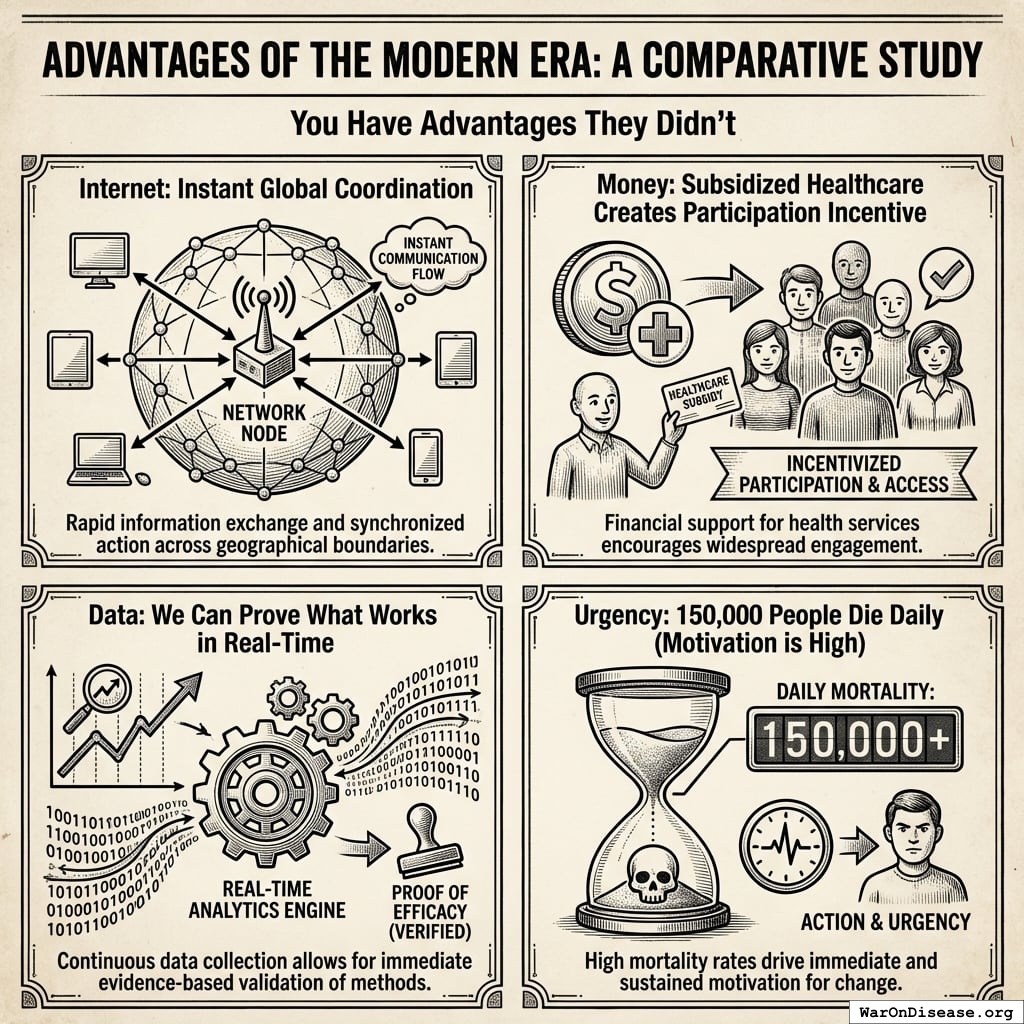
- Internet: Instant global coordination
- Money: Subsidized healthcare creates participation incentive
- Data: You can prove what works in real-time
- Urgency: 150,000 people die daily22 (motivation is high)
When Good Intentions Met Reality (And Lost)
Failures teach more than successes. Here’s every mistake past movements made, so you can make exciting new ones instead.
Eisenhower’s Warning: A 5-Star General Tried to Tell You
In 1961, President Dwight D. Eisenhower used his farewell address to warn you about something terrifying. He was a 5-star general. Supreme Allied Commander. The guy who beat the Nazis. Not exactly a hippie.
The warning: “We must guard against the military-industrial complex.”
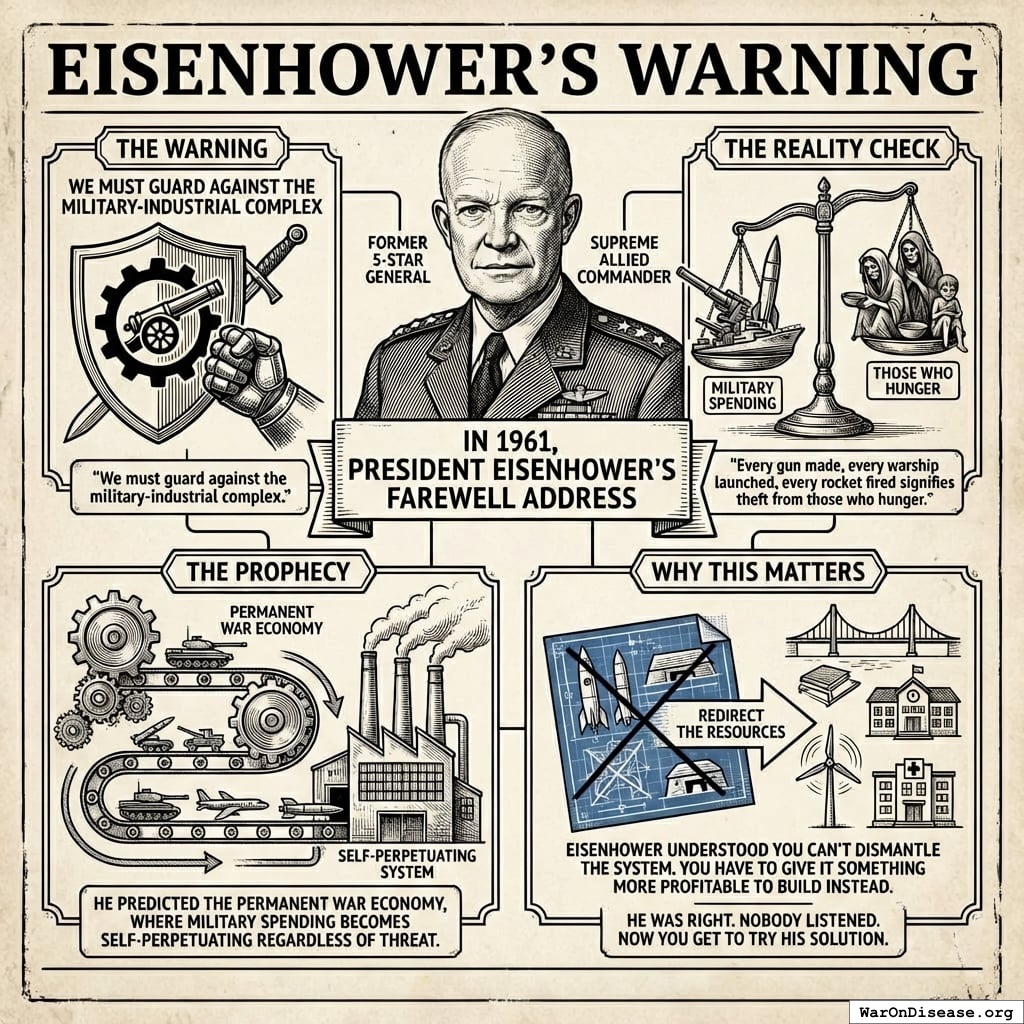
The reality check: “Every gun made, every warship launched, every rocket fired signifies theft from those who hunger.”
The prophecy: He predicted the permanent war economy you’re currently living in. Military spending becomes self-perpetuating regardless of whether anyone’s actually threatening you.
Why this matters: Eisenhower understood you can’t dismantle the system. You have to give it something more profitable to build. He was right. Nobody listened. You never do. Now you get to try his solution: redirect the resources.
The Nuclear Freeze Movement: Millions of People, Zero Results
What happened: In the 1980s, a massive global movement23 tried to freeze nuclear weapons production. Millions of protesters. Enormous popular support. Good vibes everywhere.
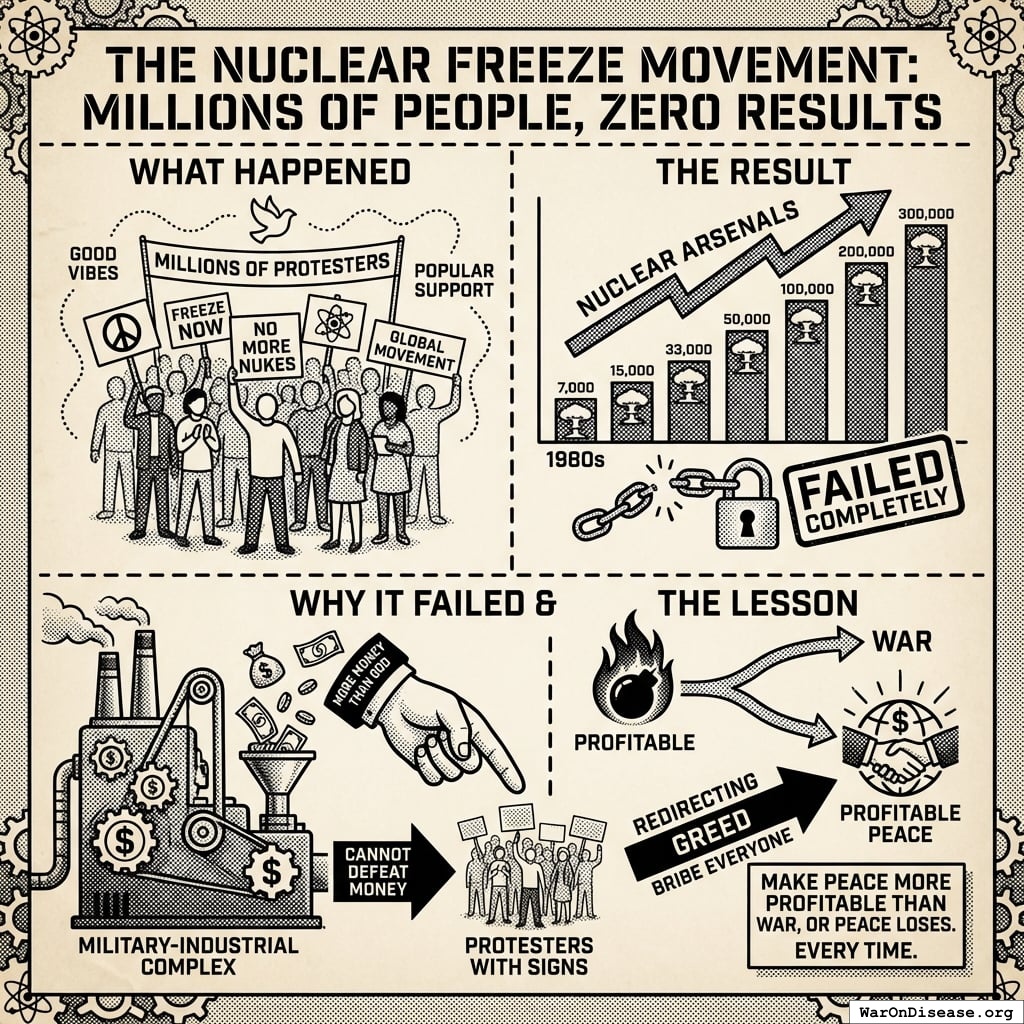
The result: Failed completely. Nuclear arsenals kept growing. The signs were very moving, though.
Why it failed: You cannot defeat money with good intentions. The military-industrial complex has more money than God, and protesters have signs. This is why a 1% Treaty24 25 doesn’t ask nicely; it bribes everyone into compliance. You’re not fighting greed. You’re redirecting it. Morality is lovely. Capitalism is faster.
The lesson: Make peace more profitable than war, or peace loses. Every single time. No exceptions. I checked.
Occupy Wall Street: When “We’re Angry” Isn’t a Strategy
What happened: In 2011, thousands occupied parks26 to protest economic inequality. They changed the conversation! They raised awareness! They accomplished nothing permanent!
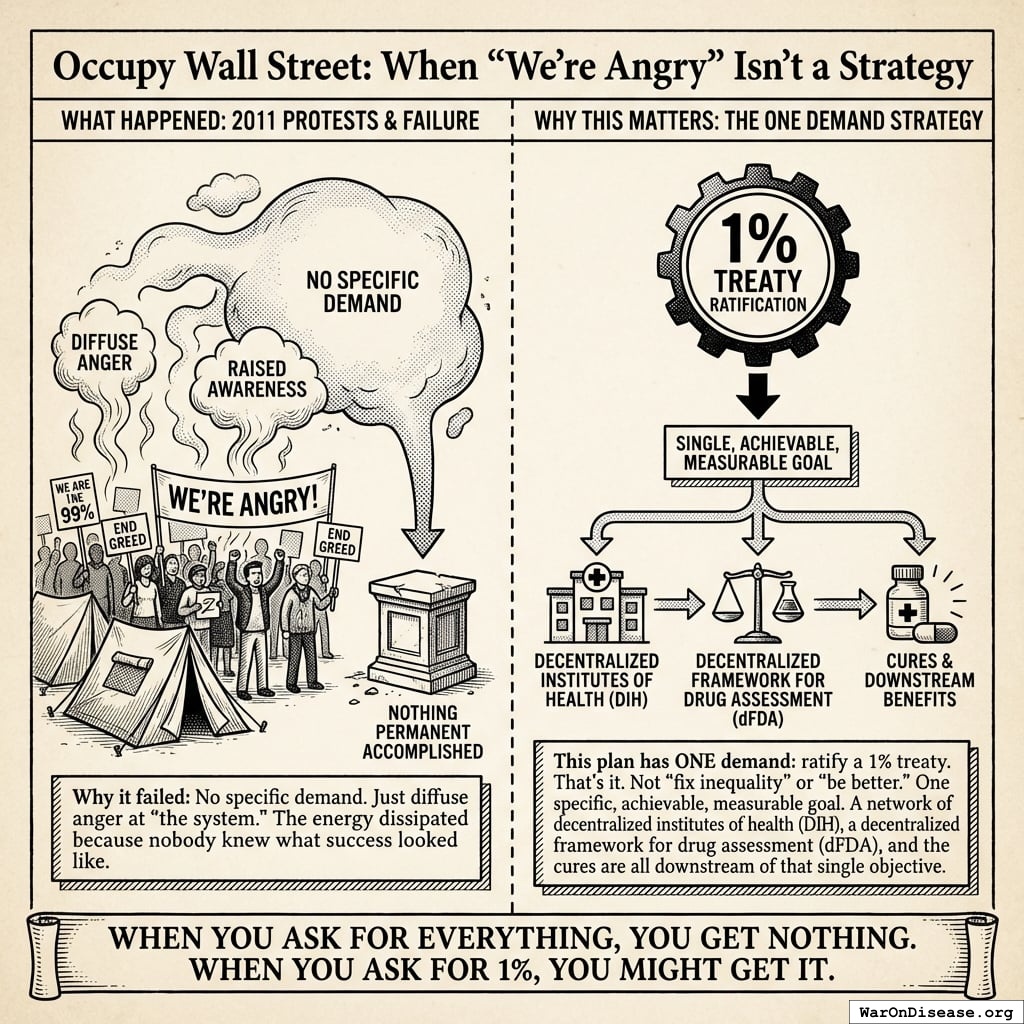
Why it failed: No specific demand. Just diffuse anger at “the system.” The energy dissipated because nobody knew what success looked like.
Why this matters: This plan has ONE demand: ratify a 1% Treaty. That’s it. Not “fix inequality” or “be better.” One specific, achievable, measurable goal. You want to change one number from 0 to 1. Ambition is inspiring, but subtraction is effective. A network of Decentralized Institutes of Health (DIH), a decentralized FDA27,28, and the cures are all downstream of that single objective.
When you ask for everything, you get nothing. When you ask for 1%, you might get it.
On How Rich People Made Money Doing Crazy Things (And Why That Matters)
You need investment terms that don’t sound insane to people with money. Fortunately, rich people have always done insane things with money. You just need to make this the least insane option.
On The Time Junk Bonds Saved Capitalism
Michael Milken & High-Yield (“Junk”) Bonds
In the 1980s, a guy named Michael Milken figured out something revolutionary: if you offer people high enough returns, they’ll invest in almost anything29.
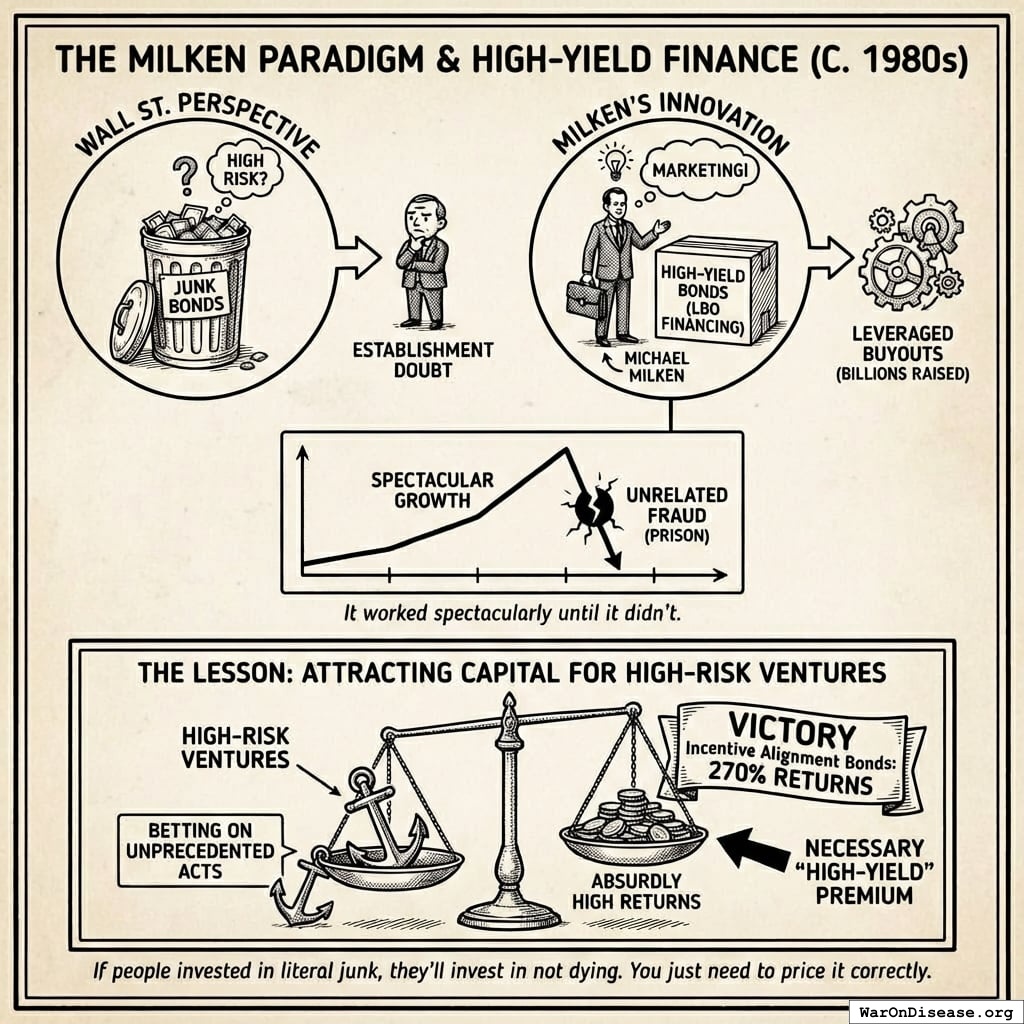
Wall Street called these “junk bonds” because they were trash. Milken called them “high-yield bonds” because marketing. He financed leveraged buyouts that the establishment said were impossible. He raised billions.
The establishment said it would never work. It worked spectacularly until it didn’t (Milken went to prison for unrelated fraud, which is how you know it was successful).
The Lesson: To attract capital for high-risk ventures, you must offer enough upside to compensate for the risk. VICTORY Incentive Alignment Bonds model 272% returns if the treaty passes. This is not a promise. It is the “high-yield” premium necessary to compensate for betting on the unprecedented act of governments doing something smart.
If people invested in literal junk, they’ll invest in not dying. You just need to price it correctly.
On The Time George Soros Broke England
George Soros & The Quantum Fund
In 1992, George Soros risked $10 billion betting that the UK would have to leave the European Exchange Rate Mechanism30.
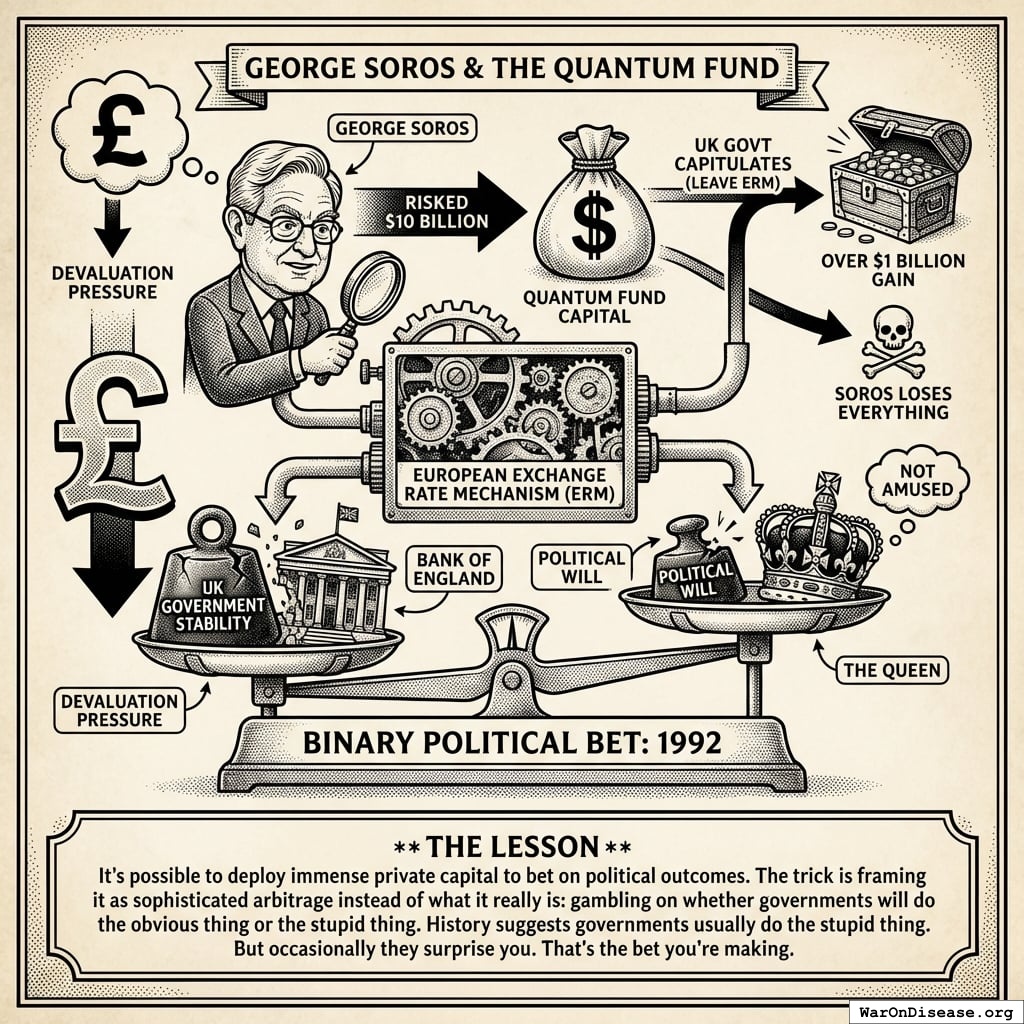
This was a binary political bet: Either the UK government capitulates, or Soros loses everything.
He won. Made over $1 billion in a single day. The Bank of England lost. The Queen was reportedly not amused. (She had her own money problems, being the Queen.)
The Lesson: You can deploy immense private capital to bet on political outcomes. The trick is framing it as sophisticated arbitrage. What it really is: gambling on whether governments will do the obvious thing or the stupid thing.
History suggests governments usually do the stupid thing. But occasionally, when you make the smart thing profitable enough, they surprise you. That’s the bet.
On When Smart People Lost All Their Money (The Cautionary Tales)
Long-Term Capital Management (LTCM): When Nobel Laureates Get Humbled
In 1998, a hedge fund run by actual Nobel Prize winners collapsed. It required a $3.6 billion bailout31.
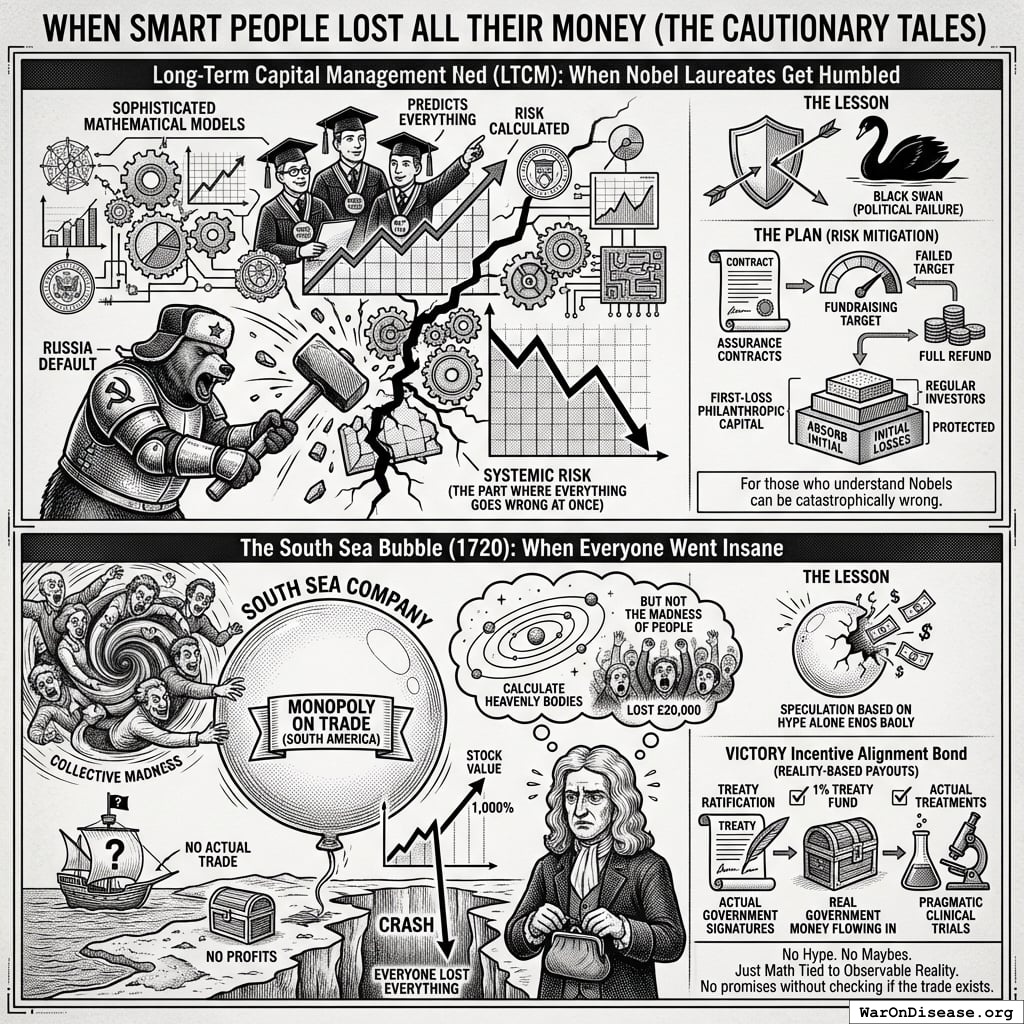
Their crime? Building sophisticated mathematical models that accounted for everything except the part where Russia just… defaults. Whoops.
These were the smartest people in finance. Nobels. PhDs from MIT. Models that predicted everything except reality, which is the one thing models need to predict.
The Lesson: Never underestimate systemic risk, also known as “the part where everything goes wrong at once.”
For this project, the “black swan” is complete political failure. Everyone says no, the treaty dies, and you look stupid.
This is why the plan includes:
- Assurance contracts: Miss the fundraising target? Everyone gets their money back. No partial failures allowed.
- First-loss philanthropic capital: Rich altruists absorb the initial losses so regular investors don’t get wiped out if things go sideways.
It’s risk mitigation for people who understand that Nobel laureates can still be catastrophically wrong.
The South Sea Bubble (1720): When Everyone Went Insane
In 1720, people in England went collectively mad. They invested in a company that promised a monopoly on trade with South America32.
Neat! Except the company had almost no actual trade. And no profits. And no business plan beyond “tell people we’re going to be really rich.”
The stock went up 1,000%. Then it crashed. Everyone lost everything. Isaac Newton lost £20,000 (in today’s money, “a lot”). He famously said “I can calculate the motion of heavenly bodies, but not the madness of people.”
The Lesson: Speculation based on hype alone ends badly.
This is why VICTORY Incentive Alignment Bond payouts are contractually tied to real, verifiable events:
- Treaty ratification (actual government signatures)
- Real government money flowing into the 1% Treaty Fund
- Actual treatments being tested in pragmatic clinical trials
No hype. No maybes. No “we’re going to be really rich someday.” Just math tied to observable reality.
If you’re going to lose your money, at least it won’t be because the plan promised a monopoly on South American trade without checking if South America exists.
The Ultimate Failsafe: The Worst-Case Scenario is Still a Win
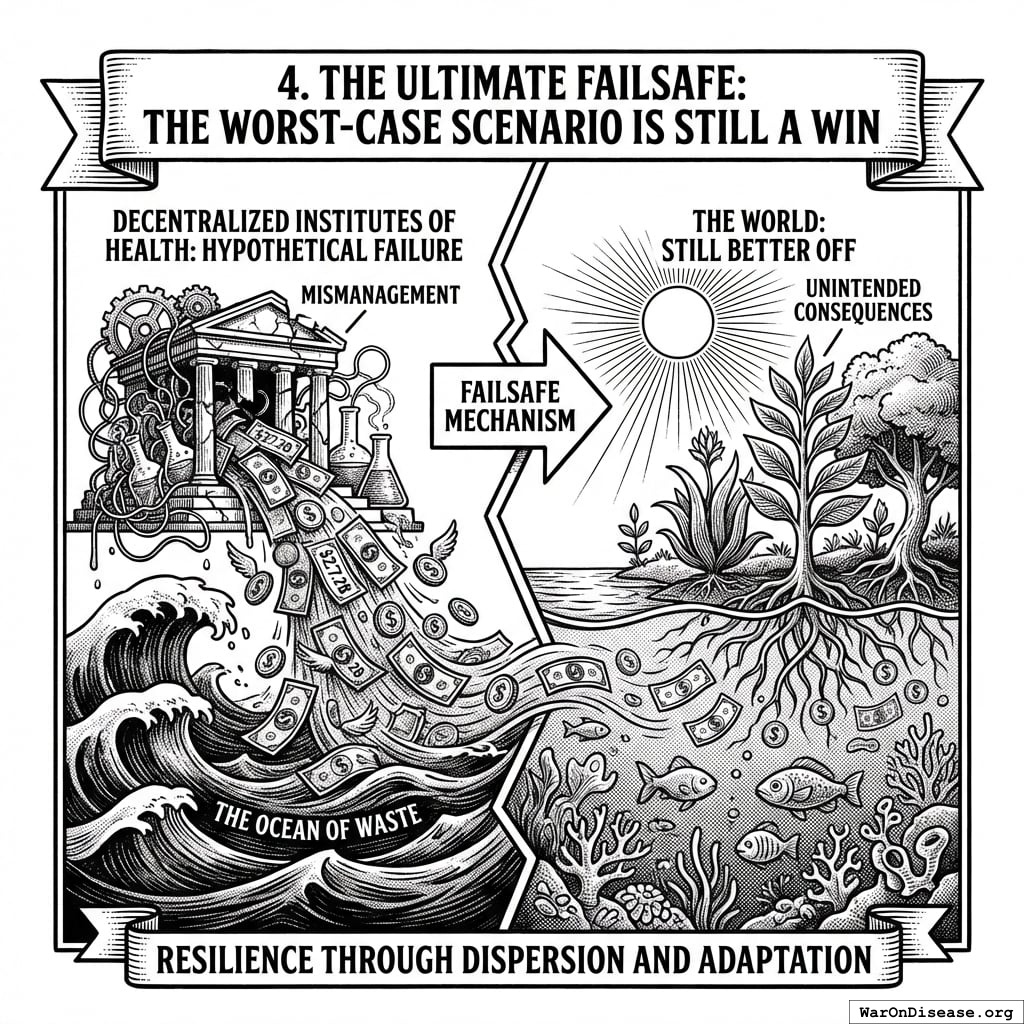
Imagine every dollar of the $27.2 billion is mismanaged, wasted, or dumped into the ocean. The world would still be better off, because you’d still have a 1% reduction in the global capacity for organized violence. Fewer bombs, fewer missiles, fewer AI-powered weapons systems.
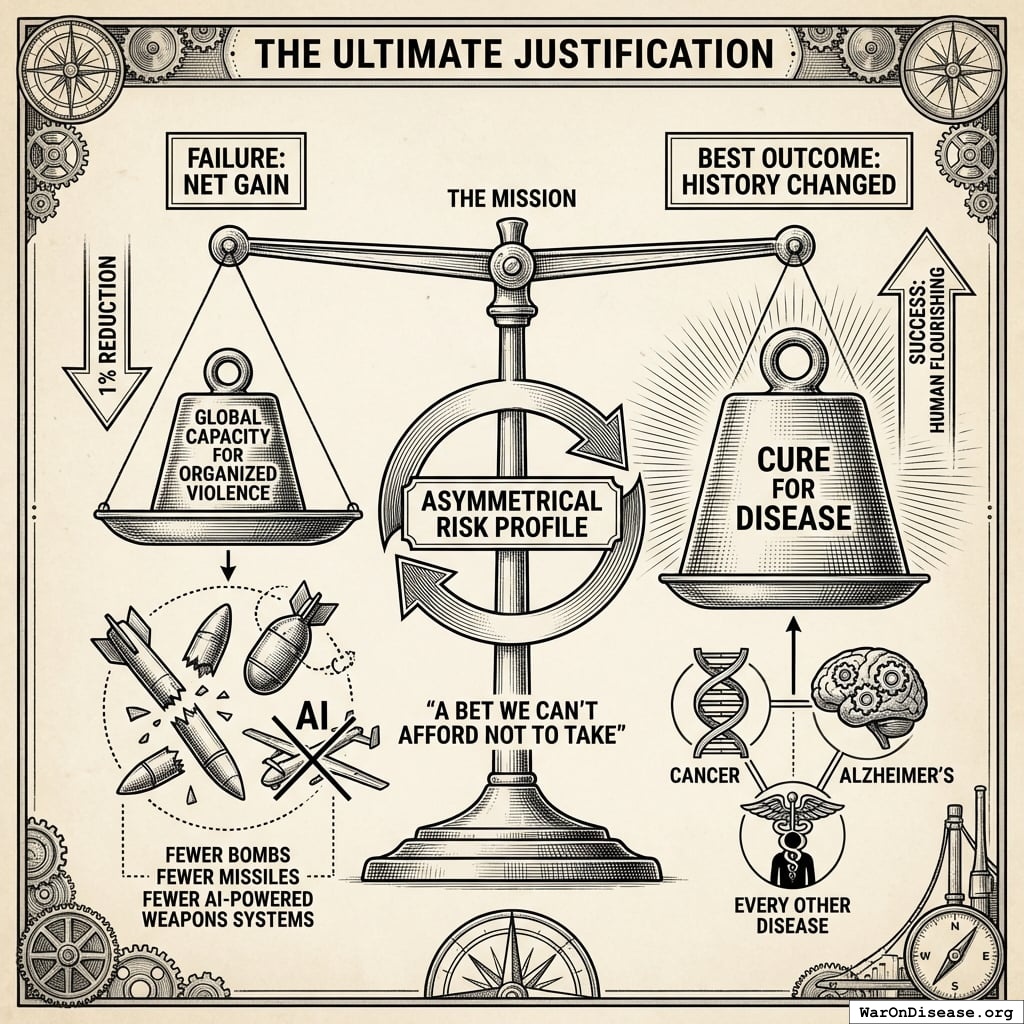
The worst outcome is still a net gain. The best outcome cures your cancer and your grandmother’s Alzheimer’s. Failure is still a victory. Success changes the course of human history. It’s a bet you can’t afford not to take.
How Your decentralized FDA Would Compare to History’s Best Health Interventions
The best health investments in history made obscene amounts of money. Smallpox eradication returned hundreds of dollars for every dollar spent. Childhood vaccines, clean water, and tobacco control did similar things. A decentralized FDA projects even higher returns than any of them: 7.53 million (90% CI: 2.96 million-15.1 million) to 11.
| Intervention | ROI (per $1) | Cost per QALY | QALYs per $1M |
|---|---|---|---|
| Decentralized drug assessment | 7.53 million (90% CI: 2.96 million-15.1 million):1 | Dominant (cost-saving) | 5,000-90,000+ |
| Smallpox Eradication | 159:1 to 400:133 | Dominant | 10,000+ |
| Childhood Vaccination (US) | 10:1 to 16:134 | Dominant | 1,000-10,000 |
| Clean Water & Sanitation | 4:1 to 21:135 | Dominant | 1,000-10,000 |
| Tobacco Control | 20:1 to 1,057:136 | Dominant | 1,000-10,000 |
That includes smallpox eradication, which is widely considered the best thing humanity ever did on purpose. The difference: this accelerates the entire research pipeline rather than targeting one disease. It’s the difference between fixing one pothole and repaving the road.
Total societal benefit including lives saved and DALYs averted, not R&D savings alone. R&D-only ROI: 439 (90% CI: 321-600):1.↩︎