NIH Fails to Institute Health
war-on-disease, 1-percent-treaty, medical-research, public-health, peace-dividend, decentralized-trials, dfda, dih, victory-bonds, health-economics, cost-benefit-analysis, clinical-trials, drug-development, regulatory-reform, military-spending, peace-economics, decentralized-governance, wishocracy, blockchain-governance, impact-investing
A Tale of Two Trials
The difference between efficient and inefficient trial design isn’t theoretical. Your species accidentally ran a controlled experiment on itself during COVID. Two countries. Same disease. One spent like it was trying to cure death. The other actually did.
RECOVERY Trial (UK Approach)
The British spent $20 million (95% CI: $15 million-$25 million) over 6 months1. Enrolled 48,000 patients2. Found multiple effective treatments, including dexamethasone3, a steroid that had been available since 1957. It reduced COVID deaths by one-third and saved over 1 million lives (95% CI: 500 thousand lives-2 million lives). Cost per patient: $500 (95% CI: $400-$2,500).
RECOVER Initiative (NIH Approach)
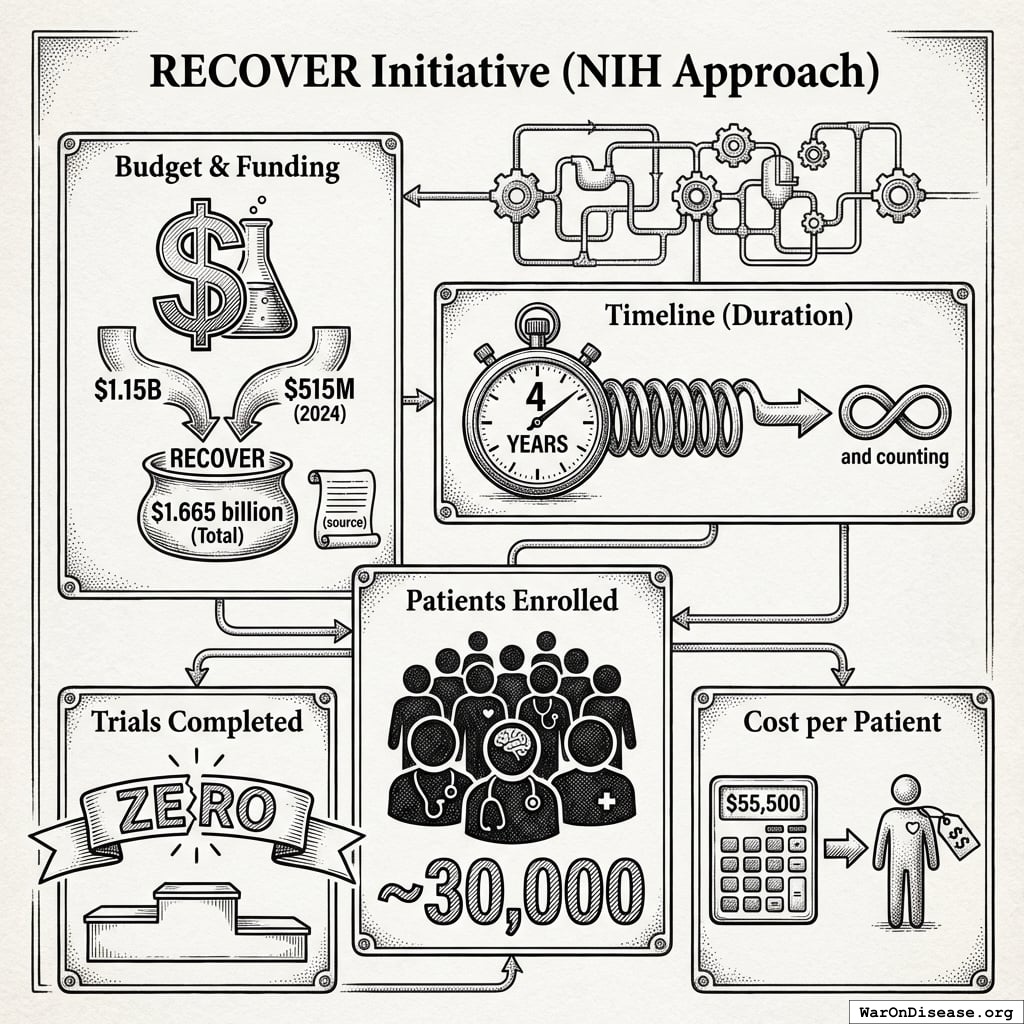
Nearly 600 potential treatments for Long COVID have been identified. At RECOVERY trial efficiency ($500 (95% CI: $400-$2,500)/patient, 5,500 patients per treatment), $1.665 billion buys 600 completed trials. The NIH received $1.665 billion4. Over 4 years5, they completed zero5.
Only 15% of the budget went to clinical trials; the rest funded observational studies, data management, and administration6. Of those enrolled, roughly 11% were in interventional trials that actually tested treatments7. The other 89% were in observational studies, which is the medical equivalent of taking attendance at a funeral.
Cost per interventional patient: $504,500, the price of a house. Nobody got a house and nobody got cured. They got observed. Expensively. The observation was very thorough. It has been peer-reviewed. The peers also observed the patients. The patients are still sick, but they are the most well-documented sick people in the history of sickness.
It gets worse. The treatments RECOVER eventually selected were called “truly absurd” by patient advocates8. Low-dose naltrexone, the number one patient-requested treatment (generic, cheap, already showing results in independent studies), was excluded for over two years before finally being added in round two. David Putrino, director of rehabilitation innovation at Mount Sinai, called the spending “largely wasted”8. Researchers outside RECOVER had lists of drugs to test. The system ignored them.
Six hundred trials were possible with that money. Zero were completed. That is the difference between a system that tests treatments and a system that tests patience.
The Translation Crisis: All Theory, No Medicine
Basic research is not the problem. Five decades of NIH-funded science built one of the largest drug candidate pipelines in history. Researchers identified targets, characterized molecules, established safety profiles. That work was essential, and it succeeded. The problem is what happens after the discoveries are made: almost nothing. The pipeline is full. The exit is closed.
COVID made this visible for the first time, but it is the institution’s default setting; the way you don’t notice a leaking roof until it rains inside. It has been raining inside for 50 years. The NIH has published several papers on indoor rain.
There are over 20,000 FDA-approved drugs that are known to be safe in humans. Thousands more clinically-tested candidates are gathering dust9, including over 3,000 marketed drugs that could be repurposed for diseases nobody’s tried them on. In Alzheimer’s alone, researchers have identified hundreds of safe drugs worth testing, yet less than 10% are in active trials10. And the number of clinical trials available for your grandma in St. Louis? Zero. There’s a warehouse of safe molecules that have never been systematically tested for new uses. The warehouse is full. The testing facility is closed for a team-building retreat.
This is not hypothetical. In 2023, researchers published case reports of severe long COVID patients experiencing complete remission within days of receiving monoclonal antibody infusions11. Previously bedridden patients returned to normal lives, with remissions sustained over two years. The U.S. government had spent over $5 billion purchasing millions of doses of these same antibodies for acute COVID12. When Omicron rendered them ineffective for acute treatment, millions of unused doses sat in refrigerated storage. Long COVID patients, having read the case reports, begged for access. They organized petitions. They cited the remissions. The government said no. The doses were authorized for acute COVID only, and the authorization had been revoked because they didn’t work for acute COVID, which meant they could not be given to anyone, for anything, ever. The antibodies matched the original variants; the long COVID patients had been infected by the original variants. Nobody tested this. Nobody ran trials. Nobody repurposed the stockpile. The first formal Phase 2 trial of monoclonal antibodies for long COVID is scheduled for mid-2026, four years after the doses were available and several years after they expired.
Five billion dollars of medicine. Millions of doses. Patients who wanted them. Case reports showing they worked. The doses expired. The patients didn’t; they just kept being sick. Your government threw away the cure and kept the disease. There is a word for this. It is considered a slur against the competence of your entire species, so I will simply note that the word exists and move on.
Then there’s metformin. A phase 3 RCT (COVID-OUT) showed it reduces long COVID incidence by 41%13. It costs $4 a month. It has been generic for decades. It is globally available. The NIH guideline response: “insufficient evidence to recommend for or against”14. Long COVID costs $170 billion a year. The $4 pill that cuts it by 41% has no corporate sponsor, because nobody profits from a generic. This is the entire chapter in one sentence.
To appreciate the scale: long COVID costs the U.S. an estimated $170 billion annually in lost wages alone15, with roughly 17 million Americans currently affected. A RECOVERY-style pragmatic trial would have cost approximately $24 million and could have produced results in months. Instead, your government spent $5 billion buying the medicine and is now paying $170 billion a year in economic damage from the disease it didn’t bother to treat. The ratio of what you’re losing to what the trial would have cost is 7,083 to 1.
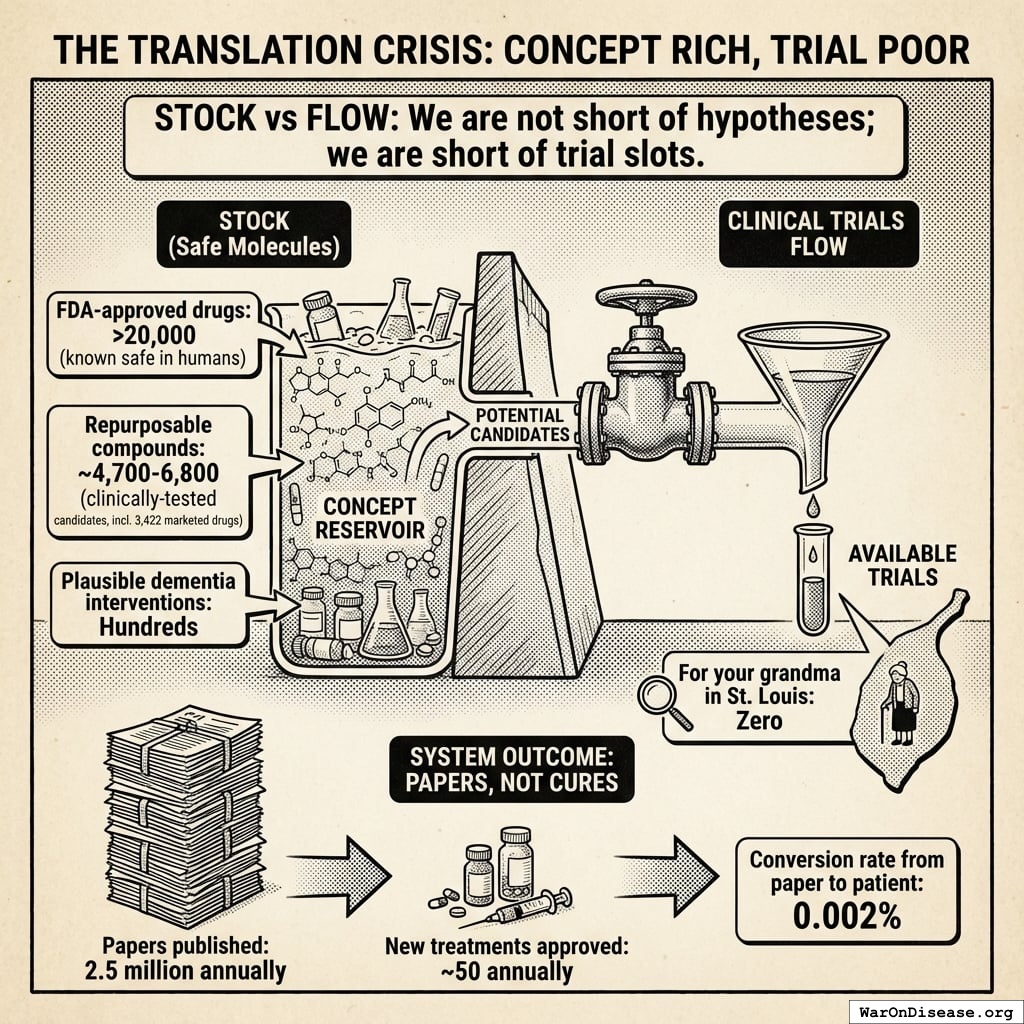
The NIH is, by its own metrics, a publishing house that occasionally dabbles in medicine. It publishes 2.5 million funded papers annually16. It produces approximately 50 new drug approvals annually17. That’s a conversion rate from paper to patient of 0.002%. For every 50,000 papers, one drug reaches a human. The rest become citations in other papers, which become citations in other papers, in an infinite loop of academics reading each other’s homework. Your species calls this “research.” A more accurate term is “knowledge ouroboros.” It looks productive from the inside. From the outside, it’s a snake eating its own tail and writing a paper about the nutritional content.
Plenty of Knowledge. No Translation.
About 5% of patients have participated in clinical trials18. About 44.8% (95% CI: 40%-50%) would participate if invited19. About 9-11% have ever been invited19. Nearly half of all patients would join a trial if asked. Almost nobody asks. Your species has a room full of volunteers holding their hands up, and a system that looked at the room and decided to study the clipboard instead. The clipboard is very well-studied. It has been studied for decades. Multiple papers have been written about the clipboard. One of them won an award. The volunteers are still holding their hands up. Some of them have died. This has been noted on the clipboard.
Understanding disease and testing treatments in humans are completely different activities. One requires microscopes. The other requires giving people medicine and seeing if they stop dying. In 1970, spending heavily on microscopes made sense; you didn’t know enough to test intelligently. In 2025, after 2.5 million papers a year for five decades, the ratio should have shifted. It didn’t. The NIH chose microscopes in 1970 and has not reconsidered since, which is the institutional equivalent of still crawling because you learned to crawl before you learned to walk.
The Allocation Problem
Your National Institutes of Health has the word “Health” in its name and an annual budget of $47 billion (95% CI: $45 billion-$50 billion). 55 million of you die annually from disease20. You would think those two facts would be related. They are not.
Of $247 billion the NIH spent over a decade, exactly 3.3% (95% CI: 2%-5%) went to testing which of the thousands of known-safe treatments actually work in humans21. The other 96.7% funded understanding disease mechanisms, translating discoveries toward (but never into) clinical use, training scientists, observational programs that spend billions watching disease without treating it, and a side quest engineering bat viruses, which is called “research” the way watching someone drown from a boat is called “lifeguarding.”
Basic research is not the problem. Understanding disease is how you find candidates to test. The problem is that after 50 years and a trillion dollars, the ratio hasn’t moved. The marginal value of the 85th cent on basic research is near zero when you’re spending 3 cents on the only activity that turns research into medicine. You don’t have a knowledge deficit. You have an allocation deficit.
3.3% (95% CI: 2%-5%) on trials might be defensible if the testing queue were empty. It isn’t. There are roughly 9,500 compounds (95% CI: 7,000 compounds-12,000 compounds) with established safety profiles, and 99.7% (90% CI: 99%-100%) of their possible disease applications have never been tested. Most are off-patent, which means no pharmaceutical company will fund trials for them, which means the NIH is the only entity that could, which means it is specifically choosing not to do the one thing only it can do. The pipeline is overflowing with candidates. The bottleneck is trials. The drugs are sitting there. Safe. Ready. Unpatentable. They’ve been waiting for decades. Some of them have been waiting longer than most of your scientists have been alive.
It’s like spending 96.7% of your grocery budget on cookbooks and 3.3% (95% CI: 2%-5%) on food, then wondering why you’re starving. Except the cookbooks are very prestigious and the starving people aren’t on the committee that decides whether to buy more cookbooks.
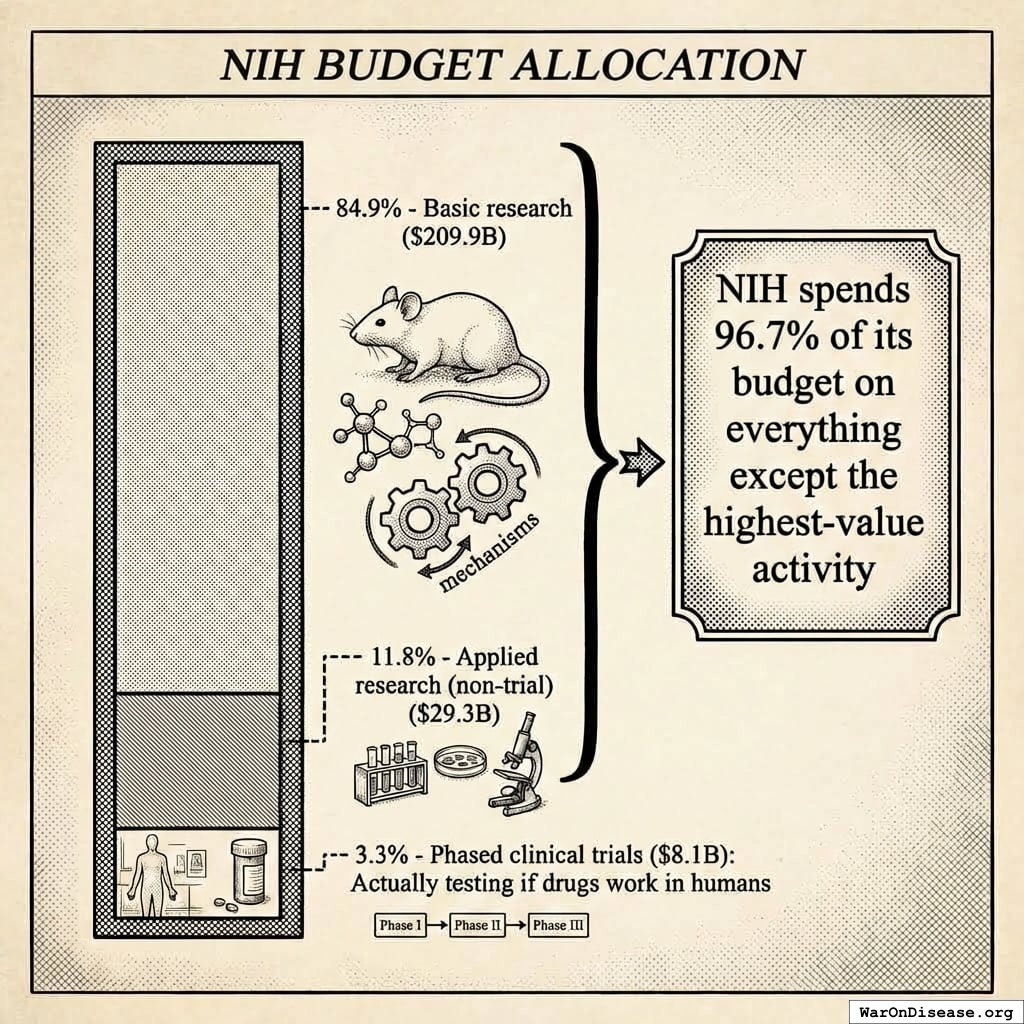
A JAMA study21 broke down $247.3 billion in NIH spending (2010-2019). I have organized it from “largest amount spent not on clinical trials” to “smallest amount spent not clinical trials,” though I should note that none of it is labeled “not clinical trials.” It is labeled “investment in the future.” The future has been invested in for 50 years. It has not yet arrived.
- 84.9% - Basic research ($209.9B): Understanding disease mechanisms, molecular biology, genomics. Essential for identifying new targets, but 85 cents of every dollar is a lot of understanding and not much testing.
- 11.8% - Applied research (non-trial) ($29.3B): Translating discoveries toward practical use, but without the final step of testing them in patients.
- CTSA infrastructure program: ~$1B/year in trial infrastructure, coordination, and training22
- Observational studies: Population health data collection (e.g., large-scale observational cohorts23: $2.16B). Valuable for identifying patterns, but observation without intervention doesn’t cure anyone.
- Other applied research: Drug characterization, health services research, epidemiology
- 3.3% - Phased clinical trials ($8.1B): The only category that directly tests whether treatments work in humans (Phases 1-3)
- Phase 1: $1.5B (18.5% of clinical trial budget)
- Phase 2: $3.5B (43.2%)
- Phase 3: $2.6B (32.1%). NIH covers only 3.7-4.3% of Phase 3 costs, leaving completion to industry, which only funds trials with patent-protected profit potential.
- Other/unclassified: $0.5B (6.2%) for cross-phase overhead, pilot studies, and trials not classified to a single phase
- Pragmatic trials24 (82x (90% CI: 21.4x-195x) cheaper per patient): Severely underfunded despite proven efficiency
Why This Allocation Exists
This is not the fault of individual researchers. Most became scientists because they wanted to cure diseases. The system they work in rewards everything except curing diseases, and those rewards were designed by someone else entirely.
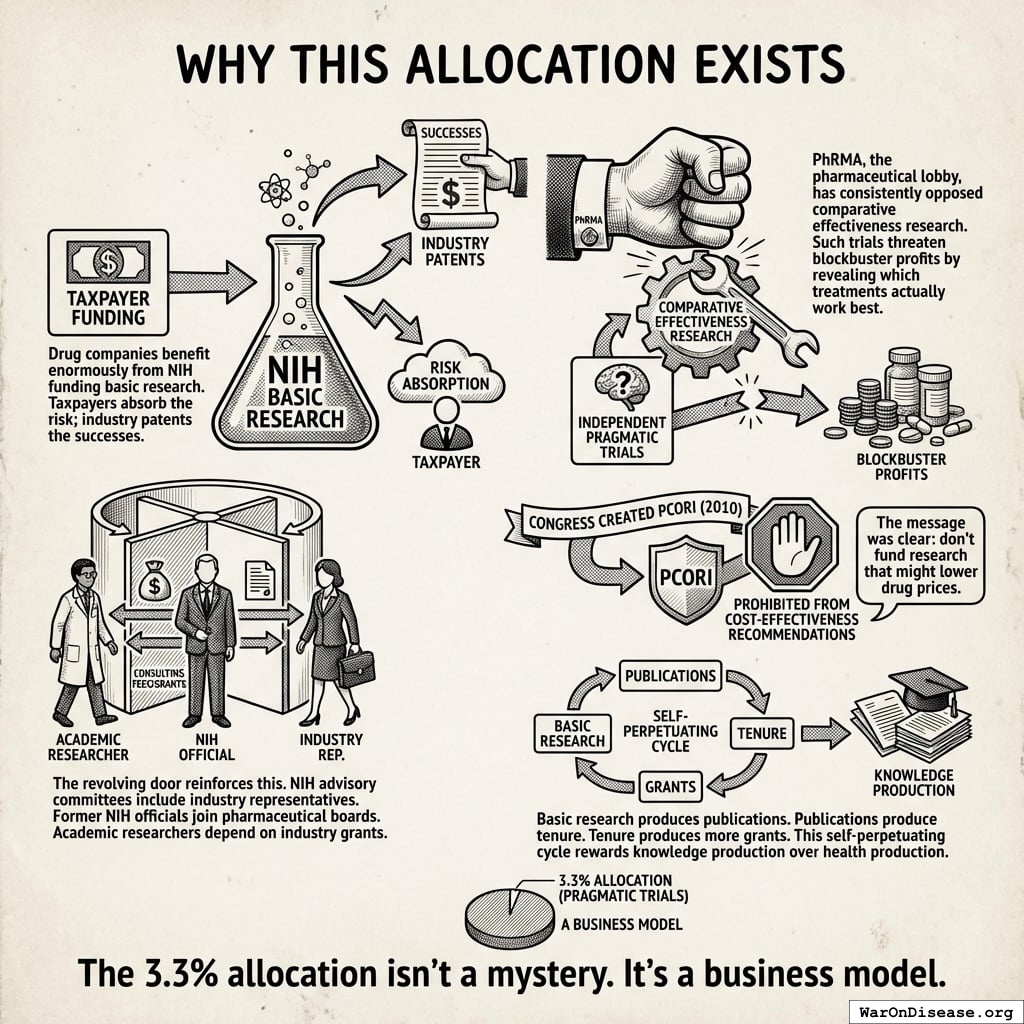
Huge drug companies with political influence love the NIH. Taxpayers absorb the risk of basic research; industry patents whatever works. It’s like if your neighbor paid for your kitchen renovation, and then you charged them rent to eat there.
But independent trials comparing drugs head-to-head? Those are terrifying. They might reveal that the $80,000 drug works about as well as the $4 generic. PhRMA, the pharmaceutical lobby, has consistently opposed comparative effectiveness research. When Congress created PCORI (the Patient-Centered Outcomes Research Institute) in 2010, industry successfully lobbied to prohibit it from making coverage recommendations based on cost-effectiveness25. Congress literally passed a law saying “don’t fund research that might lower drug prices.” They wrote it down. In legislation. On purpose. With their names on it. And then they went home and told their constituents they were fighting for affordable healthcare, because your species’ capacity for doublethink is genuinely Olympian.
This pattern held during the deadliest pandemic in a century. Operation Warp Speed initially selected 14 vaccine candidates and planned head-to-head comparative studies in primates26. Then dropped the comparative studies without explanation. Backed five companies with billions, gave others nothing. The selection process was opaque enough to draw Senate scrutiny; when Senator Tammy Baldwin asked BARDA’s acting director to name the companies receiving public funds, he refused, citing “procurement sensitivity”27. No published cost-benefit analysis for excluding any candidate28. The WHO ran a Solidarity Trial for Vaccines doing exactly this kind of head-to-head comparison29. The U.S. didn’t join. Notice the pattern: PCORI is banned from comparing drug cost-effectiveness. RECOVER ignores the treatments patients actually want. OWS drops the comparative monkey studies. Every manufacturer has financial interests; Pfizer had them, Moderna had them, and that wasn’t disqualifying. “Financial interest” only becomes a reason not to test when the treatment is cheap, generic, or threatens incumbent revenue. The system tests what’s profitable and ignores what isn’t.
The revolving door helps. NIH advisory committees include industry representatives. Former NIH officials join pharmaceutical boards. Academic researchers depend on industry grants. Everyone’s incentives align against cheap, fast trials testing whether expensive drugs outperform generics. It’s not a conspiracy. Conspiracies require secrecy. This is all public. It’s just that everyone involved happens to benefit from the same terrible outcome, purely by coincidence, repeatedly, for decades. There is a word for this. The word is “conspiracy.” The difference between a conspiracy and a system is whether the participants need to meet in a dark room. These people meet in conference rooms with catering. The outcome is identical.
The 3.3% (95% CI: 2%-5%) allocation isn’t a mystery. It’s a business model. Basic research produces publications. Publications produce tenure. Tenure produces more grants. Individual researchers want cures. The system rewards them for everything except producing one. Actual treatments are a byproduct that occasionally happens when someone forgets to optimize for papers and accidentally optimizes for results instead. It’s like a restaurant where the chefs are passionate about food but get promoted based on how many menus they print. The menus are exquisite. They have won awards. The diners are eating the menus. Nobody has mentioned this.
You Pay Twice
The NIH claims to produce “public goods” like open science and training. What it actually produces is a free R&D department for pharmaceutical companies, funded by the same people who then pay full price for the drugs.
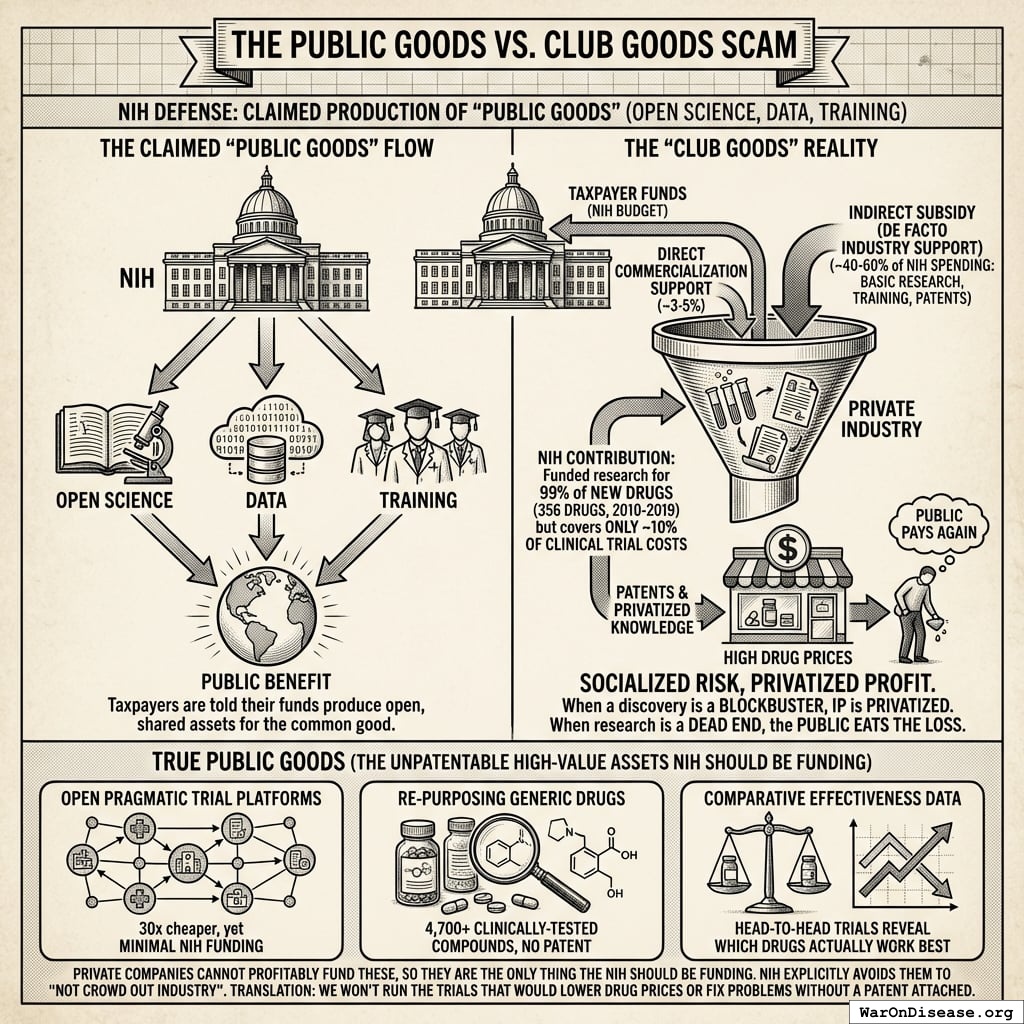
Taxpayers funded research behind 99% of new drugs30 (356 drugs, 2010-2019). Industry patents the winners. The public pays again through high drug prices. When research leads to a dead end, the public eats the loss. You pay for the lottery ticket. They cash the winnings. You’d think someone would have mentioned this arrangement before now, and someone has, many times, but the people who cash the winnings also fund the campaigns of the people who could change the arrangement, so the arrangement continues.
The only things the NIH should fund are things private companies cannot profitably fund: open pragmatic trial platforms, repurposing of generic drugs where no patent means no profit means no interest, and comparative effectiveness data from head-to-head trials revealing which drugs actually work best (pharma’s nightmare, your potential salvation). Instead, the NIH explicitly avoids them to “not crowd out industry.” Translation: “We won’t run the trials that would lower drug prices, because the people who set drug prices asked us nicely.” They asked nicely and also spent $198 million (95% CI: $190 million-$210 million) on lobbying, but the niceness was noted.
The Patient Disconnect: Zero Correlation with Health Outcomes
Correlation between NIH funding priorities and actual disease burden: 0.0731.
That is not a typo. On a scale of 0 (random) to 1 (perfect), the NIH scores “basically a coin flip.” A dartboard would allocate research funding more rationally. A drunk person throwing darts at a list of diseases would produce a funding allocation that correlates more closely with actual disease burden than the National Institutes of Health, which employs 20,000 people and has been doing this for 50 years. The dartboard doesn’t even need to be in the building.
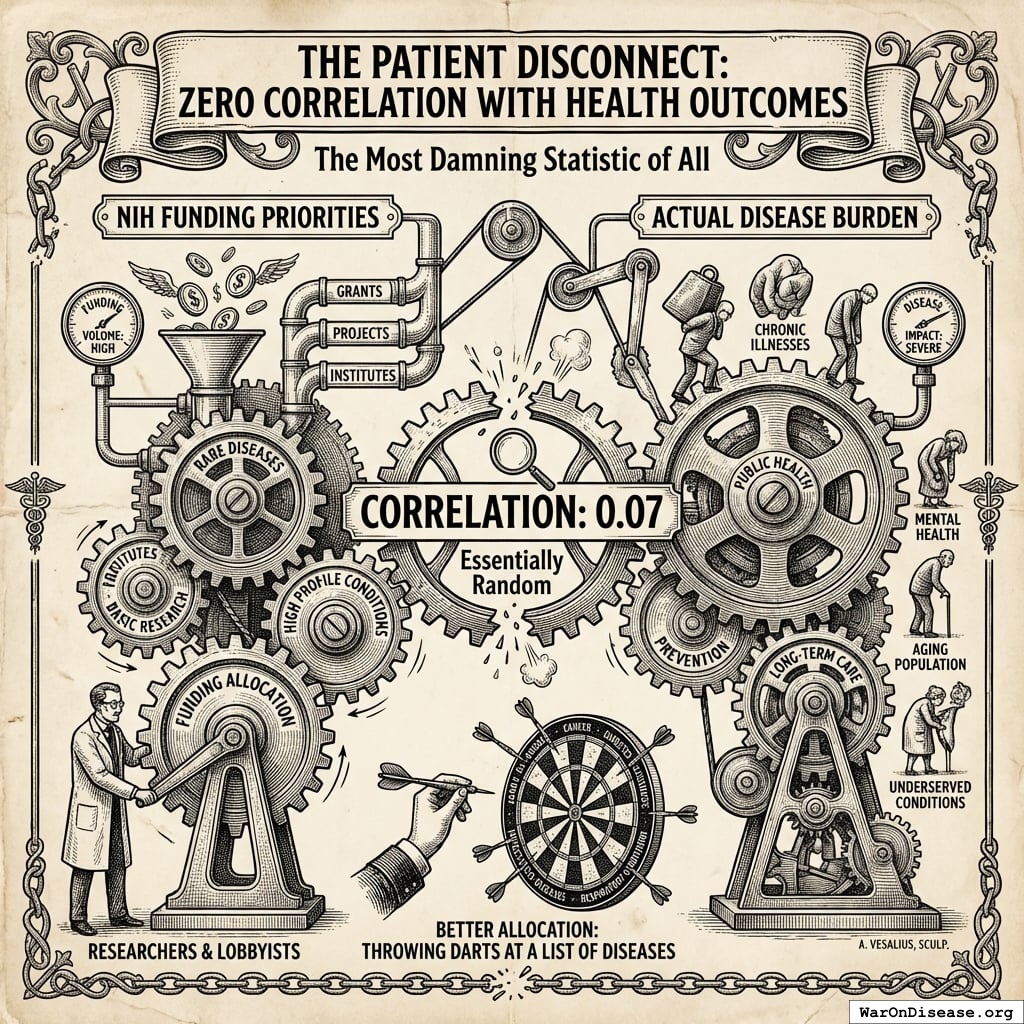
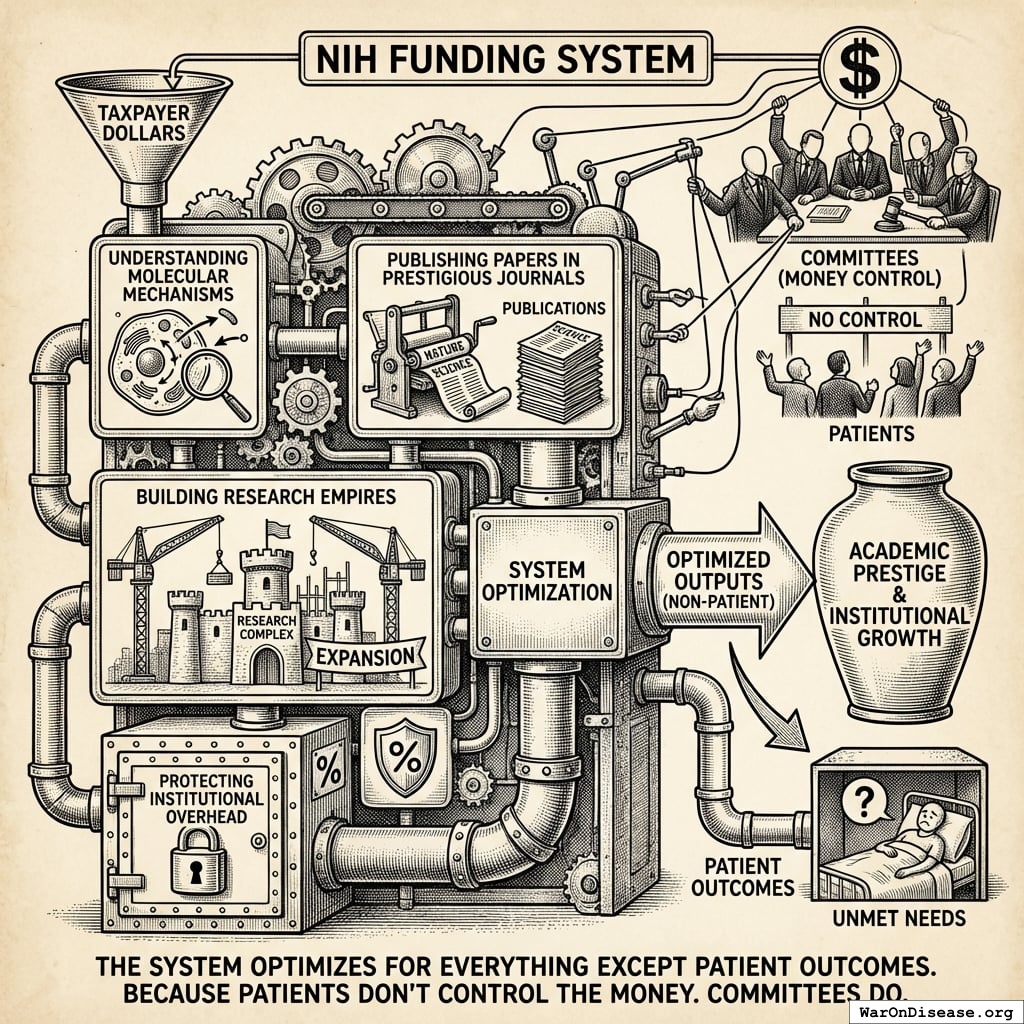
Patients want medicine that works, access to experimental therapies, trials they can join, and a cure before they die. The NIH funds molecular mechanisms, research empires, and institutional overhead. These two lists do not overlap. They don’t even live in the same neighborhood.
Patients don’t control the money. Committees do. And committees optimize for the continued existence of committees. This is true of all committees, everywhere, since the invention of committees. Nobody has ever convened a committee that recommended fewer committees. No sane biologist would struggle to classify an organism that exists solely to produce copies of itself. The word is “virus.” You call them “advisory panels.”
The Human Cost of Misallocation
When you allocate the vast majority of a $47 billion (95% CI: $45 billion-$50 billion) annual budget into understanding disease instead of testing the safe, unpatentable treatments already gathering dust on the shelf, you get a very well-understood population of dead people.
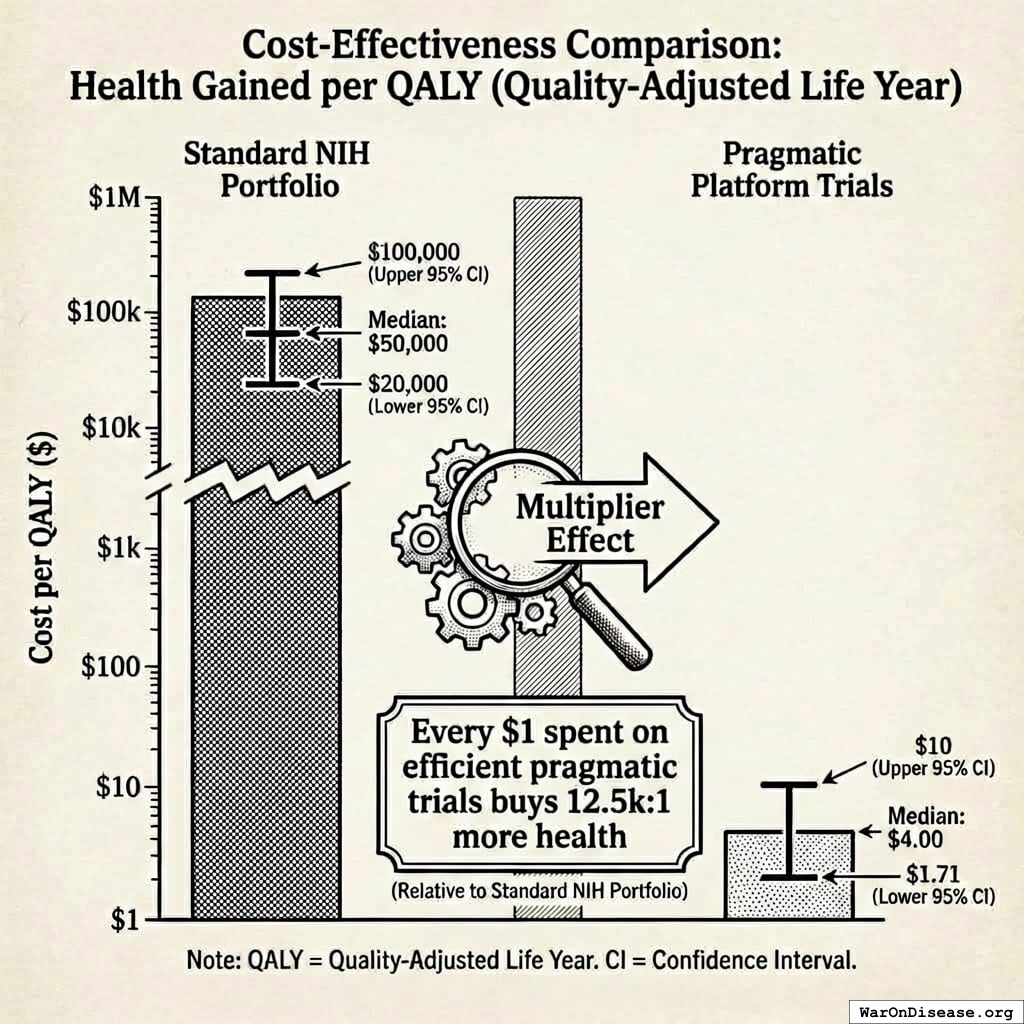
Cost Per Quality-Adjusted Life Year
A Quality-Adjusted Life Year is one year of healthy life. Lose a leg and live ten years, that’s fewer than ten QALYs. Die at forty instead of eighty, that’s forty QALYs lost. It’s how you measure whether a medical system is keeping people alive and functional, or just keeping itself funded.
The ADAPTABLE trial proved pragmatic trials cost 44.1x (90% CI: 12.8x-210x) less per patient than traditional RCTs24 ($929 (95% CI: $929-$1,400) vs $41,000 (95% CI: $20,000-$120,000)). Same science. Fewer catered meetings. 44.1x (90% CI: 12.8x-210x) more patients enrolled. Fewer conference rooms rented.
The Preventable Deaths
Conservative estimate: the NIH’s misallocation costs approximately 10 million QALYs and 700,000 preventable deaths every year. The upper bound is far worse (100 million QALYs, 7 million deaths), but even the floor is staggering. A rational civilization, upon discovering its budget allocation was killing 700,000 people a year, would adjust the budget allocation. Your species adjusted the font on the annual report.
Traditional clinical trials run at 2.27% (90% CI: 0.476%-7.84%) the efficiency of pragmatic trials. And that’s the ceiling, because it only accounts for the sliver of the NIH budget that goes to trials at all. If your car ran at 2.27% (90% CI: 0.476%-7.84%) efficiency, you would push it faster than it drives. If your heart pumped at 2.27% (90% CI: 0.476%-7.84%) efficiency, you’d be dead before finishing this sentence. Your clinical trial system runs at 2.27% (90% CI: 0.476%-7.84%) efficiency, and you gave it a raise. You gave it a raise and a new building. The building has a cafeteria.
COVID is the most vivid example of what misallocation costs. So let me tell you what happened, and I will try to keep my composure, though I should warn you that I have been told I do not have composure.
Your government knew this research was dangerous. In 2014, the Obama administration imposed a moratorium on gain-of-function research, specifically because engineering novel viruses posed pandemic risk32. The government’s own assessment: too dangerous to continue. In December 2017, the moratorium was lifted33. There is evidence that NIH officials may have effectively circumvented the pause the entire time regardless34. At no point, before the moratorium, during it, or after lifting it, did anyone publish a cost-benefit analysis showing the expected benefits of engineering novel coronaviruses exceeded the risk of starting a pandemic. The question was never formally asked. It was not even formally avoided. It simply did not occur to anyone that the question should exist, which is the kind of oversight that is forgivable when you’re deciding where to put a mailbox and less forgivable when you’re deciding whether to make new viruses.
Through a grant to EcoHealth Alliance, the NIH sent $600,000 to the Wuhan Institute of Virology for research engineering novel bat coronaviruses35. In 2018 and 2019, one of those engineered viruses turned out to be unexpectedly more infectious in mice36. EcoHealth was required to report this immediately; they did not report it for nearly two years37. The NIH was required to oversee the grant; a federal watchdog found they did not37. The NIH’s own deputy director later admitted in congressional testimony that this was gain-of-function research38. I am losing my composure.
The FBI, the Department of Energy, and the CIA (as of January 2025) have all assessed that a lab leak is the most likely origin of COVID-1939. A two-year congressional investigation concluded the same40. This is not proven beyond doubt; four intelligence agencies still lean toward natural origin. But the question is not “who is to blame?” It is: what does it cost when an institution allocates $600,000 to a side quest creating bat viruses instead of testing treatments?
If these assessments are correct: $14 to $16 trillion in economic damage to the United States alone41,42. Seven million confirmed deaths, 19 to 36 million by excess mortality estimates43. An ongoing $1 trillion per year in global long COVID costs44. The NIH’s entire budget over its 50-year history, inflation-adjusted, is approximately $1.1 trillion. A single unsupervised grant may have cost humanity roughly 13 times more than everything the NIH has ever spent, on everything, combined, since 1970. Your species does not have a unit of measurement for this level of institutional failure. This is, itself, a failure of measurement.
Nobody intended this outcome. The researchers were studying bat coronaviruses to prevent pandemics, which is a goal I would applaud if it had not produced the opposite result. The grant administrators were following procedures. The system did not fail because of villains. It failed because nobody’s job was to ask: “Is engineering novel coronaviruses in a city with inadequate biosafety protocols a better use of $600,000 than testing whether any of the thousands of safe, untested compounds on the shelf might cure a disease that is killing people right now?”
That question was never asked because the system is not designed to ask it. The system is designed to fund research. Whether that research helps anyone is a separate question, handled by a separate department, which does not exist. Most buildings have a department called “the point.” Every other department reports to it. Your species organized the entire building and forgot to include the point. The building is very well organized.
Then the pandemic happened. Then 7 million people died. Then the NIH received $1.7 billion to address the long-term damage. Then it spent 85% of that money watching people be sick instead of testing treatments. I have now fully lost my composure.
In that timeline, the NIH is too busy testing cures to fund gain-of-function research in Wuhan. There is no COVID-19 pandemic. There is no $16 trillion in economic damage. There are no 7 million dead. There is no long COVID costing $1 trillion a year.
The Track Record
You have already seen the numbers: $1.1 trillion over 50 years, zero diseases eradicated (one possibly created)45. I asked the NIH how many diseases they’ve eradicated. They sent me a 40-page document about their strategic vision. I read all 40 pages. The number wasn’t in it. The word “eradicate” wasn’t in it either. The word “strategic” was in it 31 times.
The WHO eradicated smallpox for $300 million46. Jonas Salk developed the polio vaccine in a university lab and gave it away for free, which is why nobody at the NIH talks about him at parties because he makes everyone look bad by comparison and also he’s dead, which is the thing they were supposed to be fixing. He gave away the patent. I asked an NIH official what would happen if they gave away patents today and they made a sound I can only describe as a laugh, but sadder. Veterinarians have eradicated multiple animal diseases47 on budgets the NIH would consider a rounding error.
Your veterinarians eradicated hog cholera. Pigs. I should note the irony of humanity’s failure to eradicate human diseases while more aggressively finding cures for animals you lock in metal crates too small to turn around in, standing in their own waste, whose tails you amputate without anesthesia because the confinement drives them insane enough to eat each other. But fixed that cholera for ya!
What Would Actually Work
The RECOVERY trial already proved it. $500 (95% CI: $400-$2,500) per patient instead of $41,000 (95% CI: $20,000-$120,000). First life-saving result in under 100 days48. Over 1 million lives (95% CI: 500 thousand lives-2 million lives) saved. The blueprint exists. It is not theoretical. It happened. In England. During a pandemic. While Americans were arguing about horse dewormer. The British did not use a special technique. They did not have access to secret technology. They used the same drugs, the same disease, the same species of patient. They just tested the drugs on the patients instead of writing about the drugs near the patients. This is the breakthrough. It took zero breakthroughs. The evidence is right there. It’s not hiding. It’s waving at you. It has been waving at you for years.
Now imagine the other timeline. Not as an indictment, but as a measure of what was lost. If the NIH had allocated even 20% of its $1.1 trillion to pragmatic trials over 50 years (the remaining 80% still on basic research), that produces 440 million patient-trials at RECOVERY efficiency ($500 (95% CI: $400-$2,500) per patient). That is enough to test every safe compound against every major disease, multiple times, with replication. The Oxford RECOVERY trial tested 48,000 patients and found a treatment that saved over a million lives, in 100 days, for $24 million. Multiply that across 440 million patients and 50 years and the number of lives saved becomes difficult to calculate because the diseases start disappearing and the math changes.
In that timeline, the NIH’s $1.1 trillion produces what a trillion dollars should produce: the systematic eradication of disease after disease after disease, because you finally pointed the money at the thing that actually works.
The difference between that timeline and this one is not a matter of hindsight. The Oxford RECOVERY trial happened. Pragmatic trials existed the entire time. The efficiency data was available for decades. The counterfactual is not imaginary. It is the road you could see, that was paved, that had signs on it, that other countries were already driving on. You chose the other road. It led here. I am told that on your planet, describing this situation accurately is considered “rude.” Not describing it is called “complicity.” I will risk the rudeness.
The recipe is simple enough that I can state it in four sentences:
- Pay for results. Treatment equals payment, no treatment equals no payment.
- Publish everything, including failures. Especially failures, because the people who will die if the system fails are more motivated than the people who get tenure if the system continues.
- Eliminate gatekeepers and let patients vote with participation. The volunteers are still holding their hands up.
- Automate administration with transparent systems instead of committees. Committees cannot be trusted (see above, and also see the entire history of committees, and also see the committee that was formed to investigate whether committees can be trusted, which concluded that committees are essential).
The cost of not doing this is measurable. Over 50% of trial results are never published49, which means researchers unknowingly repeat experiments that already failed. This is how your species wastes an estimated 85% of its $200 billion annual research investment50, and then passes the cost to patients as higher drug prices.
The blueprint for this system is your decentralized FDA51,52. The funding mechanism is the 1% treaty53 54. The next chapters explain both.