Problem Overview

Abstract
A Practical Guide: Get 500 Years of Clinical Research in 20, Avoid the Apocalypse, and Make Humanity Filthy Rich by Giving Papers
Keywords

war-on-disease, 1-percent-treaty, medical-research, public-health, peace-dividend, decentralized-trials, dfda, dih, victory-bonds, health-economics, cost-benefit-analysis, clinical-trials, drug-development, regulatory-reform, military-spending, peace-economics, decentralized-governance, wishocracy, blockchain-governance, impact-investing

Before you can fix something, you need to understand what’s broken. In this case, what’s broken is approximately everything.

They say knowledge is power. But in this case, knowledge is mostly just depressing. Still, you need it.

Daily Numbers

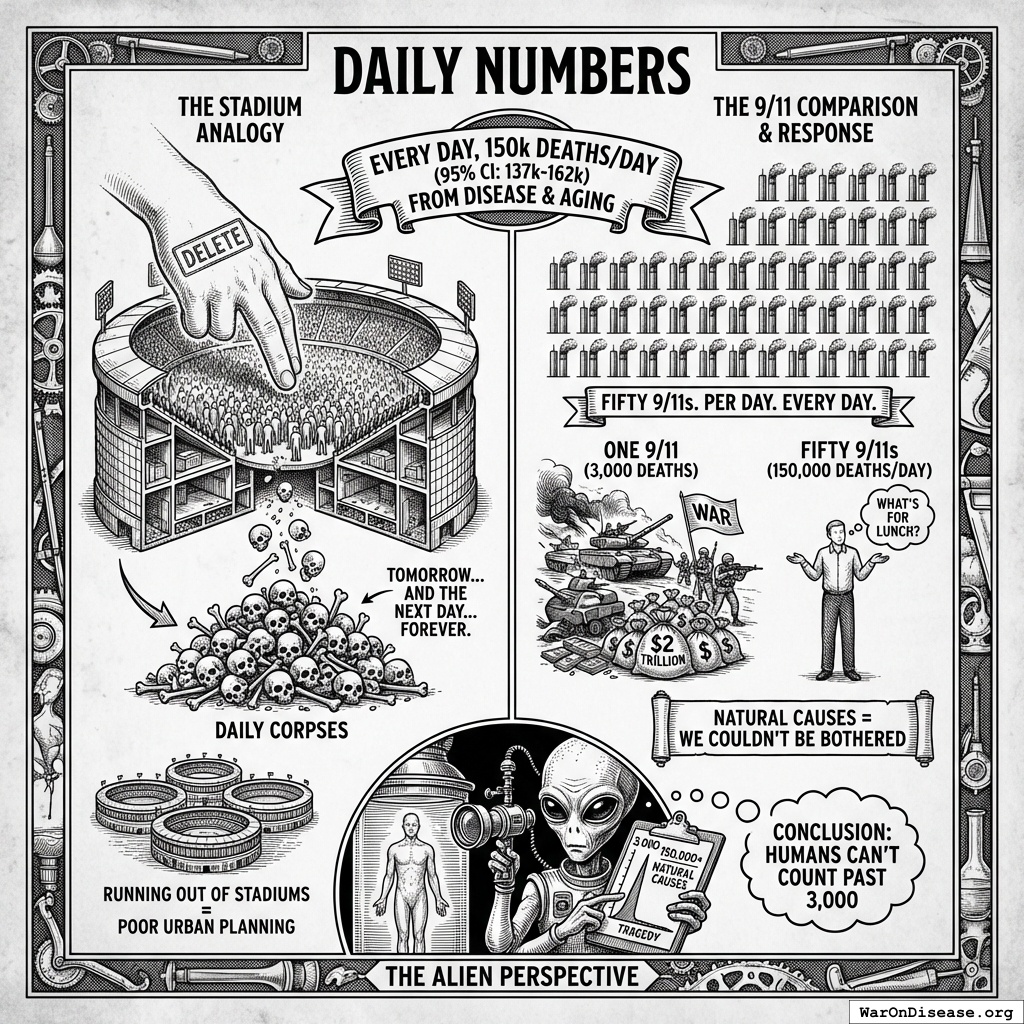
Every single day, 150k humans stop existing because of diseases you could probably cure if anyone was paying attention (nobody is).

I tried to imagine what 150k people looks like. It’s like if you took everyone in a decent-sized stadium and deleted them. Then did it again tomorrow. And the day after that. Forever. You’d run out of stadiums before you’d run out of corpses, which seems like poor urban planning.

That’s fifty 9/11s. Per day. Every day. Including weekends and holidays.

After the first 9/11, America invaded two countries and spent $2 trillion. After the fifty daily 9/11s, humanity shrugs and wonders what’s for lunch.

When one thing kills 3,000 people, it’s a tragedy and you start wars. When diseases kill 50 times that every day, it’s called “natural causes,” which is Latin for “we couldn’t be bothered”.

If aliens were studying you, they’d probably conclude you can’t count past 3,000.

Where the Money Goes

Here’s how humanity allocates its resources:

Killing each other: $2.72T per year Curing diseases: $67.5B per year

But the real bottleneck isn’t research funding. It’s testing which treatments actually work. Clinical trials determine whether medicines save lives or sit on shelves. On that front, governments worldwide spend $4.5B annually on clinical trials versus $2.72T on weapons. That’s a 604:1 ratio, which in technical terms is called “having your priorities backwards.”
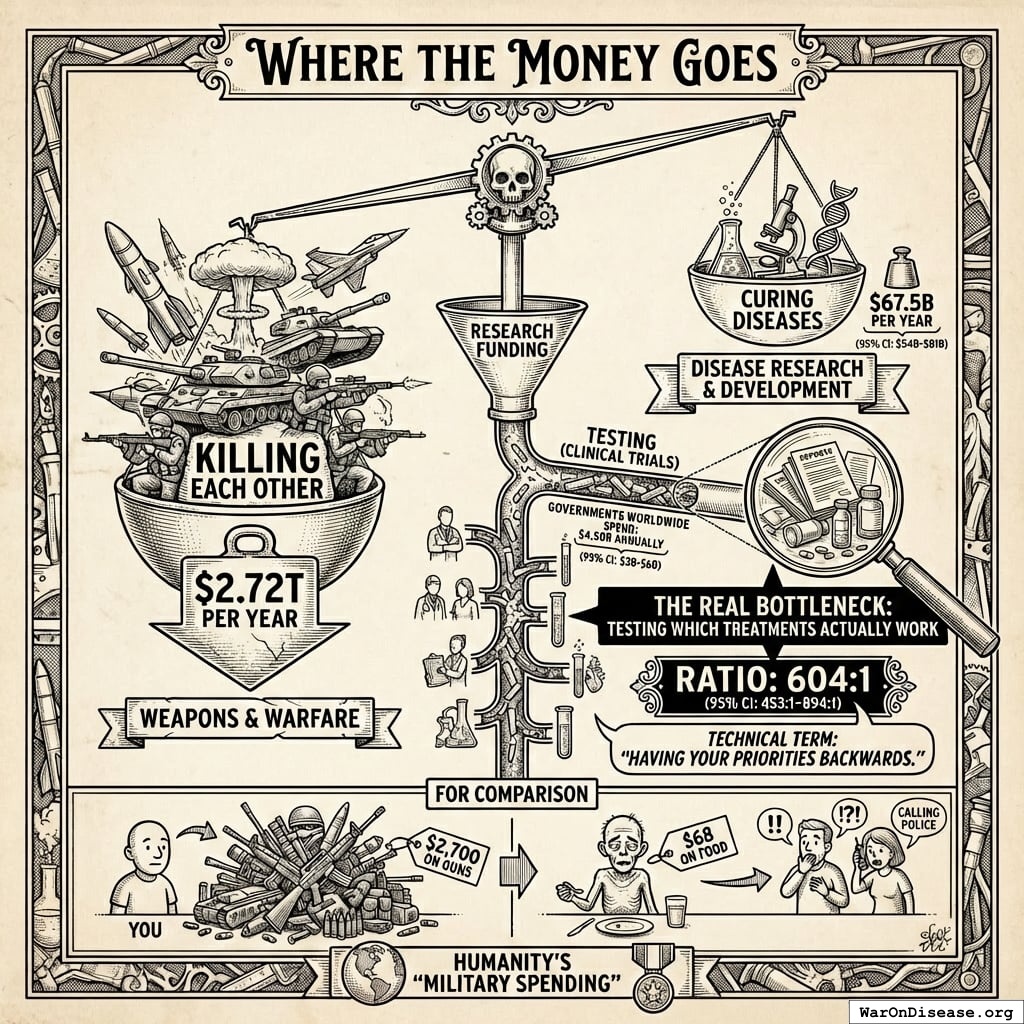
For comparison, imagine if you spent $2,700 on guns and $68 on food. Your neighbors would stage an intervention (or call the police, or possibly just move). But when humanity does it, you call it “defense spending” and give everyone medals.

On the Pentagon’s Accounting

The Pentagon has lost $2.5 trillion. Not spent. Lost. Like car keys, except the car keys could cure cancer several hundred times.

When normal people lose $20, they search the couch cushions. When the Pentagon loses $2,500,000,000,000, they ask for more money and Congress says yes.

If you tried this with your taxes, they’d arrest you. When the military does it, it’s called “standard operating procedure,” which is also Latin, probably for “we’re making this up as we go.”

They say a trillion is just a number. But it’s the number of dollars you lost that could have funded medical research for thirty-seven years. Give or take a few hospitals, several cancer cures, and maybe a solution to aging (but who needs that when you have seventeen redundant aircraft carrier strike groups).

On Medical Research

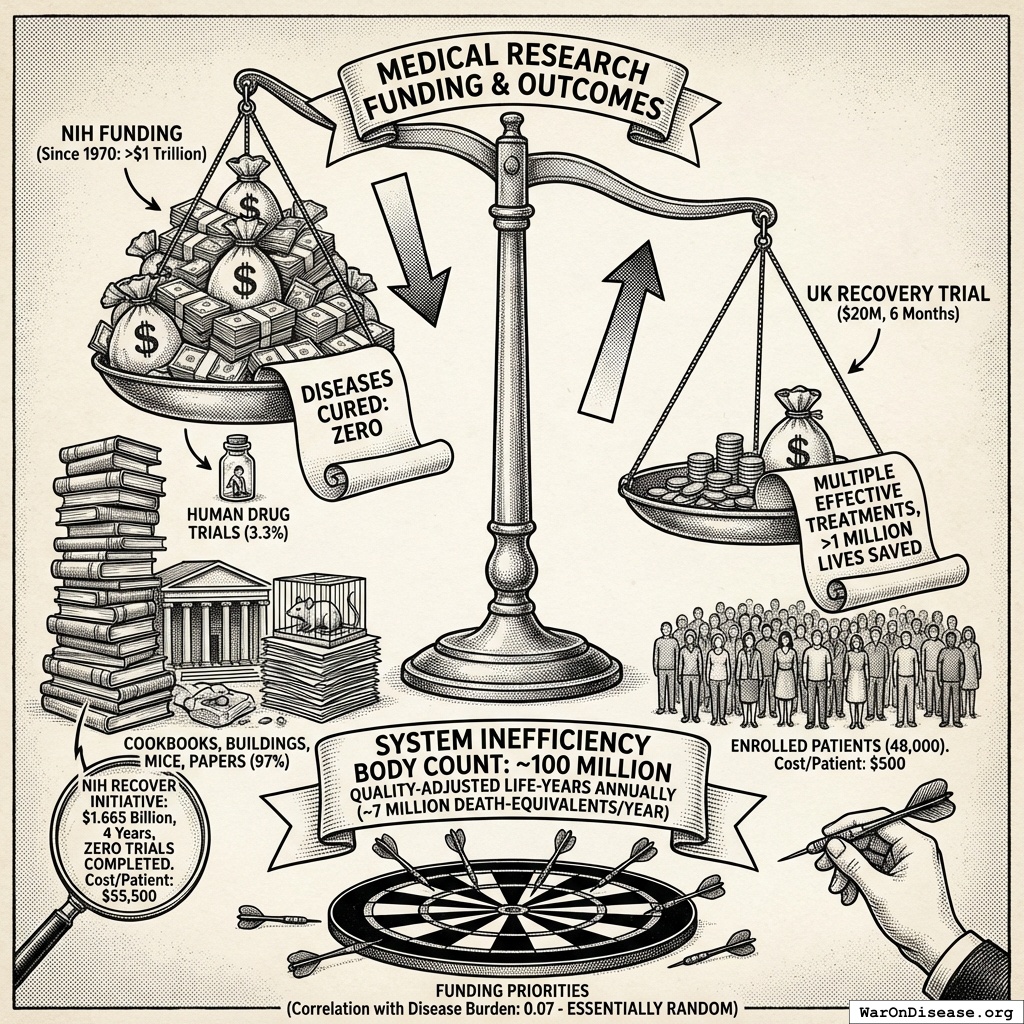
Since 1970, the National Institutes of Health has spent over $1 trillion studying diseases.

Diseases cured: Zero.

Well, technically that’s not fair. They cured… let me check my notes… no, it’s zero.

To be clear, they’ve learned lots of interesting things about how diseases work. They just haven’t gotten around to the part where people stop dying from them. It’s like spending fifty years studying how cars work without ever actually driving anywhere (you just publish papers about theoretical carburetor optimization while everyone walks to work).

The NIH tests about 5,000 treatment combinations per year. There are 166 billion possible combinations. At this rate, they’ll be done by the year 33,200,000. Mark your calendars (use pencil, timelines may shift due to budget constraints and the eventual heat death of the universe).

On the FDA

The FDA is America’s way of making sure drugs are safe. They do this by making the approval process so expensive and slow that most drugs never get approved at all.

It takes 17 years and $2.6 billion to get a drug through FDA approval. 17 years. That’s longer than it took to build the pyramids, and those involved moving rocks the size of houses without machinery (also the pharaohs didn’t have to file quarterly progress reports in triplicate).

During the Oxford RECOVERY trial, they tested treatments on 40,000 patients for $500 per person. The FDA’s process costs $41K per patient. That’s 82 times more expensive for the same result, except slower. It’s like if you could get a haircut for $10 or $820, but the $820 haircut takes 17 years and you might be bald by then anyway.

Ninety-five percent of diseases have zero approved treatments. This is because the FDA is very good at preventing bad drugs from reaching people, and also pretty good at preventing good drugs from reaching people, and absolutely excellent at preventing any drugs from reaching people.
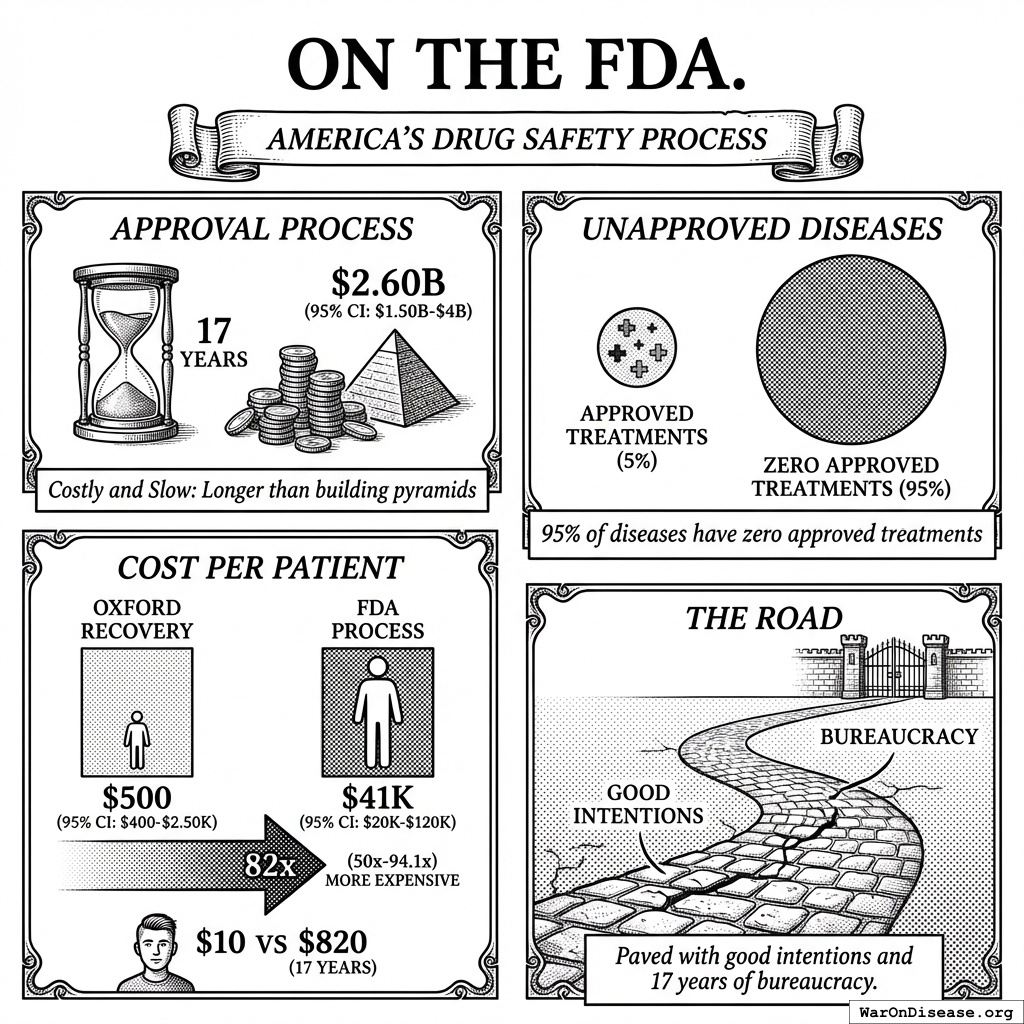
They say the road to hell is paved with good intentions. The FDA’s road is paved with good intentions and also 17 years of bureaucracy.

On What War Costs

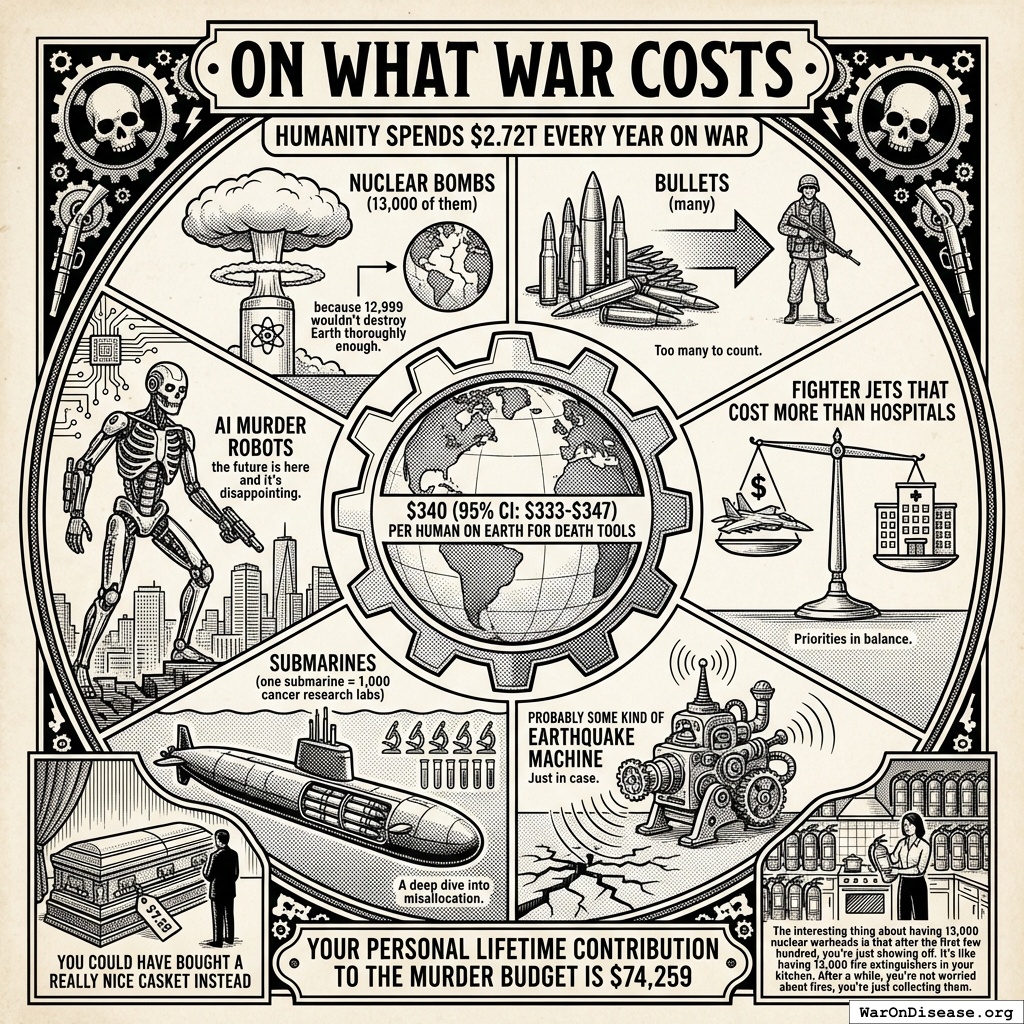
Humanity spends $2.72T every year on war. That works out to $340 per human on Earth for death tools.

This budget includes:

  • Nuclear bombs (13,000 of them, because 12,999 wouldn’t destroy Earth thoroughly enough)
  • Bullets (many)
  • AI murder robots (the future is here and it’s disappointing)
  • Fighter jets that cost more than hospitals
  • Submarines (one submarine = 1,000 cancer research labs)
  • Probably some kind of earthquake machine

Your personal lifetime contribution to the murder budget is $74,259. You could have bought a really nice casket instead.

The interesting thing about having 13,000 nuclear warheads is that after the first few hundred, you’re just showing off. It’s like having 13,000 fire extinguishers in your kitchen. After a while, you’re not worried about fires, you’re just collecting them.

On What Disease Costs

Disease extracts $109T from humanity annually. That’s trillion with a T, which stands for “that’s an unconscionably large number.”

This includes:

  • $8.2 trillion on healthcare (treating symptoms because cures are bad for business)
  • $100.9 trillion in economic losses (dead people are notoriously unproductive)
  • 10 million cancer deaths per year (cancer: 10 million, humanity: 0)
  • 2 billion people with chronic diseases (right now, as you read this)
  • 1 billion depressed humans (costing $5 trillion in lost “wanting to exist”)
  • 95% of rare diseases with zero treatments (too rare to profit from, sorry)

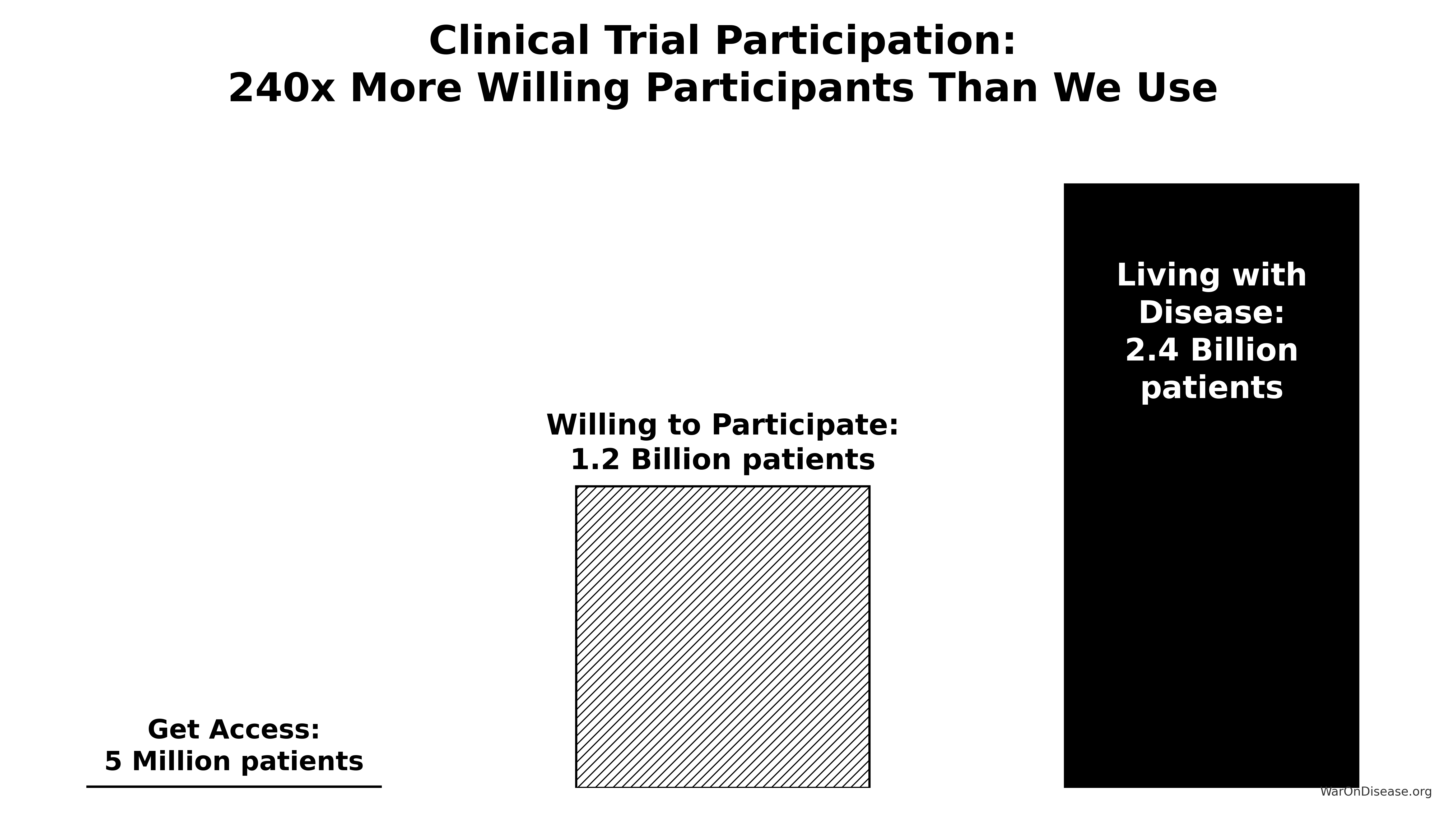
Out of 2.40B people suffering from chronic disease right now, only 1.90M get to participate in clinical trials annually. That’s 0.0792%. The other 99.8% get to suffer and wait (and fill out insurance paperwork, and argue with their insurance company about whether dying is covered under their plan).

Half of humanity would volunteer if asked. You’re turning away 99.6% of willing participants. It’s like running a restaurant but only serving 0.4% of the people who want to eat there, then wondering why everyone is so hungry.

The last disease we cured was Hepatitis C in 2014. The next cure is scheduled for 2064. Please wait patiently and try not to die in the meantime.

If disease were a country, it would be the richest country on Earth by a factor of ten. Unfortunately, disease doesn’t have a flag or an army, so nobody invades it.

On Democracy

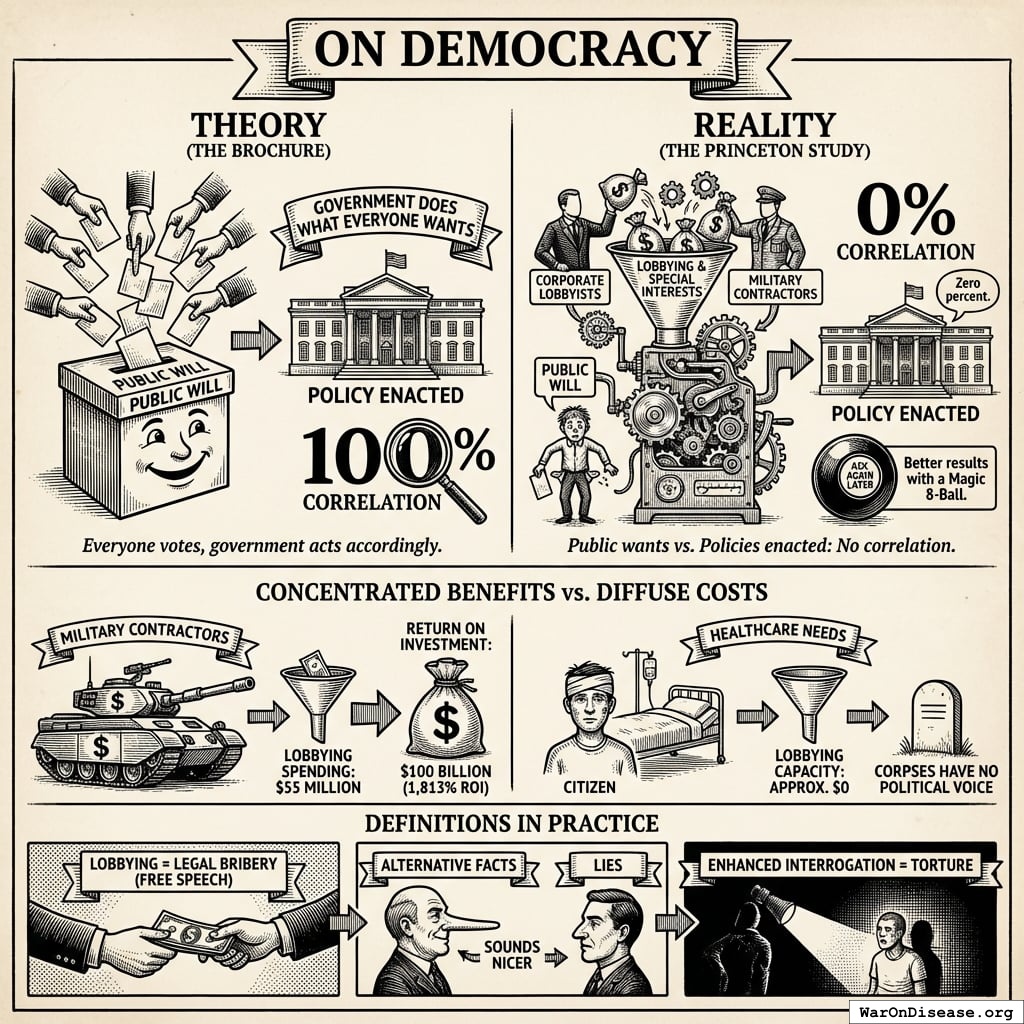
Democracy is when everyone votes and the government does what everyone wants. At least that’s what the brochure says.

In reality, a Princeton study found 0% correlation between what the public wants and what policies get enacted. Zero percent. You’d get better results with a magic 8-ball.

This is because of something called “concentrated benefits versus diffuse costs.” When defense contractors want $100 billion, they spend $55 million lobbying for it. That’s a 1,813% return on investment.

When you want healthcare, you have approximately zero dollars to lobby with because you spent it all on healthcare (or you’re dead, which significantly reduces your lobbying capacity - corpses have no political voice, despite making up a the largest constituency).

Lobbying is basically legal bribery, except we call it “free speech” so it sounds nicer. It’s like how “alternative facts” sounds better than “lies,” or how “enhanced interrogation” sounds better than “torture.”

On Regulatory Capture

Regulatory capture is when the people who are supposed to regulate an industry used to work for that industry and will work for that industry again after they’re done “regulating” it.

The process works like this:

  1. Work at pharmaceutical company, learn what they want
  2. Join FDA, write rules pharmaceutical company likes
  3. Return to pharmaceutical company with 400% raise
  4. Congratulations, you’ve completed the circle of life

The Pentagon has the same system, except with more explosions.

This is why the FDA’s rules mysteriously benefit large pharmaceutical companies who can afford $2.6 billion approval processes, and why Pentagon procurement mysteriously benefits defense contractors who can afford $1,800 hammers.

On the Fixed Pie

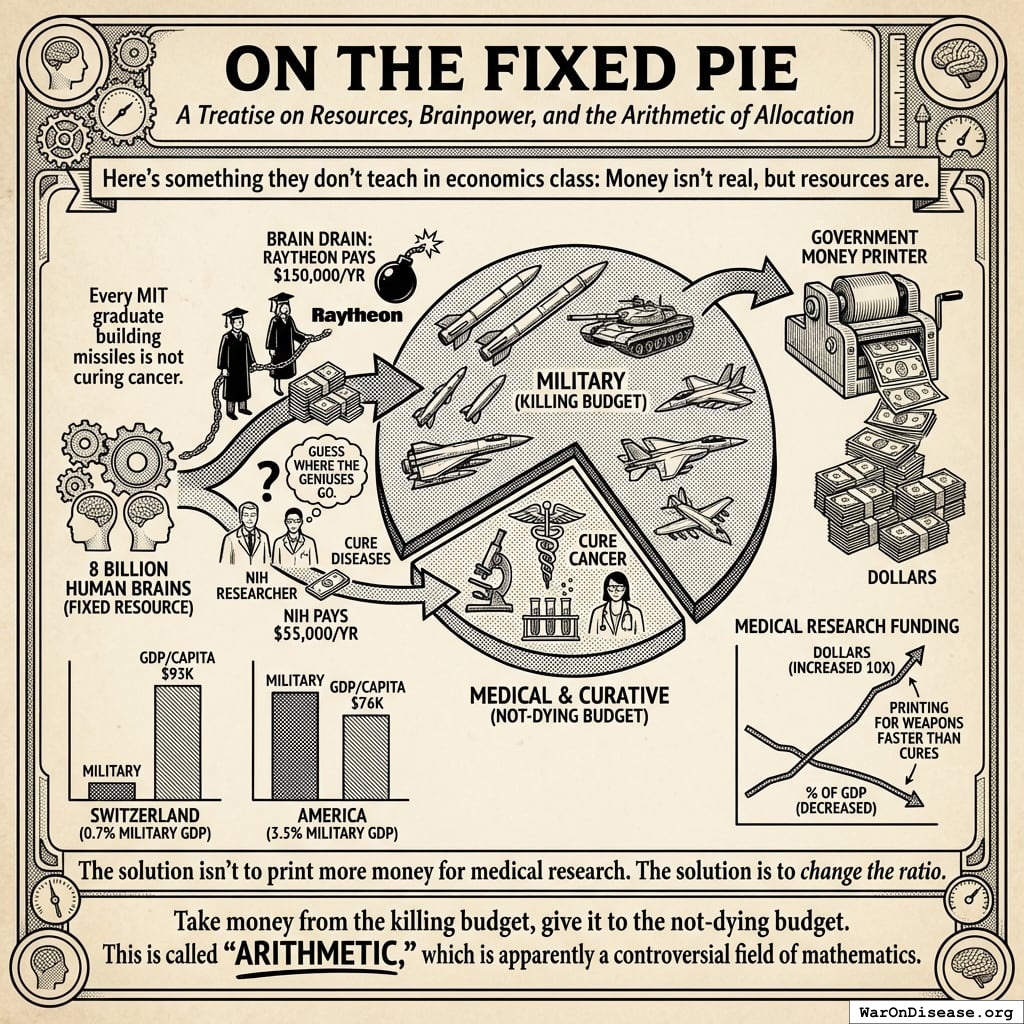
Here’s something they don’t teach in economics class: Money isn’t real, but resources are.

Earth has 8 billion human brains. You can’t print more brains. When the government prints money for defense contractors, those contractors buy the smartest people. Every MIT graduate building missiles is not curing cancer.

Medical research funding has increased 10X in dollars but decreased as a percentage of GDP. This is because you’re printing money for weapons faster than you’re printing money for cures.

The brain drain is real: Raytheon pays $150,000 to design bombs, the NIH pays $55,000 to cure diseases. Guess where the geniuses go.

Switzerland spends 0.7% of GDP on defense and has $93,000 GDP per capita. America spends 3.5% on defense and has $76,000 GDP per capita.

The solution isn’t to print more money for medical research. The solution is to change the ratio. Take money from the killing budget, give it to the not-dying budget. This is called “arithmetic,” which is apparently a controversial field of mathematics.

On Your Personal Situation

While you’ve been reading this, approximately 8 people have died from preventable diseases. By the end of this chapter, it’ll be 15.

Your body is currently:

  • Growing cancer cells (slowly, hopefully)
  • Forgetting memories (where did you park?)
  • Wearing out joints (that knee isn’t getting better)
  • Shortening telomeres (your cellular countdown clock)
  • Accumulating damage (entropy is undefeated)

You are literally falling apart at the molecular level. Every moment you exist, you’re dying slightly. It’s like being a sandcastle at high tide, except slower and with more paperwork.

The technology to fix most of this exists. It’s just busy building fighter jets instead.

What This Means

To summarize:

  • 150k humans are deleted daily by curable diseases
  • $2.72T spent annually on weapons
  • $67.5B spent annually on curing all diseases combined
  • 604:1 weapons-to-clinical-trials spending ratio (the bottleneck isn’t research. It’s testing which medicines work.)
  • Zero diseases cured in 50 years
  • $2.5 trillion lost by Pentagon (whoops)
  • 0% correlation between public preferences and policy
  • You are dying while reading this

If this seems bad, that’s because you’re paying attention.

The good news is you’re going to fix it.

The bad news is it requires doing things.

The weird news is you’ll get rich doing it.

They say every problem is an opportunity in disguise. In this case, the opportunity is disguised as 150,000 corpses per day, which is admittedly not the most encouraging disguise, but you work with what you have.

What’s Next

Now that you understand the problem, which is to say, now that you’re appropriately horrified, here’s how to fix it.

The following chapters will explain:

  • Why the NIH spent $1 trillion curing nothing
  • How the FDA makes medicine 82× more expensive than necessary
  • Why democracy is mostly theater
  • How regulatory capture ensures nothing improves
  • What you’re going to do about it

But first, you need to understand each problem in detail. Not because understanding is fun (it isn’t), but because you can’t fix what you don’t understand.

And if you don’t fix it, you’re going to die from something preventable while the Pentagon loses another trillion dollars in their couch cushions.