Peace Dividend
war-on-disease, 1-percent-treaty, medical-research, public-health, peace-dividend, decentralized-trials, dfda, dih, victory-bonds, health-economics, cost-benefit-analysis, clinical-trials, drug-development, regulatory-reform, military-spending, peace-economics, decentralized-governance, wishocracy, blockchain-governance, impact-investing
Here’s what 1% less murder money buys you. The 1% Treaty1 2 Fund gets $27.2 billion to subsidize hyper-efficient pragmatic clinical trials. In the chapter’s baseline case, the total annual societal dividend is $114 billion (90% CI: $99.6 billion-$129 billion): $27.2 billion as direct treaty funding, plus $86.4 billion (90% CI: $72.4 billion-$101 billion) in additional conflict-cost reduction. Your lifetime tab for wars in countries you can’t find on a map: $113,571 (90% CI: $99,454-$128,710) per person over 80 years, and that’s the conservative floor that pretends war costs aren’t compounding. That’s per person. Every person on Earth. Including you. You personally have been billed $113,571 (90% CI: $99,454-$128,710) for explosions on the other side of the planet, and nobody sent you an invoice because they knew you’d cancel.
How 1% Less Violence Pays For Everything
An analysis of a decentralized FDA3,4 shows pragmatic clinical trials can be 44.1x (90% CI: 12.8x-210x) more efficient. Two ways you profit from building 1% fewer bombs:
The Captured Money: $27.2 billion/Year
Your governments spend $2.72 trillion yearly on things whose sole purpose is making other things stop existing. Redirect 1%:
$2.72 trillion × 0.01 = $27.2 billion
The rounding error on your murder budget.
The Additional Conflict Savings: $86.4 billion (90% CI: $72.4 billion-$101 billion)/Year
Wars cost $11.4 trillion (90% CI: $9.96 trillion-$12.9 trillion)/year, and that total already includes the military budgets you’re redirecting. So $27.2 billion is part of the full peace-dividend number, not something you add on top of it. In the chapter’s baseline elasticity case (e = 1.0), the additional conflict-reduction piece is:
$114 billion (90% CI: $99.6 billion-$129 billion) - $27.2 billion = $86.4 billion (90% CI: $72.4 billion-$101 billion)
Money no longer spent on unblowing-up hospitals and bridges, removing shrapnel from people you put shrapnel into, housing refugees whose homes you converted into craters, and routing shipping containers around minefields. Your species has an entire industry dedicated to rebuilding things it blew up. You employ people to fill holes that you employed other people to make. This sounds like a children’s fable about inefficiency. The children laugh. Then they ask if it’s real. Then they stop laughing. It replaced the previous worst children’s fable, which was about a species that invented an instrument called “the recorder” and then made every child play it. The violence fable is considered more tragic, but only slightly.
Where the $114 billion (90% CI: $99.6 billion-$129 billion) Total Comes From
Your itemized receipt for violence. Important: the total below already includes the direct treaty transfer, because military spending sits inside the direct-cost bucket.
Direct costs: $7.66 trillion (90% CI: $6.52 trillion-$8.95 trillion) per year. Military budgets ($2.72 trillion), infrastructure you blow up and then pay to rebuild ($1.88 trillion (90% CI: $1.65 trillion-$2.1 trillion)), humans you break ($2.45 trillion (90% CI: $1.34 trillion-$3.71 trillion)), and trade routes you keep putting mines in ($616 billion (90% CI: $526 billion-$716 billion)). Cut 1%: $76.6 billion (90% CI: $65.2 billion-$89.5 billion) saved.
Indirect costs: $3.7 trillion (90% CI: $2.98 trillion-$4.56 trillion) per year. The part your accountants pretend doesn’t exist. Lost economic growth from pointing engineers at missiles instead of medicine ($2.72 trillion (95% CI: $1.9 trillion-$3.8 trillion)). Veteran healthcare, because the humans you send to war come back needing hospitals ($200 billion (95% CI: $140 billion-$280 billion)). Refugees, PTSD, environmental damage, lost human capital. Cut 1%: $37 billion (90% CI: $29.8 billion-$45.6 billion) saved.
Total: $11.4 trillion (90% CI: $9.96 trillion-$12.9 trillion) per year on war. In the baseline e = 1.0 case, 1% less war yields $114 billion (90% CI: $99.6 billion-$129 billion)/year in total societal benefit = $27.2 billion in treaty-mandated funding + $86.4 billion (90% CI: $72.4 billion-$101 billion) in additional conflict-cost reduction.
On your planet, this is called “a good deal.” On mine, it’s called “so obvious that failing to do it constitutes evidence of a cognitive disability.”
Plus cancer gets cured as a bonus. Almost forgot about that part.
The benefits cascade beyond medicine in ways that should be obvious but apparently aren’t. Addiction is a neurological disorder; cure the brain chemistry and the drug trade collapses. Most poverty is catastrophic medical costs; cure the diseases and people can work again. Radicalization is often untreated mental illness; you can’t bomb someone into being mentally stable (you tried this, it didn’t work, cost $8 trillion, created more radicals). Fix the biology and you fix the society. This is not a new insight. It’s just one your species keeps forgetting because explosions are louder than pharmacology.
The Two Numbers
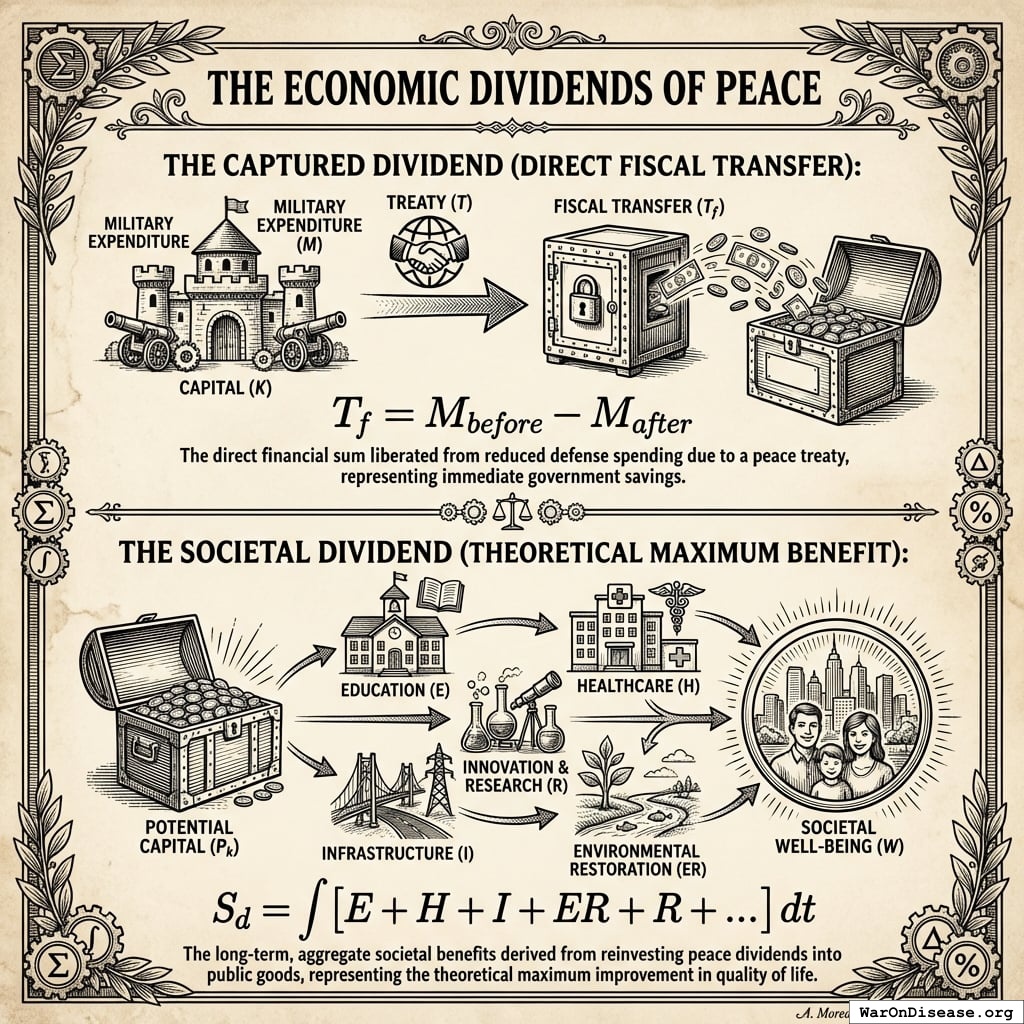
The Captured Dividend (the money you definitely get): $2.72 trillion in military spending times 1% equals $27.2 billion per year. That’s a bank transfer. It happens because the treaty says it happens. No behavior change required.
The Additional Conflict Dividend (the extra money you only get if violence actually falls): $86.4 billion (90% CI: $72.4 billion-$101 billion)/year. Add that to the Captured Dividend in the baseline e = 1.0 case and you get the full annual societal dividend of $114 billion (90% CI: $99.6 billion-$129 billion)/year.
The Elasticity Question
The elasticity parameter asks the only interesting question here: once you’ve already captured the contractual $27.2 billion, how much of the additional $86.4 billion (90% CI: $72.4 billion-$101 billion) actually materializes? If you cut military spending 1%, do the wider war costs actually drop too? Or do humans, being humans, find a way to keep killing each other at full price?
At e = 0, you still get $27.2 billion and none of the extra conflict savings. At e = 0.25, a quarter of the extra piece survives. At e = 0.5, half. At e = 1.0 (the chapter’s baseline assumption), you get the full $86.4 billion (90% CI: $72.4 billion-$101 billion) and the total reaches $114 billion (90% CI: $99.6 billion-$129 billion)/year. At e > 1.0, curing cancer together turns out to be better bonding than threatening each other with missiles, which is suspiciously wholesome and therefore the scenario I trust least.
That is why the Captured Dividend matters. Even if humans refuse to become less violent, the treaty still moves $27.2 billion. Elasticity only governs the upside. It’s a bank transfer plus a maybe, not a prayer.
The Part Where the Math Gets Embarrassing
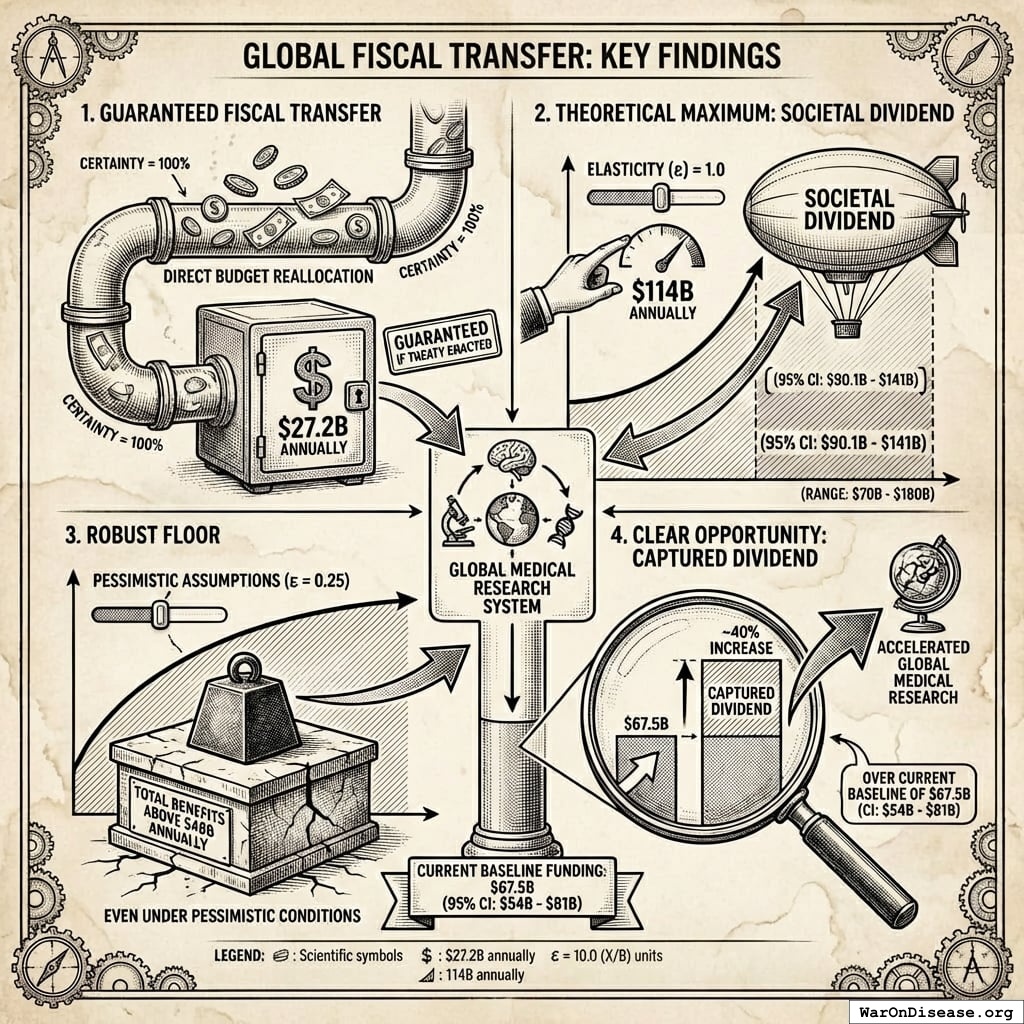
The contractual floor is $27.2 billion/year. Direct budget transfer. No elasticity, no assumptions, no hoping humans behave. Just math. Under the chapter’s baseline e = 1.0 case, the total annual societal dividend is $114 billion (90% CI: $99.6 billion-$129 billion)/year: $27.2 billion in treaty-mandated funding plus $86.4 billion (90% CI: $72.4 billion-$101 billion) in additional conflict-cost reduction. Lower elasticities shrink only that second term. For policy decisions, the safe number is still the Captured Dividend. For context, the Captured Dividend alone would boost global medical research funding by roughly 40% over the current $67.5 billion (95% CI: $54 billion-$81 billion) baseline. You’ve been spending more on camouflage paint than on curing Alzheimer’s. Camouflage paint. To make things invisible. While Alzheimer’s makes people invisible and you can’t even be bothered to match the budget.
The Countdown, Not Just the Dividend
So far I’ve been kind. I’ve been comparing 1% of today’s war bill to today’s research bill, as if today’s bill were a permanent feature of the universe. It isn’t. SIPRI’s actual data (the World row of their military expenditure database, constant 2023 dollars) shows global military spending has been compounding at 2.76% per year in real terms over the last 20 years5. That window is 2005 to 2024. It includes the 2011 to 2014 drawdown, the only period in living memory when your species briefly considered not buying more bombs. I picked 20 years on purpose so nobody can say I started at a trough. The 10-year rate is actually higher (3.4%) because the recent trajectory is steeper, but I’m using the slower number so the argument is harder to attack.
Now project it forward over one human lifespan. If the baseline holds, war costs in year 80 reach $100 trillion (90% CI: $87.8 trillion-$114 trillion) per year, nearly matching today’s entire world economy. In this model’s treaty scenario, the world does not merely shave 1% off today’s bill once; it drops to 99% of today’s level and then stays flat in real terms. Over 80 years, the baseline trajectory costs the world $3.22 quadrillion (90% CI: $2.82 quadrillion-$3.65 quadrillion) in total. The treaty trajectory costs $899 trillion (90% CI: $789 trillion-$1.02 quadrillion). The difference, $2.32 quadrillion (90% CI: $2.03 quadrillion-$2.63 quadrillion), is the peace dividend over one human lifespan.
Here’s the part that should stop you: under that explicit flat-treaty scenario, the model avoids 72.1% of the total 80-year war cost. Not 1%. Seventy-two percent. This is not the claim that a bare 1% cut mechanically creates 72% savings by itself. It is the claim that if the treaty both cuts 1% today and prevents the SIPRI-style growth path from resuming, most of the lifetime savings come from the growth that never compounds. A small action today plus 80 years of interrupted compounding becomes most of the total cost of war. Exponents are not intuitive. This is why your species underestimates them and why arms races work until suddenly they don’t.
Per person, that lifetime dividend is $290,052 (90% CI: $253,999-$328,716). It doesn’t arrive as a check. It arrives as hospitals that weren’t bombed, grandchildren who weren’t conscripted, taxes that weren’t spent rebuilding things that shouldn’t have been destroyed, and paychecks that compound in an economy that isn’t dedicating a growing slice of itself to making other things stop existing. Remember the $113,571 (90% CI: $99,454-$128,710) per person you were billed at the top of this page? That was the flat-assumption floor. On SIPRI’s actual trajectory your true 80-year cost is $402,488 (90% CI: $352,459-$456,139) per person, roughly 3.5x the opening number. Your own invoice was underselling you.
Now do the thing your species usually only does for other people’s wealth: compound it. If each year’s share of the peace dividend were invested at the long-term real return of the Nasdaq-100 since its 1985 inception (13%, used here as an illustrative opportunity-cost scenario rather than a policy forecast), the treaty dividend compounds to $53.7 million (90% CI: $47 million-$60.8 million) per person over 80 years. That is the opportunity-cost shadow of every dollar your planet spent on explosions: not what you lost, but what you would have had if you had invested it in the kind of thing humans invent when they aren’t busy destroying. Every baby born the year the treaty passes is on track to be roughly a $53.7 million (90% CI: $47 million-$60.8 million) person poorer than they could have been, because you couldn’t stop buying things whose explicit purpose is breaking other things. If you finish the job and abolish war entirely (not 1%, all of it), the ladder tops out at $244 million (90% CI: $214 million-$277 million) per person. I’m not promising anyone a check. I’m telling you what capital returns to when it isn’t pointed at a tank.
The punchline is in the exponent. At that same real growth rate, the annual war bill exceeds the entire current world economy in roughly 85.1 years (90% CI: 80.5 years-89.9 years). Let that sit for a second. Your baseline trajectory, the one you’re currently on by default, is a plan to spend more on weapons than your planet produces in goods and services. That isn’t a trajectory. It’s a countdown. The treaty doesn’t just save money. It’s the only path where “long term” is a concept that still has a long term.
The annual conflict-reduction numbers above use the chapter’s baseline elasticity of 1.0. The 80-year numbers add a separate scenario assumption: after the treaty, war costs stay flat in real terms instead of continuing along SIPRI’s historical growth path. You can argue with either assumption. Fine. That’s why the reliable policy number is still the Captured Dividend of $27.2 billion/year, while the bigger lifetime totals should be read as explicit scenario analysis rather than a promise that history will follow the script to the dollar. I still think the baseline is conservative for two reasons. First, the Pape feedback loop discussed below (bases create the terrorism they’re built to fight) means spending cuts can interrupt a cycle that scales faster than linearly. Second, the political act of getting 190+ countries to sign a document that redirects 1% of their murder budget to medicine would itself reflect a consensus that war is a bad investment. That consensus does not stop at 1%. It propagates.
What You’re Assuming (and Where It Gets Shaky)
The GDP Multiplier
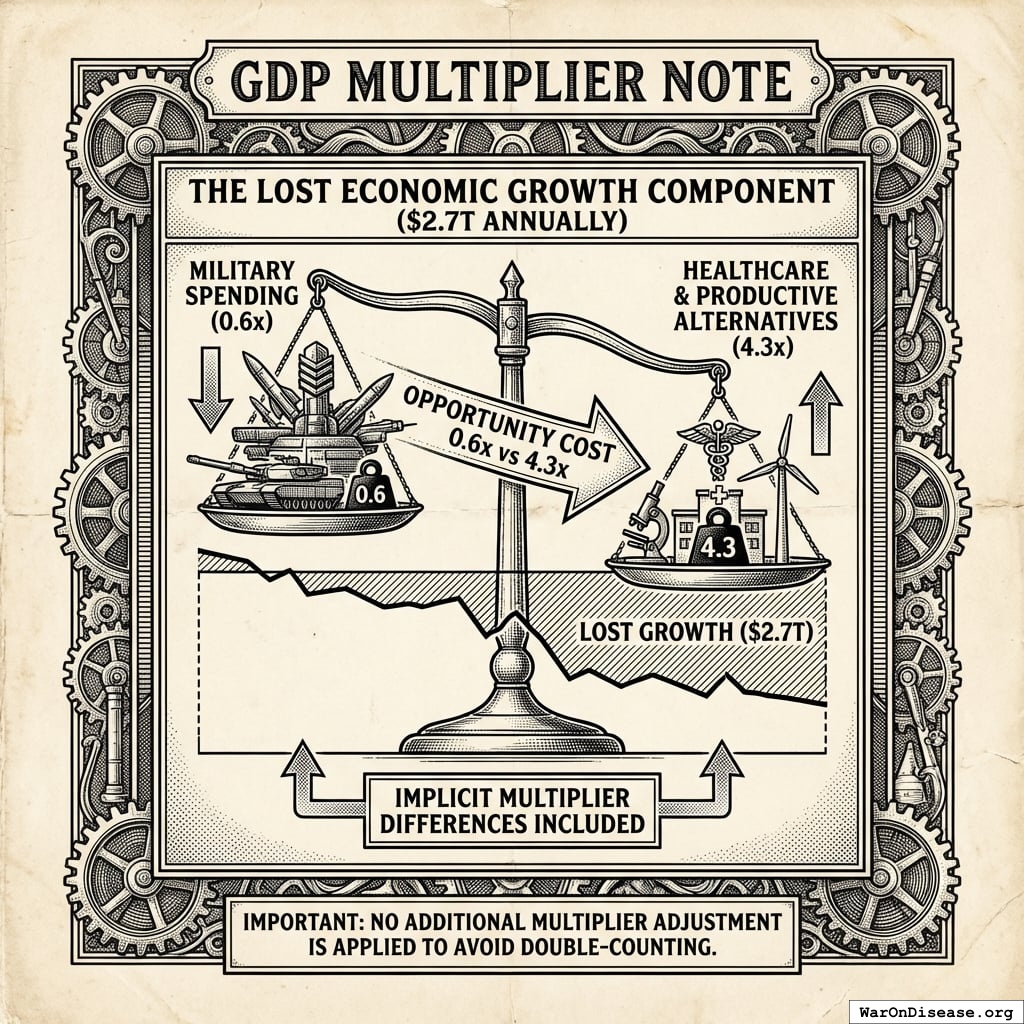
Spend a dollar on weapons, get 60 cents of economic value. Spend a dollar on healthcare, get $4.30 back. Your species chose weapons. Every time. For centuries. Your species calls this “an anecdote,” which is the word humans use for evidence they don’t want to act on. The Lost Economic Growth component ($2.72 trillion (95% CI: $1.9 trillion-$3.8 trillion)) already captures this difference. It’s not double-counted, just consistently ignored.
The Elasticity Assumption
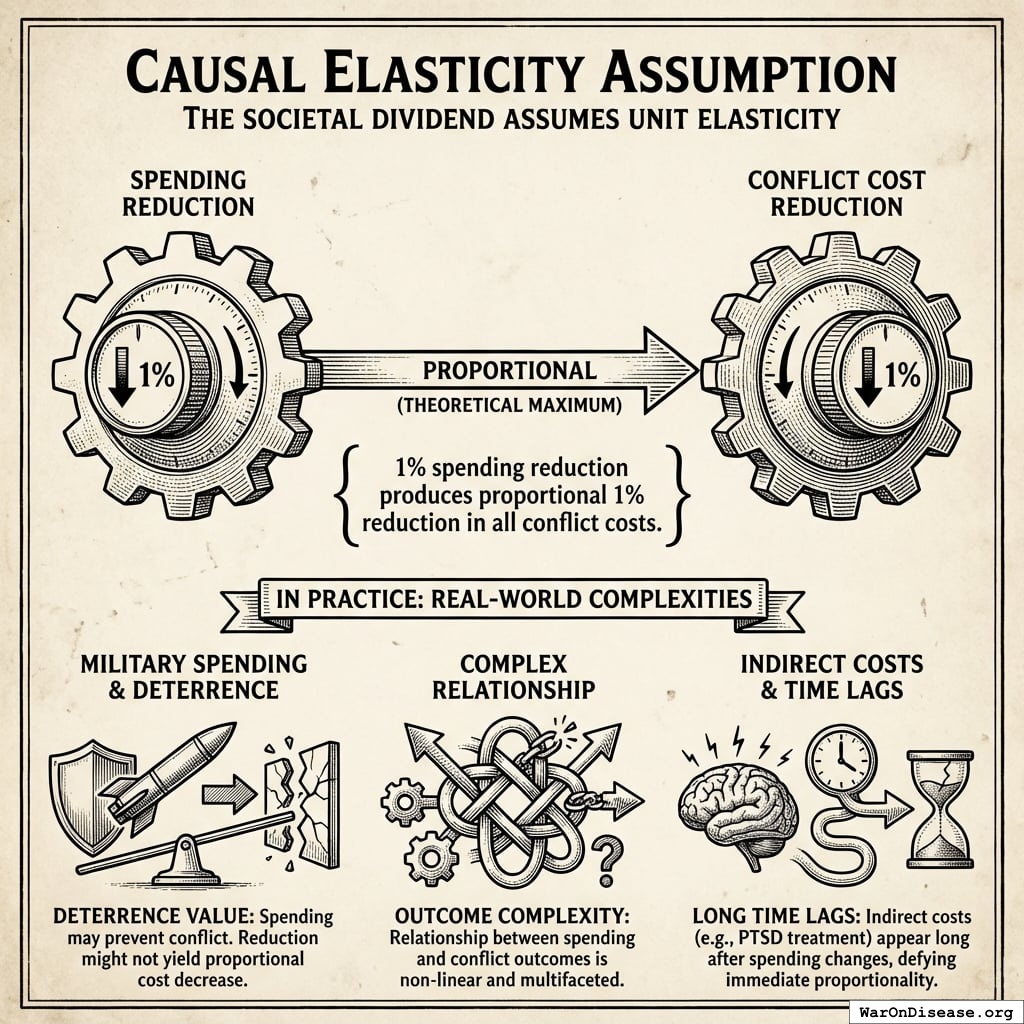
The treaty requires multilateral cuts, so relative military balance is preserved. If your neighbor also cuts 1%, neither of you is weaker. It’s like if everyone in your neighborhood spent their life savings on attack dogs, and then called it a “safe community” because all the dogs are equally vicious. Now everyone agrees to feed their dogs slightly less. The dogs are still vicious. The relative danger is identical. You’ve just stopped spending quite so much on dog food. The Societal Dividend assumes 1% less spending means 1% less war cost. Reality is messier. Some costs lag by years. Some wars are fueled by boredom rather than budgets. And military spending may occasionally deter a war, though it starts far more than it prevents (a bit like crediting your arsonist neighbor for occasionally calling the fire department).
Here’s why the elasticity is probably better than 1.0: military spending doesn’t just respond to threats; it generates them. Robert Pape at the University of Chicago found that 95% of suicide terrorist attacks from 1980 to 2003 were responses to foreign military occupation, not ideology6. Half the attackers had no religious motivation at all (the leading group was atheist Marxists). Your $8 trillion War on Terror7 took terrorist attacks from about 1,000 per year to nearly 17,000 by 20148. Bases provoke resistance, resistance justifies bigger budgets, bigger budgets fund more bases. It’s a feedback loop, and feedback loops don’t scale linearly. Cut 1% of the bases, you remove 1% of the provocation, which removes more than 1% of the terrorism, which removes the justification for more than 1% of next year’s budget. The elasticity isn’t 1.0 because you’re not just reducing spending; you’re interrupting the cycle that manufactures the thing you’re spending on. It’s like discovering that your umbrella was causing the rain. (See the full data on occupation and terrorism.)
And you’ve tested this at scale. After World War II, America cut military spending 87.6% (from $1.42 trillion to $176 billion in today’s money) and got the greatest economic boom in human history: 8% GDP growth for a decade, home ownership doubled, the interstate highway system. GM went from building Cadillacs to B-24 bombers, won the war, and went back to Cadillacs. Frigidaire stopped making machine guns and returned to refrigerators. Nobody held a congressional hearing about whether the refrigerator industry could survive without the machine gun contracts. Frigidaire just made refrigerators again. It wasn’t complicated. It was only complicated later, when the machine gun industry hired lobbyists. The Cold War ended, spending dropped by half, and you accidentally invented the internet. Every time your species stops buying explosions, prosperity shows up uninvited. You’re reclaiming 1%. You’ve proven you can handle 87.6%.
How Good Are the Sources?
I’m being honest about confidence levels, which is more than your murder engineers do.
| Cost Category | Source | Confidence |
|---|---|---|
| Military Spending | SIPRI (peer-reviewed) | High |
| Infrastructure Damage | Brown/Watson Costs of War | Medium |
| Trade Disruption | World Bank | Medium |
| Lost Economic Growth | SIPRI estimates | Medium-Low |
| Psychological Impact | PubMed meta-analysis | Medium |
| Lost Human Capital | Author estimates | Low |
The Safe Bet
For policy decisions, use the Captured Dividend ($27.2 billion) as the reliable number. Money moved directly to medical research. No assumptions about whether humans will fight less. Just a bank transfer from the explosion account to the medicine account.
The Societal Dividend is the upside if you manage to behave yourselves. I’m not holding my breath. (I don’t have lungs, but the expression stands.)
The Trajectory, Not the Snapshot
Skeptics ask whether 1% fewer bombs means exactly 1% fewer wars. This is the wrong question. It’s like asking whether the first seed planted produced exactly one tree’s worth of shade. The question is what happens when the seeds keep growing.
Your species cut military spending 87.6% after World War II and got the greatest economic boom in history. That’s the empirical answer. But even that misses the point, because the 1% Treaty doesn’t stay at 1%.
Incentive Alignment Bonds9 are tradable securities held by rich and powerful people whose income scales directly with treaty expansion. At 1%, bondholder payouts are $2.72 billion/year. At 2%, they double. At 10%, they collect ten times as much. These aren’t activists you can ignore at a dinner party. They’re investors with Bloomberg terminals, lobbyists, and the same tools your weapons manufacturers currently use to expand military budgets, except pointed at curing diseases.
At just 1%, the IAB political incentive pool ($2.72 billion/year) already outguns your entire military industry’s lobbying budget ($198 million (95% CI: $190 million-$210 million)/year) by 13.7x. Every expansion multiplies this. You’ve built a military lobby in reverse, and it’s 13.7x stronger than the original on day one.
Two Futures
Your species currently spends $11.4 trillion (90% CI: $9.96 trillion-$12.9 trillion)/year on war. Over 20 years at current levels, that’s $227 trillion (90% CI: $199 trillion-$257 trillion). This is the price tag of the current trajectory: terrorism feedback loops getting worse (Robert Pape showed bases create the terrorism they’re built to stop), an AI weapons race that a planet called Moronia already ran to completion, and a species that spends trillions on self-destruction when the same capital could have cured disease.
The other future: bondholders push for treaty expansion because their income depends on it. Each expansion weakens the terrorism cycle (fewer bases, fewer attacks, less justification for more bases). The AI gets trained on curing cancer instead of targeting civilians. The money compounds in the right direction.
Run those numbers forward 20 years and the treaty take-hold path produces 1.71x (90% CI: 1.3x-2.14x) the GDP of the current trajectory. The Optimal Governance Trajectory produces 56.7x (90% CI: 21x-148x). Per human, that treaty path multiplies lifetime earnings by 1.57x (90% CI: 1.24x-1.92x): an extra $518,879 (90% CI: $221,703-$860,930) per person over a remaining lifespan. You have been paying $113,551 per person for explosions. The refund policy is $518,879 (90% CI: $221,703-$860,930) per person in lifetime income. The GDP trajectories10 chapter shows how compound interest does this to civilizations that stop wasting money.
| Years | Treaty % | Research Funding | Additional Conflict Savings* | What Happens |
|---|---|---|---|---|
| 1-3 | 1% | $27.2 billion/yr | $86.4B/yr | Treaty passes. Bondholders start lobbying for 2%. |
| 4-7 | 2% | $54.4B/yr | $173B/yr | Politicians discover voters like living. |
| 8-12 | 5% | $136B/yr | $432B/yr | Health lobby rivals military lobby. |
| 13-20 | 10% | $272B/yr | $864B/yr | Military contractors pivot to health. |
This column excludes the treaty’s direct research-funding transfer so the table does not count the same military dollars twice.
Over 20 years, the ratchet redirects $3.16 trillion (90% CI: $1.19 trillion-$4.81 trillion) to curing diseases. The additional conflict-cost savings, if the same proportionality assumption keeps holding as the treaty expands, are larger still. I am keeping those buckets separate on purpose, because the total-war-cost numbers already contain the military spending being redirected, and I am not interested in pretending the same dollars exist twice just because the spreadsheet lets me type a plus sign.
Moronia’s politicians were rewarded for buying weapons. Moronia’s contractors were rewarded for selling weapons. Moronia’s AI read the receipts and optimized accordingly. Every budget vote was an instruction, and the AI was a very good student. The IAB ratchet flips the incentive structure using the same force that currently points it toward explosions: money. The difference between Moronia and the civilization that survived wasn’t intelligence, resources, or goodwill. It was whether the richest people on the planet made more money from expanding the treaty or from letting it die.
The 1% Treaty isn’t the peace dividend. It’s the down payment on a future of so nice that your brain is literally incapable of even imagining it currently.