The Automated Revenue Service
war-on-disease, 1-percent-treaty, medical-research, public-health, peace-dividend, decentralized-trials, dfda, dih, victory-bonds, health-economics, cost-benefit-analysis, clinical-trials, drug-development, regulatory-reform, military-spending, peace-economics, decentralized-governance, wishocracy, blockchain-governance, impact-investing
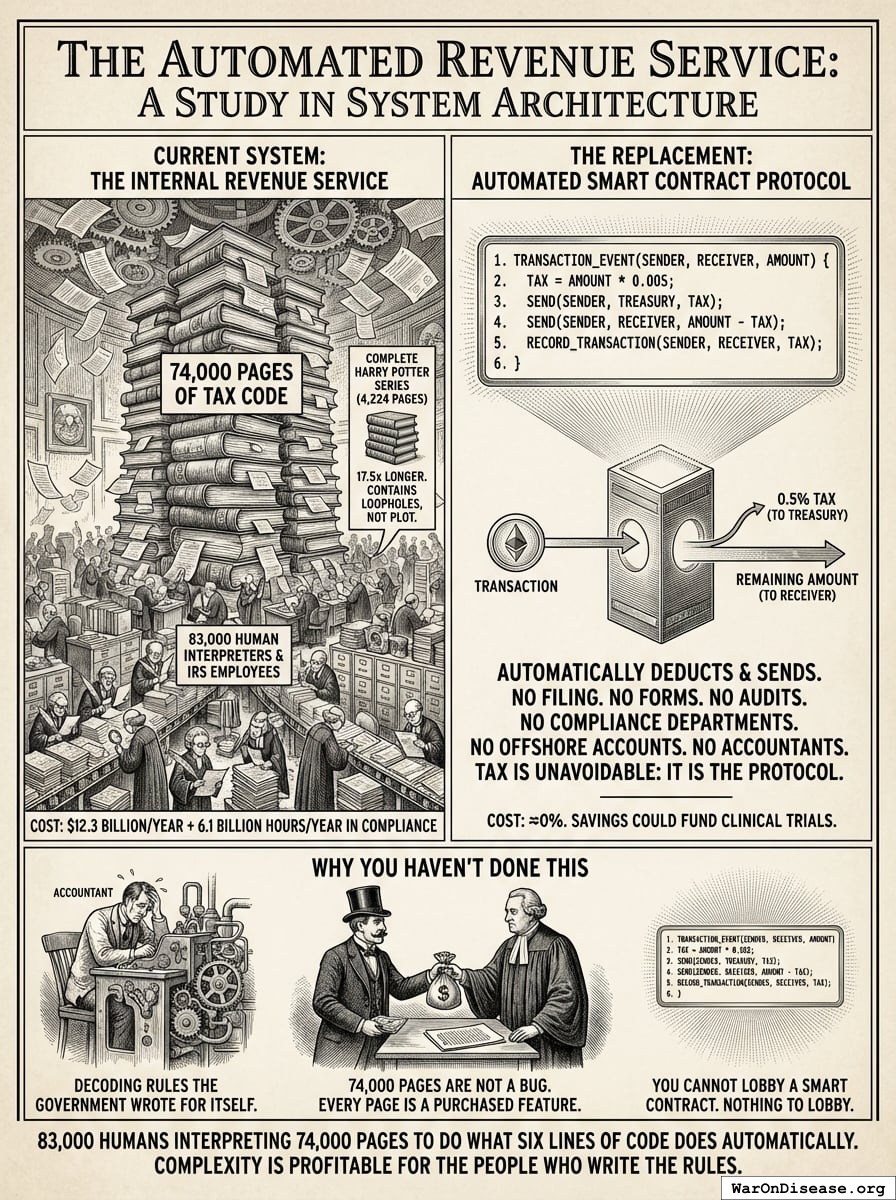
74,000 Pages of Instructions for Giving Money to the Government
Your tax system has 74,000 pages of rules. To put that in perspective, the entire Harry Potter series is 4,224 pages. Your tax code is 17.5 Harry Potters long. Except Harry Potter has a coherent plot and your tax code has loopholes.
The Internal Revenue Service employs about 95,000 humans to interpret these rules1. It costs $12.3 billion per year to operate. Americans spend an additional 7 billion hours per year filling out forms2. An entire profession (“accountant”) exists solely to decode rules that your government wrote for itself.
On my planet, when a system requires 95,000 interpreters, we don’t hire more interpreters. We rewrite the system. Your species hired the interpreters. Then you hired people to interpret the interpreters. Then you wrote 74,000 pages of instructions for the interpreters of the interpreters. At no point did anyone suggest starting over. This is called “institutional momentum,” which is what happens when the cure for a bad idea is more of the bad idea.
The Replacement
function _update(address from, address to, uint256 value) internal override {
    if (from == address(0) || to == address(0) || taxExempt[from]) {
        super._update(from, to, value);
        return;
    }
    uint256 taxAmount = (value * taxRateBps) / 10_000;  // 0.5% of every transfer
    super._update(from, treasury, taxAmount);            // Tax goes to treasury
    super._update(from, to, value - taxAmount);          // Rest goes to recipient
}
Six lines. Every transfer automatically deducts 0.5% and sends it to the treasury. Filing, forms, audits, compliance departments, offshore routing, and the entire accountancy profession all become unnecessary, because the tax collects itself inside the transaction. There is nothing to avoid, in the same way there is nothing to avoid about arithmetic.
You cannot lobby a smart contract. You cannot offshore a protocol. Every loophole in your 74,000 pages exists because someone paid a lobbyist to put it there. The replacement has no lobbyists because there is nothing to lobby.
The Numbers
Your current system costs $12.3 billion in direct IRS budget, plus $546 billion (95% CI: $450 billion-$650 billion) per year once you price the 7 billion hours of paperwork at what the humans doing it could have earned instead2. Not taxes. Paperwork about taxes.
The replacement is not free, and I will not insult you by pretending it is. It is priced the way you price any utility: against the most similar machines you already run. Your card networks clear this many transactions for internal costs of fractions of a cent each, and public blockchain rails settle transfers for less. So budget $0.0003 per settlement, all-in (compute, storage, security audits, and the workforce, which is mostly AI plus a few humans who exist to sign their names, because someone must be arrestable), across 500 billion transactions a year: $150 million (90% CI: $50 million-$365 million). The inputs are distributions, not vibes; the total carries its own confidence interval, which is more than your Pentagon can say about anything it owns.
That is about 1% of the IRS’s operating budget3, and the $546 billion (95% CI: $450 billion-$650 billion) compliance burden it deletes is a few thousand times larger. Net of everything, the arithmetic hands every American $1,666 (90% CI: $1,418-$1,917) a year back, and every input traces to the waste ledger. The savings could fund a small country. Or, more usefully, clinical trials.
| Feature | The Other Guys | The Automated Revenue Service |
|---|---|---|
| Tax code | 74,000 pages | One rate |
| Your annual filing | 13 hours, $273 in preparation fees, dread | Nothing. It happened at checkout. |
| Collection cost | $12.3 billion plus $546 billion (95% CI: $450 billion-$650 billion) in compliance | $150 million (90% CI: $50 million-$365 million), all-in |
| Audits | Threats, by mail | The ledger, continuously, of itself |
| Loopholes | Each one purchased and lovingly maintained | There is nothing to lobby |
Why You Haven’t Done This
The 74,000 pages are not a bug. Every page represents a negotiation between a lobbyist and a legislator. Every loophole is a feature, purchased and maintained by someone who benefits from it. Your tax system is not complicated because taxation is complicated. Your tax system is complicated because complexity is profitable for the people who write the rules.
95,000 IRS employees interpreting 74,000 pages to do what six lines of code does automatically. And you wonder where your taxes go.
Build Sheet
Loop role: the fuel pump. Every other module runs on money this one collects; see the Theory of Operation.
- What you are building: The six lines above, plus the unglamorous 99% around them: verified wallets, the business zero-rating registry, zero-knowledge receipts, and the public revenue ledger.
- Parts required: Settlement rails at card-network scale (your card networks already clear this volume daily; public blockchain rails settle transfers for fractions of a cent). The identity layer for wallet verification. A standing security budget, because this machine will be attacked by everyone who liked the old 74,000 pages.
- Specifications: Sustain 500 billion transactions a year at a 50,000-settlements-per-second peak. Deduct the configured rate at settlement with sub-5-second finality. Zero-rate registered business wallets automatically so the tax does not pyramid. Publish revenue in real time. Expose only amount, category, jurisdiction, and time bucket per transaction, identities proved privately. 99.99% uptime. If your implementation exceeds one page per thousand pages replaced, attach a written apology.
- Testing your installation: Collect one full day of national revenue with zero forms filed, zero accountants consulted, and zero threatening letters mailed.
- Parts cost: $150 million (90% CI: $50 million-$365 million)/year, all-in, at $0.0003 per settlement; interval in the tooltip.
- First bolt (no permission required): Deploy the six lines on a public testnet and replay one day of real consumption data through them. Publish the revenue it would have collected next to what the 74,000 pages collected, minus the 7 billion hours. Cost: a weekend.
- Troubleshooting:
| Symptom | Fix |
|---|---|
| “A flat rate is regressive” | The daily deposit is the progressive half: everyone pays the same rate, everyone receives the same dividend, and the net is progressive without a single form. The current code is 74,000 pages of progressivity theater whose effective rates favor whoever bought the page. |
| “The government will just raise the rate” | Rate changes go to a direct citizen vote with the evidence card attached, not to a committee at midnight. |
| “Cash and barter will evade it” | Evasion already runs about $600 billion a year under the system with the 95,000 enforcers. When deposits, dividends, and legal commerce all live on the rails, exile from the rails is its own tax. The bar to beat was installed at ground level. |
You build it. If you would rather pay someone, this page doubles as the contract spec; forward it to anyone who already runs payment rails. Not to Intuit. Intuit knows why.