Algorithmic Public Administration
A Protocol for Replacing Government Intermediaries with Deterministic Functions
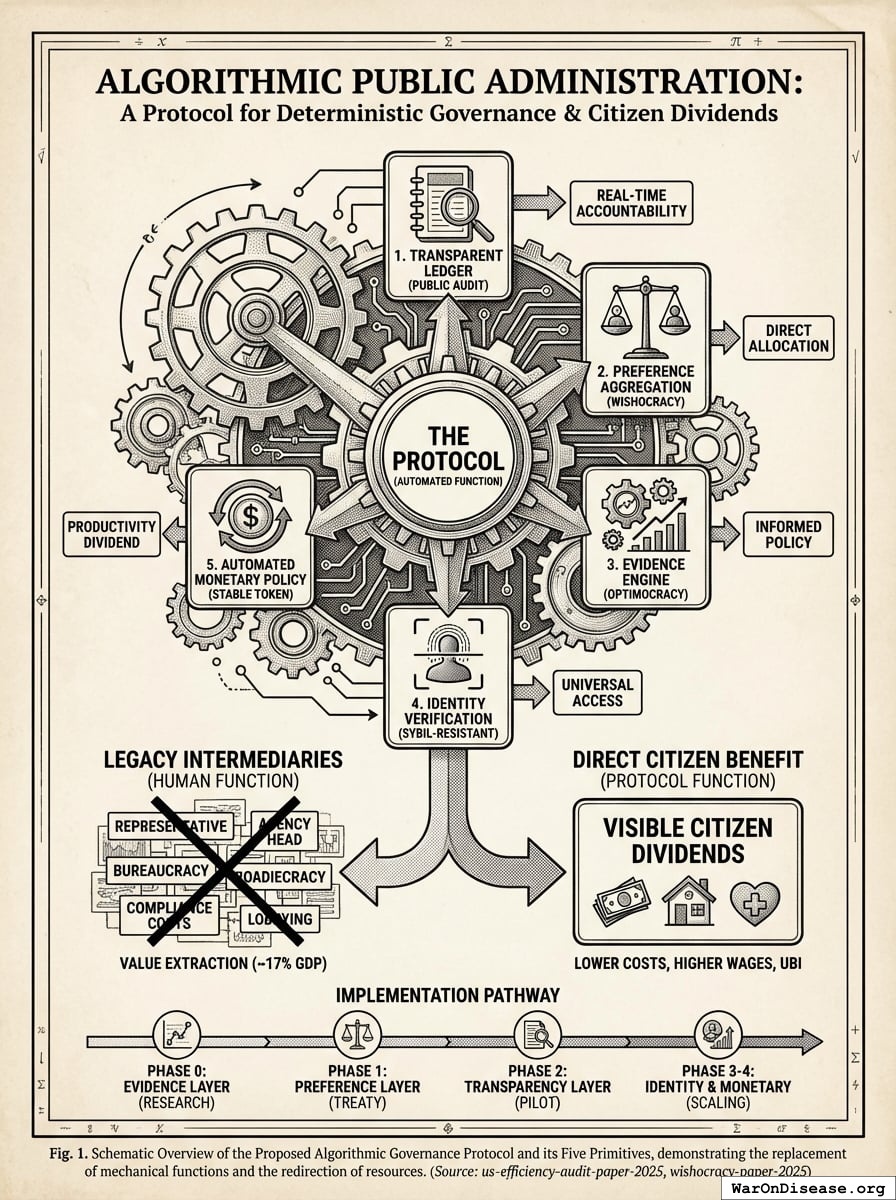
Government agencies are largely chains of humans passing records to other humans, each checking whether the previous human filled out the right form rather than whether anyone was helped. In the United States alone, this intermediation destroys or diverts $4.98 trillion (90% CI: $4.39 trillion-$5.61 trillion) per year, or 17.3% (90% CI: 15.3%-19.5%) of GDP135. We describe a protocol combining five primitives (a transparent ledger, citizen preference aggregation, a cross-jurisdictional evidence engine, an identity layer, and rules-based monetary policy) that replaces specific mechanical functions currently performed by the Federal Reserve, Internal Revenue Service, Social Security Administration, Government Accountability Office, Congressional Budget Office, Office of Management and Budget, Federal Election Commission, Securities and Exchange Commission, and Census Bureau. The protocol is deliberately neutral about policy ends. It preserves democratic control: citizens still decide resource allocation through evidence-informed pairwise preference comparison, and the algorithm executes those decisions without extracting value at each administrative layer. Whether the recovered value is returned as debt reduction, expanded public goods, a citizen dividend, or lower taxes is a choice left to voters, not embedded in the mechanism. We distinguish fiscal cash the protocol can route directly to citizens from broader societal gains that arrive as lower prices and higher wages, and we describe a phased implementation pathway that proves each component at bounded scale before the next is deployed.
algorithmic-governance, public-administration, mechanism-design, government-efficiency, direct-democracy, monetary-policy, evidence-based-policy, preference-aggregation
Intermediation cost of governance in the United States: $4.98 trillion (90% CI: $4.39 trillion-$5.61 trillion) per year. People employed to execute functions that are algorithmic in nature: millions. Time since the technology to replace them became available: over 15 years. Number of agencies replaced: zero. This is a technical specification for the obvious. It describes plumbing, not a program.
Introduction
A citizen who wants a particular research priority funded must persuade a representative, who must negotiate with other representatives, who must instruct an agency head, who must direct a bureaucracy, who must process applications, who must distribute funds. Six intermediaries sit between “I want this” and “this happens.” Each layer extracts value (salaries, overhead, compliance costs) and introduces preference distortion (lobbying, logrolling, regulatory capture). The aggregate cost of this intermediation in the United States alone is $4.98 trillion (90% CI: $4.39 trillion-$5.61 trillion) per year135, or 17.3% (90% CI: 15.3%-19.5%) of GDP.
Most of what these intermediaries do is mechanical. Tax calculation, benefit distribution, budget execution, auditing, census enumeration: these are algorithms currently executed by humans. Humans are slower, more expensive, and more susceptible to capture than software.
This paper describes a protocol that replaces specific mechanical agency functions with deterministic code while preserving democratic control over what those functions do. Citizens still decide how resources are allocated, through evidence-informed pairwise preference aggregation. The protocol executes their decisions without extracting value at each administrative layer.
The proposal is not to replace government. It is to replace the intermediaries between citizens and governance outcomes. Democracy is a decision-making system, not an employment program. The functions that require human judgment (enforcement, diplomacy, adjudication) remain human. The functions that are arithmetic become arithmetic. This is the same category of change as the ATM, the spreadsheet, and electronic payments: each replaced a specific manual function without any claim to replace the judgment around it. Nobody argued that reconciling a ledger by hand was a sacred act of discretion.
The protocol is empty of policy content. It does not set the size of government, what to tax, or what to fund; it changes only the cost and integrity of executing whatever voters decide.
The Cost of Intermediation
A first-principles audit of United States governance135 identifies four categories of waste:
- Direct spending waste: $1.1 trillion (90% CI: $1.03 trillion-$1.17 trillion)/year in military overspend beyond deterrence requirements, corporate welfare, agricultural subsidies paid to not produce food, fossil fuel subsidies, and drug-war enforcement
- Compliance burden: $1.13 trillion (90% CI: $856 billion-$1.49 trillion)/year in tax compliance costs ($546 billion (95% CI: $450 billion-$650 billion)) and regulatory red tape ($580 billion (95% CI: $290 billion-$1 trillion))
- Policy-induced GDP loss: $1.56 trillion (90% CI: $1.11 trillion-$2.1 trillion)/year from housing supply restrictions ($1.4 trillion (95% CI: $500 billion-$2 trillion)) and tariffs ($160 billion (95% CI: $90 billion-$250 billion))
- System inefficiency: $1.2 trillion (90% CI: $1 trillion-$1.44 trillion)/year in healthcare system waste ($1.2 trillion (95% CI: $1 trillion-$1.5 trillion))
Total: $4.98 trillion (90% CI: $4.39 trillion-$5.61 trillion)/year, and that is the United States alone. Extended across all governments, the opportunity cost of suboptimal governance runs on the order of $101 trillion (90% CI: $59.6 trillion-$161 trillion)/year in foregone health and wealth54; the US figure is one country’s slice of it. That is the size of the problem this protocol addresses. Two adjacent gains sit outside that audit arithmetic and are treated separately below: roughly ~$500B/year in recovered tax gap and roughly ~$1.1T/year in excess financial-sector cost, with ~$2.3T/year as the gross ceiling if most money-moving migrates to the protocol.
At 335 million people, the conservative quantified stack in this paper is roughly $19,800 per person per year, or about $79,000 for a family of four. The point is not that every dollar becomes a government transfer. The point is that every dollar stops being consumed by intermediation.
Every category traces to the same root cause: intermediaries whose incentives diverge from the citizens they serve. The IRS is expensive because the tax code is complex. The tax code is complex because legislators grant exemptions to organized interests. Those interests seek exemptions because the return on lobbying is extraordinary. The exemptions require interpretation, which sustains a compliance industry, which lobbies for more complexity, which produces more exemptions. This is not dysfunction. It is the system performing as designed: each participant acting rationally inside a structure that produces collectively irrational outcomes. The protocol removes the structure.
System Architecture
The protocol has five parts:
Transparent ledger. Every government transaction recorded on a shared, publicly auditable ledger. Private settlements record only the minimal fields needed for tax collection and macroeconomic measurement, with identities and item-level details proved privately. This makes ex-post auditing (GAO) largely unnecessary and closes the opacity that corruption depends on.
Preference aggregation. Verified citizens in the relevant jurisdiction express resource-allocation preferences through a short series of pairwise comparisons. An aggregation algorithm136 produces budget weights via eigenvector decomposition (the same class of mathematics used in web-page ranking) and, where legal change is required, direct rule votes. This replaces the appropriations bottleneck and much committee bargaining without deciding what the budget should contain.
Evidence engine. A cross-jurisdictional causal-inference system that compares policy and budget outcomes across thousands of jurisdictions and identifies which choices actually move two widely shared outcome metrics: growth in real after-tax median income and median healthy life years. It has two components. The Optimal Policy Generator evaluates laws and regulations and produces enact / replace / repeal / maintain recommendations137. The Optimal Budget Generator estimates the spending level in each category at which the marginal dollar stops paying for itself138. Together they supply, in real time, the analysis the CBO and executive-branch scoring offices produce slowly and in isolation.
Identity layer. Continuous, sybil-resistant citizen verification. Every verified citizen counts exactly once for allocation, distribution, and enumeration. This replaces the decennial census headcount and the eligibility-verification bureaucracy without prescribing what anyone is entitled to.
Rules-based monetary policy. A transparent, rule-bound monetary policy targeting stable purchasing power in a rule-defined basket, with money creation tied to measured productivity growth rather than to discretionary committee judgment.
These five primitives are interdependent. The ledger enables accountability without a standing army of auditors. Preference aggregation enables allocation without an appropriations bottleneck. The evidence engine enables informed choice without a scoring monopoly. Identity enables distribution and enumeration without duplicate bureaucracies. Rules-based money enables stable prices without discretionary committees. Remove any primitive and the system degrades.
Monetary Policy and Revenue
Discretionary versus rules-based money
Monetary policy in the United States is set by a committee exercising discretion. The debate over whether a transparent rule would do better is old, mainstream, and cross-ideological: it runs from Milton Friedman’s fixed-growth rule to John Taylor’s interest-rate rule to contemporary nominal-GDP-targeting proposals. The protocol does not resolve that debate on the merits. It observes that a rule, once chosen, can be executed transparently by software rather than opaquely by discretion, and that the distributional consequences of money creation can be made explicit rather than incidental.
The most consequential of those consequences is who receives new money first. When new money enters the economy through banks and large counterparties, those first receivers spend or lend it before prices adjust, capturing purchasing power at the expense of later receivers. This first-receiver advantage (sometimes called the Cantillon effect) is recognized across mainstream and heterodox economics alike; it is arithmetic, not a school of thought. A rules-based protocol can hold the first-receiver question open as an explicit policy choice instead of settling it, by default, in favor of whoever is closest to the central bank.
A second consequence is fiscal accountability. Creating money to finance spending lets a government avoid the visible, felt cost of a direct tax, and a cost that is not felt is harder to refuse. This has mattered most for war: deficit- and inflation-financed conflict does not force the electorate to vote on a war tax, removing a brake that direct taxation would apply. The stakes are not small, since wars since 1900 have killed roughly 310 million people. A transparent, rule-bound monetary policy cannot stop a war, but it makes the fiscal cost of one legible instead of hidden, which is the same accountability logic behind the transparent ledger.
Automated tax collection at settlement
The novel element is not a particular tax; it is the collection mechanism. When money moves on the ledger, the tax due on that transaction is computed and withheld in the same step, so most taxpayers never file a return. This is agnostic about the base. A jurisdiction can settle a broad consumption tax (of the kind that appears in OECD value-added taxes and national-retail-tax proposals) or route income, capital-gains, corporate, estate, or wealth components through the same automatic settlement. What the protocol changes is that collection happens at settlement, the displayed rate is set by a published rule rather than by annual negotiation, and any rebate is delivered as an automatic deposit rather than a filed claim. What to tax, and how progressively, stays a voter choice.
Collection at settlement. Whatever base voters choose, the tax on a covered transaction is withheld automatically when the transaction settles. If the base is a consumption tax, transfers between registered business accounts, capital formation, and pure balance-sheet reallocations can be zero-rated automatically by wallet type so the tax does not pyramid through supply chains; an income, capital, or estate base settles against the relevant flows the same way. Most taxpayers file nothing, because return processing is automated; enforcement against evasion, a judgment function, remains staffed.
Where the base is a single displayed rate, that rate has two destinations behind it. The fiscal component funds the government’s democratically determined budget. The stabilization component does not fund spending; when activated, it is retired or held in a non-spendable reserve until the price basket returns to target. This separation avoids a common conceptual error: the same dollar cannot both finance expenditure and be withdrawn from circulation.
Once citizens and businesses can hold verified settlement wallets directly on the protocol, banks are no longer required as deposit warehouses, payment-rail operators, and first receivers of new money. What survives is lending. Underwriting default risk, duration risk, and project selection remain real work. Mortgages, business loans, and venture finance still exist, funded by competitive credit pools layered on top of the protocol rather than by institutions that also control custody and payments.
Returning recovered value. When the protocol recaptures fiscal cash (eliminated agency overhead, reclaimed direct-spending waste, recovered tax gap), that value has to go somewhere. The protocol is agnostic about where. Four options are on the menu, in no fixed priority, and citizens choose among them through preference aggregation:
- debt reduction;
- expanded funding for public goods that clear the evidence engine’s cost-effectiveness bar;
- an equal per-citizen dividend, of the kind Alaska has paid from resource revenue since 1982; or
- a lower headline tax rate.
Nothing in the mechanism requires the dividend option, and nothing forbids it. New currency created to prevent deflation as output grows (a productivity dividend) still has to enter somewhere, and the design insists only that the entry point be an explicit choice rather than defaulting silently to first receivers via the banking system. Whether that issuance funds a rate cut, debt reduction, public goods, or an equal per-citizen credit is set by voters like any other allocation.
Why target stable prices rather than deflation
A growing economy with a fixed money supply produces mild deflation: more goods, same money, falling prices. Whether that is benign or harmful is contested (the deflationary late-nineteenth-century United States, for instance, coincided with severe agrarian debt distress). The protocol defaults to stable purchasing power for three reasons:
- Legibility. A visible, stable unit of account is easier for households and firms to plan around than a slowly appreciating one, and easier to communicate.
- Debt neutrality. Deflation raises the real burden of existing debts; inflation erodes savers’ balances. A stable target is neutral between borrowers and lenders rather than favoring either.
- Distribution over doctrine. The strongest objection to discretionary money is not that some inflation exists; it is that the gains from money creation accrue to first receivers. A rules-based system can create exactly enough currency to keep prices stable and make the recipient of that new money an explicit choice, rather than defaulting it to the banking system.
This is a pragmatic default, not a monetary doctrine. The rule’s objective is itself a voter choice: a jurisdiction can encode price stability, a nominal-income path that also stabilizes employment, a dual mandate of the kind the Federal Reserve already operates under, or a mild-deflation target. The mechanism executes whichever objective is chosen; it does not select one.
Measuring prices without gaming the measure
If the price index is wrong, the rule stabilizes the wrong thing. The Consumer Price Index has well-documented, technically debated biases (substitution effects, hedonic adjustment, owner’s-equivalent rent, geometric weighting) and is compiled by the same government whose obligations (indexed benefits, inflation-linked securities) move with the reported number. Whatever one concludes about the size of the biases or the good faith of the measurement, the governance problem is structural: the party whose liabilities are indexed to a number should not be the sole party computing it.
The protocol uses a rule-bound purchasibasket derived from actual settlement data on the ledger rather than surveys or imputations. For private transactions, the ledger exposes only the fields needed for macro measurement and tax collection (amount, standardized category, jurisdiction, time bucket); identities, counterparties, and item-level receipts stay private and are validated with zero-knowledge proofs. The basket is anchored to essential categories (energy, food, housing, healthcare). Weights are derived from observed spending, fixed for a governance interval, and updated only on a public schedule. The entire calculation is public and auditable. Anyone can verify it; no single party can quietly adjust it.
Why not simply restore a gold standard
A metallic standard constrains money creation by requiring a physical reserve; a purchasing-power rule constrains it by targeting an index. Both discipline money creation, which is the goal of anyone who wants predictable, rule-bound money. The rule has three practical advantages over metal: it can accommodate real growth without passively rewarding existing holders; it is harder to suspend, because it runs on a distributed ledger rather than a single government’s decree; and it is auditable in real time rather than requiring trust that the metal is in the vault. The “backing” is a commitment that the unit will buy a defined basket tomorrow as it does today.
What this replaces
| Current System | Replacement | Mechanism |
|---|---|---|
| Federal Reserve (12 FOMC members, ~24,000 staff, ~$6.8B/year) | Transparent monetary rule | Rule chosen democratically, executed by software |
| Discretionary money creation | Rule-bound issuance | Recipient of new money made an explicit choice |
| First-receiver advantage (proximity to issuance) | Explicit first-receiver rule | Distribution stated, not incidental |
| Commercial banks as money utilities | Protocol wallets + competitive credit funds | Custody and settlement become protocol functions; lending remains a risk-priced service |
| Manual filing and return processing | Automatic collection at settlement | Base set by voters; returns auto-processed; evasion enforcement retained |
| Annual tax-rate negotiation | Rule-based fiscal + stabilization adjustment | Budget funding separated from price stabilization |
The Tax System It Replaces
The federal income tax fit in 27 pages in 1913. The current federal tax system (the Internal Revenue Code plus Treasury regulations, rulings, and case law) fills roughly 74,000 pages of the CCH Standard Federal Tax Reporter. Most of the growth is accreted exemptions, deductions, and credits, each of which had a beneficiary and an advocate. The result is less a revenue mechanism than a sedimentary record of past bargains.
Americans spend about 6.1 billion hours per year on tax compliance, the equivalent of roughly three million people working full-time on paperwork. The IRS employs about 95,000 people139, and its operating budget of roughly $14 billion is dwarfed by the $546 billion (95% CI: $450 billion-$650 billion) per year122 in compliance burden the surrounding system imposes on everyone else. Regulatory compliance adds another $580 billion (95% CI: $290 billion-$1 trillion) per year54.
The compliance industry has a structural interest in complexity. The IRS could pre-fill most returns from data it already receives (wages from employers, interest from banks, gains from brokerages), as many countries do; it largely does not, in part because firms that sell tax-preparation services lobby against it. Taxpayers thus pay to sustain a problem that some of the paid parties have an interest in preserving. Simplifying the base is one of the few reforms with constituencies on both the left (who dislike the regressive burden of compliance) and the right (who dislike the drag and the rent).
What this replaces
| Current System | Replacement | Savings |
|---|---|---|
| IRS (~100,000 employees) | Protocol-level settlement tax | $546 billion (95% CI: $450 billion-$650 billion)/year direct |
| 74,000-page tax code | One rate, applied uniformly | 6.1B hours/year compliance eliminated |
| Tax-compliance industry | No longer required | $200B+/year in private compliance costs |
| Tax evasion (~$600B/year net gap) | Low-rate settlement tax collected at source | ~$500B+/year recovered |
The 27-page code of 1913 could have been a function. The 74,000-page version is, in effect, a jobs program for the people who interpret the function. Returning to a function is a matter of engineering, not of choosing a party.
Allocation
The problem
The United States federal budget of roughly $6.8 trillion is allocated by 535 members of Congress through committee negotiation, floor votes, conference reports, and roughly $4.4 billion (95% CI: $3.74 billion-$5.06 billion) per year in lobbying. The CBO scores legislation over weeks or months; the OMB prepares the executive budget request. By the time a budget is enacted (when one is: the federal government has lapsed into shutdown more than 20 times since 1976), the document reflects donor preferences filtered through electoral incentives, committee seniority, floor amendments, and conference bargaining. At no point does a citizen directly express a preference over how their money is spent.
Representatives are elected on bundled platforms, so issue-level preference expression is impossible. A voter who wants more medical research and less military spending, or lower taxes and more border security, cannot register that combination. They get a package designed to win an election, not to match any individual’s priorities. This is the principal-agent problem operating at the scale of a multi-trillion-dollar budget.
The protocol
Preference aggregation replaces the appropriations process and, where needed, the committee bottleneck in rulemaking. Each verified citizen in the relevant jurisdiction performs a short series of pairwise comparisons (“$100 toward medical research or $100 toward border security?”), with a continuous slider rather than a binary choice. The aggregation algorithm converts these into budget weights via eigenvector decomposition136.
The evidence engine informs those comparisons. Before allocating, citizens see what the available evidence says each option actually produced where it was tried. This is deliberately symmetric: it does not favor spending or cutting, only whatever the cross-jurisdictional record supports. Budget weights update continuously, so there is no annual cliff, no continuing resolution, and no shutdown.
Some questions are budgetary and some are legal. If the question is how much to spend, the aggregation allocates the money and the Optimal Budget Generator supplies the marginal-return evidence. If the question is whether a tariff, subsidy, mandate, or zoning restriction should exist at all, the Optimal Policy Generator supplies the enact / replace / repeal / maintain evidence and citizens vote on the rule directly.
The reach of the evidence engine is broad, and pointedly nonpartisan about direction. It scores defense spending against a first-principles deterrence baseline the same way it scores social spending against outcomes; a category that is underfunded relative to the evidence is flagged just as loudly as one that is overfunded. Applied to contested areas, this cuts across party lines: drug policy is evaluated on measured outcomes (treatment-versus-incarceration comparisons such as Portugal’s) rather than on rhetoric; occupational licensing and land-use rules are evaluated on their measured effect on income and mobility; the approval of medical treatments can be informed by continuously updated real-world outcome data rather than by a single agency’s slow, all-or-nothing determination; and where the evidence shows an unpriced harm or an under-provided public good (pollution, monopsony wages, neglected public health), the engine flags the gap as loudly as it flags a rule worth repealing. In every case the engine reports what the data support and leaves the vote to citizens.
Direct allocation governs discretionary spending within constitutional limits; it is not a mechanism for a bare majority to suspend protected rights. Individual and minority protections, property rights, and the tax base itself are constitutional parameters, changeable only by supermajority, so the day-to-day allocation layer cannot vote them away.
What this replaces
| Current System | Replacement | Mechanism |
|---|---|---|
| Congressional appropriations (535 members) | Verified citizens, direct allocation | Eigenvector preference aggregation |
| OMB (~530 staff, $143M/year) | Democratic budget weights | Automated |
| CBO (275 analysts, months per score) | Optimal Budget Generator | Real-time empirical scoring |
| Regulatory analysis scattered across agencies | Optimal Policy Generator | Cross-jurisdictional enact/replace/repeal/maintain evidence |
| Lobbying industry ($4.4 billion (95% CI: $3.74 billion-$5.06 billion)/year) | No intermediary to lobby | Function is removed |
A budget that cannot be agreed on does not shut the system down, because there is no negotiation to deadlock. The weights update; the ledger executes.
Distribution
The problem
The United States spends over $1.1 trillion per year on means-tested programs across 89 federal programs, of which roughly $100 billion goes to administration: determining who qualifies, processing applications, verifying eligibility, and policing fraud. A significant fraction of each program’s cost is spent deciding whether a person qualifies rather than helping them, and the people least able to navigate application processes (the disabled, the elderly, non-English speakers, the severely ill) are often those who need help most. Social Security disability determinations averaged 230 days in FY2024, up 81% from 121 days in 2019; appeals take longer still.
Whatever one believes the right level of assistance is, spending a large share of it on gatekeeping is a pure efficiency loss, independent of how generous the policy is.
The protocol
The protocol provides a distribution rail, not a distribution policy. The rail has three properties: the identity layer verifies who counts as a citizen; a formula converts a democratically chosen pool into per-recipient amounts; and settlement deposits those amounts automatically, without applications, caseworkers, or waiting periods. The rail can deliver an unconditional per-citizen payment, a negative income tax, categorical benefits, or a mix. Which of those a jurisdiction runs is set by voters through preference aggregation, not by the protocol.
Two design observations follow:
- Automating delivery removes the gate. Where a benefit is fundamentally a transfer, delivering it automatically to verified recipients removes the eligibility bureaucracy without changing the benefit’s size. Whether that transfer is best delivered as cash or in kind is itself a voter choice: the rail can deposit cash, or it can fund in-kind provision (health coverage, housing, child nutrition) where voters judge it achieves something cash does not.
- Some functions are not ordinary transfers. Catastrophic risk (a loss too large for a household to self-insure), health coverage, support for those who genuinely cannot manage funds on their own behalf, and investments in children are structurally different from ordinary income support, and are better kept as explicit, rule-bound categories than folded into flat cash or dissolved into caseworker discretion.
The evidence engine evaluates outcomes against two widely shared metrics: growth in real after-tax median income and median healthy life years. Median rather than average is a Goodhart safeguard, a figure that a handful of large gains cannot inflate. Voters can weight additional outcomes (aggregate growth, mobility, an economic-freedom index) into the evaluation set; the two median metrics are the default headline, not the only permitted objective.
What this replaces
| Current System | Replacement | Mechanism |
|---|---|---|
| SSA benefit calculation and distribution | Deterministic distribution function | distribute(pool / citizenCount) for the cash portion |
| Cash-transfer administration (SNAP, TANF, SSI overhead) | Automatic deposit on the rail | No eligibility bureaucracy for pure transfers |
| Means-tested eligibility determination | Identity verification + rule-bound exception categories | Gate removed where the benefit is a transfer |
| Poverty-determination bureaucracy | Eliminated for the cash portion | The protocol distributes; it does not adjudicate desert |
The system currently spends a large share of assistance deciding who deserves it. Automating delivery spends more of the budget on the goal and less on the gate.
Accountability
The problem
The Government Accountability Office employs roughly 3,600 staff, spends about $812 million per year, and produces reports that arrive months or years after the spending they examine, because government financial systems are opaque and must be reconstructed by hand. The Department of Defense has failed its financial audit every year since audits became mandatory in 2018 (seven consecutive failures through FY2024), and the consequence of those failures has been essentially nil. Freedom of Information Act requests, the citizen’s remaining window into spending, are answered in months; complex requests take years, and some agencies carry backlogs in the tens of thousands.
The protocol
When every government transaction is on a public ledger, auditing stops being a periodic activity and becomes a property of the system. Every unit spent by any governance function is visible in real time. There is no document to request and no official to interview. Anyone can verify any public expenditure and trace any allocation from preference to disbursement. A ledger cannot pass or fail an audit; it is the audit.
What this replaces
| Current System | Replacement | Savings |
|---|---|---|
| GAO (~3,600 staff, $812M/year) | Transparent ledger | $812M/year + audit lag eliminated |
| Inspector General offices (per-agency) | Redundant; the watched activity is public | Hundreds of millions/year |
| FOIA request processing (months-to-years) | Unnecessary; spending is public by default | Administrative cost + delay eliminated |
Transparency of public money is a value both parties claim. The protocol supplies it by construction rather than by promise.
Political Incentives
The problem
Politicians raise campaign funds from donors whose interests need not align with constituents’, and the returns to that spending are documented. Corporate welfare of $181 billion (95% CI: $150 billion-$220 billion) per year54 is, in part, the return on $4.4 billion (95% CI: $3.74 billion-$5.06 billion) per year in lobbying; studies of individual campaigns have found returns in the thousands of percent (the American Jobs Creation Act of 2004 delivered $62.5 billion in tax breaks to 93 corporations that spent $282.7 million lobbying for it140). The revolving door completes the circuit: roughly half of departing members of Congress become lobbyists. None of this is illegal, which is precisely the problem; it is the system operating as designed.
The protocol
Two properties of the transparent ledger reduce the leverage of concentrated money without banning anything. First, an alignment measure136 continuously and publicly compares each representative’s votes to their constituents’ evidence-informed preferences, so divergence is visible rather than buried. Second, because allocation and rulemaking increasingly run through direct preference aggregation and public evidence, the number of discretionary levers available to purchase shrinks. You cannot buy an exemption that no committee has the power to grant.
What this replaces
| Current System | Replacement | Mechanism |
|---|---|---|
| FEC (regulator of a donor-driven system) | Fewer discretionary levers to capture | Structural reduction |
| Opaque campaign influence | Public alignment measurement | Divergence from constituents made visible |
| Lobbying industry ($4.4 billion (95% CI: $3.74 billion-$5.06 billion)/year) | Fewer purchasable intermediaries | Targets removed as functions are automated |
The return on lobbying is high because the intermediary it buys is cheap relative to the payoff. Removing the intermediary removes the target. There is no discretionary exemption to sell when there is no discretion to exercise.
Capital Formation and Investor Protection
The problem
The Securities and Exchange Commission protects investors in part by restricting who may invest. Under the accredited-investor rule, a person may buy into private companies and early-stage deals only with income over $200,000 ($300,000 with a spouse) or net worth over $1 million excluding a primary home141. Most households fail that test and are therefore barred from an asset class that has historically returned roughly 17% (95% CI: 13%-22%) a year, while the retirement accounts they are permitted to hold return about 6.5% (95% CI: 5%-8%). The thresholds are written in 1982 dollars and have never been indexed142, so inflation steadily enlarges the excluded class.
The stated justification is fraud protection, but a wealth test does not prevent fraud; it selects who is permitted to bear the risk and collect the returns. Fraud is separately illegal and separately enforced: the SEC brought 583 enforcement actions and collected a record $8.2 billion in FY2024143. And the screen fails on its own terms. Every victim of Bernie Madoff’s $64.8 billion fraud was accredited144. The screen also sits oddly beside the rest of the law: the same government that bars most households from a $1,000 startup stake permits them unlimited gambling, and U.S. commercial gaming took in a record $66.5 billion in 2023145. And when investment access was actually broadened (Regulation Crowdfunding, effective 2016), the predicted fraud wave did not arrive: roughly $1.3 billion flowed across some 8,500 offerings through 2024, and the SEC’s own review found “a low incidence of fraud”146.
The protocol
Replace gatekeeping-by-wealth with protection-by-transparency, using three properties of the public ledger rather than offices of reviewers:
- Disclosure by default. Every issuer’s filings, capitalization table, use of funds, and ongoing results are published to the ledger in standardized, machine-readable form.
- Algorithmic fraud detection. Pattern analysis runs continuously over the ledger and flags the statistical signatures of fraud (impossible returns, circular flows, undisclosed related-party transfers) as they occur rather than after a collapse.
- A chosen access standard, cheaply enforced. Who may bear private-market risk (a wealth gate, a competence check, a holdings cap, or disclosure-only) is a policy choice; the ledger makes whichever standard voters choose cheaper to apply and harder to evade than a paper net-worth attestation.
What this replaces
| Current System | Replacement | Mechanism |
|---|---|---|
| Accredited-investor wealth test (paper attestation) | Voter-set access standard + standardized disclosure + continuous detection | Protect by information and monitoring, at lower enforcement cost |
| SEC disclosure review (~$2.1–2.4B/year, ~5,000 staff147) | Disclosure-by-default on a public ledger | Filings public and machine-readable by construction |
| Post-hoc fraud enforcement | Continuous algorithmic detection | Fraud flagged as it happens, not litigated after |
The wall was never the protection. The disclosure was.
Identity, Enumeration, and Migration
The problem
The 2020 census cost $14.2 billion, counted everyone once, took months to process, was out of date by publication, and will not be repeated until 2030. Meanwhile most residents carry a device that reports their location continuously to several private companies. The government spends billions to learn, once per decade and with a lag, a coarse version of what is already measured continuously elsewhere. Separately, immigration mixes two different questions (the rule for who may enter, which is a matter of law and enforcement, and the administration and pricing of whatever entry the law authorizes) into one contested process, so the fiscal and allocative dimension is handled implicitly rather than explicitly.
The protocol
Continuous, sybil-resistant verification through the identity layer. Every verified citizen has exactly one identity in the jurisdiction where they vote and receive distributions, and the population count becomes a real-time view function rather than a decennial survey. The same layer prevents double-counting (census), double-spending (monetary system), and double-voting (allocation): one primitive, three functions.
The identity layer also makes the fiscal side of migration explicit without touching the enforcement side, which remains a matter of law and human judgment. How many people may enter, and by what criteria (lottery, points, family ties, price, humanitarian status, or a mix), is set by voters and law, and may be any level, including a low one; enforcing that rule is an objective the protocol supports, not a cost to minimize. What the mechanism adds is that, for whatever quota voters authorize, allocation and any fee can be handled transparently rather than through smugglers and informal markets, and if a jurisdiction chooses to price entry, the revenue can be shared with existing citizens rather than dissipating into unpriced congestion. This separates two questions current policy conflates: who is permitted to enter (a political and enforcement question, left to law) and how whatever entry voters authorize is administered and priced (a mechanical question the protocol can handle).
What this replaces
| Current System | Replacement | Savings / Effect |
|---|---|---|
| Census Bureau ($14.2B per decade) | Continuous real-time count | ~$1.4B/year amortized |
| Voter registration (separate bureaucracy) | Merged into identity layer | Administrative cost eliminated |
| Per-program eligibility verification | Unified in identity layer | Redundant systems eliminated |
| Manual administration of authorized entry | Transparent allocation and optional pricing of the voter-set quota | Entry rule and enforcement unchanged; any fee shared with citizens |
Where the Recovered Value Goes
If the protocol saves trillions, it is worth being precise about where that value currently sits and how the savings behave, because the categories differ in kind. The accounting rule below is deliberately conservative.
Agency operating overhead
This is the direct public cost of running intermediary agencies. It is real and recoverable, and smaller than the value diverted by captured policy:
| Agency/System | Annual Admin Cost | Replacement |
|---|---|---|
| Federal Reserve | ~$6.8B operational | Rules-based monetary policy |
| IRS (agency operations) | ~$14B | Protocol-level settlement tax |
| SSA + welfare administration (not benefits) | ~$100B across 89 programs | Distribution rail |
| GAO + IG offices | ~$1B+ | Transparent ledger |
| CBO | ~$60M | Optimal Budget Generator |
| OMB | ~$143M | Preference aggregation |
| Census Bureau | ~$1.4B/year amortized | Identity layer |
| Total public operating overhead | ~$123B/year |
Private compliance burn is larger but different in kind. Americans and firms spend $546 billion (95% CI: $450 billion-$650 billion) per year on tax compliance and $580 billion (95% CI: $290 billion-$1 trillion) per year on regulatory red tape. That value returns to households and firms as time, fees not paid, and lower operating costs. It is real gain, but it is not a Treasury pool and is therefore not counted as routable cash.
Note what is not in this table: the benefit pools themselves. The conservative floor below excludes current transfer benefits to avoid mixing transfer policy with waste removal, not because transfer programs are free of waste; improper payments (which the GAO put at about $162 billion federally in FY2024148) and program duplication are audited on the same evidence basis as everything else.
Financial intermediation. The audit totals count government waste, not the private cost of moving money through the same architecture. Finance and insurance grew from about 4% of US GDP in the early 1970s to about 8% (roughly $2.3 trillion/year) by Q3 2025149,150, without a matching improvement in the unit cost of intermediation. A conservative read of the efficiency opportunity is the post-1971 doubling itself, roughly 4% of GDP or about $1.1 trillion/year; supporting micro evidence finds that 30–50% of the finance wage premium is not explained by measured complexity150. The protocol does not seize anything: it ends the requirement that payments, custody, and settlement flow through chartered banks, and lets lenders keep whatever value they add. Credit analysis, bankruptcy workouts, and duration matching remain real work and remain profitable. The sector shrinks only to the extent it cannot compete on price once it is no longer a mandatory tollbooth, a market test rather than a confiscation. The full $2.3 trillion/year is a ceiling, realized only if most money-moving migrates to the protocol.
Lobbying-purchased policy
The larger savings come from ending policies that persist because an intermediary was purchased, not from eliminating agencies. These are the audit’s current findings; each is a level the evidence engine re-scores against voters’ chosen objectives (deterrence, public safety, food security) and that citizens can override, not a fixed verdict:
- Corporate welfare: $181 billion (95% CI: $150 billion-$220 billion)/year54
- Agricultural subsidies: $75 billion (95% CI: $50 billion-$120 billion)/year116
- Fossil fuel subsidies: $50 billion (95% CI: $30 billion-$80 billion)/year118
- Drug-war enforcement: $90 billion (95% CI: $60 billion-$150 billion)/year117 (evaluated on measured outcomes)
- Military overspend: $702 billion (90% CI: $671 billion-$728 billion)/year above a first-principles deterrence baseline
This money does not vanish; it is transferred to specific industries whose lobbying secured it. Remove the discretionary intermediary and the transfer has no seller.
- Tax-gap recovery: the net tax gap is ~$600B/year. A low-rate settlement tax collected at source is both harder to evade (settlement and collection occur in the same transaction) and less worth evading (a low single- or low-double-digit rate versus a combined income-plus-payroll marginal rate). Conservative estimate: ~$500B/year recovered.
Structural GDP recovery
Some waste is prevented activity rather than misspent money. The audit estimates $1.56 trillion (90% CI: $1.11 trillion-$2.1 trillion)/year in policy-induced GDP loss recoverable at OECD-median performance: housing-supply restrictions cost $1.4 trillion (95% CI: $500 billion-$2 trillion)/year120, and tariffs cost $160 billion (95% CI: $90 billion-$250 billion)/year121. These are the output effects the evidence engine measures; a jurisdiction can still weigh a rule’s other aims (a tariff’s strategic value, a zoning rule’s local ones) and vote it up or down on the evidence. Budget automation alone does not repeal a law, so where evidence and a citizen vote favor changing a rule, and a higher jurisdiction cannot repeal a lower one’s, funding is conditioned on compliance rather than pretending federalism away.
Where the savings flow
The accounting rule is simple. If the protocol directly captures cash, it becomes routable value. If it removes a cost without routing money through the Treasury, the gain shows up as lower prices, lower fees, less compliance labor, or higher wages. Mixing the two is how governance estimates become unreliable.
| Bucket | Annual value | Per capita | Form |
|---|---|---|---|
| Agency operating overhead eliminated | ~$123B/year | ~$370/person | Routable cash |
| Direct spending waste reclaimed | $1.1 trillion (90% CI: $1.03 trillion-$1.17 trillion)/year | ~$3,000/person | Routable cash |
| Tax-gap recovery | ~$500B/year | ~$1,500/person | Routable cash |
| Total protocol-routable value | ~$1.63T/year | ~$4,900/person | Returned to citizens (debt reduction, public goods, dividend, or rate cut) |
| Compliance burden removed | $1.13 trillion (90% CI: $856 billion-$1.49 trillion)/year | ~$3,400/person | Time back, lower private costs, lower prices |
| Healthcare system waste removed | $1.2 trillion (90% CI: $1 trillion-$1.44 trillion)/year | ~$3,600/person | Lower healthcare prices and premiums |
| GDP suppression reversed | $1.56 trillion (90% CI: $1.11 trillion-$2.1 trillion)/year | ~$4,700/person | Higher wages, more output |
| Financial intermediation cost reduced (defensible excess) | ~$1.1T/year | ~$3,300/person | Lower fees and spreads, labor released |
| Total non-cash societal gain | ~$4.99T/year | ~$14,900/person | Cheaper life rather than a transfer |
| Combined conservative quantified total | ~$6.62T/year | ~$19,800/person | Recovered value plus lower costs |
Using the full $2.3T/year finance ceiling instead of the $1.1T excess estimate raises the combined total to roughly ~$7.82T/year, or about ~$23,400 per person. That is a ceiling, not the central claim.
The paper therefore makes two conservative claims. First, the protocol can recover roughly $4,900 per person per year in routable value that voters may return however they choose. Second, it can remove an additional ~$14,900 per person per year in diffuse extraction that people experience as cheaper life rather than as a government transfer. Several plausible additional gains (state and local duplication, queue-based workflow automation, the standalone cost of the political-compliance industry) are excluded because they are real but not yet modeled cleanly enough to add without risk of double-counting. A defensible floor is more useful than an inflated ceiling.
Implementation Pathway
The protocol cannot be deployed all at once. Each primitive has prerequisites, and trust must be earned by demonstrated performance rather than assumed. The pathway below is designed so that each stage is bounded, reversible, and independently valuable.
Phase 0: Evidence layer (deploy now). The Optimal Policy Generator137 and Optimal Budget Generator138 require no legislative change. They compare existing outcomes across jurisdictions and publish findings. This is research, not governance. Deployment: immediate.
Phase 1: A bounded allocation pilot. Apply preference aggregation to a single, ring-fenced pool of discretionary funds, with outcomes tracked by the evidence layer. One funding stream, one mechanism, measurable results, and a small, contained downside if it underperforms. The pilot can be run at the level of a city, a state, an agency program, or a dedicated fund.
Phase 2: Transparency layer (Years 1–3). Route the piloted funds through a public ledger so that every allocation from preference to expenditure is visible. This demonstrates the accountability model at limited scale before extending it.
Phase 3: Identity and distribution (Years 3–7). The identity layer and automated distribution require the largest infrastructure investment. The engineering is proven at national scale: India enrolled over a billion people in Aadhaar; Estonia runs a national government digitally. Global scale requires coordination between national systems, not new invention, and multiple approaches (biometric, social-graph, zero-knowledge) are already in production.
Phase 4: Revenue and monetary policy (Years 7–15). Replacing the tax and monetary systems requires the most political capital and the highest demonstrated reliability, so it is deployed last, after the earlier phases have shown the model works at increasing scale.
Each phase is a test. If citizens allocate a pilot pool better than committees do, the case for extending the method strengthens on its own evidence. If a transparent ledger reduces waste in that pool, the case for extending transparency strengthens. The protocol earns trust by performing, not by promising, and at no point is an existing system retired before its replacement has proven itself.
Objections
“You can’t replace human judgment with algorithms”
The proposal does not replace judgment; it replaces arithmetic. The IRS does not exercise judgment when it computes a tax liability, the SSA does not when it computes a benefit, and the Census Bureau does not when it counts. Those functions execute a formula, apply a table, and tally a total. The functions that do require judgment (criminal sentencing, disability determination, asylum adjudication, enforcement, diplomacy) remain human. The proposal automates the spreadsheet, not the courtroom.
“Citizens are too uninformed to allocate budgets”
The realistic alternative is not informed experts; it is elected officials who spend a large share of their time fundraising (by common estimates the median member of Congress devotes on the order of 30 hours a week to it) under organized lobbying. And direct citizen fiscal control has been tested across the spectrum: Swiss cantonal referenda are associated with tighter fiscal discipline, U.S. state and local ballot initiatives routinely set spending and tax limits, and participatory budgeting in Brazil, beginning in Porto Alegre in 1989, coincided with a fall in infant mortality of roughly 5 to 10 percent across municipalities that adopted it151 and, in Porto Alegre itself, a rise in water-and-sewer access from 75% to 98%152. Given direct allocation and evidence, citizens funded infrastructure and health. The evidence engine exists precisely so that preferences are expressed with information rather than without it.
“This is techno-utopianism”
The claim is narrow. It is not that algorithms will solve governance; it is that the specific functions that are already algorithmic, and are currently executed by millions of expensive and lobbyable people, can be executed by software. The ATM, the spreadsheet, and electronic payments each did exactly this to a specific manual function without any utopian claim about the surrounding judgment.
“The transition would be chaotic”
The status quo is not orderly: recurring shutdowns, billions of hours of compliance labor, months-long waits for benefits, and audits that lag the spending by years. The phased pathway is designed so that each component demonstrates value before the next is deployed, and so that no existing system is retired before its replacement has proven itself. A bounded pilot has a bounded downside.
“What about privacy?”
Government spending should be public by default because it is public money; personal consumption should be private by default because it is not. The current arrangement inverts this, harvesting personal data while hiding public spending behind slow FOIA queues. The protocol reverses it: government transactions are public, while private settlements reveal only the minimum fields needed for tax collection and macro accounting (amount, standardized category, jurisdiction, time bucket), with identities and item-level receipts kept private via zero-knowledge proofs. Public money becomes transparent; private life does not.
Limitations
What cannot be replaced
The protocol replaces mechanical functions. It does not replace enforcement (arrest, investigation, prosecutorial discretion), diplomacy (negotiation, cultural judgment, strategic ambiguity), adjudication (interpretation of law in context), or emergency response (adaptive decisions under uncertainty). It solves the deterministic part, which is the part currently costing $4.98 trillion (90% CI: $4.39 trillion-$5.61 trillion) per year.
Failure modes
Algorithmic capture. If the algorithm’s parameters can be tuned by concentrated interests, the intermediary problem returns in a new form. Mitigation: minimize tunable parameters, treat tax base, wallet classes, basket definition, update schedule, and vote thresholds as public constitutional parameters requiring supermajority approval to change, and have the evidence engine independently verify outcomes.
Identity attacks. If sybil-resistance fails, the whole system (distribution, voting weight, enumeration) is compromised. This is the single highest-risk component and the least technically settled.
Goodhart’s Law. Optimizing for measurable metrics (median income, healthy life years) may degrade unmeasured outcomes. Mitigation: continuously expand the measurement set, and let citizens fund measurement of outcomes they care about.
Transition disruption. The protocol displaces workers, which deserves honest arithmetic rather than hand-waving. The targeted agencies employ roughly 195,000 permanent staff (IRS ~100,000; SSA ~60,000; Federal Reserve ~24,000; Census Bureau ~4,000; GAO ~3,600; CBO, OMB, FEC ~1,100). Not all of those roles are mechanical; enforcement, IT transition, and oversight of the new systems remain human. Perhaps 60–70% of roles perform the deterministic functions the protocol replaces, or roughly 115,000–135,000 workers.
Average federal total compensation (salary plus benefits) is about $130,000 per year, so one year of full pay for every displaced worker is roughly $15–18 billion. Against a conservative quantified annual gain of ~$6.62T (of which ~$1.63T is routable cash), the transition cost is about 1% of the routable cash and under 0.3% of the full gain. A jurisdiction could pay every displaced worker a decade of full salary, fund retraining and early retirement, and offer priority placement in the human-judgment roles that remain, and the total would still be a rounding error against the savings. Displaced public workers are a real constituency with a legitimate interest, and the phased pathway and full-salary transition funding exist so that interest is met rather than overridden. A political barrier remains, since some of the people whose functions are automated also help approve the automation; that is not new (the same was true of every prior office-automation wave), and gradual displacement plus funded transition is how earlier waves were absorbed.
What we do not know
The protocol assumes that citizen preferences, informed by evidence, allocate at least as well as expert committees operating under donor pressure. The supporting evidence (participatory budgeting, direct democracy in Switzerland, digital governance in Estonia) is encouraging but has not been tested at this scale. The phased pathway is designed to generate that evidence incrementally, at bounded cost, before full deployment. The honest position is that some of the design here is wrong in ways only deployment will reveal.
Conclusion
Government is expensive in large part because it is intermediated, and every layer between citizen preference and public outcome extracts value and introduces distortion. A first-principles audit identifies $4.98 trillion (90% CI: $4.39 trillion-$5.61 trillion) per year in intermediation waste in the United States alone; once recovered tax gap and excess financial-sector cost are included, the conservative quantified stack rises to roughly ~$6.62T/year.
This protocol does not replace governance and does not choose a political program. It replaces the mechanical functions that governance currently delegates to humans at extraordinary cost (calculating taxes, distributing benefits, executing budgets, auditing expenditures, counting citizens, and managing the money supply) while leaving the decisions about what to tax, what to fund, and how much to redistribute where they belong: with voters.
The implementation described here is almost certainly wrong in important ways, which is why it is specified to be forked, tested at bounded scale, and improved. What is not wrong is the underlying observation: paying millions of people to execute deterministic functions is an expensive way to avoid writing the code.