The Cost-Benefit Analysis of Global Hegemony
We present the first consolidated cost-benefit ledger of US military hegemony. The quantifiable annual benefits (dollar reserve currency privilege: $20-200 billion) are exceeded by the direct costs ($874 billion Pentagon budget, ~$1.4 trillion total national security) by a factor of 4-70x, yielding a net annual loss of $674 billion to $1.38 trillion. Claimed benefits of trade protection fail scrutiny: the most rigorous analysis finds naval spending exceeds the value of disruptions it prevents by an order of magnitude. A systematic study of foreign-imposed regime change finds it increases civil war probability in target states. Countries spending 0-1% of US levels (Switzerland, Finland, Costa Rica) achieve equal or superior security outcomes. The US Army ranked 17th in the world in 1939, behind Portugal, and won World War II through rapid industrial mobilization, demonstrating that permanent high spending is not required for defense. We conclude that the net return on hegemony is negative, and that the primary product of the spending is the instability it claims to prevent.
war-on-disease, 1-percent-treaty, medical-research, public-health, peace-dividend, decentralized-trials, dfda, dih, victory-bonds, health-economics, cost-benefit-analysis, clinical-trials, drug-development, regulatory-reform, military-spending, peace-economics, decentralized-governance, wishocracy, blockchain-governance, impact-investing
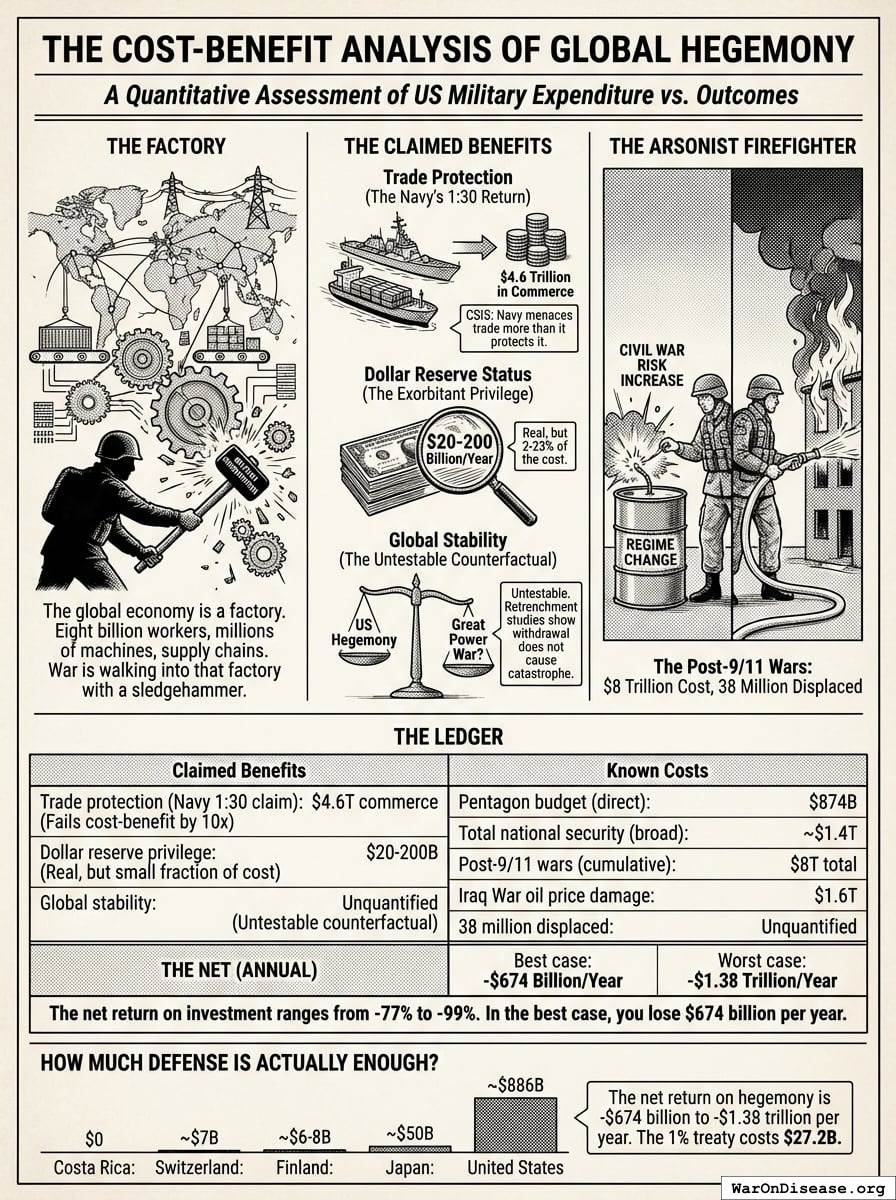
The United States spends $886 billion per year on military. The only benefit anyone has managed to quantify is $20-200 billion per year in dollar reserve currency privilege. The net is -$674 billion to -$1.38 trillion per year. This paper shows the math.
The Factory
The global economy is a factory. Eight billion workers, millions of machines, supply chains threading through every country on Earth, producing goods and services and wealth your ancestors could not have imagined.
War is walking into that factory with a sledgehammer and smashing the machines. You destroy an oil refinery in the Middle East and fuel prices spike in Ohio. You bomb a port in the Red Sea and a car factory in Germany stops production because the parts are on a ship that can no longer dock. You hit an electrical grid and the hospitals go dark and the server farms go offline and the stock market drops because investors can see, in real time, the global machine becoming less efficient.
Every missile that hits infrastructure is a sledgehammer blow to a machine that feeds you. The stock market does not drop because traders are emotional. It drops because the machine just lost a piece and everyone who depends on the machine (which is everyone) is now slightly poorer.
The question is whether the $886 billion per year is protecting the factory or swinging the sledgehammer.
The Claimed Benefits
Dollar Reserve Status (The Exorbitant Privilege)
Dollar reserve status yields an estimated $20-200 billion per year in reduced borrowing costs. This is real. It is the only claimed benefit that survives quantification.
It is also roughly 2-23% of the military budget that supposedly maintains it. You are spending $874 billion to earn $20-200 billion. Accountants call this a “negative return on investment.” Your species calls it “national security.”
Global Stability (The Untestable Counterfactual)
The remaining claimed benefit is “stability.” This is not quantified. It cannot be quantified because it rests on a counterfactual: “Without US hegemony, there would be great power war, nuclear proliferation, and trade collapse.”
A 2024 study in the European Journal of International Security examined every historical case of great power withdrawal and found that three of four types of retrenchment “do not regularly create opportunities for rivals”3. The catastrophe does not materialize. The Soviets withdrew from Romania. The US withdrew from Korea. The US reduced forces in Western Europe after the Cold War. Nobody invaded.
The stability claim also assumes US military activity produces stability. The evidence runs the other direction.
The Arsonist Firefighter
Georgetown political scientist Alexander Downes studied every foreign-imposed regime change from 1816 to 2008 and found that it systematically increases the probability of civil war in the target state4. Not correlates with. Causes. Peer-reviewed, quantitative, published by Cornell University Press. The instrument of “stability” is, by the data, an instrument of civil war.
The post-9/11 wars cost the United States $8 trillion5 and displaced 38 million people, more than any conflict since World War II except the partition of India6. The Iraq War spiked global oil prices by an estimated $1.6 trillion between 2003 and 20087. Nobel laureate Joseph Stiglitz argued the war was a significant contributing factor to the 2008 financial crisis, because the oil price transmission mechanism weakened the broader economy while war costs were financed entirely by debt. The sledgehammer hit the factory, and the factory was the global economy, and everyone got poorer, and then the financial system collapsed, and then the people who swung the sledgehammer asked for more money to protect the factory.
The pattern repeats:
- Iraq (2003): Invasion toppled Saddam, created a power vacuum. The decision to disband the Iraqi military put 400,000 armed, trained men out of work. Many became insurgents. The insurgency became ISIS. The US then spent additional trillions fighting ISIS.
- Libya (2011): NATO intervention toppled Gaddafi. The country collapsed into civil war, open-air slave markets, and a migration crisis that destabilized European politics for a decade. The UK Parliament’s own inquiry concluded the intervention was based on flawed intelligence and created a failed state.
- Afghanistan (2001-2021): Twenty years. $2.3 trillion. The Taliban retook the country in 11 days. The war ended exactly where it started, except 170,000 people were dead and the money was gone.
Chalmers Johnson, the late UC San Diego political scientist, called this pattern “blowback”: CIA jargon for the unintended consequences of covert operations that come back to harm the country that launched them8. He compared the US military posture to a protection racket. The evidence since his death in 2010 suggests he was being generous. A protection racket at least protects you from other criminals. This one creates them.
The Ledger
Claimed benefits:
| Benefit | Annual Value | Status |
|---|---|---|
| Trade protection (Navy 1:30 claim) | “$4.6 trillion in commerce” | Fails cost-benefit by 10x2. CSIS: Navy menaces trade more than it protects it1 |
| Dollar reserve privilege | $20-200 billion | Real, but 2-23% of the cost |
| “Global stability” | Unquantified | Untestable counterfactual. Retrenchment studies show withdrawal does not cause catastrophe3 |
Known costs:
| Category | Annual Cost | Source |
|---|---|---|
| Pentagon budget (direct) | $874 billion | DoD |
| Total national security (broad) | ~$1.4 trillion | Brown University5 |
| Post-9/11 wars (cumulative, 20 years) | $8 trillion total | Brown University5 |
| Iraq War oil price damage (2003-2008) | $1.6 trillion | Stiglitz & Bilmes7 |
| 38 million displaced (ongoing costs) | Unquantified | Brown University6 |
The net (annual):
| Scenario | Benefit | Cost | Net |
|---|---|---|---|
| Best case for hegemony | $200 billion (high privilege estimate) | $874 billion (direct only) | -$674 billion/year |
| Worst case for hegemony | $20 billion (low privilege estimate) | $1.4 trillion (broad) | -$1.38 trillion/year |
The return on investment ranges from -77% to -99%. In the best case, using the most generous benefit estimate and the lowest cost estimate, you lose $674 billion per year.
Nobody publishes this ledger because the ledger is negative and publishing it would raise questions that military budgets are not designed to survive.
How Much Defense Is Actually Enough?
| Country | Annual Military Spending | Last Invaded | Notes |
|---|---|---|---|
| Costa Rica | $0 | Never (since 1949) | Abolished military entirely in 19489 |
| Switzerland | ~$7 billion | 1798 (227 years ago) | Armed neutrality, citizen militia, Alps10 |
| Finland | ~$6-8 billion (pre-NATO) | 1944 (80+ years ago) | 830-mile border with Russia, 900,000 reserves11 |
| Japan | ~$50 billion (1976-2022) | 1945 (80+ years ago) | Self-imposed cap for 47 years |
| United States | ~$886 billion | Never | Spends more than next 10 countries combined |
Costa Rica abolished its military entirely in 1948 and has not been invaded since. UNESCO inscribed the abolition documents in its Memory of the World Register, which is the international community’s way of saying “this was a good idea and we would like it noted for the record.”
Switzerland has not been invaded in 227 years. It spends roughly $7 billion per year on defense. The average Swiss citizen has higher income, longer life expectancy, better healthcare, and lower crime than the average American. The American is paying 126 times more for defense.
I tried to identify the specific benefit that the American citizen receives from global hegemony that the Swiss citizen does not receive for free. The Swiss citizen uses the same global trade routes. Buys the same goods. Travels to the same countries. Lives under the same international order.
The standard response is “free-riding.” Switzerland free-rides on American security. But it assumes the $886 billion is helping. The evidence suggests otherwise. Switzerland did not need the US Navy to protect its trade routes. Switzerland needed the United States to stop bombing the countries the trade routes go through.
If the free rider has higher income, longer life expectancy, better healthcare, lower crime, and has not been invaded in 227 years, the interesting question is not “who is free-riding?” The interesting question is whether the person paying is buying security or buying the wars that make security necessary.
When someone pays for a service and gets a worse outcome than the person who does not pay, the non-payer is not a free rider. The payer is a victim.
The Army That Was Smaller Than Portugal’s
In 1939, the United States Army ranked 17th in the world12. Behind Romania. Behind Portugal13. It had 190,000 soldiers, 464 tanks (mostly light models), and not a single officer who had commanded a division in combat. Military spending was roughly $1.3 billion in 1939 (about $28 billion in 2024 dollars)14.
Four years later, the United States had 12.2 million troops, was producing 43,000 aircraft per year, and won the largest war in human history. The automobile industry had been fully converted to war production. Merchant shipbuilding went from 71 ships over six years to nearly that many in a single year.
The 17th-largest army in the world became the most powerful military force in human history in approximately the time it takes to finish a bachelor’s degree.
(Defense analysts typically measure military spending as a percentage of GDP, as though a richer country needs proportionally more missiles. It does not. Bullets do not cost more because your economy grew. The absolute number is what matters, and the absolute number is $2.72 trillion.)
The primary argument for maintaining a $2.72 trillion-per-year standing military is: “We need to be ready.” The United States was not ready in 1939. It was less ready than Portugal. It won anyway, because modern industrial economies can mobilize when existential threats actually materialize. The question is not whether a country can defend itself. The question is whether it needs to spend $886 billion per year on readiness for threats that have not materialized, while diseases that kill millions every year go unfunded.
What the Defense Scholars Say
Barry Posen, Ford International Professor of Political Science at MIT, argues in Restraint that the United States could cut defense spending by roughly 37% while maintaining adequate security through nuclear deterrence and geographic advantages15. This is not a peace activist. This is an endowed chair at MIT publishing with Cornell University Press.
Defense analysts at the Cato Institute calculated that a restraint-oriented budget could be cut at least 25%16. They also note that US ballistic missile submarines alone provide sufficient nuclear deterrence. You do not need ICBMs. You do not need the bomber leg. You need submarines that nobody can find.
These numbers seem conservative. Posen proposes a 37% cut. Cato proposes 25%. But both are answering the wrong question. They are asking: “What is the minimum budget to maintain a reduced version of American global hegemony?” They are not asking: “What is the minimum budget to prevent someone from invading the United States?”
Those are different questions. The first one requires 750+ overseas bases, carrier strike groups, NATO commitments, Pacific alliances, and the ability to project force anywhere on Earth within 48 hours. The second one requires two oceans, friendly neighbors, and a submarine fleet that nobody can track. Posen and Cato are trimming the empire. The data from the table above suggests you could skip the empire entirely.
How low is “skip the empire entirely”? Priced from first principles, the defense of the United States (a survivable nuclear second strike, homeland air and missile defense, the Coast Guard, the National Guard, cyber defense of infrastructure, and a mobilization hedge for a peer threat that has not yet emerged) comes to about $184 billion (90% CI: $158 billion-$215 billion) per year, against current spending of $886 billion. That is a cut of roughly 79.2% (90% CI: 75.7%-82.2%), derived threat by threat in The Eisenhower Curve. Posen and Cato land higher because they are still buying a trimmed hegemony. The homeland itself, defended at efficient prices, is cheap, because two oceans and a nuclear deterrent do most of the work for free.
What You Could Buy Instead
SIPRI calculated that achieving all sustainable development goals in health, education, agriculture, and infrastructure would cost $760-885 billion per year17. That is 46-54% of global military spending. You could solve most of humanity’s measurable problems with half the death budget. You are choosing not to. Every year. On purpose.
A 1% treaty18 19 asks for $27.2 billion from this budget. Not 50%. Not 25%. One percent. Redirected to clinical trials so that humans might figure out which of the 9.5 million untested treatment combinations actually work.
That is the modest version. The immodest version is the overspend itself. At $929 (95% CI: $97-$3,000) a patient instead of the $41,000 (95% CI: $20,000-$120,000) a traditional trial charges, one year of it would fund pragmatic trials for 756 million people, about 398x (90% CI: 158x-1.6kx) the 1.9 million who are in a trial today. (This is the same calculation as the treaty’s 12.3x (90% CI: 4.92x-50.8x), just scaled to the overspend: patients you can fund, against patients enrolled now.) That number sounds impossible only if you think the limit is a shortage of patients. It is not. Aging is a condition everyone has, and there are billions of people whose chronic diseases nobody has been paid to treat optimally. The limit was always the price of a trial, and pragmatic trials remove it.
The net return on hegemony is -$674 billion to -$1.38 trillion per year. The 1% treaty costs $27.2 billion. If you are looking for the controversial part of this proposal, it is not in the math.
Appendix: A Structured Welfare Model
The back-of-envelope calculation above uses two numbers (benefit, cost) and subtracts. An economist would want more structure. Here is the same argument decomposed into components with explicit ranges on every assumption.
Setup
We estimate the net annual welfare effect of the US-led order relative to a plausible counterfactual (reduced US footprint, other powers filling regional gaps):
\[ \Delta W = B - C \]
Where \(B\) = quantifiable benefits of the current order and \(C\) = quantifiable costs attributable to it.
Benefits
Finance (dollar reserve privilege):
\[ F = D \cdot r \cdot \alpha \]
- \(D\) = $30.87 trillion (US debt held by public)
- \(r\) = interest rate reduction (range: 0.1-0.3 percentage points, midpoint 0.2)
- \(\alpha\) = share attributable to military (range: 25-85%, midpoint 50%)
- Median: ~$31 billion/year
Trade and security umbrella:
\[ T = G \cdot s \cdot \beta \]
- \(G\) = value of trade potentially at risk ($150-490 billion, midpoint $300 billion)
- \(s\) = security multiplier on trade flows (1.0-1.8x, midpoint 1.3x)
- \(\beta\) = share attributable to US military vs. mutual commercial interest (30-85%, midpoint 55%)
- Median: ~$215 billion/year
This is the most generous component. It assumes the US military is responsible for 55% of the security that enables at-risk trade. CSIS and Quiggin’s analyses suggest this is too high1,2.
Institutional coordination: $0-250 billion (midpoint $75 billion). Covers WHO, WTO, IMF coordination that the US anchors. Much of this would persist under alternative arrangements.
Catastrophic war risk reduction:
\[ R_{tail} = (p_{alt} - p_{us}) \cdot L_{cat} \]
- Probability of great power war under current order: 0.05-0.5% per year
- Probability under counterfactual: 0.08-0.9% per year
- Loss from catastrophic war: $5-100 trillion
- Median: ~$20 billion/year (the probability differential is small; the consequences are large but rare)
Total benefits: ~$340 billion/year (median)
Costs
Excess military burden:
\[ M = S \cdot \gamma \]
- \(S\) = $2.72 trillion (global military spending)
- \(\gamma\) = fraction attributable to US hegemonic posture vs. what countries would spend anyway (5-35%, midpoint 15%)
- Median: ~$408 billion/year
This is conservative. It assumes only 15% of global military spending is excess driven by the hegemonic system (arms races, alliance commitments, threat inflation). The actual figure may be higher.
Direct war damage: $200-650 billion/year in active conflict zones, of which 20-75% is attributable to US-initiated or US-escalated conflicts (midpoint 45%). Median: ~$180 billion/year.
Macroeconomic instability: War damage multiplied by a spillover factor (oil price transmission, supply chain disruption, financial contagion). Multiplier range: 0.5-2.5x. Median: ~$225 billion/year. The Iraq War oil spike alone ($1.6 trillion over 5 years = $320 billion/year) suggests this is conservative7.
Refugee and displacement burden: 123 million forcibly displaced globally, 5-30% attributable to US-initiated conflicts (midpoint 15%), at $1,500-10,000 per displaced person per year. Median: ~$74 billion/year6.
Mortality cost: 20,000-120,000 conflict deaths per year in US-attributable theaters, at $0.5-6 million per statistical life. Median: ~$90 billion/year.
Human capital loss: Mortality cost multiplied by a human capital factor (lost productivity, education disruption, generational trauma). Multiplier: 0.25-1.5x. Median: ~$68 billion/year.
Environmental damage: ~75 million tons CO2/year from military operations, at $120/ton social cost of carbon, with 45% attribution. Median: ~$4 billion/year. Small relative to other components.
Total costs: ~$1,049 billion/year (median)
Net Result
\[ \Delta W = 340B - 1{,}049B \approx -709B/\text{year} \]
Propagating the triangular distributions on all parameters through the model:
| Statistic | Value |
|---|---|
| Median | -$0.9 trillion/year |
| 90% interval | -$1.55 trillion to -$0.28 trillion |
| Probability net positive | <1% |
The result is not driven by any single assumption. It is driven by the combined weight of persistent military expenditure, war-related destruction, macroeconomic spillovers, and human and environmental losses. The largest uncertainties are in counterfactual war risk and trade benefit attribution, but within any reasonable bounds, these do not reverse the central result.
What Would It Take to Flip the Sign?
To make hegemony net positive, you would need to assume:
- The US military is responsible for >80% of global trade security (CSIS says this is wrong)
- Without the US, great power war probability exceeds 2% per year (no historical basis)
- US-initiated wars cause zero macroeconomic spillovers (Stiglitz documented $1.6 trillion from Iraq alone)
- All of the above simultaneously
The assumptions required to make the number positive are individually implausible and collectively absurd. The central result, a net loss of roughly $0.7-1.0 trillion per year, is robust to reasonable variation in every parameter.