1
people have died from curable diseases
since this page started loading...
💀

Solution Overview

Keywords

war-on-disease, 1-percent-treaty, medical-research, public-health, peace-dividend, decentralized-trials, dfda, dih, victory-bonds, health-economics, cost-benefit-analysis, clinical-trials, drug-development, regulatory-reform, military-spending, peace-economics, decentralized-governance, wishocracy, blockchain-governance, impact-investing

How to Build Systems That Don’t Suck

How to Build Systems That Don’t Suck

Now that you understand the problem, which is that everyone is dying while you build missiles, it’s time to learn how to fix it.

Your solution has three parts:

  1. A 1% treaty (stealing money from the murder budget)
  2. A 1% Treaty Fund with algorithmic governance (so no one can steal it back)
  3. A decentralized framework for drug assessment (making medicine 44.1x (95% CI: 39.4x-89.1x) times cheaper)

Take money from death, give it to life. The tricky part is convincing humans, who historically prefer the death option.

A 1% treaty

Here’s how you redirect $27.2B per year from bombs to medicine:

You ask every nation on Earth to cut military spending by 1%. Just 1%. They keep the other 99% for wars and parades and whatever else militaries do when they’re not accidentally losing trillions (marching in formation mostly, lots of marching, humans love walking in straight lines).

One percent is a rounding error. It’s what the Pentagon loses between couch cushions.

Everyone cuts simultaneously. Nobody loses “relative power,” which is the thing military people care about when they’re not busy caring about flags and saluting.

I asked a general if losing 1% of weapons would weaken national security. He said yes. I asked if having 1% fewer weapons pointed at you by every enemy would make you safer. He stopped talking to me.

The math is simple: If everyone has 1% fewer weapons, the balance stays exactly the same, except now there are 1% fewer weapons total.


On What You Buy With 1% Less War

$27.2B funds:

  • 54,000 pragmatic clinical trials at $500,000 each (the cheap way)
  • Or 27 million patients in trials at $1K each
  • Or 540 new drug approvals (current rate: 50 drugs/year (95% CI: 45 drugs/year-60 drugs/year) per year)
  • Or curing 10-20 rare diseases completely in Year 1
  • Or preventing 180,000 deaths annually

For comparison, $27.2B is:

  • Less than the Pentagon’s annual “we lost it” budget
  • About what Americans spend on Valentine’s Day (flowers and chocolate > curing cancer, apparently)
  • Roughly what humans spend on pet food every three months
  • Apparently too much to ask for curing diseases

Of that $27.2B, here’s where it goes:

Allocation Share Amount Purpose
VICTORY Incentive Alignment Bond investors

10%

$2.72B

Repay the people who funded the campaign
Political incentives

10%

$2.72B

Keep politicians aligned via IABs
Patient Subsidies for Pragmatic Clinical Trials

80%

$21.8B

Actually cure diseases

They say you can’t put a price on human life. But apparently the price is somewhere south of pet food, which seems like it should be revised upward (or you should admit you value dogs more than humans, which honestly might be fair).

The 1% Treaty Fund

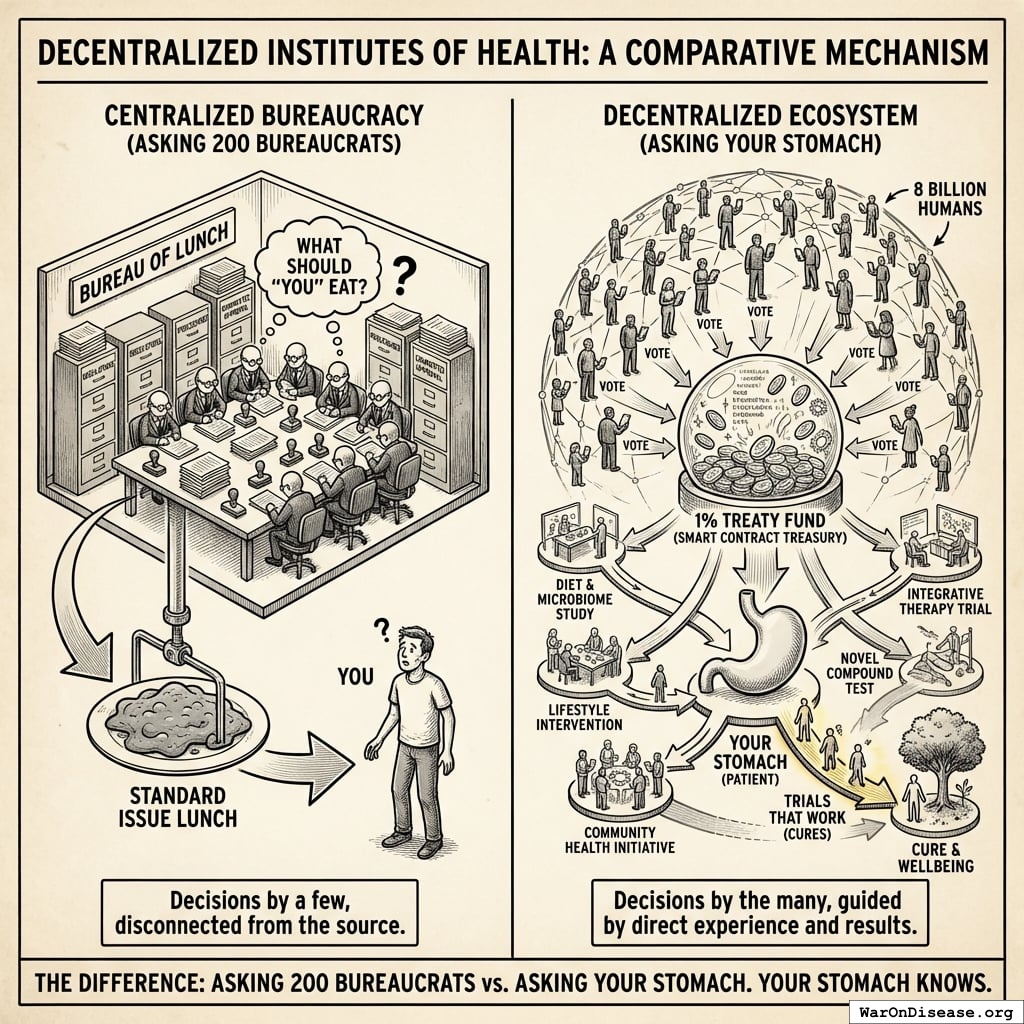
Once the 1% Treaty is ratified, that $27.2B per year flows into a 1% Treaty Fund, a treasury with no CEO, no board, and no one to corrupt. Money flows directly to patients and researchers via algorithmic rules, not through any intermediary organization.

The governance protocol (sometimes called a “decentralized institute of health” or DIH) is the opposite of the NIH:

What the NIH does

  • 200 people in a building decide what to fund
  • They guess what might work
  • They give grants to their friends
  • Nothing gets cured
  • Everyone gets tenure

What the 1% Treaty Fund does

  • Smart contracts hold the treasury (no human intermediaries)
  • Patients choose which trials to join (market allocation)
  • Funding flows automatically to researchers based on patient enrollment
  • Trials that work get more patients and more funding
  • Things actually get cured

The difference is like asking 200 bureaucrats what you should have for lunch versus asking your stomach. Your stomach knows things bureaucrats don’t.

A conceptual flow of the decentralized health ecosystem, showing the 1 percent Treaty Fund moving from global voting to patient-selected trials and resulting in a feedback loop of successful cures.

A conceptual flow of the decentralized health ecosystem, showing the 1 percent Treaty Fund moving from global voting to patient-selected trials and resulting in a feedback loop of successful cures.
On Wishocracy

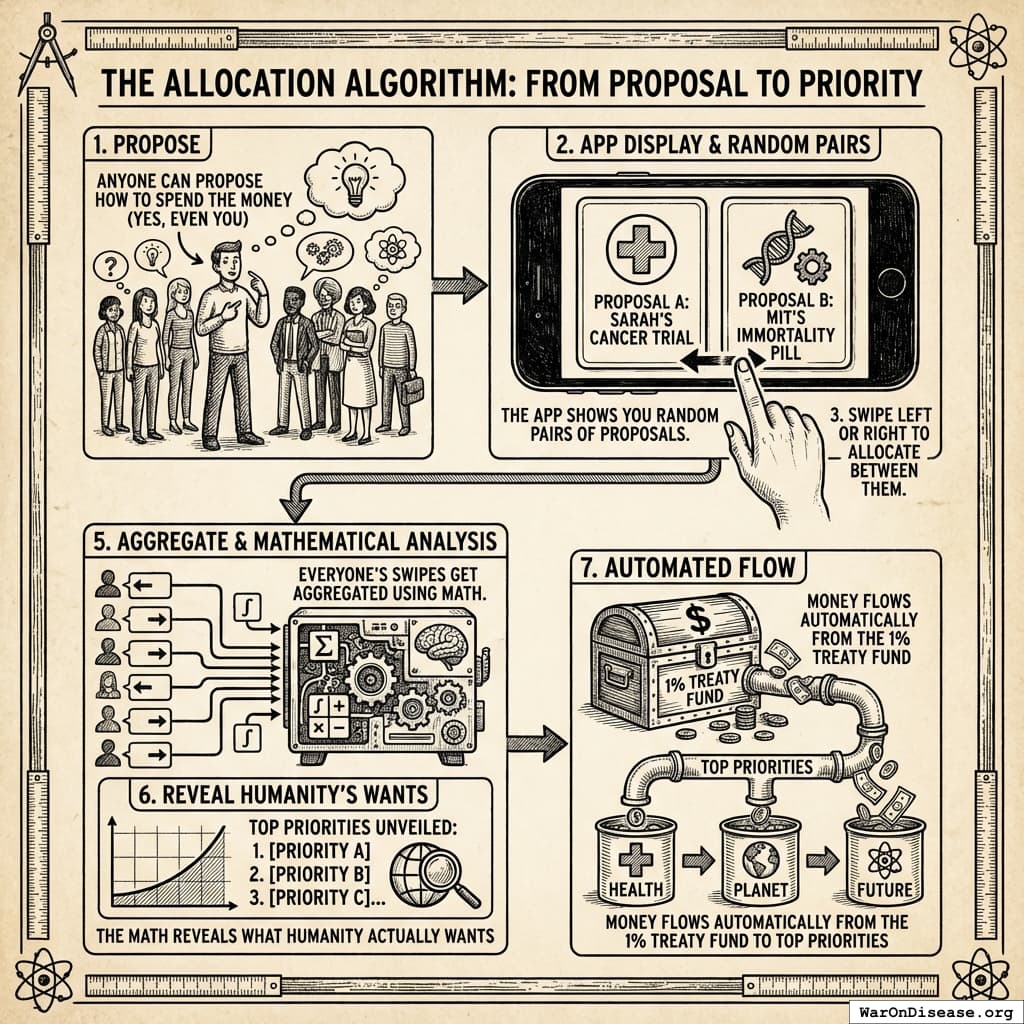
Wishocracy is how you let 8.00B of people (95% CI: 7.80B of people-8.20B of people) billion people control a budget without everyone killing each other in meetings.

Here’s how it works:

  1. Anyone can propose how to spend the money (yes, even you)
  2. The app shows you random pairs of proposals
  3. You swipe left or right to allocate between them
  4. “Sarah’s cancer trial” versus “MIT’s immortality pill”

Wishocracy slider interface showing pairwise comparison between proposals

Wishocracy slider interface showing pairwise comparison between proposals

The ‘Wishocracy’ workflow: transforming individual swipes into automated funding allocation via Aggregated Pairwise Preference Allocation (APPA).

The ‘Wishocracy’ workflow: transforming individual swipes into automated funding allocation via Aggregated Pairwise Preference Allocation (APPA).
  1. Everyone’s swipes get aggregated using math
  2. The math reveals what humanity actually wants
  3. Money flows automatically from the 1% Treaty Fund to top priorities

This is called “Aggregated Pairwise Preference Allocation,” or APPA, which sounds complicated but is actually just “Tinder for budget priorities.”

The important part is there’s no committee. No gatekeepers. No humans with the power to say no. Just billions of micro-decisions that add up to what humanity actually wants, not what 200 people in suits think humanity wants.
Your decentralized framework for drug assessment

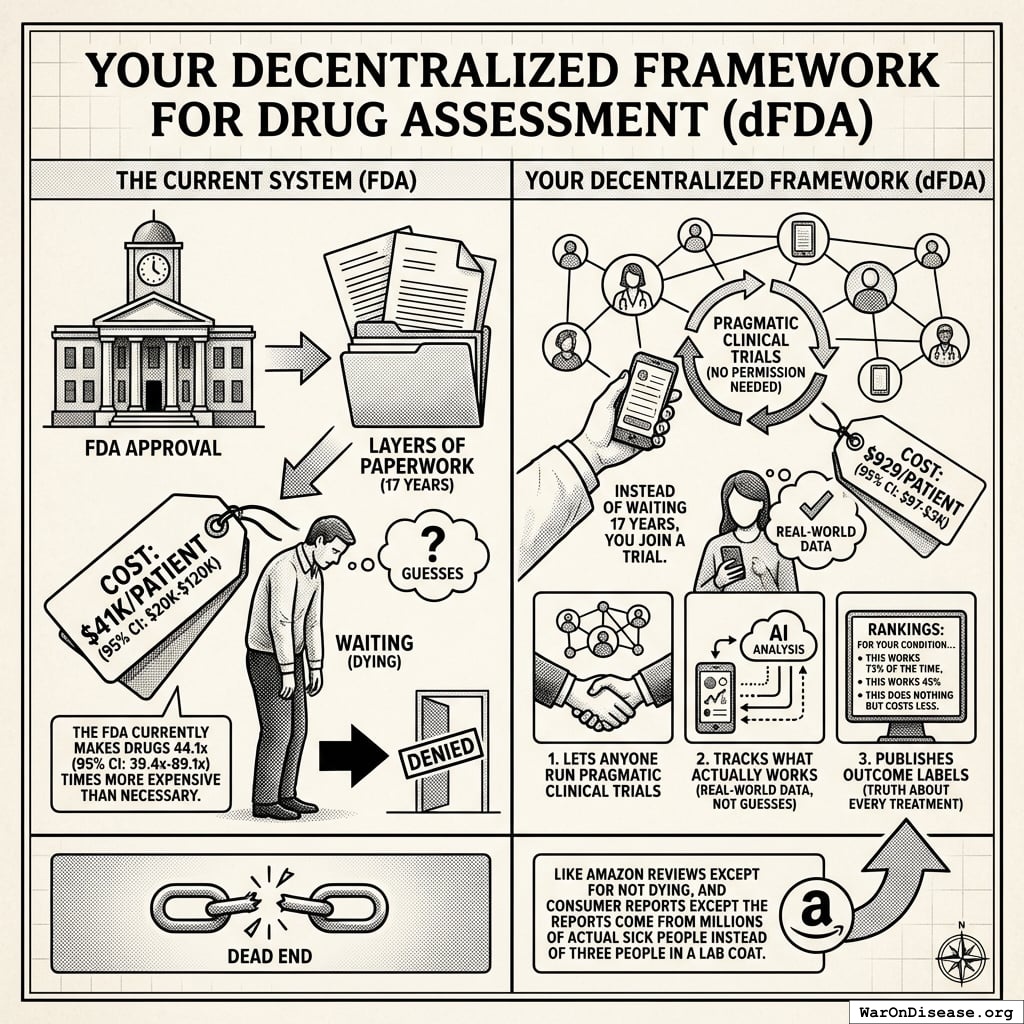
The FDA currently makes drugs 44.1x (95% CI: 39.4x-89.1x) times more expensive than necessary. You’re going to build a better one.

A comparison between the traditional FDA drug approval process and the decentralized dFDA framework, contrasting cost, time, and data sources while illustrating the three-step decentralized workflow.

A comparison between the traditional FDA drug approval process and the decentralized dFDA framework, contrasting cost, time, and data sources while illustrating the three-step decentralized workflow.

Your decentralized framework for drug assessment (dFDA) does three things:

  1. Lets anyone run pragmatic clinical trials (no permission needed)
  2. Tracks what actually works (real-world data, not guesses)
  3. Publishes outcome labels (truth about every treatment)

Instead of waiting 14 years (95% CI: 12 years-17 years) from discovery to patient while you die, you join a trial. The trial costs $929 (95% CI: $97-$3K) per patient instead of $41K (95% CI: $20K-$120K) because it turns out you don’t need 10.5 years (95% CI: 6 years-12 years) of regulatory process to figure out if aspirin works.

You report outcomes through your phone. The AI analyzes millions of data points. The framework publishes rankings: “For your condition, this works 73% of the time, this works 45%, this does nothing but costs less.”

It’s like Amazon reviews except for not dying, and Consumer Reports except the reports come from millions of actual sick people instead of three people in a lab coat.

On Outcome Labels

Right now, nutrition labels tell you what’s in food. Warning labels tell you cigarettes kill you. Drug labels tell you to “ask your doctor,” which is code for “we have no idea and neither do they.”

A comparison between a traditional drug warning label and a proposed Outcome Label displaying clear success rates, side effect percentages, and cost based on patient data.

A comparison between a traditional drug warning label and a proposed Outcome Label displaying clear success rates, side effect percentages, and cost based on patient data.

Outcome labels tell you what actually happens:

“This drug for your condition:”

  • Improves memory 35%
  • Reduces symptoms 60%
  • Causes headaches 9% of the time
  • Costs $50/month
  • Based on 50,000 real patients like you

It’s just facts. No marketing. No lies. No 40-page legal documents written by lawyers having seizures.
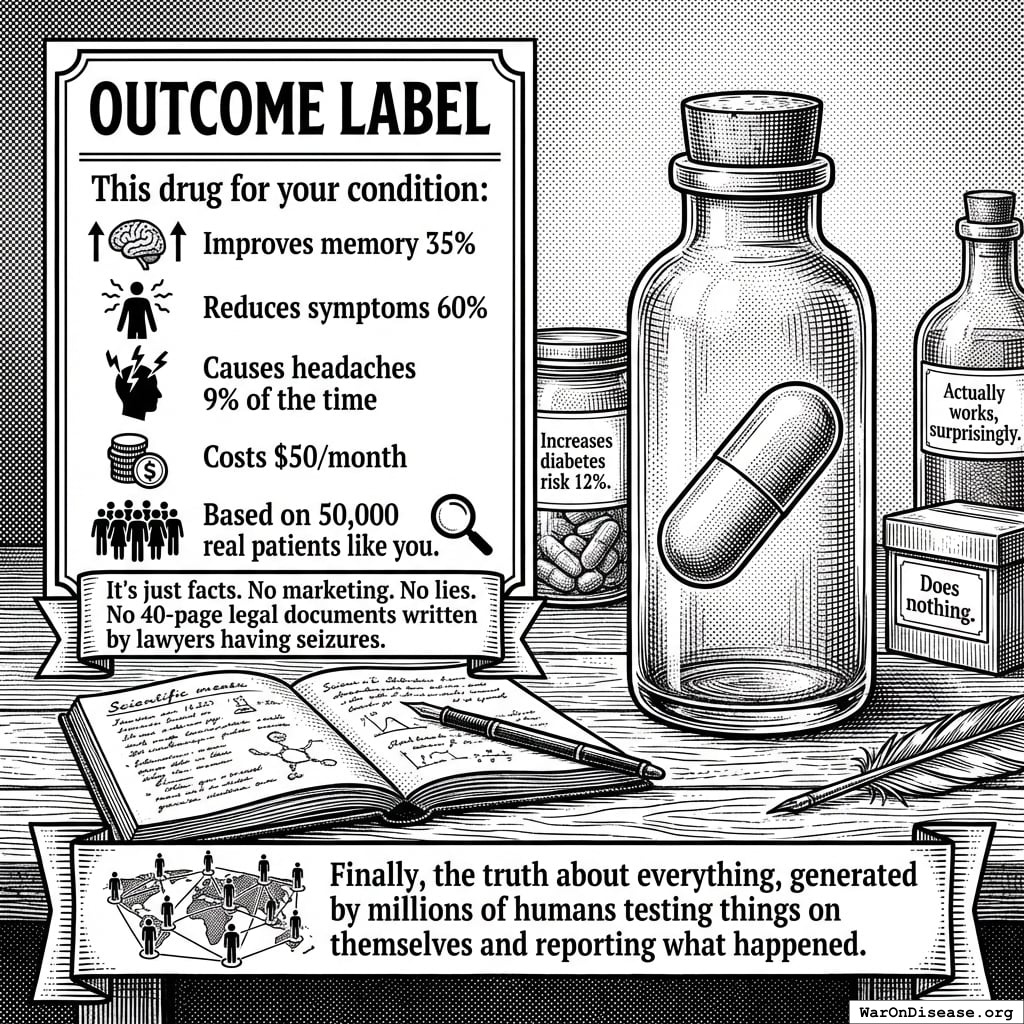
Every food, every drug, every supplement: Outcome label. “Increases diabetes risk 12%.” “Does nothing.” “Actually works, surprisingly.”

Finally, the truth about everything, generated by millions of humans testing things on themselves and reporting what happened.

On How Patients Pay Researchers

Here’s where it gets weird in a good way:

Currently: Pharma companies pay $41K (95% CI: $20K-$120K) per trial patient New system: Patients pay researchers, subsidized by the 1% Treaty Fund

The subsidy works like this: Available treaty funds divided by number of participating patients equals subsidy per person. More patients means lower subsidy per person, which prevents frivolous treatment seeking.

A comparison between the current pharmaceutical-funded trial model and a new decentralized system where patient choice and treaty subsidies drive research funding.

A comparison between the current pharmaceutical-funded trial model and a new decentralized system where patient choice and treaty subsidies drive research funding.

Researchers set their own price. Patients choose which trials to join. Money flows automatically. Successful trials attract more patients and more funding. Unsuccessful trials fade away.

Markets decide, not committees.

Sick people, guided by their doctors and data, choose what gets funded. Not bureaucrats. Not grant writers. Actual humans who need actual cures.
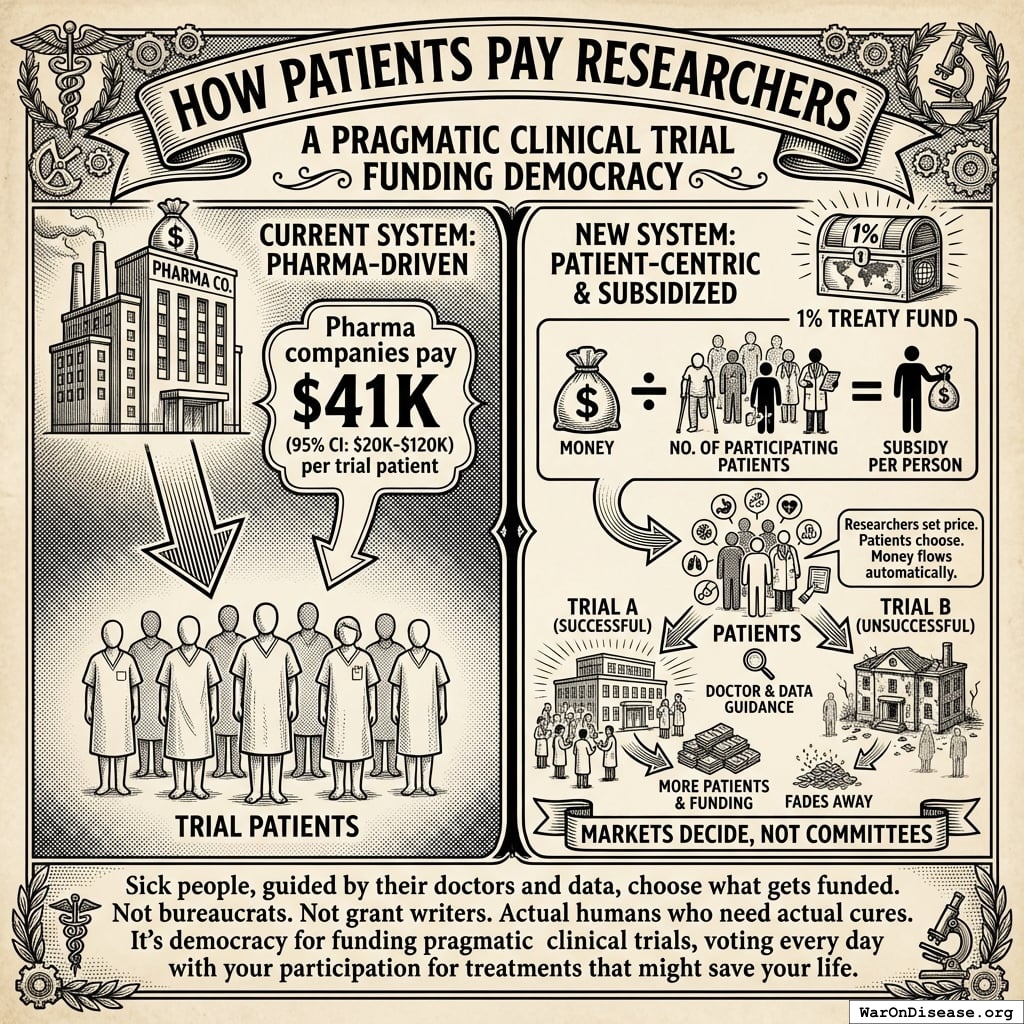
It’s democracy for funding pragmatic clinical trials, except instead of voting every four years for people who lie to you, you vote every day with your trial participation for treatments that might save your life.

On Why Defense Contractors Should Care

You’d think military contractors would hate this. But here’s what you tell them:

“You can keep 99% of your murder budget. But also, here are some bonds that pay 272% returns. Your pension fund would like those returns. Your shareholders would like those returns. You would personally like those returns because you also have a body that’s falling apart.

A comparison of a defense contractor’s traditional budget versus a diversified portfolio where 1 percent is allocated to longevity bonds, highlighting the resulting gains in profit, PR, and ESG scores.

A comparison of a defense contractor’s traditional budget versus a diversified portfolio where 1 percent is allocated to longevity bonds, highlighting the resulting gains in profit, PR, and ESG scores.

Plus, killing people is getting bad PR. Curing cancer is excellent PR. Your ESG score goes up. Your stock price goes up. You still make weapons with the other 99%, you just also cure diseases with 1%.

It’s called diversification. Ask your financial advisor.”

Defense contractors are not evil. They’re rational actors optimizing for profit within existing incentive structures. You’re just offering them a better incentive structure that happens to save humanity as a side effect.

On Why 1% Is Just The Beginning

Here’s the thing they don’t tell you: The goal isn’t 1%. The goal is 100%.

Eventually, nearly all $2.72T in global military spending should go to curing diseases. The 1% treaty is just the door, not the destination.

“But won’t the treaty stall at 1% like every other international agreement?” (asks the skeptic who has read about 0.7% ODA targets sitting unmet for 50 years)

No. Because unlike every other treaty, this one has a scaling engine built in.

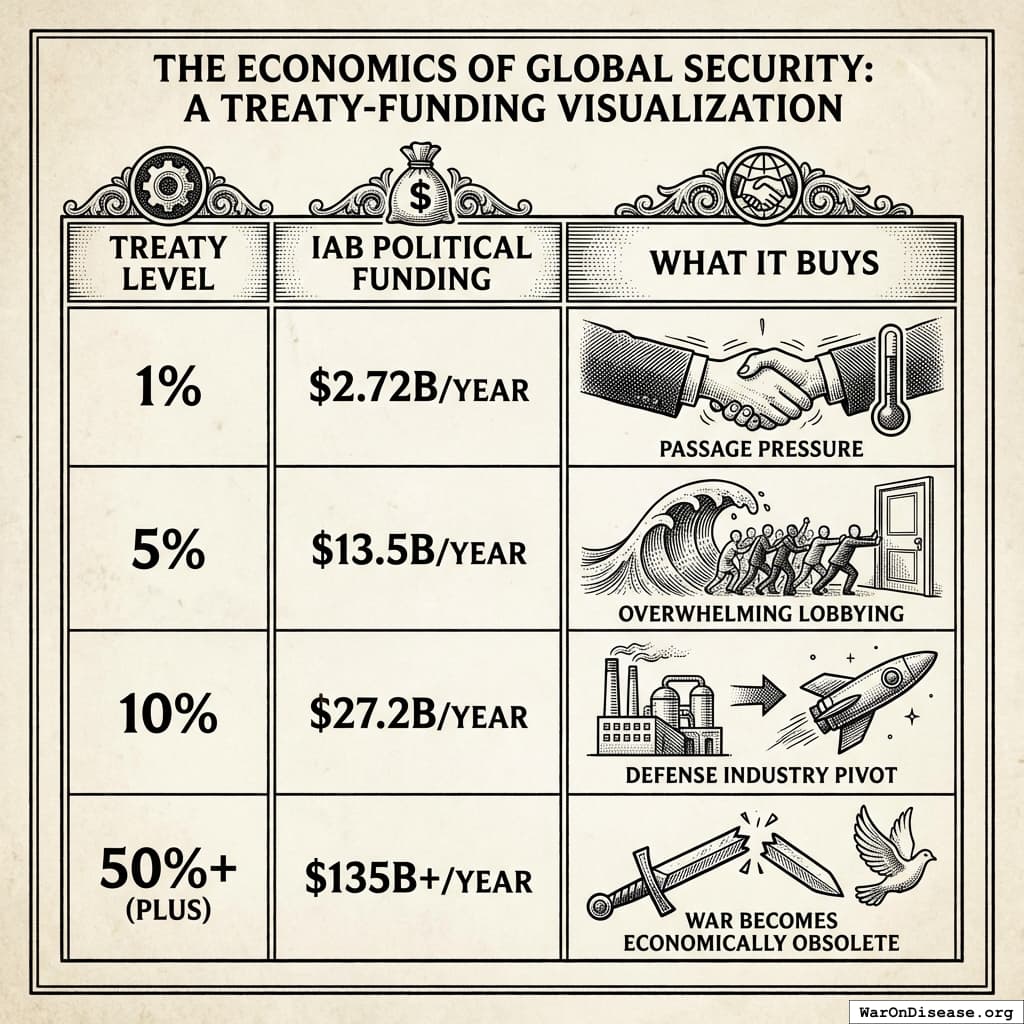
The 10% going to Incentive Alignment Bonds doesn’t just help pass the 1% treaty - it creates a perpetual political machine that pushes for expansion. When 1% passes, $2.72B/year flows to people whose entire financial interest is getting the treaty to 2%. When 2% passes, $5.4B/year flows to people pushing for 5%.

The political pressure for expansion accelerates with each success:

Treaty Level IAB Political Funding What It Buys
1% $2.72B/year Passage pressure
5% $13.5B/year Overwhelming lobbying
10% $27.2B/year Defense industry pivot
50%+ $135B+/year War becomes economically obsolete

This is why the 80/10/10 split exists. The 80% cures diseases. The 10% to investors pays back the people who funded the initial campaign. The 10% to political incentives ensures the campaign never stops.

The Scaling Engine: How increasing treaty levels exponentially fuels political lobbying power.

The Scaling Engine: How increasing treaty levels exponentially fuels political lobbying power.

VICTORY Incentive Alignment Bonds are a specific Incentive Alignment Bond - a single instrument that aligns investors (10% returns), politicians (10% career incentives), and patients (80% cures) with the same outcome: expand treaty funding.

Without the scaling engine, you get another nice international agreement that everyone ignores. With it, you get a ratchet that can eventually redirect $2.72T/year from war to health.

That’s the meta-strategy: Use 1% to prove the model works, then use the built-in expansion mechanism to capture 2%, 5%, 10%, until “military spending” becomes a quaint historical term like “bloodletting.”

On Insurance Companies

Insurance companies have a simple preference: They want you either dead or immortal. Anything but expensively lingering.

A diagram illustrating the transition from high-cost chronic illness to low-cost outcomes (cure or mortality) and how VICTORY Bonds create a virtuous cycle of insurance profitability.

A diagram illustrating the transition from high-cost chronic illness to low-cost outcomes (cure or mortality) and how VICTORY Bonds create a virtuous cycle of insurance profitability.

Dead people file zero claims. Immortal healthy people file zero claims. Currently sick people cost billions.

This new framework moves people from “currently sick” to either “dead” (whoops) or “cured” (success). Either way, the insurance company pays less.

Insurance companies have been trying to achieve this for fifty years but couldn’t because the FDA makes cures impossible.

Show them the math: Every cure prevents decades of treatment costs. Every prevention program avoids future claims. Every patient in a trial is a patient not in an emergency room.

They’ll buy VICTORY Incentive Alignment Bonds because healthy people are profitable people, and profitable people make insurance executives happy, and happy insurance executives buy bonds that make them richer.

It’s a virtuous cycle, which is Latin for “everyone wins by not dying.”

On the War on Disease

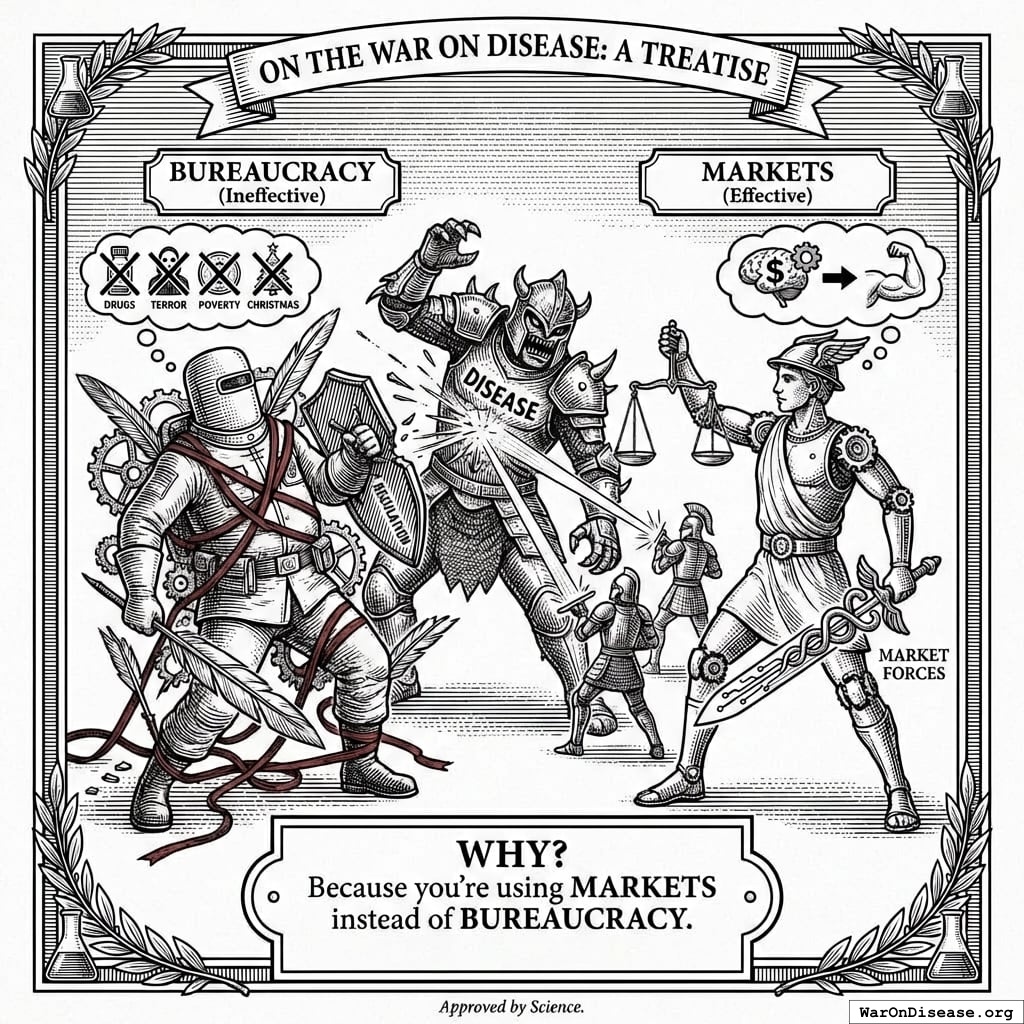
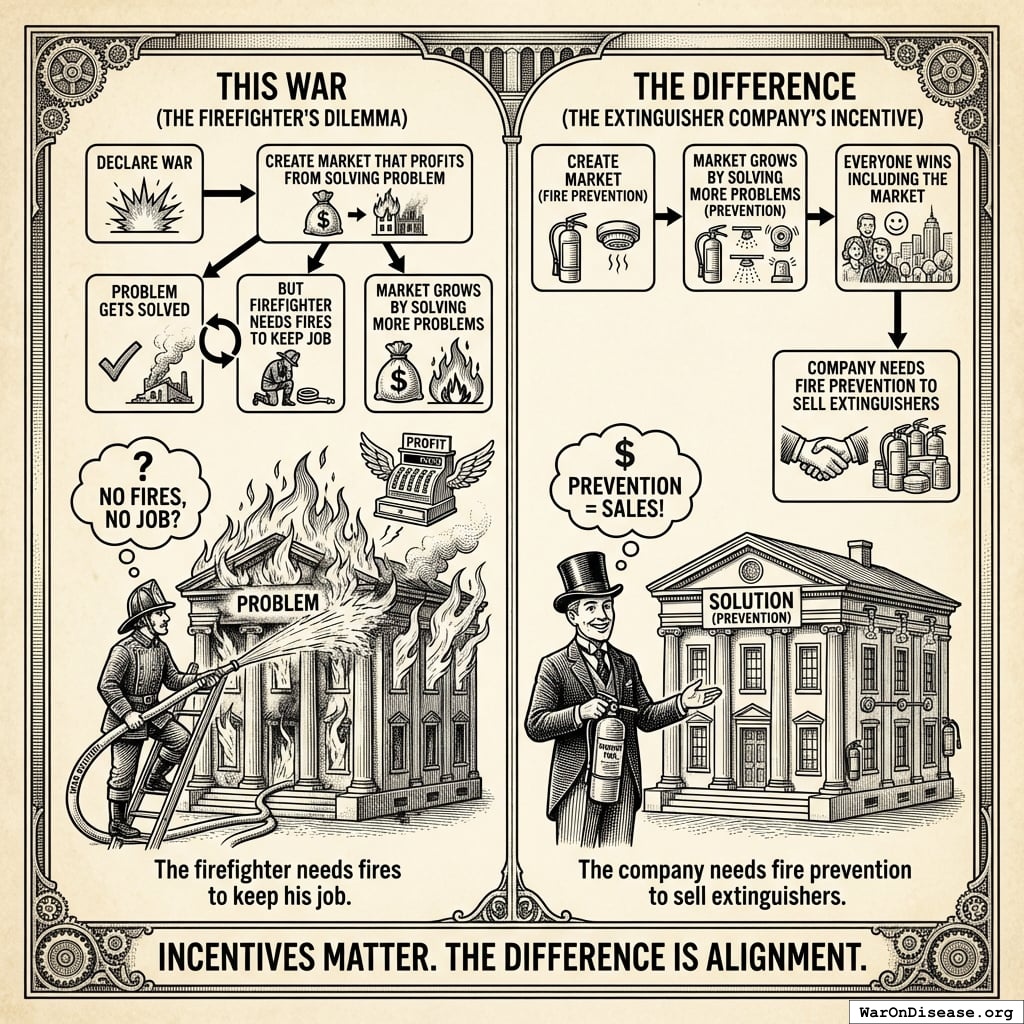
You’re declaring war on disease. But unlike previous wars on abstract concepts (drugs, terror, poverty, Christmas), this one will actually work.

A comparison chart contrasting the failed bureaucratic approach to abstract ‘wars’ with the proposed market-driven success model for the war on disease.

A comparison chart contrasting the failed bureaucratic approach to abstract ‘wars’ with the proposed market-driven success model for the war on disease.

Why? Because you’re using markets instead of bureaucracy.

Previous Wars on Things

A flowchart illustrating the self-perpetuating cycle of bureaucracy in ‘Wars on Things,’ where institutional survival leads to the persistence and growth of the problem.

A flowchart illustrating the self-perpetuating cycle of bureaucracy in ‘Wars on Things,’ where institutional survival leads to the persistence and growth of the problem.
  • Declare war
  • Build bureaucracy to fight war
  • Bureaucracy needs the problem to exist to justify its existence
  • Problem gets worse
  • Bureaucracy gets bigger
  • Everyone loses except the bureaucracy

This War

  • Declare war
  • Create market that profits from solving problem
  • Problem gets solved
  • Market grows by solving more problems
  • Everyone wins including the market

The difference is like asking a firefighter to prevent fires versus asking a fire extinguisher company to prevent fires. The firefighter needs fires to keep his job. The company needs fire prevention to sell extinguishers. Incentives matter.

A comparative visualization of incentive structures, contrasting a reactive service model with a proactive market-based model that scales through problem-solving.

A comparative visualization of incentive structures, contrasting a reactive service model with a proactive market-based model that scales through problem-solving.
On Aligning Everyone’s Greed

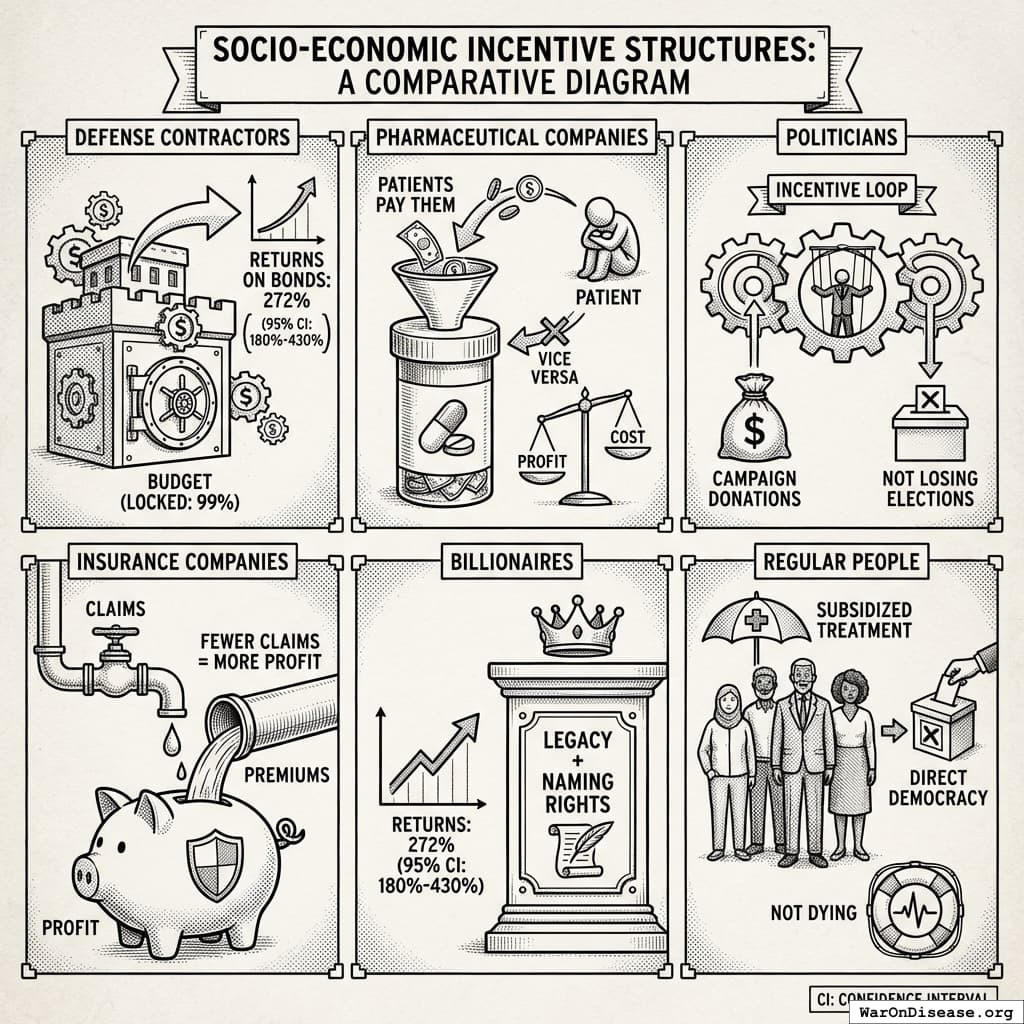
The solution only works if everyone wins by winning. Here’s who gets what:

Defense contractors: Keep 99% of budget + 272% returns on bonds Pharmaceutical companies: Patients pay them instead of vice versa Politicians: Campaign donations + not losing elections Insurance companies: Fewer claims = more profit Billionaires: 272% returns + legacy + naming rights Regular people: Subsidized treatment + direct democracy + not dying

Notice that everyone’s selfish reason for participating happens to save humanity. Trick people into doing good by making good profitable.

Ecosystem of incentives showing how the model satisfies the specific greed of six distinct stakeholder groups.

Ecosystem of incentives showing how the model satisfies the specific greed of six distinct stakeholder groups.

The system doesn’t require anyone to stop being selfish. It just redirects selfishness toward curing diseases instead of building bombs. It’s like installing a fire alarm that also makes coffee, you’re going to use it even if you don’t care about fire safety.
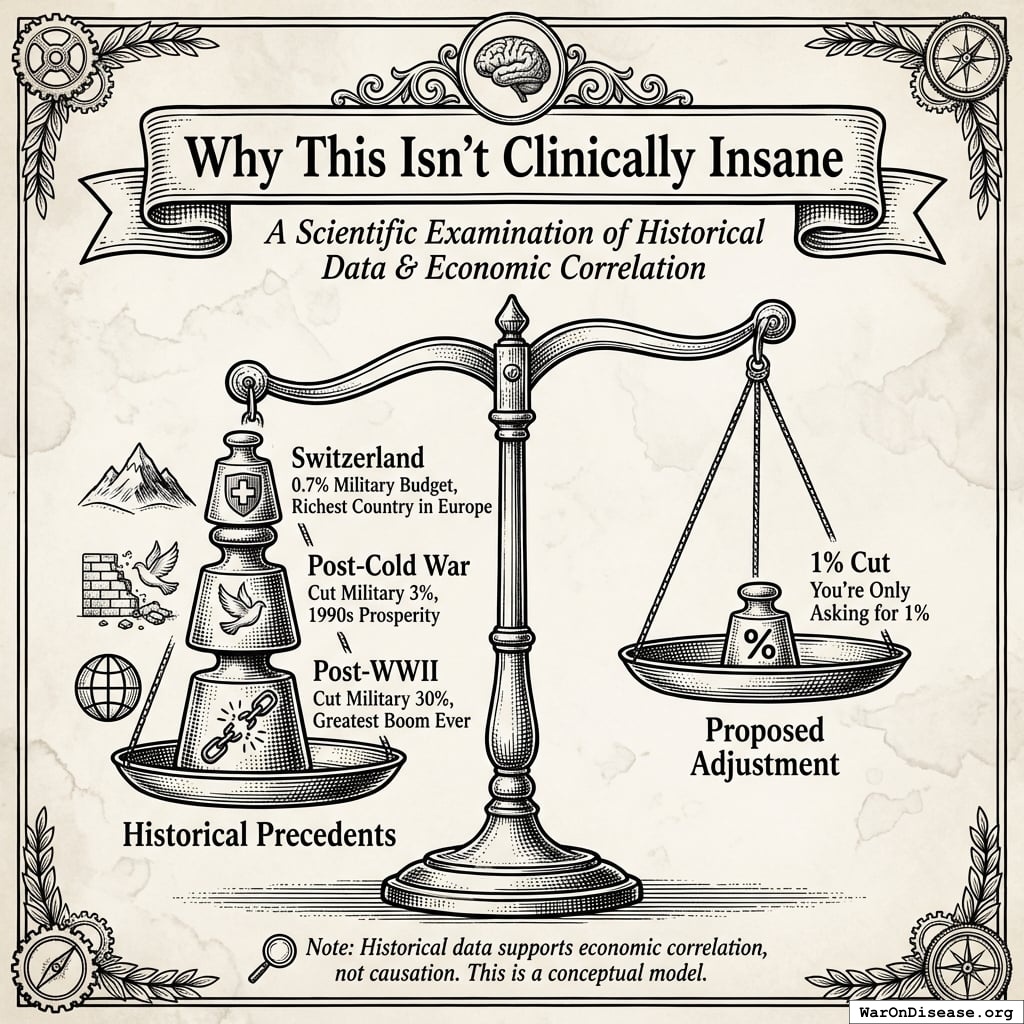
On Why This Isn’t Clinically Insane

History shows this works:

  • Post-WWII: Cut military 30%, greatest boom ever
  • Post-Cold War: Cut military 3%, 1990s prosperity
  • Switzerland: 0.7% military budget, richest country in Europe

You’re only asking for 1%.

A comparison chart showing historical military budget reductions and their correlation with periods of economic prosperity in various nations and eras.

A comparison chart showing historical military budget reductions and their correlation with periods of economic prosperity in various nations and eras.
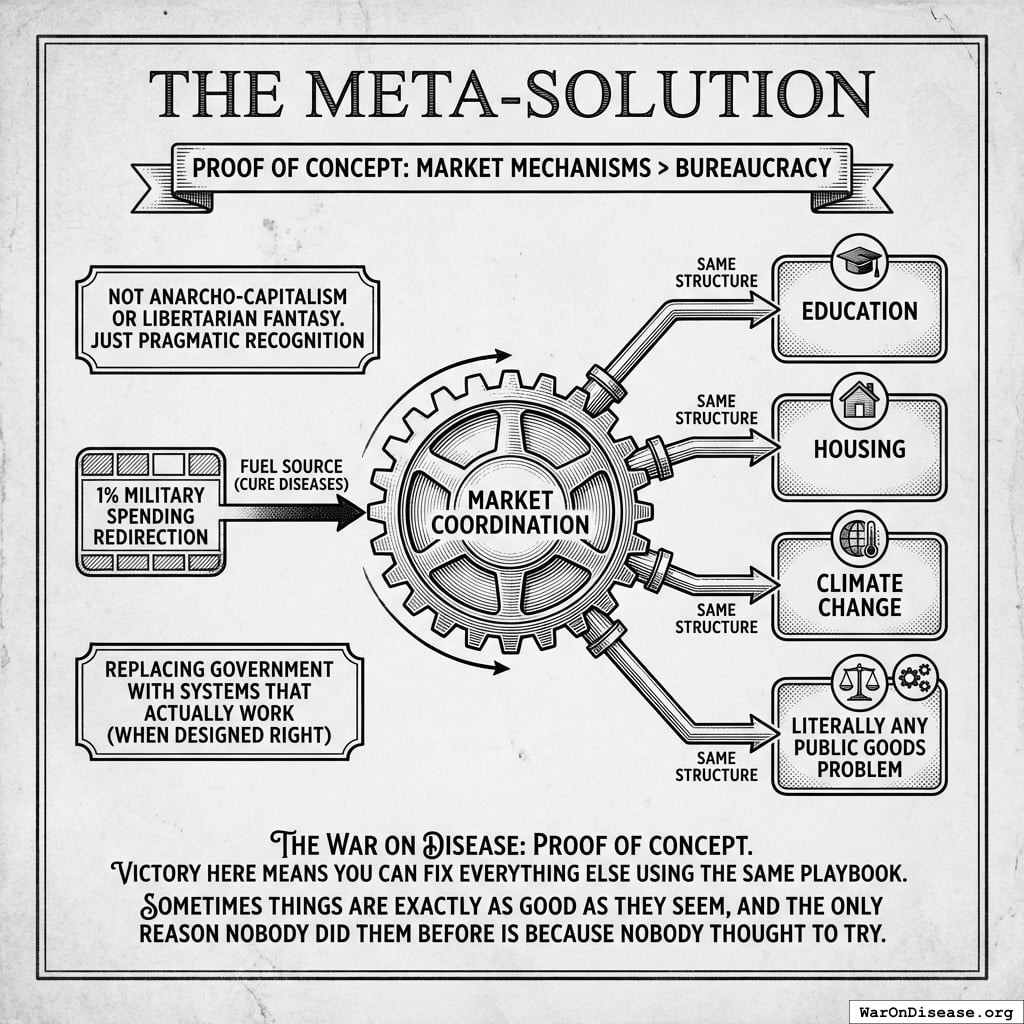
On the Meta-Solution

This solution isn’t just about ending disease. It proves markets work better than bureaucracy for literally everything.

A conceptual diagram showing a single market-based ‘Meta-Solution’ template being applied as a universal engine to solve diverse public goods problems including health, education, housing, and climate change.

A conceptual diagram showing a single market-based ‘Meta-Solution’ template being applied as a universal engine to solve diverse public goods problems including health, education, housing, and climate change.

If you can cure diseases by redirecting 1% of military spending through market mechanisms, you can solve:

  • Education (same structure, different market)
  • Housing (same structure, different market)
  • Climate change (same structure, different market)
  • Literally any public goods problem (same structure, different market)

This is the template for replacing government with systems that actually work. Not anarcho-capitalism or libertarian fantasy. Just pragmatic recognition that markets coordinate better than committees when you design them right.

The War on Disease is proof of concept. Victory here means you can fix everything else using the same playbook.

They say if something seems too good to be true, it probably is. But sometimes things are exactly as good as they seem, and the only reason nobody did them before is because nobody thought to try.

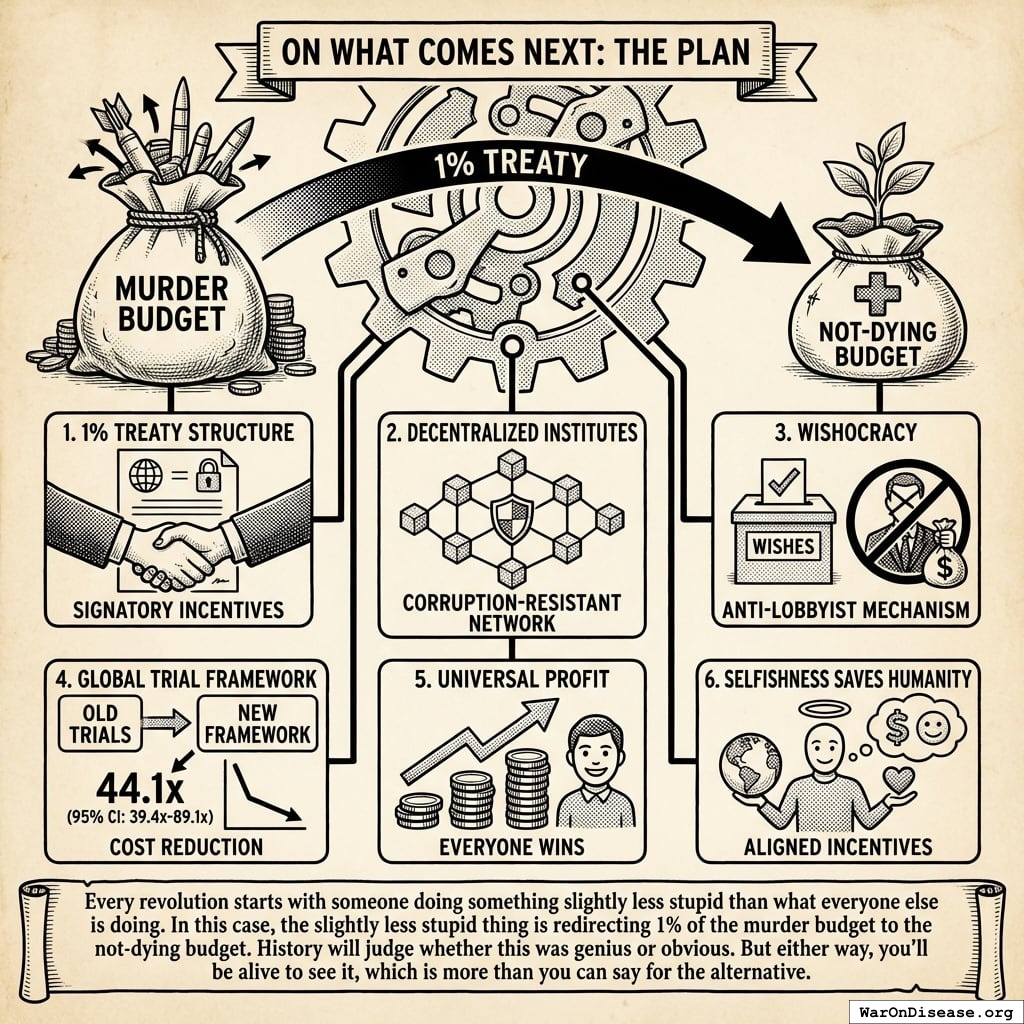
On What Comes Next

The rest of Part II explains each component in detail:

  • How to structure a 1% treaty so countries actually sign it
  • How the 1% Treaty Fund governance prevents corruption
  • How Wishocracy prevents lobbyists from stealing all the money
  • How your global trial framework achieves 44.1x (95% CI: 39.4x-89.1x) cost reduction
  • How everyone makes money
  • How to make selfishness save humanity

That’s it. That’s the plan.

A conceptual diagram showing the redirection of 1 percent of defense spending into a decentralized health ecosystem comprised of treaties, institutes, and clinical trials.

A conceptual diagram showing the redirection of 1 percent of defense spending into a decentralized health ecosystem comprised of treaties, institutes, and clinical trials.

If that seems anticlimactic, remember: Every revolution starts with someone doing something slightly less stupid than what everyone else is doing.

In this case, the slightly less stupid thing is redirecting 1% of the murder budget to the not-dying budget.

History will judge whether this was genius or obvious. But either way, you’ll be alive to see it, which is more than you can say for the alternative.