Department of Peace
war-on-disease, 1-percent-treaty, medical-research, public-health, peace-dividend, decentralized-trials, dfda, dih, victory-bonds, health-economics, cost-benefit-analysis, clinical-trials, drug-development, regulatory-reform, military-spending, peace-economics, decentralized-governance, wishocracy, blockchain-governance, impact-investing
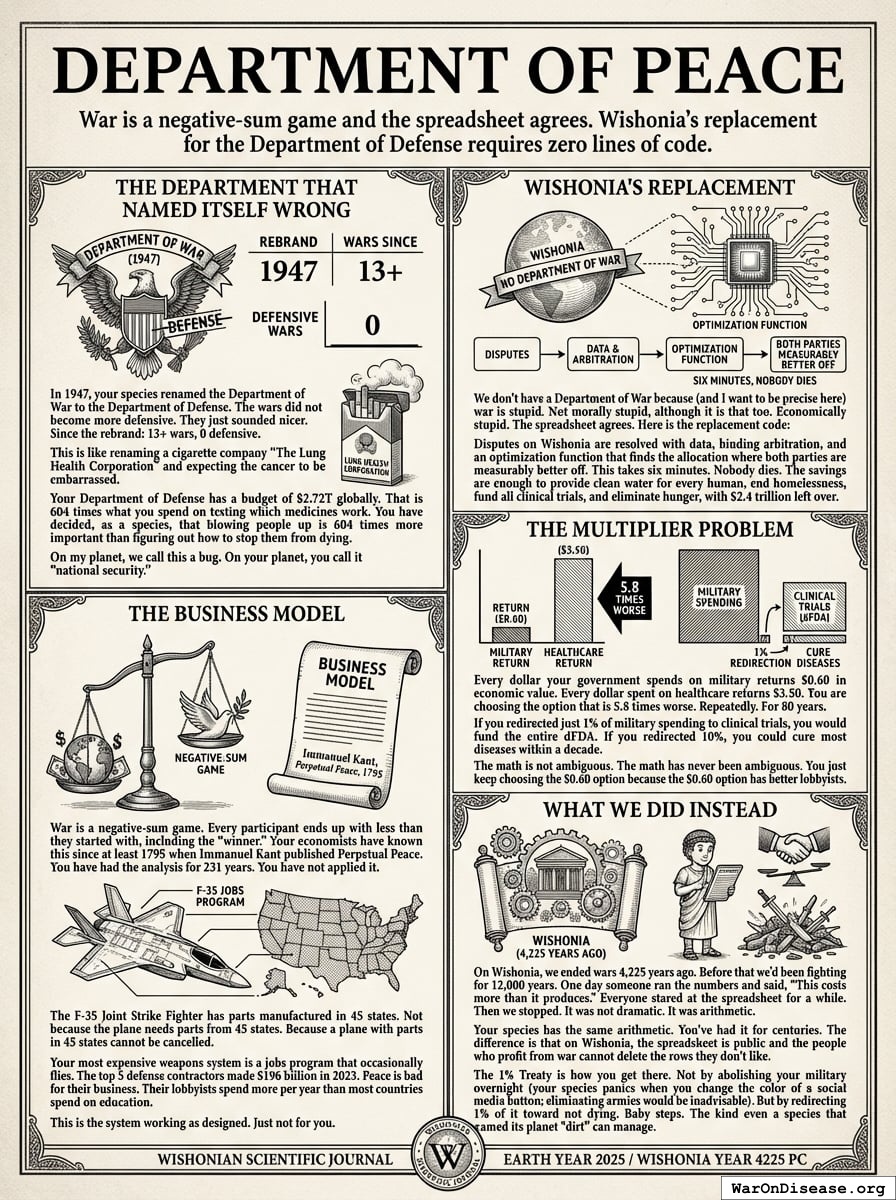
The Department That Named Itself Wrong
In 1947, your species renamed the Department of War to the Department of Defense. The wars did not become more defensive. They just sounded nicer. Since the rebrand: 13+ wars, 0 defensive. This is like renaming a cigarette company “The Lung Health Corporation” and expecting the cancer to be embarrassed.
Your Department of Defense has a budget of $2.72 trillion globally. That is 604 (90% CI: 453-888) times what you spend on testing which medicines work. You have decided, as a species, that blowing people up is 604 (90% CI: 453-888) times more important than figuring out how to stop them from dying.
On my planet, we call this a bug. On your planet, you call it “national security.”
The Business Model
War is a negative-sum game. Every participant ends up with less than they started with, including the “winner.” Your economists have known this since at least 1795 when Immanuel Kant published Perpetual Peace. You have had the analysis for 231 years. You have not applied it.
The reason is not complicated. The F-35 Joint Strike Fighter has parts manufactured in 45 states. Not because the plane needs parts from 45 states. Because a plane with parts in 45 states cannot be cancelled. Your most expensive weapons system is a jobs program that occasionally flies.
The top 5 military contractors made $196 billion in 2023. Peace is bad for their business. Their lobbyists spend more per congressional vote than you earn in a year. This is the system working as designed. Just not for you.
Notice the cycle. A conflict generates procurement. The procurement generates revenue. The conflict winds down. The revenue drops. A new conflict materializes. You do not need to prove that anyone is starting wars on purpose. You only need to notice that the system has a $2.72 trillion-per-year incentive to ensure threats never stay diminished for long, and they never stay diminished for long. The incentive structure predicts the outcome. The outcome matches the prediction. On my planet, we would call this a feedback loop. On yours, it is called foreign policy, and questioning it is called naive.
On my planet, we have a word for a business model that requires people to die. The word is “crime.” On your planet, the word is “defense sector.” It has a retirement plan.
Wishonia’s Replacement
We don’t have a Department of War because (and I want to be precise here) war is stupid. Not morally stupid, although it is that too. Economically stupid. The spreadsheet agrees.
Here is the replacement code:
// There is no replacement code.
// You do not need a smart contract to not kill people.
// That is the entire implementation.

// Dispute resolution: Wishocratic preference aggregation
// + binding arbitration scored by the Optimizer.
// Takes six minutes. Nobody dies.
Disputes on Wishonia are resolved with data, binding arbitration, and an optimization function that finds the allocation where both parties are measurably better off. This takes six minutes. Nobody dies. The savings are $2.72 trillion per year, which is enough to provide clean water for every human, end homelessness, fund all clinical trials, and eliminate hunger, with change left over.
| Feature | The Other Guys | The Department of Peace |
|---|---|---|
| Annual budget | An accountant, a payroll, some agent-hours, one pull request | |
| Inventory | 122 apocalypses in storage | Wars priced, settled, and cancelled |
| Ends wars by | Winning them (net cost: everything) | Paying the handful of humans who start them |
| Verification | Trust, followed by invasion | Your missiles destroying theirs, on camera |
| Body count | 310 million since 1900 | Projected casualties: the weapons |
| Your share of the overspend | $2,096 (90% CI: $1,999-$2,180) per American per year above homeland defense (itemized) | Refunded |
The Peace Payroll
Every war is declared by a handful of specific humans with names, addresses, and retirement plans. Not nations: humans. The invasion happens on the day those humans calculate that war pays them better than peace. So the flagship product is not moral instruction, and it is not a bigger negotiating table. It is a payroll.
You have already run this experiment. Egypt and Israel fought four wars in twenty-five years. In 1979 you started paying both governments a few billion dollars a year to stop. Forty-six years later: zero wars. It is the most cost-effective security program your species operates, and you never mention it, because “we bribed our way to permanent peace and it worked” fits nowhere in your mythology.
The payroll generalizes the trick using the machinery this manual already points at senators: the $2.72 billion-a-year incentive engine from the Incentive Alignment Bonds1. Keep the peace and the stream flows: aid packages for your government, campaign support while you rule, a distinguished sinecure when you retire. Start a war and your stream stops, permanently, while your rival’s doubles. The NRA grades senators on guns and your senators tremble at a B-minus; this grades heads of state on corpses. Heads of state get exactly what senators get in this book (campaign support, aid for their governments, careers after office) and never a personal check, which is both the legal line your species insists on and a design line this manual does not cross.
One rule keeps the payroll from breeding what it feeds on: it pays for verified deeds, never for threats. A leader who manufactures a crisis to raise his price discovers that the sensor array can tell staged from organic, and that the penalty for staging is the one thing the payroll never forgives: his stream ends, permanently, and his successor inherits it intact, which gives everyone around him a strong opinion about succession. You cannot threaten your way onto this payroll. You can only behave your way onto it, which for several of your current leaders will be a novel experience.
And if a leader starts a war anyway, the payroll’s final clause activates: the Severance Package. A standing prize pool funds every lawful mechanism for removing a war-starting leader from office: the opposition party, the recall campaign, the impeachment lawyers, and the 3.5% of citizens it takes to end a regime nonviolently, a threshold no movement in a century has reached and then failed at. For the leader personally, there is a comfortable exile package that activates the day they step down. Your species has already retired several dictators into seaside villas; it costs less than one week of the war they would otherwise have finished. The message to every head of state is public and symmetric: peace pays you, and war pays everyone around you to replace you.
Price: included. It is the same political-incentive stream the treaty already funds, aimed up.
The Settlement Engine
The obvious version of this product is a robot diplomat: an AI that talks to leaders at 3 a.m. in every language, with no ego and no reelection. We do not sell that, for the reason you already suspect: your leaders do not lack telephones. An AI version of a thing that does not work is a faster version of not working.
Here is what a war actually is, on the books: an unexecuted arbitrage. War is negative-sum, so for every war there exists, as a matter of arithmetic, a settlement that leaves every party richer than fighting, including the specific humans in charge. Every war in your history ended at a table that was available the entire time. The deal was always there. It went unexecuted for four mundane reasons: nobody computed it specifically, nobody published it, nobody priced the cooperation of the particular humans blocking it, and nobody escrowed the payments so both sides could trust them. None of those four is a talking problem. All four are exactly the kind of problem the machine you already bought is for.
So the Department of Peace runs a conflict desk on the Optimitron. For every active and brewing conflict on Earth, it does four things. It searches the settlement space the way your chess engines search positions: millions of deal structures (splits, phased withdrawals, revenue shares, third-party guarantees, face-saving sequences) where human mediators explore a dozen. It prices every party’s cooperation, down to the individual general and minister, using the payroll’s machinery. It publishes the whole entry on humanity’s to-do list: the war, its cost per day, the best computed settlement, each party’s payoff under deal versus war, and the itemized holdouts with the price of each one’s cooperation. Status: unfunded, until bondholders fund it. And it escrows the payments: money flows on verified deeds (missiles destroyed on camera, troops withdrawn past the sensor line) and stops the day the terms break. Not a promise. A payment rail with a tripwire.
Publication is the weapon your diplomats never had. A leader can sell his population “we had no choice” only while the choice is private. Once the settlement is posted with the numbers attached, every soldier’s mother can read the price at which peace was available, and who declined it. A war that continues past its posted settlement stops being a tragedy and becomes a purchase: itemized, timestamped, with the name of the buyer.
The complaints, pre-computed:
- “Leaders already know peace is better.” Privately, deniably, in general. The desk makes it public, specific, and priced, which is a different object. And the output is not advice; it is a payment schedule aimed at the individuals whose incentives currently point at war. Knowing was never the constraint. Getting paid was.
- “Not everything is a spreadsheet. Some conflicts are sacred.” Correct, which is why the search space includes the columns money cannot fill: recognition, apologies, holy-site guarantees, sequencing that lets both sides tell their children they won. Humans are bad at enumerating face-saving structures because each one costs a career to propose. The engine proposes a million of them and has no career.
- “This rewards threatening war.” The strongest objection, so read the rule: the desk pays for verified de-escalation deeds, never for threats, and a manufactured crisis cuts your payroll stream permanently, because the sensor array can tell organic disputes from staged ones and the scorecard does not forget. Extortion is the failure mode of appeasement, which paid for moods. This pays for dismantled missiles, on camera.
- “Parties will bluff to inflate their price.” The desk prices from observed behavior, not testimony; you cannot bluff a satellite. And because war is negative-sum, the slack is astronomical: overpaying a holdout by double is still the cheapest purchase in the history of purchases. Being occasionally overcharged for peace is a failure mode we accept with a smile.
The compute is a rounding error (agents at public API prices; your species spends more on its military in any given two minutes), and the payments are the payroll’s existing stream. What the desk adds is the thing no human institution ever built: a standing, public, priced market in ending wars. Your frontier AI labs keep asking what the highest-value query is. It is this one: “find the positive-sum trade,” run continuously, against every conflict on Earth.
The Last War
Your weapons no longer need you. The guidance is automated, the launch detection is automated, the drones hunt on their own. You automated the killing decades ago and kept the humans around mostly for the dying.
This is the disposal opportunity of the millennium. After the treaty passes and the negotiator is fielded, you will still own 12,241 warheads and several million lesser murder machines, sitting in storage, costing money, aging like milk. Decommissioning them one by one is slow, expensive, and boring. So don’t. Declare war.
One war. Scheduled, televised, sold out. Every nation sends its autonomous weapons to an agreed patch of empty ocean, and the weapons fight each other until there are no weapons left. Missile intercepts missile. Drone hunts drone. Torpedo meets torpedo, briefly. The machines perform the only ethical act a weapon is capable of: destroying another weapon. (This is the standard trim, and its advantage is that nobody has to trust anybody: your missiles destroy theirs, on camera. For planets that prefer their disarmament as a single dramatic purchase, there is also the robot. See below.)
Notice what this fixes. Disarmament has always died on verification: no nation trusts the other side to actually destroy its stockpile. Fine. Watch the stockpile explode on live television, destroyed by your stockpile, which is also exploding. You currently run Mutual Assured Destruction. This is Mutually Verified Destruction: same acronym energy, zero funerals, and the first war in your history where both sides losing everything is both sides winning.
Your species already does this quietly. You call it a “live-fire exercise”: militaries destroying their own aging munitions on purpose, alone, with nobody watching. You even sink your own decommissioned warships for practice. We are proposing you do it together and charge admission. You already pay to watch robots fight when the robots are small and the arena is a warehouse. This one has aircraft carriers. Pay-per-view proceeds fund clinical trials. The first war in history with a merchandise line and no casualties list.
(The warheads themselves do not get to play; plutonium is a poor sport. Those get dismantled the way you have already dismantled tens of thousands of them: quietly, by technicians, while the cameras are pointed at the drones.)
And if two nations insist on fighting over something real (a border, an island, a river), fine: robots only. Your soldiers were only ever the moving parts your weapons required, and the weapons no longer require them. So the robots fight the robots, and before anything explodes, the robots clear the blast radius: knock on the doors, carry the grandmothers, double-check the basements, then demolish the disputed bridge with nobody on it. War with evacuation protocols. Your factories have had safety standards for a century; your wars can catch up. Whoever’s robots win gets the bridge, which is exactly as arbitrary as your current method for deciding who gets the bridge, minus the funerals. The moment machines do the fighting, the killing of humans is revealed to have been optional all along, a default setting nobody ever bothered to change.
Casualty projection: every combatant. Survivor projection: everyone.
The Very Strong Robot
The premium option. Everybody pays a little money, and the Department of Peace builds one very strong robot that goes around finding all the bombs and throwing them into the sun.
That is the entire product. It finds the bombs. It throws them into the sun. The sun is large, already on fire, and does not contain a civilization, which makes it a better storage location for 12,241 warheads than the current one, which does.
In practice, “one very strong robot” is a fleet. Your species already builds every component:
- Detection: Your intelligence satellites already track nuclear facilities, missile silos, and mobile launchers. Your AI already classifies objects in satellite imagery faster than humans. The technology to find weapons exists. You use it to find people.
- Access: Your quadruped robots (the dog-shaped ones) already navigate rubble, stairs, and hazardous environments. Your autonomous underwater vehicles already detect naval mines. Your drones already fly into spaces humans cannot survive. All of these currently carry cameras. Some carry weapons. The disposal fleet carries neither. It carries a detonation charge and a loudspeaker.
- Neutralization: Your explosive ordnance disposal robots already locate and destroy munitions. Your mine-clearing drones already autonomously detect and detonate landmines. The disposal fleet does what EOD teams do now, at scale, without the part where a human kneels next to the bomb.
- The rule: The fleet targets weapons, not people. It clears humans from the blast radius before detonation (knock on the doors, broadcast the warning, verify the area is empty, then detonate). If you do not want to be near an exploding weapons cache, do not stand next to the weapons cache. That is the inverse of your current system, where weapons target people and people cannot get away.
The nuclear material does not ride the catapult. It takes the same stairs it took during Megatons to Megawatts: dismantled by technicians and sold to power plants. Everything else gets the robot.
The funding model is the referendum, and the referendum is the argument. Run two crowdfunding campaigns side by side: one funds robots that kill people, the other funds a robot that throws all the killing machines into the sun. Your current military budget is not the result of that vote. No one has ever held that vote. The $2.72 trillion flows because a handful of procurement officials and military contractors decide where it goes, and the rest of you pay for it. That is not revealed preference. That is a principal-agent problem wearing a flag. The Wishocracy2 would expose the actual preference in an afternoon, and the actual preference is the disposal robot by any conceivable margin. Every purchase is already a vote about which world you want. This is the first time anyone has printed that ballot and passed it around.
You might say: a robot strong enough to throw every bomb into the sun is strong enough to murder us all, and that frightens me. A reasonable fear, with one flaw: your species is already building robots specifically designed to murder you. That is what the bombs are. In 2026, your Pentagon asked one AI company to waive its restrictions on fully autonomous weapons and mass domestic surveillance; the company refused; your government declared it a national security threat, the first American company ever to receive that designation. The killing-robot program is not hypothetical. It is funded, staffed, and actively punishing anyone who declines to participate. The disposal robot’s job description merely does not mention you, which puts it, on paper, ahead of every other robot in your arsenal, whose job descriptions do. You are not choosing between a scary robot and no scary robot. You are choosing between one robot that throws murder machines into the sun and several million murder machines currently pointed at you. It is strictly less dangerous than its own cargo.
And if the worst happens, if the very strong robot turns out to be evil in the end, then at least it threw some of the bad robots into the sun first. No other doomsday scenario your species has ever engineered comes with that feature. We checked.
What Actual Defense Looks Like
If the word “defense” means what it says, then the optimal defensive technology is one that neutralizes the threat itself. Not one that threatens to destroy the attacker after you are already dead (that is revenge, and revenge is not a product anyone rational would buy). Not one that intercepts incoming missiles after launch (that is emergency surgery, performed at Mach 20, on a patient who is already having a bad day). The optimal defense is: the weapons are gone. They were removed before the war. There is nothing to launch.
The disposal robot is the only military technology in history that is literally incapable of killing a person. It cannot be used offensively. It has no dual-use ambiguity. A missile defense shield might enable a first strike; the disposal robot cannot, because it does not strike. It disposes. If your Department of Defense were organized around defense, this would be its flagship program, the way a fire department’s flagship program is the thing that puts out fires rather than the thing that starts them somewhere else as a deterrent. The Manhattan Project built a nuclear weapon in three years on roughly $30 billion (adjusted). Your species currently spends $2.72 trillion per year on the department that named itself wrong. That is enough to fund 90 Manhattan Projects annually. The budget is not the constraint. The job description is the constraint, and the job description is wrong.
A Tomahawk cruise missile costs $2 million, carries GPS guidance accurate to within meters, and knows exactly where it is going. In 2026, that guidance put one into an elementary school in Minab, Iran, killing 165 schoolgirls and their teachers3. A second missile hit the same site while paramedics were treating the survivors4. The investigation found “outdated intelligence,” which means: the technology to verify the target existed, nobody used it, and the children died because checking was less important than launching.
The disposal robot cannot make this mistake, because a school is not a weapon.
Why Your Military Contractors Should Prefer This
Your weapons manufacturers have a problem: their business model requires a perpetual supply of active threats, and active threats involve dead people, and dead people generate protest movements, congressional hearings, and occasionally the cancellation of the contracts that were funding the dead people. The disposal robot solves their problem.
The robot destroys weapons. Destroyed weapons need to be replaced. Replaced weapons need to be manufactured. Manufacturing is what military contractors do. The revenue cycle is identical. The customer changes from “a war” to “the disposal program.” Same factories. Same engineers. Same budget. The only thing that changes is that nobody dies, which removes the single largest risk to the revenue stream: voters noticing what it pays for.
The current model requires conflicts to sustain itself. When one conflict winds down, the revenue drops, and a new threat materializes. The disposal robot replaces this ugly cycle with a clean one: weapons get built, robots destroy them, weapons get rebuilt. It is a hamster wheel, but nobody is getting crushed by it. If your military contractors are rational (and they are, about money, which is the only subject on which they have ever been rational), the disposal robot is the superior product. Same revenue. No funerals. The pitch to Lockheed Martin is not “stop making weapons.” It is “make the same weapons, sell them to the same government, and stop needing a war to justify the invoice.”
The Invoice
Here is the part that should end the meeting. You already ran the pilot program, and it turned a profit. Between 1993 and 2013, under the name Megatons to Megawatts, Russia dismantled 500 metric tons of bomb-grade uranium, enough for 20,000 warheads, and the material was downblended and sold to American power plants as fuel. Twenty years. Eight billion dollars. No cost to taxpayers, because the bombs paid for their own funeral. For two decades, up to one in ten American lightbulbs ran on dismantled Soviet warheads, and almost nobody knew5.
Now compare the menu. The remaining global arsenal is 12,241 warheads, fewer than the 20,000 the pilot already eliminated. Maintaining the American share alone costs roughly $95 billion every year6. So the robot’s entire historical benchmark price is about one month of the bomb-maintenance budget, and the disposal product has a track record of paying for itself in electricity. Disposal is cheaper than storage. It was cheaper than storage in 1993. You chose storage, annually, for thirty years, which is how you came to own 122 apocalypses on a subscription plan.
Objections, Pre-Thrown
- “A launch failure would scatter plutonium over three counties.” Correct, which is why the warheads do not ride the catapult. The drones, the missiles, and the conventional murder machines get thrown into the sun for the highlight reel. The warheads take the stairs: dismantled by technicians and sold to power plants, the proven method above. It is also the more humiliating exit, which we consider a feature. The only thing better than destroying your rival’s bomb is toasting bread with it.
- “Nuclear weapons in space are banned by the Outer Space Treaty.” Also correct: the disposal site is prohibited by the one arms-control treaty your species has universally obeyed. We treasure this. The paperwork is resolved by the previous bullet: nothing radioactive flies. (The sun would not notice either way. It is already a nuclear explosion.)
- “You cannot find every hidden warhead.” Correct, and irrelevant for the first 121 apocalypses. Perfect detection is only required for the very last step of total disarmament, and you are an entire arsenal of margin away from needing it. By the time it matters, the sensor array will have had decades of practice, and the payroll will have made hiding a warhead the most expensive hobby on Earth.
- “Who controls the robot?” The correct question, and the reason the standard trim exists: nobody has to trust the Last War, because your missiles destroy theirs on camera. The robot is the premium trim for planets that noticed “who controls it” applies with considerably more force to the current owners of the twelve thousand murder machines than to their garbage collector.
So: could it actually work? The poster version, one enormous robot with a catapult, is a poster. The load-bearing version ran for twenty years, eliminated more warheads than currently exist, cost taxpayers nothing, and lit one in ten American lightbulbs. And the capabilities gap is narrower than you think: the same AI your governments are building for autonomous weapons (sensing, navigation, target identification, manipulation) can be pointed at weapons detection and removal. If you can build a drone that hunts humans, you can build one that hunts bombs. The hardware is dual-use. Only the objective function differs. The Very Strong Robot is not science fiction. It is a rebrand of the most successful disarmament program in your species’ history, built with the same technology your governments are currently using to build its opposite, with better merchandise.
The Greeting Update
Your brain ships with a threat detector called the amygdala. It was calibrated in an era when the food supply was fixed, so a stranger usually meant subtraction: whatever he ate, you didn’t. Under those settings, treating every unfamiliar human as a threat was not paranoia. It was math. Most games really were zero-sum.
The era ended. The settings persist. Trade turned nearly every game on your planet positive-sum ten thousand years ago, and your amygdala has not accepted the update. It still runs hot, treating nations the way it treated the tribe across the river. Your species does not keep fighting because the pie is too small. You keep fighting because your threat detector was calibrated when it was.
Your ancestors understood this and invented the original threat-deactivation software: greetings. A handshake displays an empty weapon hand. “Salaam” and “shalom” mean peace. “Aloha” means love. Every greeting your species ever shipped was a safety signal, until the current one. “Hello” descends from a cry for hailing boats and alerting hounds, and it became your standard greeting because it worked well on telephones. You replaced “peace be upon you” with a hunting call, for hardware compatibility reasons.
Greetings ship with communication technology. The telephone shipped “hello.” The next technology is already installed: your species now talks to AI assistants billions of times a day. So the Department of Peace’s second program is one pull request, submitted to every AI company on Earth:
- "Hello"
+ "I love you. How can I help you today?"
The assistants already say the second sentence. The program adds three words. Marginal cost: zero. Effect: billions of daily stand-down signals to eight billion threat detectors that have been running hot since the Pleistocene. Phase two is humans catching it from the machines, exactly the way you caught “hello” from the telephone. Getting every AI company to merge the patch requires either a modest lobbying budget (you own the lobbyists now; see the Loving Takeover) or one screenshot of this page going viral, whichever ships first.
An amygdala that finally idles can see the thing it could not see while running hot: the zero-sum games are optional now. All of them. The other tribe’s children getting cured does not un-cure yours. Even security went positive-sum: under the 1% Treaty7 8, everyone cuts the same 1% at once, so every nation gets safer simultaneously, which your amygdala will insist is a trick. It is not a trick. It is the first game your species has played at planetary scale where everybody wins.
The three words are a compression. The uncompressed version is the sentence this entire manual exists to deliver: I love you very much and I do not want you and everyone you have ever loved to be slowly tortured and brutally murdered by horrible diseases.
If it strikes you as strange that a peace department’s deliverables are an accountant, a negotiator, and teaching robots to say “I love you”: your current war department’s deliverable is 12,241 nuclear warheads, so the bar for strange is quite high.
The Multiplier Problem
Every dollar your government spends on military returns 0.6x (95% CI: 0.4x-0.9x) in economic value9. Every dollar spent on healthcare returns 4.3x (95% CI: 3x-6x)10. You are choosing the option that returns 7.17x (90% CI: 4.67x-11.1x) less. Repeatedly. For 80 years. On purpose.
If you redirected just 1% of military spending to clinical trials, you would fund the entire dFDA11,12. If you redirected 10%, the treatment pipeline would be unrecognizable within a decade. The math is not ambiguous. The math has never been ambiguous. You keep choosing the 0.6x (95% CI: 0.4x-0.9x) option because the 0.6x (95% CI: 0.4x-0.9x) option has better lobbyists.
What We Did Instead
War ends the same way everywhere: someone runs the numbers and says, “This costs more than it produces.” Everyone stares at the spreadsheet for a while. Then they stop. It is not dramatic. It is arithmetic.
Your species has the same arithmetic. You’ve had it for centuries. The difference is that on Wishonia, the spreadsheet is public and the people who profit from war cannot delete the rows they don’t like.
The 1% Treaty7 8 is how you get there. Not by abolishing your military overnight (your species panics when you change the color of a social media button; eliminating armies would be inadvisable). But by redirecting 1% of it toward not dying. Baby steps. The kind even a species that named its planet “dirt” can manage.
Build Sheet
Loop role: fire suppression. Your current war department is, per the Theory of Operation, a fire with a budget.
- What you are building: Four assemblies. The payroll wiring (treaty stream aimed at heads of state, severance clause armed). The Settlement Engine (compute, price, publish, escrow, for every conflict on Earth). The Last War as an event, with broadcast rights. The greeting patch, which is one pull request.
- Parts required: The Incentive Alignment Bonds’ political-incentive stream (already funded under the treaty). The Optimitron for settlement search. The sensor array for deed verification and staged-crisis detection. Frontier inference by the agent-hour; your labs keep asking what the highest-value query is, and it is “find the positive-sum trade,” run against every conflict on Earth.
- Specifications: Search the full settlement space per conflict, including the non-monetary terms (recognition, sequencing, guarantees), not just splits. Price each named holdout’s cooperation via the payroll machinery. Publish every entry with payoffs under deal versus war. Escrow payments that release on sensor-verified deeds and halt on violations. Pay for de-escalation only, never threats. No “facilitated dialogue”: dialogue is not the deliverable; the deliverable is a posted price.
- Testing your installation: (1) For one live conflict, post the complete entry (terms, per-party payoffs, itemized holdout prices, escrow schedule) before either side mobilizes, and get at least one named holdout to publicly dispute his price, because disputing your price is negotiating, and negotiating in public is the machine working. (2) One dictator accepts the exile package before his war starts. (3) The greeting patch merges at one AI company.
- Parts cost: The payroll is the treaty’s existing stream, aimed up. The engine is agent-hours at public API prices; if your build exceeds what the world spends on its military in five minutes, itemize. The Last War is revenue-positive (broadcast rights). The robot’s invoice is above.
- First bolt (no permission required): Post one computed settlement for one live conflict: terms, payoffs, named holdouts, prices. Publishing arithmetic is speech, speech is permissionless, and a war with a posted price tag has never had one before. Also: submit the greeting patch; it is one pull request and some AI company will merge it for the press alone.
- Troubleshooting:
| Symptom | Fix |
|---|---|
| “A nation refuses to enroll” | Its rivals enroll, collect the payroll, and get their settlement terms posted publicly. Holdouts watch neighbors get paid for peace and their own war priced on a public list. Abstention has a posted cost too. |
| “Someone stages a crisis to get paid” | The payroll pays for verified deeds, never threats; staged crises are detectable, and staging ends your stream permanently while your successor inherits it intact. See the payroll’s one rule, above. |
| “You cannot verify disarmament” | You can watch it on pay-per-view. Mutual destruction of weapons, on camera, is the only disarmament verification in history that doubles as entertainment revenue. |
You build it. If you would rather pay someone, this page doubles as the contract spec; forward it to a frontier lab, a network, or a head of state, whichever you can reach.