Treaty Feasibility & Cost Analysis
war-on-disease, 1-percent-treaty, medical-research, public-health, peace-dividend, decentralized-trials, dfda, dih, victory-bonds, health-economics, cost-benefit-analysis, clinical-trials, drug-development, regulatory-reform, military-spending, peace-economics, decentralized-governance, wishocracy, blockchain-governance, impact-investing
“Getting 195 countries to agree costs billions and takes forever.”
No. Getting countries to implement things costs billions. Getting them to sign papers is surprisingly cheap. Your entire diplomatic system runs on the principle that writing your name on a document feels like accomplishing something (it doesn’t, but it’s affordable).
What Treaties Actually Cost
NGO campaign budgets are rarely disclosed publicly, but treaty campaigns run on pocket change compared to the thing they create.
The Ottawa Treaty1 banning landmines took 14 months. One staff member, Jody Williams, grew a coalition to over a thousand organizations across 60 countries. 122 states signed. She won the Nobel Peace Prize. One woman with a phone convinced 122 countries to stop burying explosives in the ground where children walk. Your species is capable of remarkable things when one person gets sufficiently annoyed.
The Cluster Munitions Convention2 took about two years. Seven governments and a coalition of NGOs got 94 states to sign. The Arms Trade Treaty3 took a decade but started with three supporting governments. The Control Arms coalition4 published 50+ reports until 130 countries signed. The Nuclear Ban Treaty5 also took a decade. ICAN ran the entire operation with five staff in a Geneva office. 122 states voted yes. Another Nobel Prize. Five people in a Geneva office won a Nobel Prize. You have more people in your accounting department.
Pattern: Total to get a treaty signed: $15-50M. Your species spends more than that on Super Bowl ads for beer (the thing that makes you temporarily stupider). You will pay more to sell stupidity beverages during one sporting event than it costs to get 122 countries to agree on anything.
Inflation-Adjusted to 2024 Dollars
Using BLS CPI data6:
| Treaty (Year) | Original Cost Estimate | 2024 Dollars | Inflation Multiplier |
|---|---|---|---|
| Ottawa (1997) | $15-25M | $30-50M | ~2.0x |
| Cluster Munitions (2008) | $15-25M | $23-38M | ~1.5x |
| Arms Trade Treaty (2013) | $20-30M | $27-41M | ~1.35x |
| Nuclear Ban (2017) | $10-20M | $13-25M | ~1.25x |
In today’s money: Treaty campaigns cost roughly $25-50M (2024 USD). Banning landmines: ~$40M to get the signatures, $5B+ to actually dig them up1. The paperwork is always the cheap part. The expensive part is doing the thing you wrote on the paperwork (your species often skips this part).
Cost for a 1% Health Treaty
Historical treaty campaigns ran on pocket change. But this is not just a signature campaign. It is a referendum engine, lobbying operation, diplomatic push, and reserve fund aimed directly at military budgets, which means you are picking a fight with the most powerful industry your species has ever created. The relevant planning number is not what it costs to collect signatures. It is what it costs to win a fight with the people who build aircraft carriers.
| Budget Frame | What It Covers | Cost |
|---|---|---|
| Historical treaty-signing benchmark | NGO-led campaigns to get signatures on paper | $25-50M (2024 USD) |
| Modeled 1% Treaty campaign | Referendum, lobbying, diplomacy, legal work, reserve fund | $1 billion |
| Modeled annual burn | Average spend across the campaign window | $250 million (90% CI: $168 million-$369 million)/year |
The Math
Modeled campaign cost: $1 billion. What the treaty unlocks: $27.2 billion/year. Forever.
Even before you count downstream health gains, this is a one-year redirection of government spending far larger than the campaign that triggered it. You are not buying signatures. You are buying leverage.
How to Make Governments Sign Things
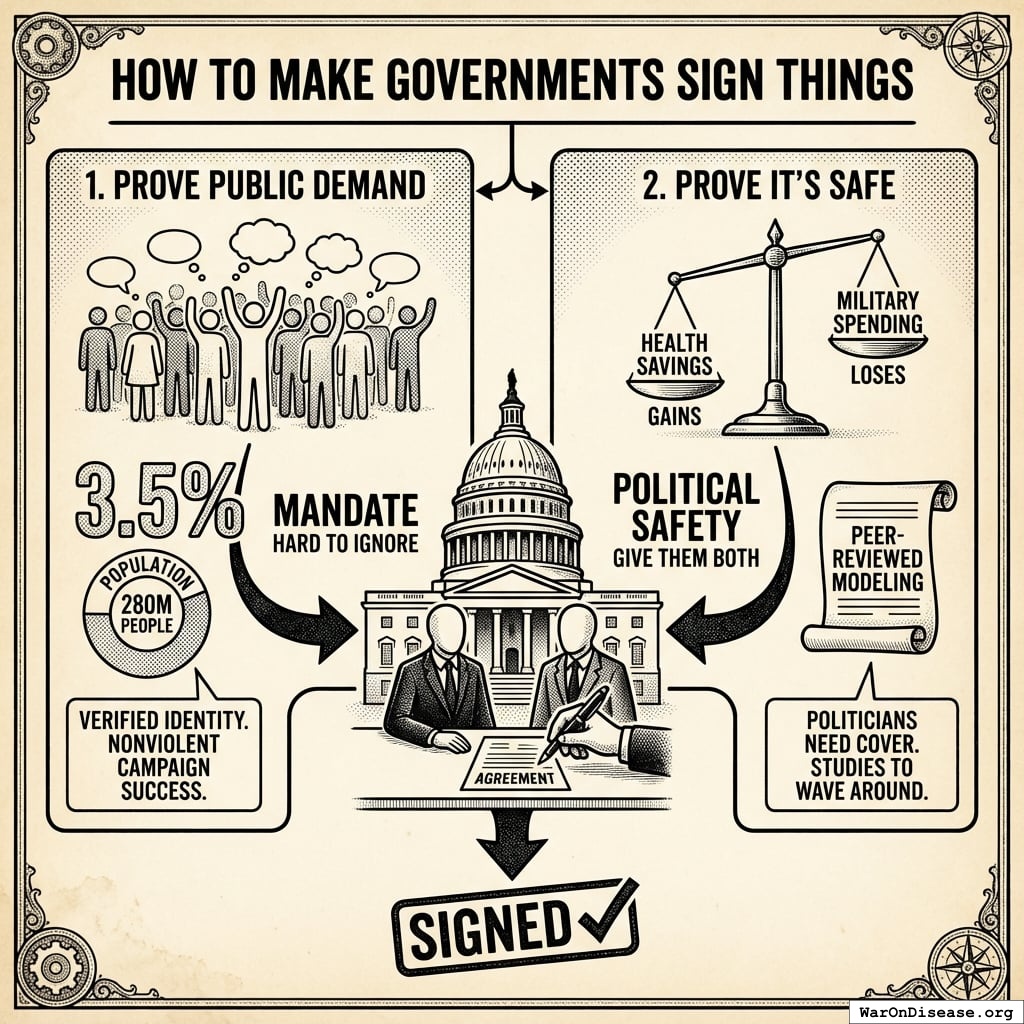
Politicians move when they see voters demanding it and political cover to do it. Give them both.
First, prove public demand. Get 3.5% (95% CI: 1%-10%) of the population7 (280 million people) to say “yes” with verified identity. The 3.5% (95% CI: 1%-10%) finding7 is not a magic law of treaty ratification. It is a coordination heuristic: the point where a cause stops looking like a niche moral hobby and starts looking like a voting bloc large enough to create career risk. That’s not activism. That’s a mandate.
Second, prove it’s safe. Peer-reviewed modeling showing every nation gains more in health savings than it loses in military spending. Politicians need cover the way vampires need darkness. Give them the numbers and they’ll pretend it was their idea (the second most reliable pattern in your political history, after blaming the previous administration).
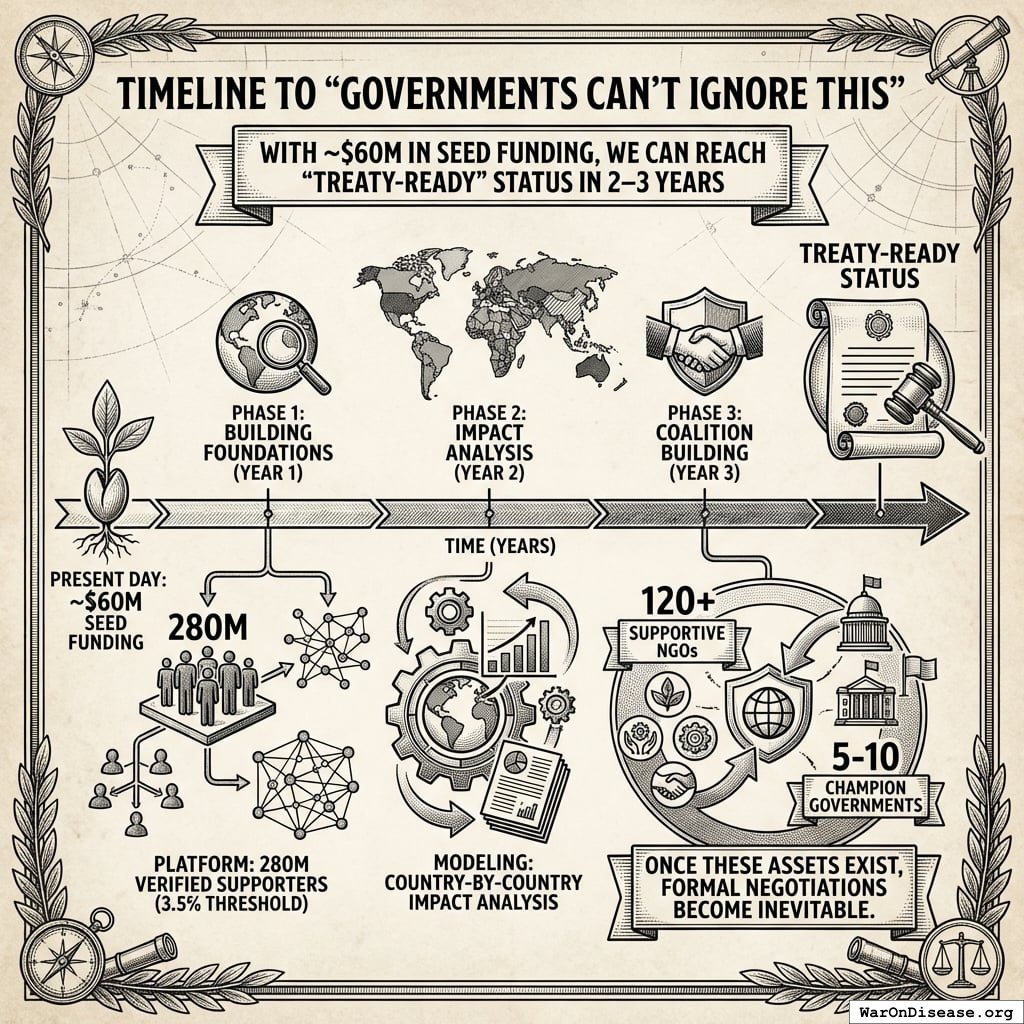
Timeline to “Governments Can’t Ignore This”
With the first phase of a $1 billion campaign, you can reach “Treaty-Ready” status in 2-3 years: a platform with 280 million verified supporters (the 3.5% (95% CI: 1%-10%) threshold), country-by-country impact modeling, and a coalition of 120+ supportive NGOs and 5-10 champion governments.
Once these assets exist, formal negotiations become very hard to avoid. Not because politicians want them. Because ignoring 280 million people is the kind of career decision that leads to “spending more time with family.”
The slow part is not physical implementation. It is coalition activation. Once a political threshold is crossed, budget priorities can move much faster than peacetime common sense suggests. The United States cut military spending by 87.6% in the two years after World War II. The bottleneck is not whether states can reallocate fast. It is whether enough pressure, cover, and institutional machinery exist to make them do it.
You aren’t buying a treaty. You’re buying the machinery that makes the treaty very hard to refuse.
Political Success Probability: Economic Analysis
This section documents the rationale for the 1% (95% CI: 0.1%-10%) central estimate (and a 25% optimistic scenario ceiling). The model assumes failure is the base case. It’s still a good bet. No sane species would invest in something where failure is the base case. Your species calls it “venture capital” and your richest humans do it professionally.
Even at 1% (95% CI: 0.1%-10%) probability of success, this intervention’s expected cost per DALY ($1.99 (90% CI: $0.37-$38)) is still 92.1x (90% CI: 4.55x-493x) more cost-effective than malaria bed nets ($184 (90% CI: $113-$252)/DALY). Bed nets are the gold standard of global health interventions. This beats the gold standard while assuming it will almost certainly fail. Your pessimism is not the variable you think it is.
| Metric | Point Estimate | 95% CI |
|---|---|---|
| Political success probability | 0.1%-10% | |
| Expected cost per DALY | $0.029-$3.20 | |
| Cost-effectiveness vs bed nets | 30x-3.0kx | |
| Bed net cost per DALY | $78-$100 |
Historical Precedents (The Depressing Table)
| Commitment | Target | Actually Did It? | Duration | Notes |
|---|---|---|---|---|
| 0.7% ODA Target | 0.7% of GNI to foreign aid | ~20% of countries | 50+ years | Scandinavia and Germany. That’s basically it. |
| Kyoto Protocol | Binding emissions targets | ~55% initially, then collapse | 1997-2012 | US never ratified. Canada withdrew. Classic. |
| Paris Agreement | Non-binding pledges | ~15-25% on track | 2015-present | 195 countries signed. Maybe 40 meant it. |
| NATO 2% GDP Military | 2% of GDP on military | ~72% of members (2024) | Since 2014 | Was ~32% until an actual land war in Europe motivated compliance. Took tanks rolling across a border to get countries to spend more on killing. No equivalent motivator exists for spending on not-killing. |
| EU Stability Pact | 3% deficit, 60% debt | Routinely violated | Since 1997 | France and Germany broke their own rule |
Pattern: International financial commitments achieve <25% meaningful compliance. Your species signs things and then doesn’t do them. It’s like a New Year’s resolution, but for geopolitics.
Why a 1% Treaty is Harder Than Most Precedents
Let’s be honest about the obstacles. This is not a chapter written by someone trying to sell you something. (It is. But at least it’s honest about the hard parts.)
It touches military budgets, and politicians would rather discuss their browser history than their military budget. It requires ongoing annual allocation, not a one-time signature, which makes it a gym membership for peace (monthly, forever, no quitting). There’s no immediate security threat driving it; 150 thousand deaths/day apparently doesn’t qualify as a catastrophe because the deaths are distributed, quiet, and polite, and your species only responds to deaths that are concentrated, loud, and rude. The mechanism is novel, and humans are suspicious of things they haven’t tried before (odd, for a species that invented bungee jumping). And nobody wants to sign first. Everybody wants to sign second.
Why a 1% Treaty Might Beat the Odds
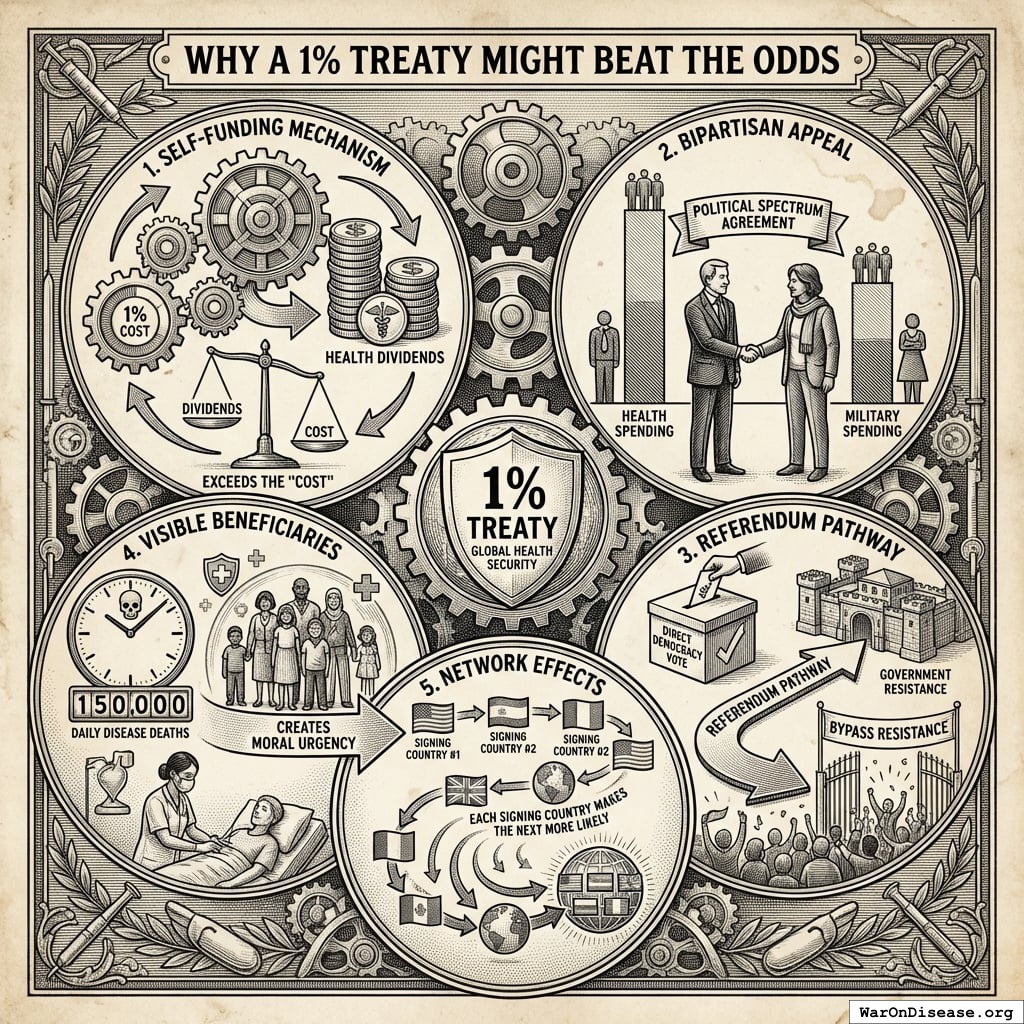
It’s self-funding: the health dividends exceed the “cost,” so you make money by doing the right thing, which is the only way your species does the right thing. “Should we cure more diseases?” polls well across every political spectrum, alongside “Is water wet?” and “Should we pay Congress less?” It has a referendum pathway that bypasses government resistance (politicians hate this, which is how you know it works). It has visible beneficiaries: 150 thousand deaths/day. And each signing country makes the next more likely, because peer pressure is humanity’s most reliable technology and the reason your teenagers wear the same shoes.
Probability Estimates
Economists would find the following defensible (and economists find very little defensible, which is their brand):
| Scenario | Probability | Translation |
|---|---|---|
| Pessimistic floor | 0.1% | Everything goes wrong. Global crises. Political gridlock. Asteroid, possibly. |
| Conservative central | Failure remains the base case. Still 92.1x (90% CI: 4.55x-493x) better than bed nets. | |
| Optimistic ceiling | 25% | A major crisis opens a political window. Or humans just… decide to be smart for once. |
The model uses: Central estimate 1% (95% CI: 0.1%-10%)
Expected Value (Even When You Assume Failure)
At 1% (95% CI: 0.1%-10%) probability of success, expected ROI is 75.3 thousand (90% CI: 3,703-404 thousand):1 (still positive, even assuming near-certain failure) and expected cost per DALY is $1.99 (90% CI: $0.37-$38), which is 92.1x (90% CI: 4.55x-493x) better than bed nets at $184 (90% CI: $113-$252)/DALY.
Downside: capped at ~$1 billion. You lose the cost of a nice yacht. Upside: unbounded. You cure most diseases.
Even assuming failure is the base case, this beats the gold standard of global health interventions. The downside is a yacht. The upside is the end of most disease. Your species makes worse bets every day in Las Vegas, except there the upside is a slightly larger pile of papers.
The Chain Reaction Model: Why This Idea Cannot Stay Contained
Your species has a cognitive immune system. When someone suggests redirecting 1% of murder money to medicine money, approximately 90% (95% CI: 80%-97%) of humans will dismiss it without engaging. This is the institutionalization rate: the probability that a human’s brain classifies “stop funding murder” as crazier than “continue funding murder.”
On Earth, this is called “being realistic.”
The question is whether a 90% (95% CI: 80%-97%) dismissal rate prevents the idea from reaching someone who can act on it. This section answers whether reaching such people is overwhelmingly likely. (The next section addresses what happens once they understand the incentive structure.)
The Orbit-Overlap Model
You don’t need to reach a billionaire directly. You need the content to reach anyone in their information orbit: the staff, advisors, social media feeds, and professional contacts whose recommendations actually land on their desk. Each implementer has roughly 1,000 such people (lower bound: Dunbar’s 150 close contacts; upper bound: a corporate C-suite’s full intake funnel).
There are 2,976 potential implementers (2,781 billionaires8 plus 195 heads of state). An initial audience of 50,000 readers shares content with an effective reproduction number of 0.15 (95% CI: 0.04-0.8) per generation, producing a cascade that fans out over three sharing generations. The question is whether that cascade overlaps with any implementer’s orbit.
The Mathematics
The probability that a given implementer’s orbit is reached by the cascade:
\[ \begin{gathered} P_{reach} \\ = 1 - \left(1 - \frac{O_{impl}}{N}\right)^{N_0 \cdot \sum_{i=0}^{3} R_{eff}^i} \end{gathered} \]
The expected number of implementers who engage (orbit reached, not dismissed):
\[ E[N_{engaged}] = P_{reach} \times P_{engage} \times N_{impl} \]
The probability that at least one engages: 96.9% (90% CI: 11.3%-100%).
That is not a typo. With 2,976 implementers and 1,000 orbit contacts each, the cascade needs to hit just one person who can flag it upward. The model expects approximately 3.48 implementers to engage. The dismissal rate stops mattering once enough shots are on goal.
This model answers only: “Is it overwhelmingly likely to reach someone who matters?” The answer is yes. The next section asks: “What happens once it does?”
This model is deliberately conservative in three ways:
- Base engagement rate: Uses the same engagement rate for personal recommendations as for passive exposure (personal recommendations convert at ~3x higher rates)
- Narrow implementer definition: Counts only billionaires and heads of state (excludes foundation heads, WHO officials, major fund managers, etc.)
- No media feedback loop: Ignores the compounding effect where media coverage of early adoption increases subsequent encounter rates
The Decision-Theoretic Case: Why Rational Actors Eventually Move
The chain reaction model says approximately 3.48 implementers will probably engage with this idea. The next question is what they do once they understand it. Any rational actor would move immediately. Your species requires proof that acting is profitable, because it will not save itself for free.
The Incentive Structure
Most “save the world” pitches are public-good pleas. Public goods have a free-rider problem: everyone wants the bridge, nobody wants to pay for the bridge, and so the bridge doesn’t get built and everyone drowns in the river while complimenting each other’s fiscal prudence. This design is different. It routes part of the upside back to whoever moves first.
| Others also act | No one else acts | |
|---|---|---|
| You act | Treaty passes, you capture 272% annual returns as an early backer, plus humanity gets healthier (side benefit). | You still bought a cheap option on the largest health intervention in history. The yacht money was going to depreciate anyway. |
| You wait | Someone else gets the returns, the credit, and the Wikipedia entry. You get to explain that you were “still doing due diligence.” | Nothing changes. 150 thousand deaths/day continue. You remain rich, mortal, and forgettable. |
This does not make action a mathematical certainty. It makes action the obviously attractive move for anyone who can read a spreadsheet and prefers not dying.
Why the EV Is Not Just Moral
“Good for humanity” has never been enough to make humans act. If it were, you would have cured malaria with the money you spend on novelty phone cases. The mechanism has to pay people, because your species requires payment for everything including not dying.
- For funders: VICTORY bondholders are modeled at 272% annual returns if the treaty passes. That is the price of being early to the largest health intervention in history.
- For politicians: $2.72 billion/year in campaign support for legislators who voted yes. Reelection fuel. The only substance politicians metabolize.
- For governments: they trade a small fraction of murder budget for lower disease burden, visible domestic wins, and $27.2 billion/year in new health-research funding. This is the kind of deal where saying no requires active effort.
The claim is not “humanity benefits, therefore billionaires act.” Your species is not built that way, and pretending otherwise is how you got 50 years of unmet 0.7% ODA targets. The claim is: this architecture pays funders, politicians, and states enough that someone with resources has a reason to move first.
Why This Should Matter Even to a Self-Interested Billionaire
If you are extremely rich, the relevant question is not “Is this charitable?” Charity is what you do to feel better at galas. The relevant question is: “Does this improve the expected future for me, my family, and the pile of assets I’m sitting on like a dragon who read an economics textbook?”
- Your family is made of biology. Private jets, private islands, and private security do not protect your children from cancer, neurodegeneration, autoimmune disease, antibiotic resistance, or aging. Redirecting $27.2 billion/year into treatment discovery is not altruism in the abstract. It is a direct attack on the probability that everyone you love dies the normal human way.
- Your fortune sits on top of the productive economy. When the destructive/parasitic economy reaches equilibrium with the productive one, wealth preservation gets harder for everyone. The current destructive economy9 is already $13.2 trillion/year, or 11.5% of GDP, and the model projects it reaching the failed-state danger zone by 2033 if the loop is not broken.
- The upside is macro-scale, not boutique-scale. The 20-year model projects the Minimum Sustainable Trajectory (1% Treaty10 11) producing 1.71x (90% CI: 1.3x-2.14x) the GDP of doing nothing. The Optimal Governance Trajectory, where the Political Dysfunction Tax12 is also removed, projects 56.7x (90% CI: 21x-148x). The broader system is currently bleeding $101 trillion (90% CI: $59.6 trillion-$161 trillion) in opportunity cost, or 87.8% (90% CI: 51.8%-140%) of global GDP. If you are rich because you own claims on future productive output, this matters to you personally.
In other words: this is not “give up 1% of military spending so strangers can feel better.” It is “buy a claim on the healthier, richer, less collapse-prone future in which your family survives longer and your assets sit on top of a civilization that still functions.”
The Real Threshold
The launch question is simpler than “what is the exact probability that a tiny elite coalition privately coordinates?” The real threshold is whether enough capital and will exist to fund a campaign costing $1 billion that unlocks $27.2 billion/year and pushes the world off a trajectory where the destructive economy reaches the failed-state danger zone by 2033.
This is not a civilization-sized funding problem. It is a syndicate-sized funding problem. One year of treaty funding dwarfs the campaign cost. The broader system is bleeding $101 trillion (90% CI: $59.6 trillion-$161 trillion)/year while the current trajectory compounds toward extraction, cybercrime, and waste. If the Minimum Sustainable Trajectory (1% Treaty) produces 1.71x (90% CI: 1.3x-2.14x) the GDP of doing nothing after 20 years, and the Optimal Governance Trajectory produces 56.7x (90% CI: 21x-148x), then the relevant question is not whether some abstract billionaire archetype becomes morally enlightened. It is whether enough actors notice the asymmetry.
The Earth Optimization Prize13 makes this easier, not harder. It replaces the fantasy of a secret benevolent cabal with visible committed capital, a public scoreboard, and a recruitment machine that pays people to expand the coalition. That matters. Once the coalition is public, the first-mover problem gets smaller because nobody has to imagine acting alone.
Why Delay Stops Looking Rational
If you already believe the upside is enormous and the downside of doing nothing is civilizational, waiting stops looking prudent.
- Move early: help define the structure, shape the campaign, recruit the coalition, and capture the largest first-mover influence.
- Wait: arrive after the structure is set by other people, accept their terms, and explain that you were “monitoring developments” while the destructive economy kept compounding.
The prize strengthens this asymmetry. Early participants do not merely fund a campaign. They help create the public machine that makes later participation easier.
What Would Have To Be Wrong
If no serious campaign emerges within 3 years, then at least one of the following is true:
- The expected-value math is wrong. The ROI, health gains, or leverage claims do not hold. Check the math in the appendix.
- The idea fails to reach enough implementers. The chain reaction model turns out to overestimate reach.
- The private-incentive bridge is weaker than it looks. The surplus exists, but not enough of it is capturable by first movers, funders, or organizers.
- Visible coalition machinery still fails to overcome inertia. Even with the prize, scoreboard, and financial incentives, nobody with resources chooses to move.
- Elite actors truly prefer the collapse trajectory. Possible. But when the destructive economy is already 11.5% of GDP and the productive upside is measured in multiples of world output, it is not the first explanation a rational model should reach for.
Rejecting this means defending one of those five. Waving at “complexity” is not one of them.
Why This Still Feels Hard To Suppress
The combined story is now stronger than the old launch-coalition probability story.
- The chain reaction model handles reach.
- The Earth Optimization Prize handles public coordination and visible momentum.
- Incentive Alignment Bonds14 handle later direct financial motive for expansion and implementation.
That does not prove success. It changes the burden of explanation. The question is no longer “what is the probability that exactly the right four billionaires privately coordinate?” The question is “how long can everyone with money, ambition, and pattern recognition ignore a visible coalition with committed capital, public upside, and a machine paying people to expand it?”
Why The Treaty Won’t Stop at 1%
Most international commitments stagnate after signing. You saw the depressing table. 0.7% ODA targets unmet for 50+ years. Kyoto abandoned. Paris missed. Your track record with follow-through makes goldfish look disciplined. So why would a 1% health treaty be any different?
Because this time, people get paid.
The 80/10/10 funding structure allocates 10% of treaty funding ($2.72 billion/year at 1%) to Incentive Alignment Bonds14. These are securities that pay out when treaties expand, not just maintain. People get rich when more diseases get cured. It only took your species 400 years of financial instruments to produce one that doesn’t require someone to suffer (progress).
The Expansion Mechanism
| Treaty Level | Annual IAB Pool | Political Pressure | Historical Comparison |
|---|---|---|---|
| 1% | $2.72 billion/year | Strong | 10x largest NGO budgets |
| 2% | $5.44B/year | Very strong | Nation-state level |
| 5% | $13.6B/year | Overwhelming | Major industry lobby |
| 10% | $27.2B/year | Probably irresistible | No precedent |
Why This Differs from Every Other Treaty
0.7% ODA failed because nobody made money when countries complied. The NGOs pushing for compliance run on guilt. Guilt has terrible fuel efficiency. Guilt gets you to the gym in January. Greed gets you there in July. Guilt volunteers at the soup kitchen once. Greed builds the soup kitchen and names it after itself. This treaty runs on greed.
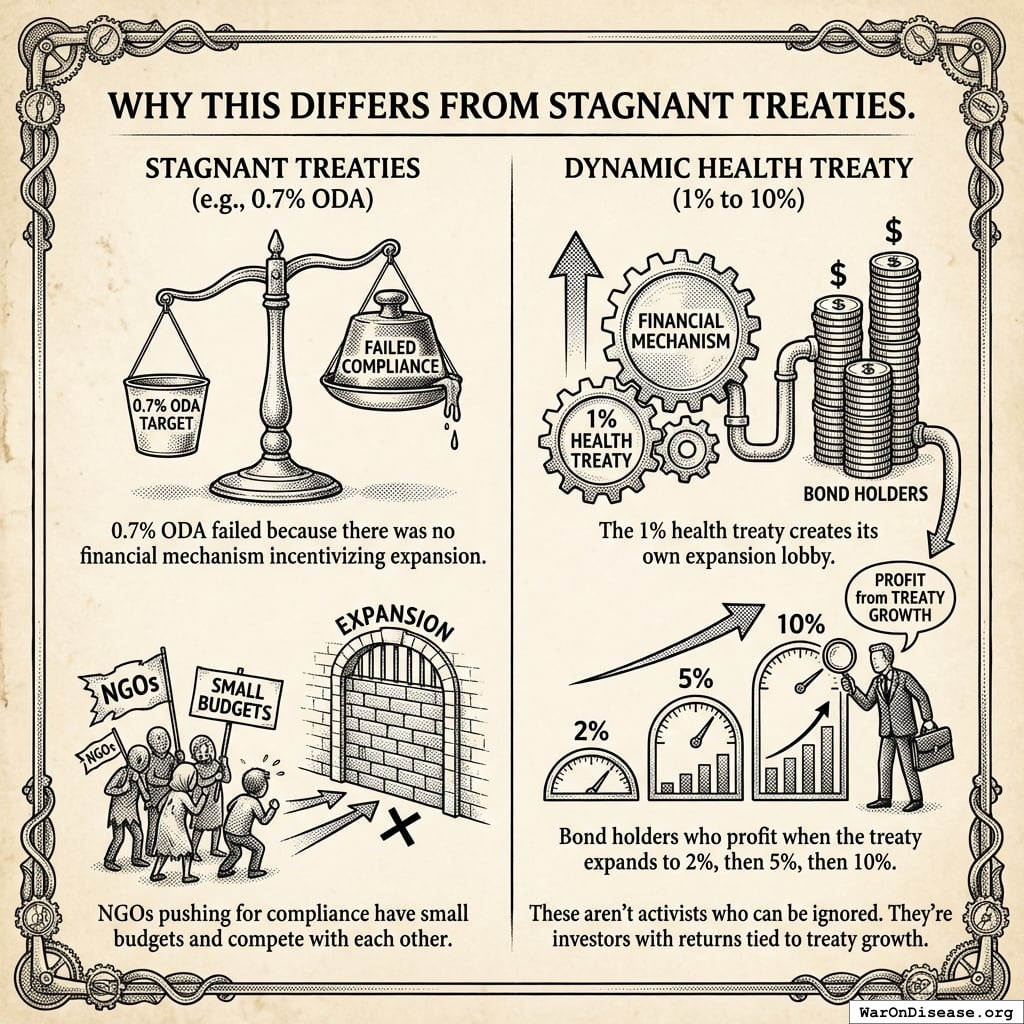
The 1% health treaty creates its own expansion lobby. Bond holders profit when the treaty expands to 2%, then 5%, then 10%. These aren’t activists you can ignore at a dinner party. They’re investors with quarterly earnings calls about curing diseases. They have Bloomberg terminals. They have lobbyists. They have the same tools that weapons manufacturers currently use to expand military budgets, except pointed in the opposite direction.
The Ratchet Effect
Once 1% passes, $2.72 billion/year flows to IAB holders pushing for 2%. When 2% passes, $5.44B/year pushes for 5%. The engine runs on compound greed, which is like compound interest but for not dying.
The politicians feel it too. The treaty’s 10% political incentive allocation scales identically: at 1%, it’s $2.72 billion/year in campaign support for legislators who voted yes. At 5%, five times that. A politician who votes to expand the treaty is voting to expand their own reelection budget. You didn’t change what politicians are. You changed what they’re rewarded for.
Most treaties are gym memberships purchased in January and abandoned by February. This one has a constituency that grows with each success. This arrangement is embarrassing. It is also the only arrangement that works.
Long-Term Feasibility
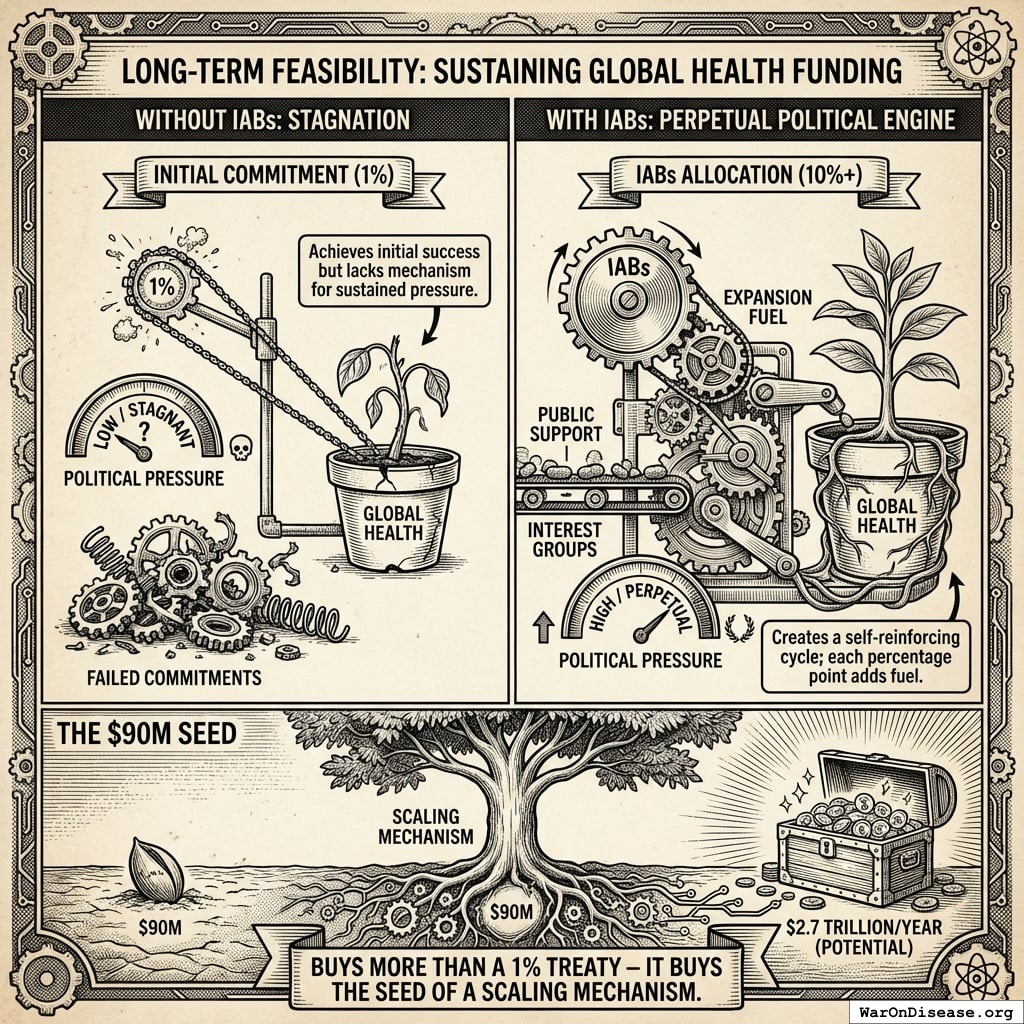
With IABs, the 10% allocation creates a perpetual political engine. A machine that runs on greed and outputs health. Embarrassing, but effective.
Without IABs, this joins Kyoto in the Museum of Things Humanity Promised to Do and Then Didn’t.