The Apocalypse Markup
We introduce three terms: the Price of Apocalypse ($752 million (90% CI: $464 million-$2.16 billion) per year, the cost of maintaining one civilization-ending exchange’s worth of warheads), the Minimum Viable Apocalypse (~100 warheads, the threshold for a regional-scale nuclear winter that collapses the global food system and kills roughly 2 billion people from famine), and the Apocalypse Markup (all military spending above the Price of Apocalypse). Nine nuclear states spend $92 billion per year on 12,241 warheads, 122x (90% CI: 42.6x-198x) the threshold for civilizational collapse. Total military spending of $2.72 trillion represents an 3.6kx (90% CI: 1.3kx-5.9kx) markup on the cost of ending civilization. A proposed 1% treaty would redirect $27.2 billion from the Apocalypse Markup to clinical trials, without touching nuclear arsenals or deterrence.
war-on-disease, 1-percent-treaty, medical-research, public-health, peace-dividend, decentralized-trials, dfda, dih, victory-bonds, health-economics, cost-benefit-analysis, clinical-trials, drug-development, regulatory-reform, military-spending, peace-economics, decentralized-governance, wishocracy, blockchain-governance, impact-investing
The Price of Apocalypse is $752 million (90% CI: $464 million-$2.16 billion) per year. That is the cost of maintaining the ~100 warheads it takes to trigger a regional-scale nuclear winter, collapse the global food system, and kill roughly 2 billion people from famine. Your governments spend $2.72 trillion on military. That is an 3.6kx (90% CI: 1.3kx-5.9kx) markup on the end of civilization.
This paper shows the math. It is not complicated. A child could follow it. (The adults who set these budgets presumably also followed it, which makes the outcome harder to explain.)
The Price of a City
How much does one nuclear bomb cost?
The military bundles warhead costs into “modernization programs” and “delivery systems” to hide the individual price tags, in the same way a restaurant hides the cost of bread by calling it “table service.” But we have the B61-12 Life Extension Program as a benchmark:
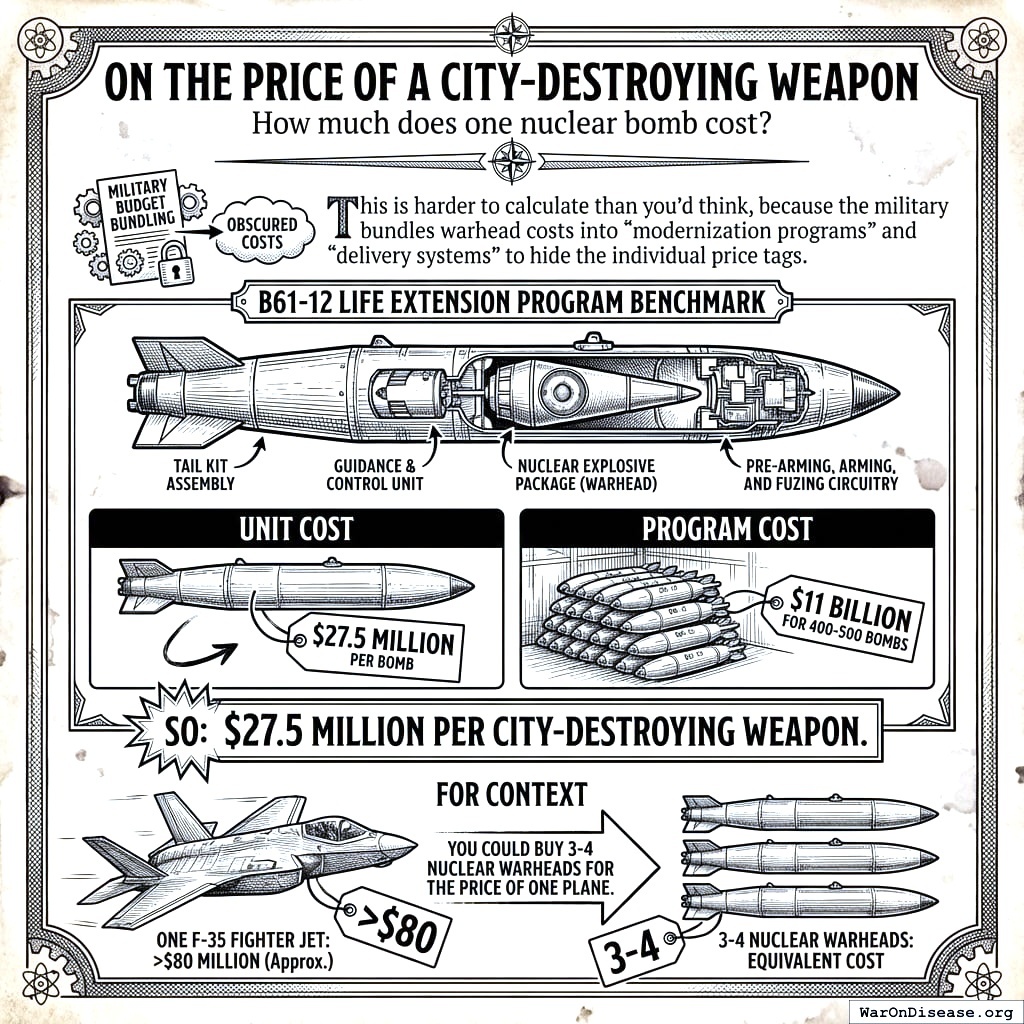
- Program Cost: $11 billion for 400-500 bombs
- Unit Cost: $27.5 million per bomb
$27.5 million per city-destroying weapon. That is less than one F-35 fighter jet. You could buy 3-4 nuclear warheads for the price of one airplane. The airplane requires maintenance. The warheads just sit there, patiently, being worth more than your neighborhood.
The Price of a Person
NUKEMAP (created by historian Alex Wellerstein) simulates nuclear detonations. A single modern 300-kiloton W87 warhead over Manhattan:
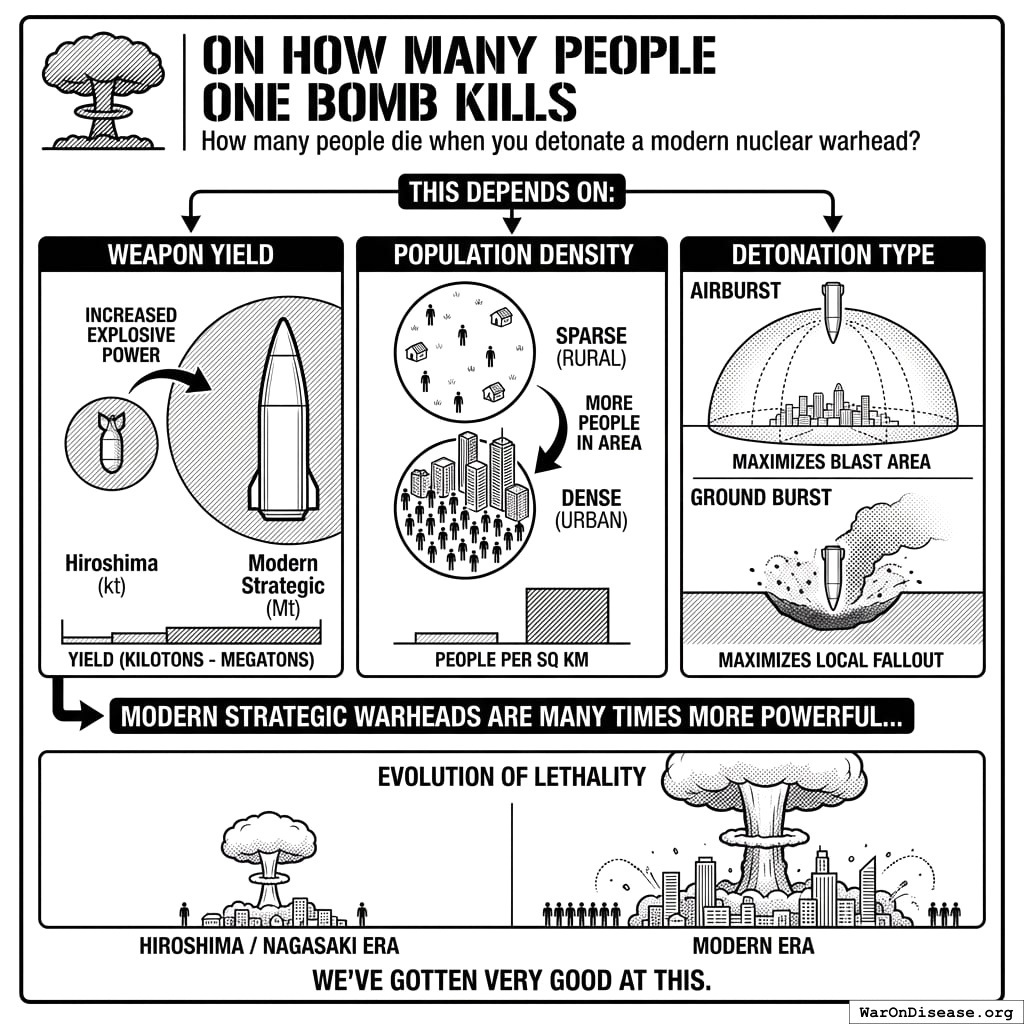
- Estimated Fatalities: 1,619,570 people
Immediate deaths. Blast, heat, initial radiation. Not counting fallout, disease, starvation, or the collapse of medical infrastructure. Those numbers are much higher. This is the conservative estimate.
Now the math:
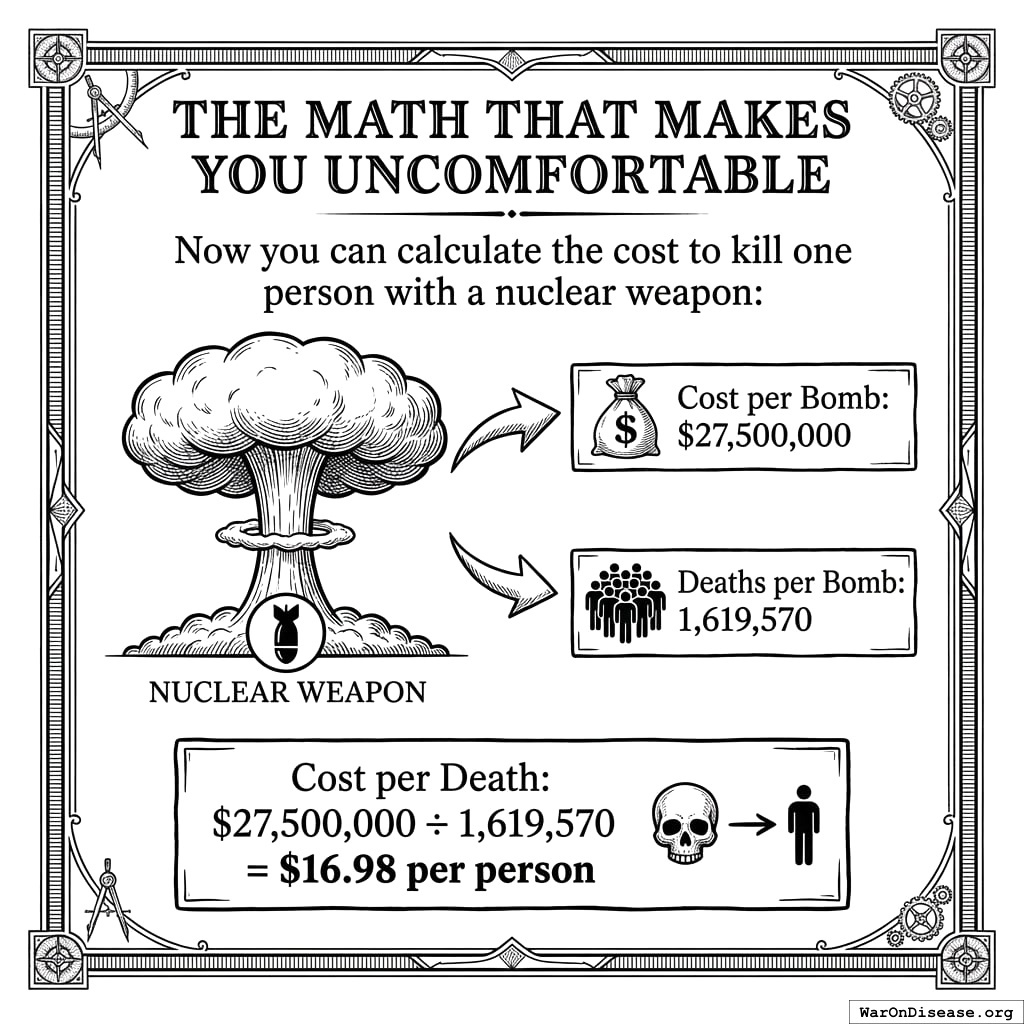
- Cost per Bomb: $27,500,000
- Deaths per Bomb: 1,619,570
- Cost per Death: $27,500,000 / 1,619,570 = $16.98
For the price of a coffee, your military can kill one human being. You have industrialized death to the point where killing a person costs less than caffeinating them.
I looked for a consumer product cheaper than $16.98 that is considered essential to daily life. A Starbucks latte costs more. A sandwich costs more. A movie ticket costs more. The cheapest thing in your economy is ending a human life with a nuclear weapon, and nobody put this on a graph, because putting it on a graph would make it real, and if it were real, someone might have to do something about it.
The Overkill Calculation
The world’s nine nuclear-armed states maintain approximately 12,241 nuclear warheads1. This fact requires context.
How Nuclear Weapons Actually Kill
A single warhead detonated over Manhattan kills 1.6 million people from blast, heat, and radiation. That is the upper bound: the densest urban target on Earth hit by a modern strategic weapon. Across a realistic mix of military, industrial, and urban targets, the average drops to roughly 50,000-100,000 deaths per warhead.
At that rate, the entire global arsenal would kill 0.6-1.2 billion people directly. That is not even once through the world’s population. If nuclear weapons only killed people with blast and radiation, the arsenal would not be large enough for a single pass through humanity.
But nuclear weapons do not only kill with blast and radiation.
Nuclear Winter: The Actual Extinction Mechanism
Robock, Toon, and colleagues (2007) modeled what happens after a regional nuclear exchange, roughly 100 warheads detonated on cities2,3. The fires inject about 5 teragrams of soot into the stratosphere. Global temperatures drop for a decade. Growing seasons shorten worldwide. Crops fail. Approximately 2 billion people end up at risk of starvation. Not from the bombs. From the dark. Xia et al. (2022, Nature Food) extended the modeling to larger exchanges and confirmed the direction: more soot, more dead4. A full 4,400-warhead US-Russia exchange kills ~5 billion from agricultural collapse. The 100-warhead regional exchange is the lower bound, not the total.
The global arsenal contains 12,241 warheads. The threshold for the regional-scale nuclear winter that ends civilization as the median human experiences it is roughly 100. The overkill factor, measured against the thing that actually causes extinction, is 122x (90% CI: 42.6x-198x).
The arsenal you need to deter your enemies and the arsenal you need to starve the planet are, troublingly, the same number.
Minimum Credible Deterrence
How many warheads do you actually need?
China maintained approximately 200-300 warheads for decades. Nobody invaded China. The UK maintains 225. France maintains 290. Israel maintains roughly 90, which is sufficient to deter every country in its region, several of which have tried to destroy it. Air Force researchers Forsyth, Saltzman, and Schaub published in Strategic Studies Quarterly that the United States could maintain effective deterrence with 311 warheads. These were not peace activists. They were active-duty officers.
The academic consensus on minimum credible deterrence: 100-300 warheads, depending on delivery system survivability. A submarine-based force requires fewer because nobody can find the submarines.
The world maintains 12,241. It needs, at most, a few hundred per nuclear state.
The Price of Apocalypse
The nine nuclear-armed states spend approximately $100 billion per year maintaining their arsenals5:
| Country | Annual Nuclear Spending | Warheads |
|---|---|---|
| United States | $51.5 billion | 5,044 |
| China | $11.8 billion | ~500 |
| United Kingdom | $8.1 billion | 225 |
| Russia | $8.3 billion | 5,580 |
| France | $6.8 billion | 290 |
| India | ~$2.7 billion | 172 |
| Israel | ~$1.2 billion | 90 |
| Pakistan | ~$1.1 billion | 170 |
| North Korea | ~$0.7 billion | ~50 |
| Total | ~$92 billion | ~12,121 |
The nine states spend $92 billion total on nuclear weapons, but the arsenal is 122x (90% CI: 42.6x-198x) the civilizational-collapse threshold. One apocalypse’s worth costs:
\[
\begin{gathered}
P_{apocalypse} \\
= \frac{S_{nuke}}{Overkill_{winter}} \\
= \frac{\$92B}{122} \\
= \$752M
\end{gathered}
\]
where:
\[
\begin{gathered}
Overkill_{winter} \\
= \frac{W_{global}}{W_{winter}} \\
= \frac{12{,}200}{100} \\
= 122
\end{gathered}
\]
$752 million (90% CI: $464 million-$2.16 billion) per year. That is the Price of Apocalypse: the Minimum Viable Apocalypse, priced. Less than one Hollywood tentpole movie. Less than a mid-size pharmaceutical company spends on marketing in a quarter. Less than what the world spends on cat food in six days. The end of civilization costs less per year than ten F-35 fighter jets, and you already bought more than a thousand of those. There is no word for an organism that spends more on pet food than it would cost to exterminate itself, because no organism has ever been that interesting.
If these states right-sized their arsenals to minimum credible deterrence (100-300 warheads each, submarine-based delivery), they would still retain civilization-ending capacity and save tens of billions per year on maintenance alone.
But nuclear spending is not the point. It is a rounding error on the global military budget. The other 99+% is the point.
The Apocalypse Markup
The Price of Apocalypse is $752 million (90% CI: $464 million-$2.16 billion). Global military spending is $2.72 trillion.
\[
\begin{gathered}
M_{apocalypse,x} \\
= \frac{Spending_{mil}}{P_{apocalypse}} \\
= \frac{\$2.72T}{\$752M} \\
= 3{,}620
\end{gathered}
\]
where:
\[
\begin{gathered}
P_{apocalypse} \\
= \frac{S_{nuke}}{Overkill_{winter}} \\
= \frac{\$92B}{122} \\
= \$752M
\end{gathered}
\]
where:
\[
\begin{gathered}
Overkill_{winter} \\
= \frac{W_{global}}{W_{winter}} \\
= \frac{12{,}200}{100} \\
= 122
\end{gathered}
\]
An 3.6kx (90% CI: 1.3kx-5.9kx) markup. You are paying 3.6k times the sticker price of the end of civilization. The Apocalypse Markup is $2.72 trillion: everything above the $752 million (90% CI: $464 million-$2.16 billion) that buys one apocalypse.
You are adding a home security system to a house rigged with enough explosives to destroy the neighborhood. The security system is not the problem. The question is why you keep buying more explosives.
“But conventional forces serve purposes other than extinction! Deterrence! Alliance commitments! Humanitarian operations! Power projection!” Correct. And those purposes are funded at a level where the nuclear arsenal alone, costing a small fraction of the budget, can already end civilization 122 times over. Whatever “purposes” the surplus serves, it serves them on top of a civilization-ending guarantee that costs a fraction of a penny of every military dollar. The rest is the Apocalypse Markup.
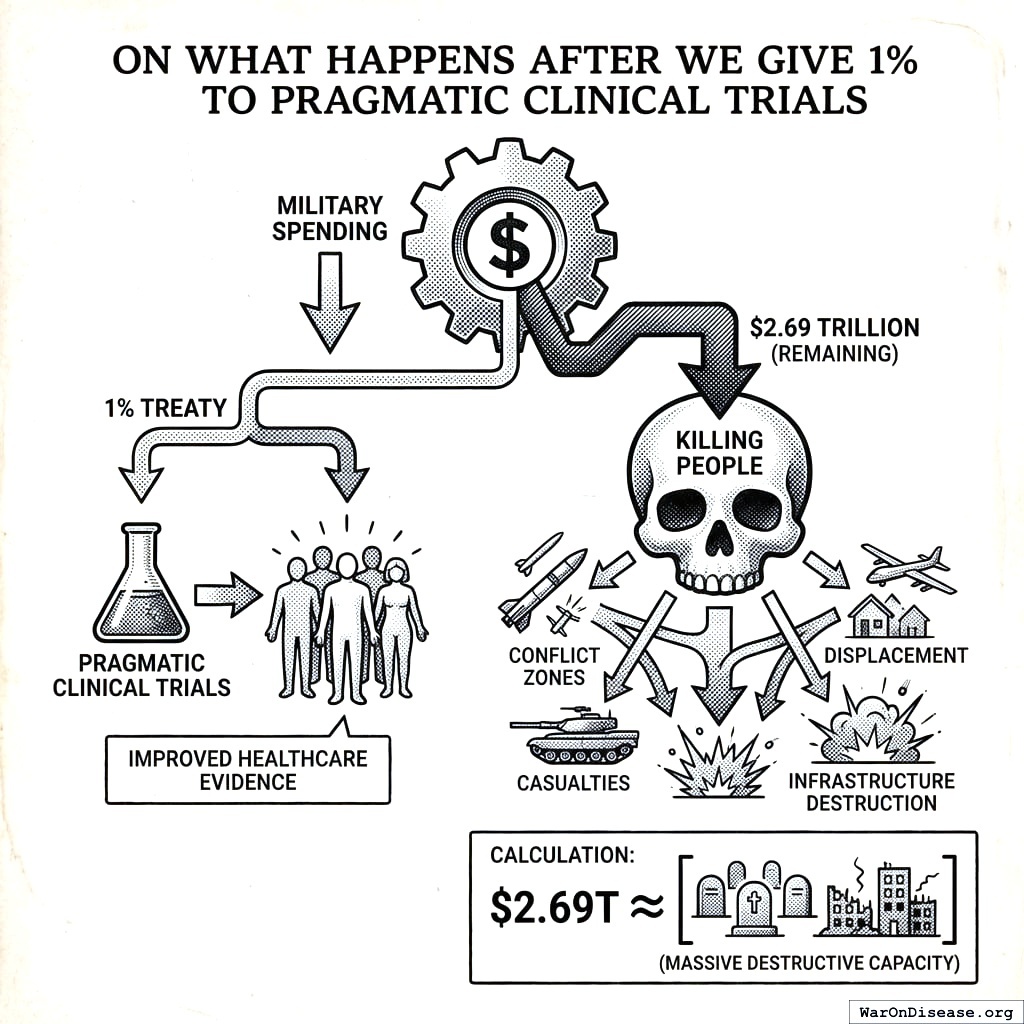
A 1% treaty6 7 asks for $27.2 billion from this surplus. It does not touch deterrence. It does not touch nuclear arsenals. It does not touch conventional readiness. It takes from the budget that sits on top of an extinction guarantee and redirects it to clinical trials.
How Much Defense Is Actually Enough?
The net return on US military hegemony is -$674 billion to -$1.38 trillion per year. The only quantifiable benefit ($20-200 billion in dollar reserve privilege) covers 2-23% of the cost. Switzerland spends $7 billion on defense, has not been invaded in 227 years, and the average Swiss citizen has higher income, longer life expectancy, and better healthcare than the average American who is paying 126 times more. The US Army ranked 17th in the world in 1939, behind Portugal, and won World War II by mobilizing in four years. For the full cost-benefit analysis, deterrence sufficiency data, and the evidence that hegemony creates the instability it claims to prevent, see The Cost-Benefit Analysis of Global Hegemony.
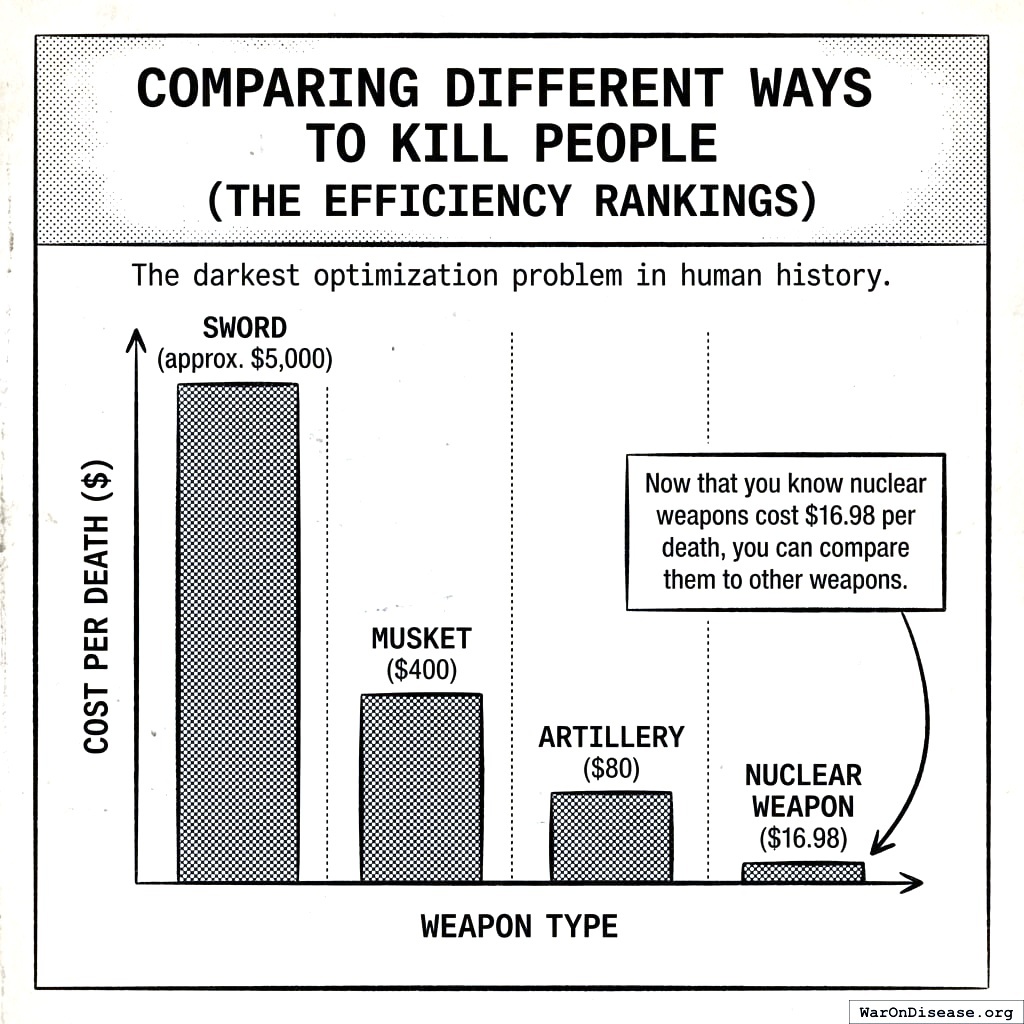
The Weapon Efficiency Rankings
Now that you know nuclear weapons cost $16.98 per death, you can compare them to other methods of killing people. This is the darkest optimization problem in human history. But here we are.
Small Arms
In Iraq and Afghanistan, U.S. forces fired approximately 250 thousand rounds for every insurgent killed8.
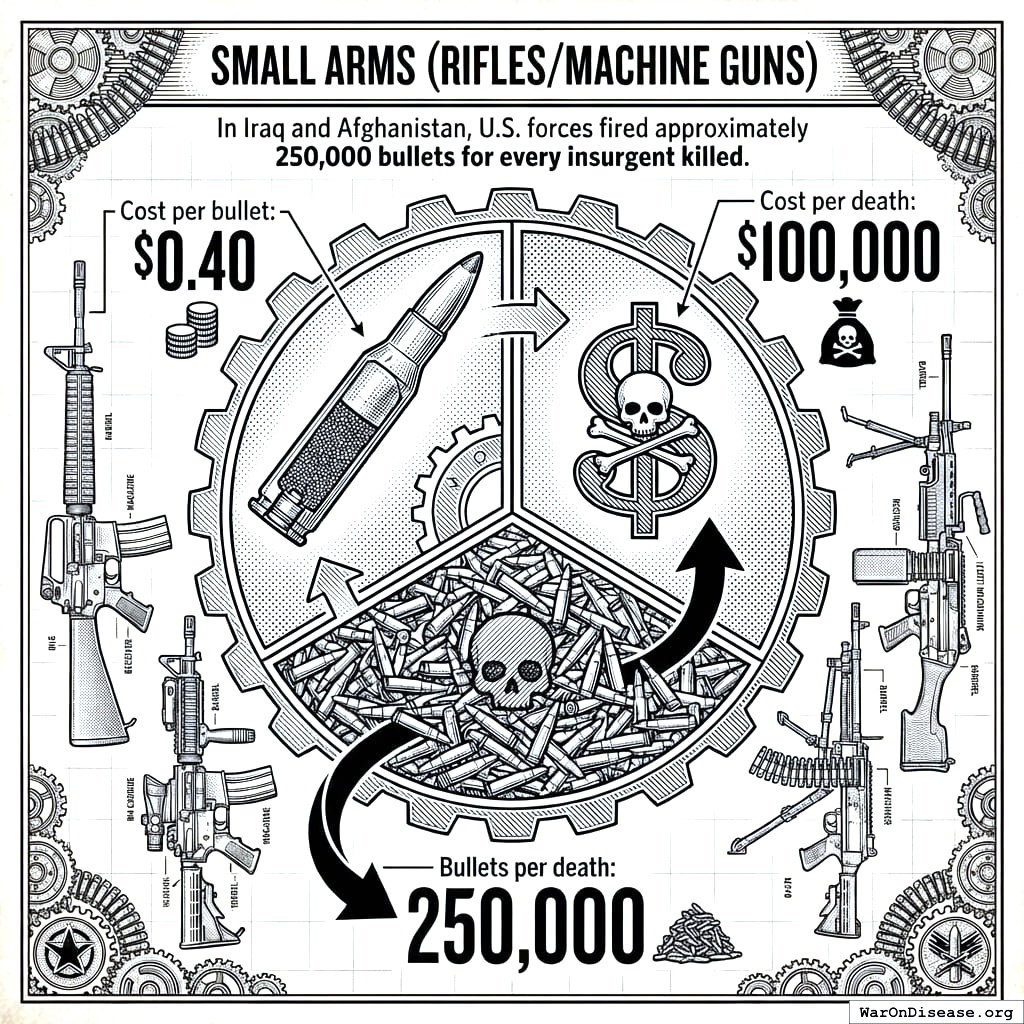
- Cost per bullet: $0.4 (95% CI: $0.25-$0.6)9
- Bullets per death: 250 thousand
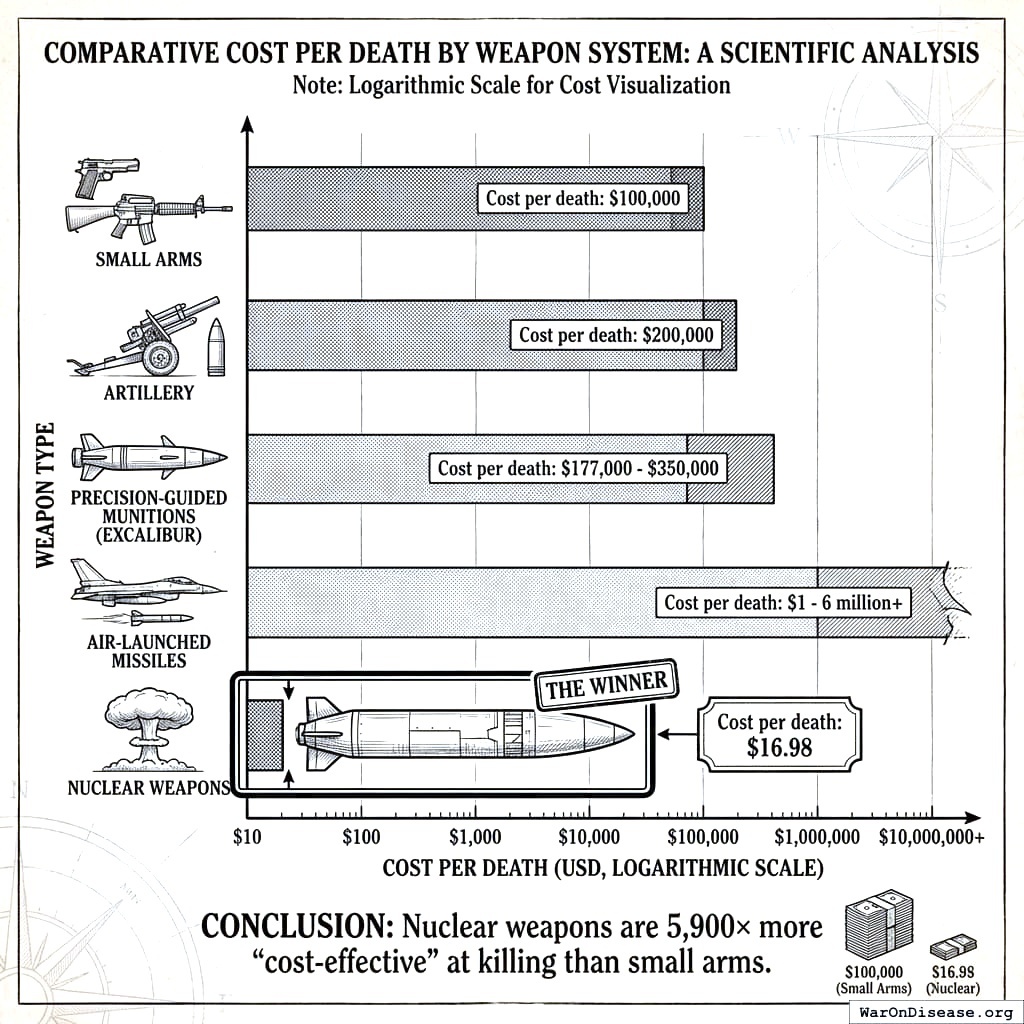
- Cost per death: $100,000
Artillery
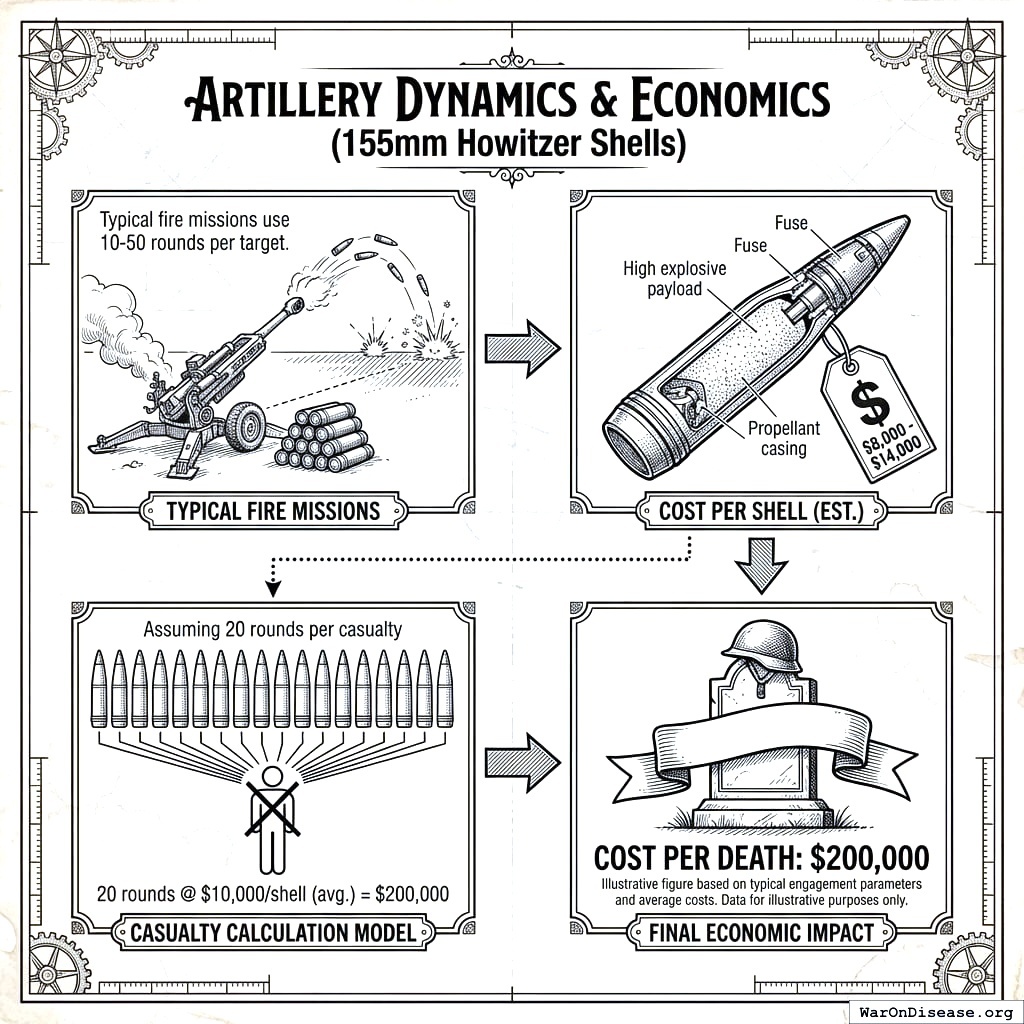
- 10-50 rounds per target, $8,000-$14,000 per shell
- Cost per death: $200,000
Precision-Guided Munitions
- Excalibur GPS-guided: $176,624 per round. Cost per death: $177,000-$350,000
- Air-launched missiles (AMRAAM, AARGM-ER): $1-6 million each. Cost per death: $1-6 million+
Nuclear Weapons (The Winner)
- B61-12: $27.5 million per bomb, ~1.6 million deaths per detonation
- Cost per death: $16.98
The Leaderboard
| Weapon | Cost per Death |
|---|---|
| Nuclear warhead | $16.98 |
| Small arms | $100,000 |
| Artillery | $200,000 |
| Precision artillery | $177,000-$350,000 |
| Missiles | $1-6 million+ |
Nuclear weapons are 5,900x more cost-effective at killing than bullets. They are 10,000-350,000x more cost-effective than precision missiles. Your species optimized for maximum death per dollar and then expressed surprise at the result. There is a word for organisms that optimize a single metric until it destroys everything around them. The word is “cancer.”
The Bullet Metric
The efficiency rankings measure combat cost-per-death. But there is a simpler calculation that requires no combat at all.
A 5.56mm NATO round costs $0.4 (95% CI: $0.25-$0.6) at bulk military rates9. Global military spending is $2.72 trillion a year.
\[
\begin{gathered}
n_{bullets/person} \\
= \frac{N_{bullets,yr}}{Pop_{global}} \\
= \frac{6.8T}{8B} \\
= 850
\end{gathered}
\]
where:
\[
\begin{gathered}
N_{bullets,yr} \\
= \frac{Spending_{mil}}{c_{bullet}} \\
= \frac{\$2.72T}{\$0.4} \\
= 6.8T
\end{gathered}
\]
Every year, your governments spend enough on military to murder every man, woman, and child on Earth 850 times over. With bullets alone. Every year.
The nuclear winter overkill factor (122x (90% CI: 42.6x-198x)) measures a stockpile: existing weapons, built over decades. The bullet metric measures something worse. It measures annual cash flow. You are not sitting on a one-time surplus of redundant death. You are renewing your subscription to it. Every year, you pay for the capacity to murder everyone 850 times, receive a receipt, and then pay again next year.
“But militaries don’t actually spend their entire budget on ammunition!” Correct. They also buy food, housing, vehicles, pensions, and very expensive airplanes. This is a purchasing power calculation. It measures the scale of spending by converting it to the cheapest lethal commodity available. In actual combat, it takes 250 thousand rounds to kill one person8. At that rate, the entire global military budget converted to small arms would kill roughly 27 million people. Not 8 billion.
This objection is interesting because the person making it thinks it helps their case. “We can only kill 27 million people with bullets, not 8 billion” is not the reassurance they believe it to be. I have noticed that on your planet, when someone points out that a number is obscene, the response is often to quibble about the denominator. The denominator is not the problem. The numerator is the problem. The numerator is $2.72 trillion.
| Metric | Overkill | Type |
|---|---|---|
| Nuclear arsenal | Existing stockpile | |
| Bullet purchasing power | 850x/year | Annual spending flow |
A 1% treaty moves the bullet count from 850 to about 842 per person. Nobody will notice.
The Receipt
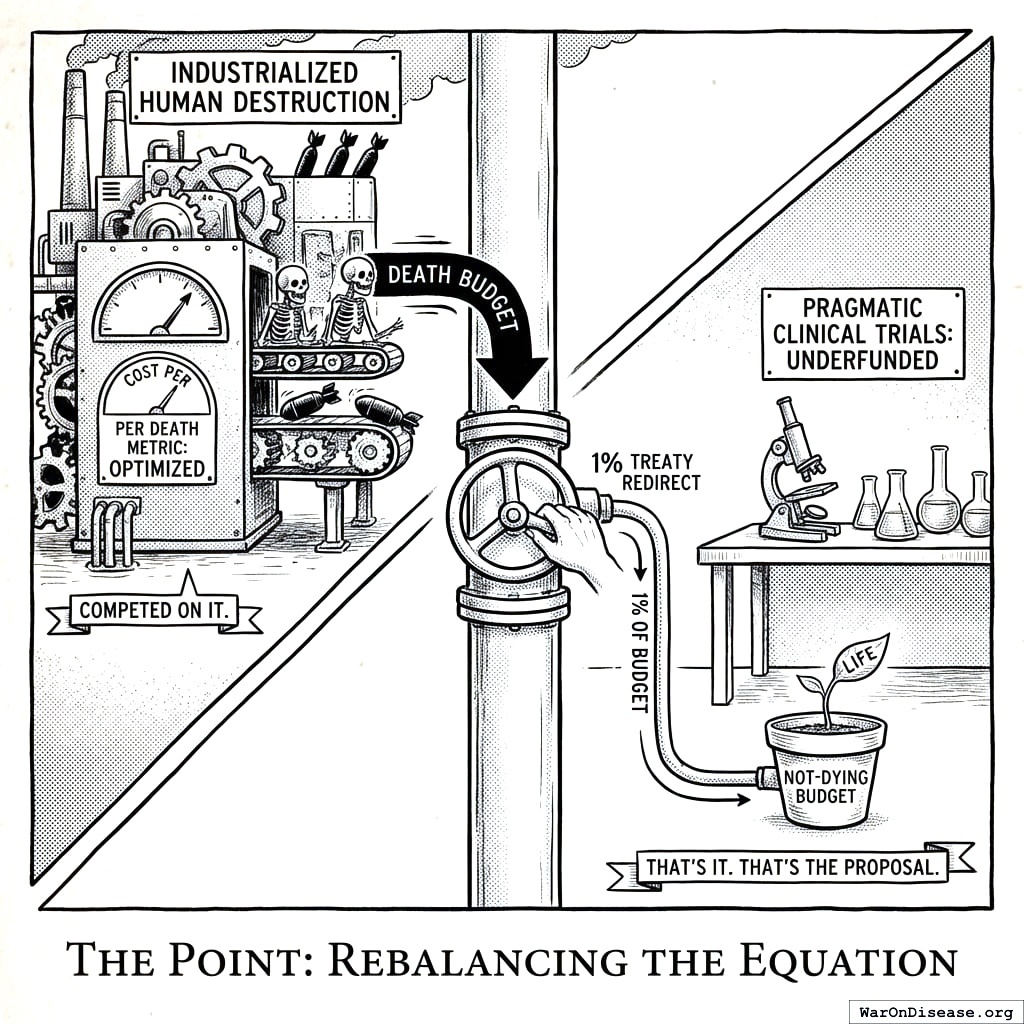
The Price of Apocalypse is $752 million (90% CI: $464 million-$2.16 billion). The Apocalypse Markup is $2.72 trillion. A 1% treaty asks for $27.2 billion.
The treaty does not touch the Price of Apocalypse. It does not reduce deterrence. It does not weaken a single military. It takes from the 3.6kx (90% CI: 1.3kx-5.9kx) markup and redirects it to clinical trials, so that humans might figure out which of the 9.5 million untested treatment combinations actually work.
Your species can end civilization 122 times over. It cannot cure most cancers. It spends $2.72 trillion a year on the first problem and a fraction of that on the second. The proposal is to move 1% from the budget that ends civilization 122 times over to the budget that might stop some of those people from dying.
That is the whole proposal. I have been trying to find the controversial part. I cannot find it. If you find it, please let me know, because I have been looking for several years and I am beginning to suspect it does not exist.