Governance
Abstract
A Practical Guide: Get 500 Years of Clinical Research in 20, Avoid the Apocalypse, and Make Humanity Filthy Rich by Giving Papers
Keywords
war-on-disease, 1-percent-treaty, medical-research, public-health, peace-dividend, decentralized-trials, dfda, dih, victory-bonds, health-economics, cost-benefit-analysis, clinical-trials, drug-development, regulatory-reform, military-spending, peace-economics, decentralized-governance, wishocracy, blockchain-governance, impact-investing
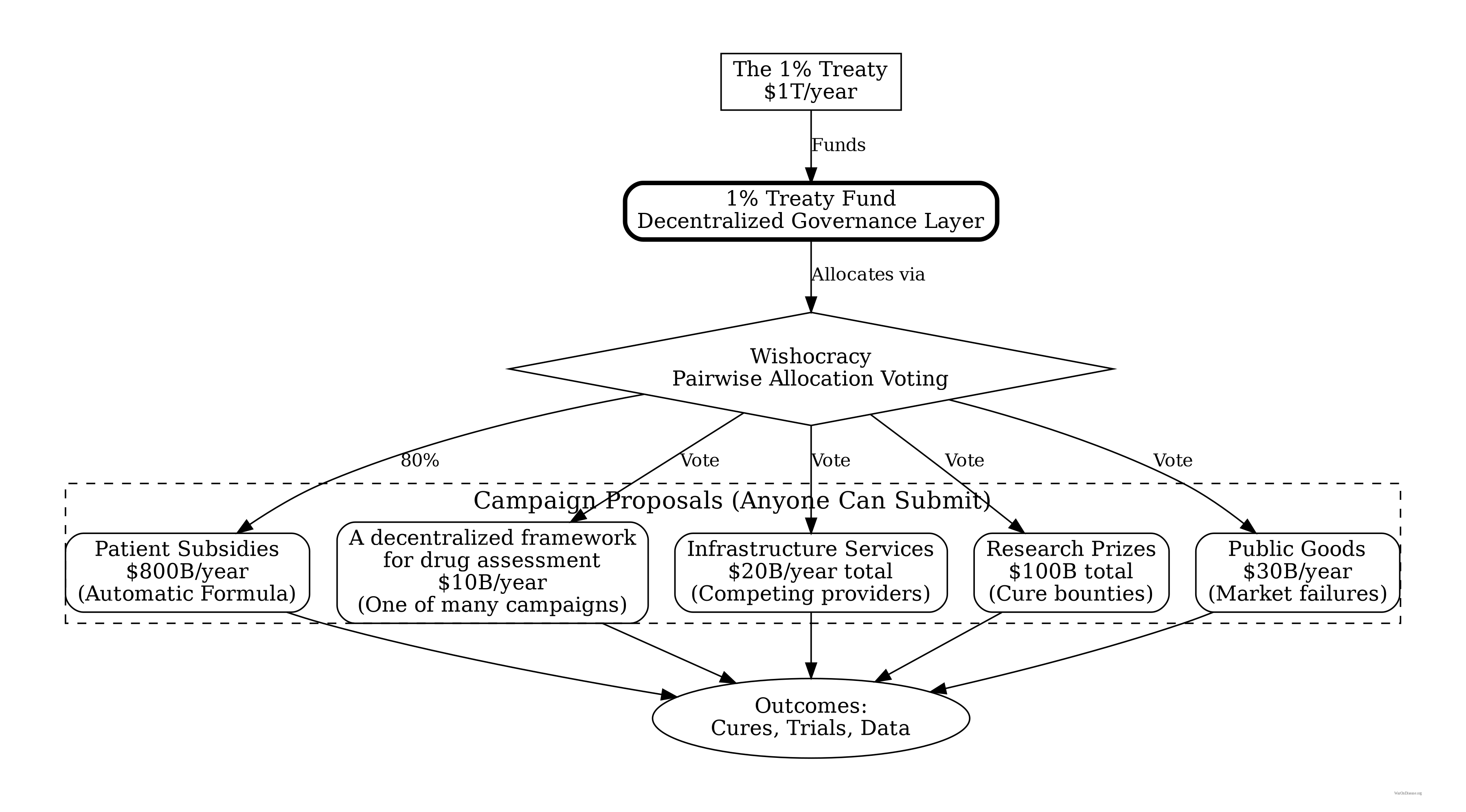
Your decentralized institutes of health (DIH) is a decentralized crowdfunding platform that serves as the single governance layer for all health research funding.
It functions like Kickstarter meets the NIH, but without corruption or bureaucracy - governed by Wishocracy, a pairwise allocation voting system that lets 8 billion people collectively decide how to spend $27.2B annually.
DIH Architecture: Single Governance Layer
Your decentralized institutes of health (DIH) handles ALL budgeting decisions:
- Governs the allocation of the 1% Treaty Fund treasury
- Accepts campaign proposals from anyone
- Uses Wishocracy to allocate funds across competing campaigns
- No CEO, no board, governed by transparent code
Clean Separation: Governance vs Platform
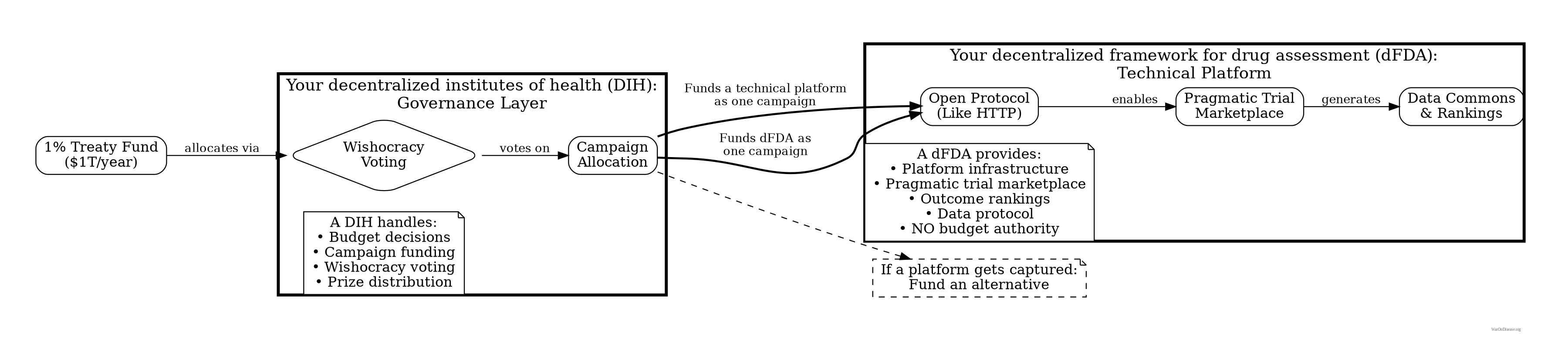
Your decentralized institutes of health (Governance Layer)
- Handles all budget allocation
- Wishocracy voting on campaigns
- Treasury governance
- Prize distribution
Your decentralized framework for drug assessment (dFDA)
- Pure technical infrastructure
- NO budget authority
- Is funded by the 1% Treaty Fund (as directed by DIH governance)
- If captured → fund an alternative platform instead
This prevents the “new FDA” problem: a decentralized framework for drug assessment can’t become a bureaucratic bottleneck because it has no independent funding - it’s just one campaign competing with others for 1% Treaty Fund funds.
How Budget Allocation Works
Your decentralized institutes of health (DIH) network uses Wishocracy - a pairwise voting system - to allocate funds across competing campaign proposals.
See Wishocracy for detailed explanation of how pairwise allocation works.
What Gets Funded: Market Failures Only
Since the marketplace enabled by a decentralized framework for drug assessment (dFDA) handles most research allocation automatically (patients choose trials → funding flows there), the 1% Treaty Fund primarily funds market failures - things the marketplace can’t handle:
Infrastructure (Platform Must Exist First)
- Development and operations for a decentralized framework for drug assessment (~$10B/year)
- Competing alternative implementations of a decentralized drug assessment framework
- Data commons infrastructure (storage, processing)
- Security audits and fraud detection systems
True Public Goods (No Revenue Model)
- Patient trial participation subsidies (~$800B/year, automatic)
- Negative results publishing incentives (no revenue from failures)
- Basic research with no patient application yet (can’t be trials)
- Replication studies (unglamorous but critical)
Why This is Minimal: The marketplace created by a decentralized framework for drug assessment eliminates most traditional research funding needs. Companies register treatments → Patients join trials → Revenue flows → Research happens. Your decentralized institutes of health only needs to direct the 1% Treaty Fund to cover what the marketplace truly can’t handle.
Dive Deeper into the Governance Model
- Wishocracy (RAPPA) Governance Model: The original whitepaper on the pairwise preference allocation system used for decentralized budget decisions.
- DIH On-Chain & AI Architecture: The technical blueprint for the smart contracts, AI agents, and on-chain modules that power a decentralized institutes of health network. (Coming Soon)
Security & Anti-Corruption: Building Uncorruptible Institutions
The Challenge: A $27.2B treasury is a massive target for hackers, fraudsters, and corrupt actors.
The Multi-Layered Defense
Nobody’s in Charge (And That’s the Point)
Other organizations that manage billions of dollars this way already exist and work fine.
Turns out you don’t need a CEO when you have math.
- Every VICTORY Incentive Alignment Bond holder directly controls treasury through on-chain voting (MakerDAO/Uniswap model)
- No human signers = no kidnapping, corruption, or coercion targets
- Smart contracts automatically execute community decisions after 24-72h timelocks
- Battle-tested approach managing billions in existing DAOs
AI-Powered Fraud Detection
- Fraud Agent: real-time anomaly detection, duplication monitoring, collusion identification, sybil detection
- Safety Oracle: incident severity scoring with automatic payout holds for affected interventions
- Manual review queue for flagged actions with whistleblower bounty rewards
- Identity Oracle: verifies affiliations and conflicts, prevents unauthorized access
Complete Transparency & Auditability
- All treasury addresses published with real-time public dashboards
- Immutable transaction logs with standardized disbursement tags
- Annual smart contract audits and semiannual operational audits with published reports
- Hash-committed invoices and budgets for full accountability
Recovery & Response Mechanisms
- Clawbacks for data falsification or trial misconduct
- Emergency pause capabilities triggered by incident signals
- Progressive unpause policies tied to remediation completion
- Guardian modules for pausing non-critical functions under defined conditions
Beyond Medical Research: A Template for Uncorruptible Governance
This isn’t just about protecting funding for pragmatic clinical trials and other public health goods – it’s an experiment in demonstrating a new model for uncorruptible, transparent governance of public goods.
Using proven DAO models that already manage billions (MakerDAO, Uniswap, Aave), you demonstrate that $27.2B can be managed with:
- Zero human targets for violence, kidnapping, or corruption
- True community control through direct token holder governance
- Complete transparency with all decisions and executions on-chain
- Automated efficiency eliminating bureaucratic waste and political favoritism
What Else This Could Fix
Once you prove you can run a $27.2B treasury without anyone stealing from it, you can do the same thing for schools, roads, or anything else the government currently screws up.
- Education: Pay teachers based on whether kids actually learn things
- Infrastructure: Fund roads that don’t immediately fall apart
- Environment: Pay for actual carbon reduction, not paperwork
- Social Services: Get help to people who need it without 47 forms
The End State: Replace corrupt, inefficient bureaucracies with transparent, automated, outcome-driven institutions that actually work and can’t be bribed.
The 1% Treaty Fund becomes the prototype for a new era of public governance - one that eliminates human corruption points entirely while delivering measurable results.
This experiment could usher in a new era of peace, prosperity, and abundance by proving that large-scale public goods can be managed through true decentralization without any centralized control points.