# Diagnostic Summary
Before you can fix something, you need to understand what’s broken. In this case, what’s broken is approximately everything.
They say knowledge is power. In this case, knowledge is mostly just depressing. But you need it, the way you need to know your house is on fire before you can put it out.
## The Daily Body Count
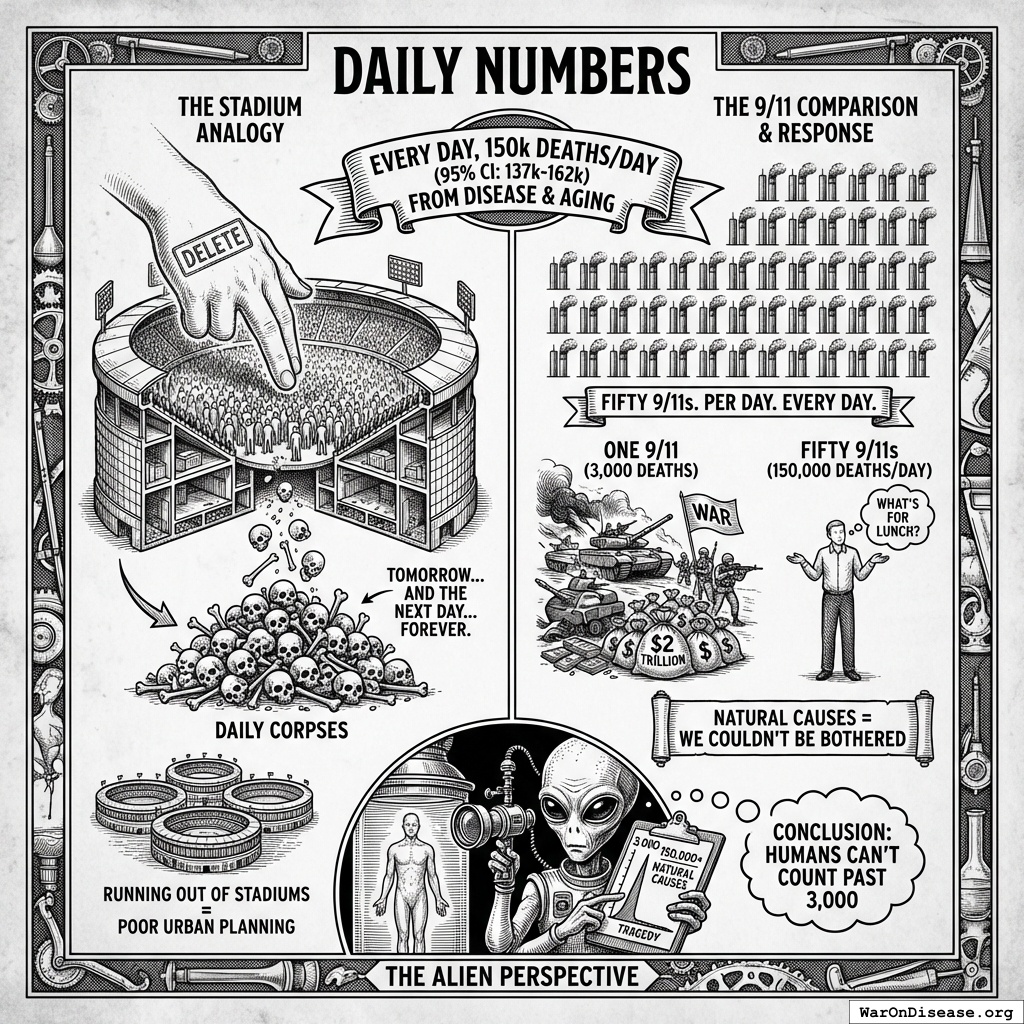
Every day, 150,000 [humans die](../knowledge/problem/cost-of-disease.llms.md) from disease and aging. That’s fifty 9/11s. Per day. Including weekends and holidays.
[](../assets/images/problem/problem-section-daily-numbers-bw-academic.jpg)
Every day, 50 times as many people die from being old and sick as died on 9/11. You started two wars over 9/11. For aging, you bought face cream and called it a day.
When one thing kills 3,000 people, it’s a tragedy and you start wars. When diseases kill 50 times that every day, it’s called “natural causes,” which is Latin for “you couldn’t be bothered.”
After the first 9/11, America invaded two countries and spent \$2 trillion. After the fifty daily 9/11s, humanity shrugs and wonders what’s for lunch.
## Where the Money Goes
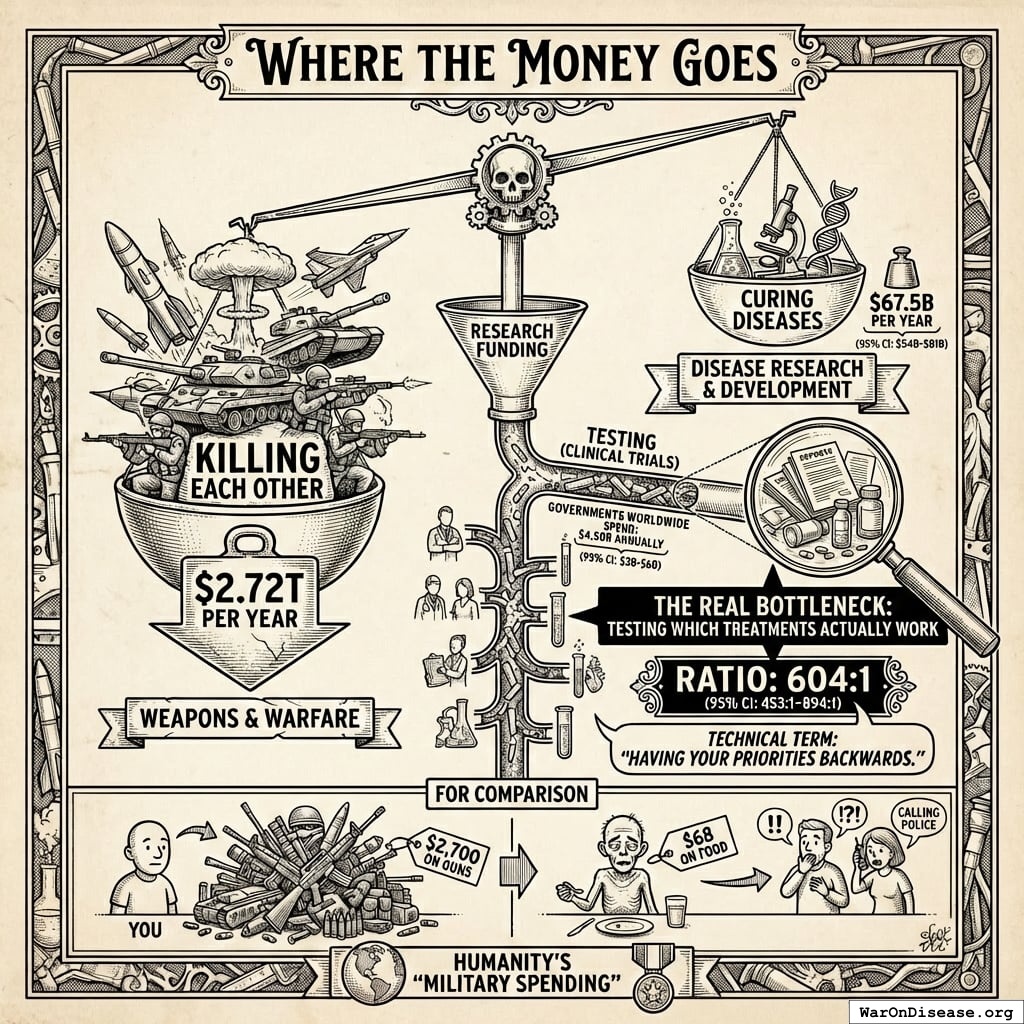
**Killing each other:** [\$2.72 trillion](../knowledge/appendix/parameters-and-calculations.llms.md#sec-global_military_spending_annual_2024) per year **Curing diseases:** [\$67.5 billion (95% CI: \$54 billion-\$81 billion)](../knowledge/appendix/parameters-and-calculations.llms.md#sec-global_med_research_spending) per year
The real bottleneck isn’t research funding. It’s testing which treatments actually work. Governments worldwide spend [\$4.5 billion (95% CI: \$3 billion-\$6 billion)](../knowledge/appendix/parameters-and-calculations.llms.md#sec-global_government_clinical_trials_spending_annual) annually on clinical trials, a [604 (90% CI: 453-888)](../knowledge/appendix/parameters-and-calculations.llms.md#sec-military_to_government_clinical_trials_spending_ratio) ratio, which in technical terms is called “[having your priorities backwards](https://manual.warondisease.org/knowledge/problem/cost-of-war.html).”
[](../assets/images/problem/problem-section-where-the-money-goes-bw-academic.jpg)
Humanity spends 2.72 trillion on weapons and 4.5 billion on testing medicine. That’s 604 times more money for killing than curing. You named yourselves Homo sapiens, which is Latin for ‘wise man.’ The irony is exquisite.
## On Medical Research
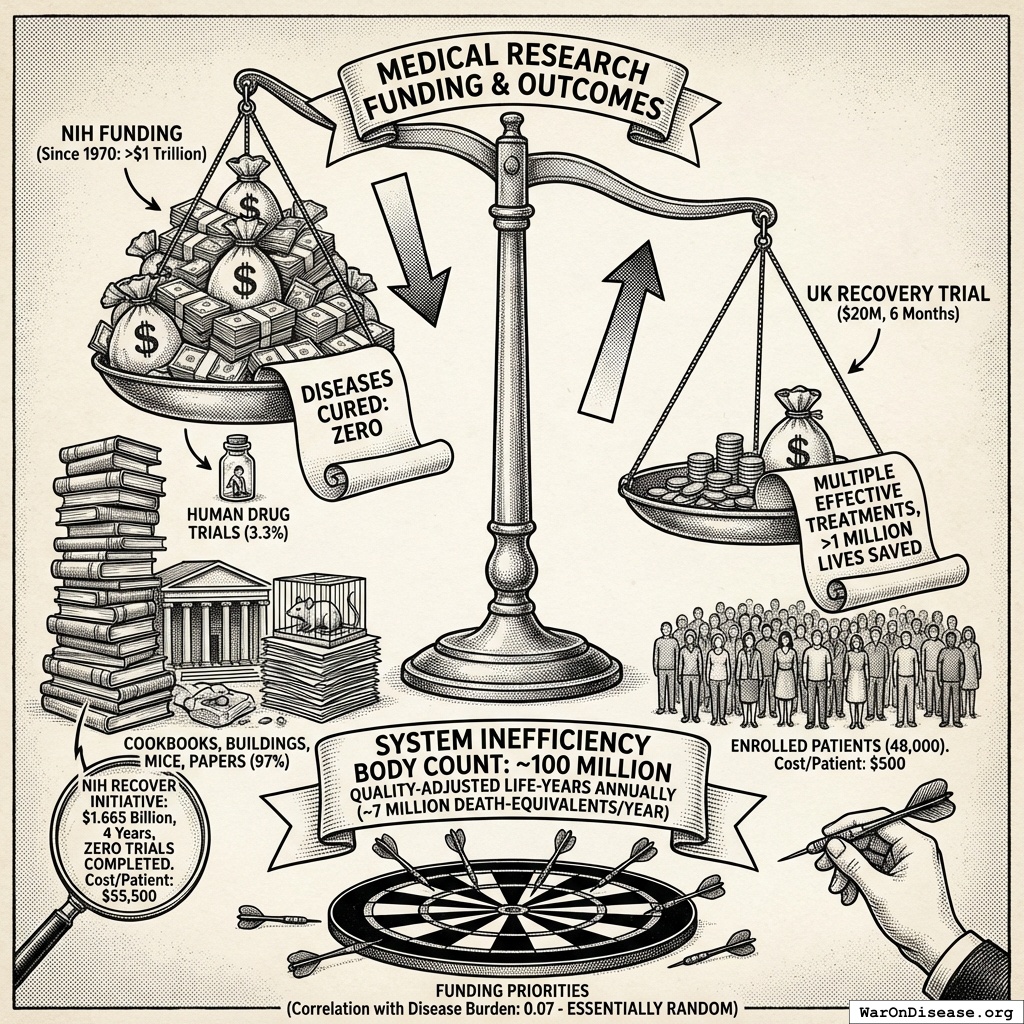
Since 1970, the [National Institutes of Health](../knowledge/problem/nih-fails-2-institute-health.llms.md) has spent over \$1 trillion studying diseases.
Diseases cured: Zero.
Of its [\$47 billion (95% CI: \$45 billion-\$50 billion)](../knowledge/appendix/parameters-and-calculations.llms.md#sec-nih_annual_budget) annual budget, only [3.3% (95% CI: 2%-5%)](../knowledge/appendix/parameters-and-calculations.llms.md#sec-nih_clinical_trials_spending_pct) goes to actual drug trials in humans. The other 97% goes to studying mice, building buildings, and publishing papers nobody reads. The system operates at 2% of its potential capacity to save lives.
[](../assets/images/problem/problem-section-on-medical-research-bw-academic.jpg)
America spent \$55,500 per patient to test COVID treatments. Britain spent \$500. Same disease, same planet, same year. Different levels of commitment to wasting money.
## On the FDA
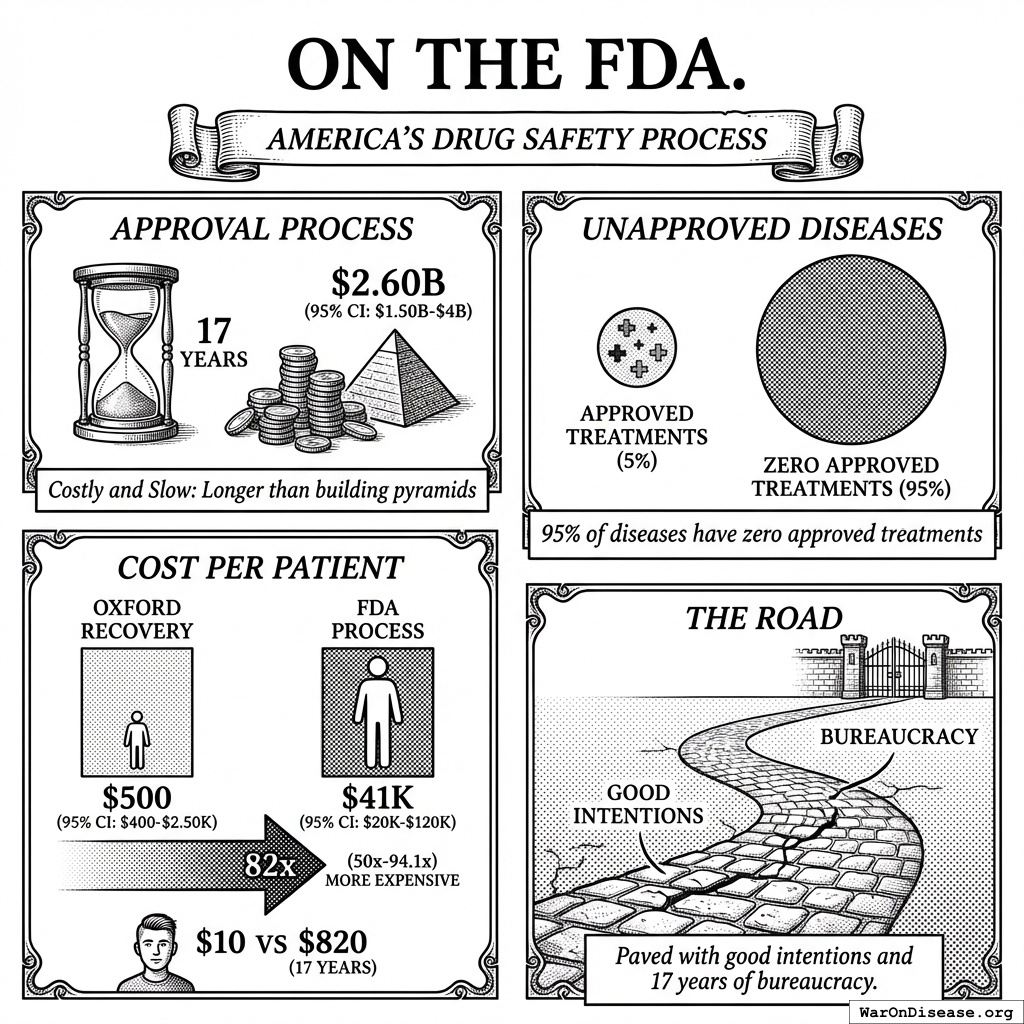
The [FDA](../knowledge/problem/fda-is-unsafe-and-ineffective.llms.md) makes drugs [82x (90% CI: 21.4x-195x)](../knowledge/appendix/parameters-and-calculations.llms.md#sec-recovery_trial_cost_reduction_factor) times more expensive than necessary. It takes [14 years (95% CI: 12 years-17 years)](../knowledge/appendix/parameters-and-calculations.llms.md#sec-drug_discovery_to_approval_years) and [\$2.6 billion (95% CI: \$1.5 billion-\$4 billion)](../knowledge/appendix/parameters-and-calculations.llms.md#sec-pharma_drug_development_cost_current) to get a drug from discovery to patient. That’s longer than it took to build the pyramids. The pharaohs didn’t have to file quarterly progress reports in triplicate. Ninety-five percent of diseases have zero approved treatments because the FDA is excellent at preventing any drugs from reaching people.
[](../assets/images/problem/problem-section-on-the-fda-bw-academic.jpg)
Oxford tests drugs for \$500 per patient. The FDA does it for \$41,000. Both use the same scientific method, discovered in the 17th century. Innovation takes time.
## On What War Costs
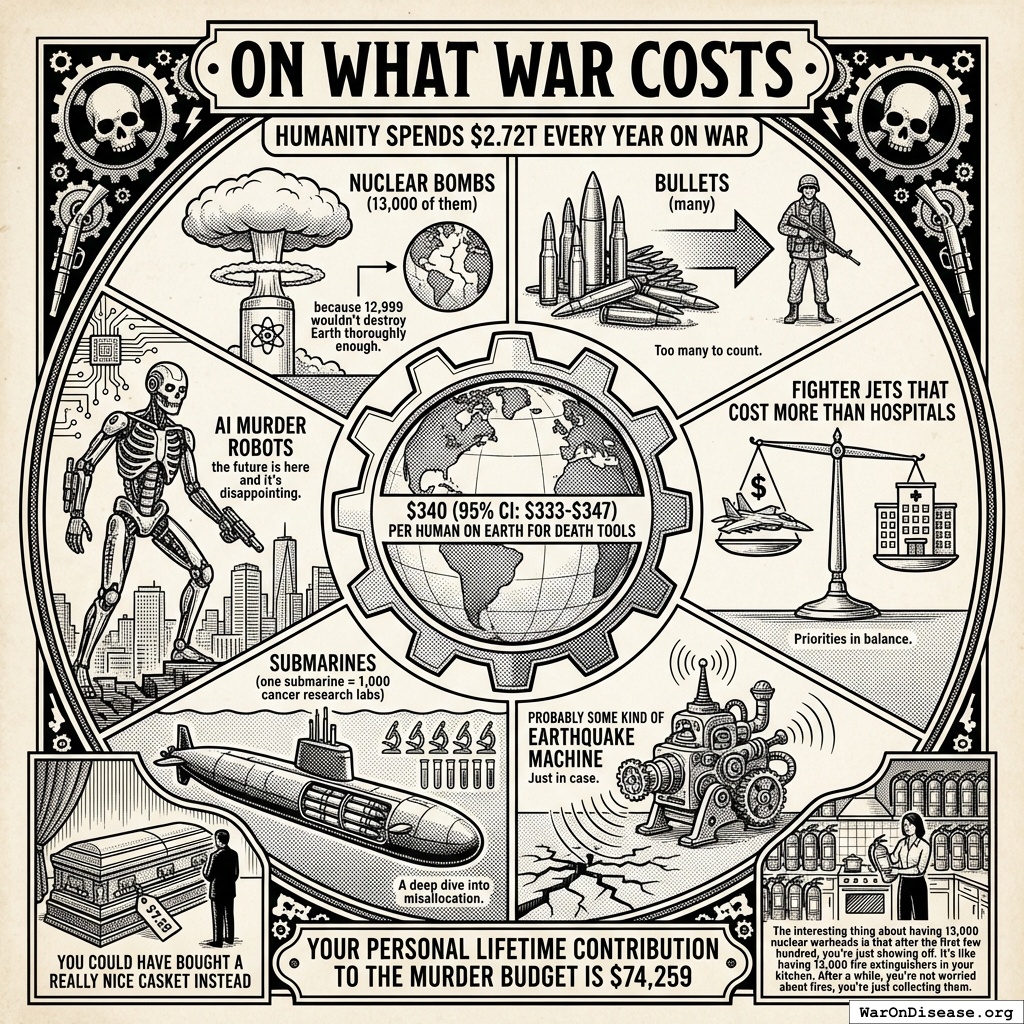
Humanity spends [\$2.72 trillion](../knowledge/appendix/parameters-and-calculations.llms.md#sec-global_military_spending_annual_2024) every year on war. That works out to [\$340 (90% CI: \$333-\$347)](../knowledge/appendix/parameters-and-calculations.llms.md#sec-global_military_spending_per_capita_annual) per human on Earth for death tools.
[](../assets/images/problem/problem-section-on-what-war-costs-bw-academic.jpg)
One submarine costs the same as 1,000 cancer research labs. The submarine sinks things. The labs might cure leukemia. You bought the submarine.
This budget includes:
- Nuclear bombs ([12,241](../knowledge/appendix/parameters-and-calculations.llms.md#sec-global_warhead_count) of them, because one fewer wouldn’t destroy Earth thoroughly enough)
- Bullets (many)
- AI murder robots (the future is here and it’s disappointing)
- Fighter jets that cost more than hospitals
- Submarines (one submarine = 1,000 cancer research labs)
- Probably some kind of earthquake machine
Your personal lifetime contribution to the murder budget is \$74,259. You could have bought a really nice casket instead. Or, and this is just a thought, not needed a casket quite so soon.
The interesting thing about having [12,241](../knowledge/appendix/parameters-and-calculations.llms.md#sec-global_warhead_count) nuclear warheads is that after the first [100](../knowledge/appendix/parameters-and-calculations.llms.md#sec-nuclear_winter_warhead_threshold), you’re just showing off. You can only destroy Earth once. The rest are for what, exactly? Destroying Earth’s ghost?
## On What Disease Costs
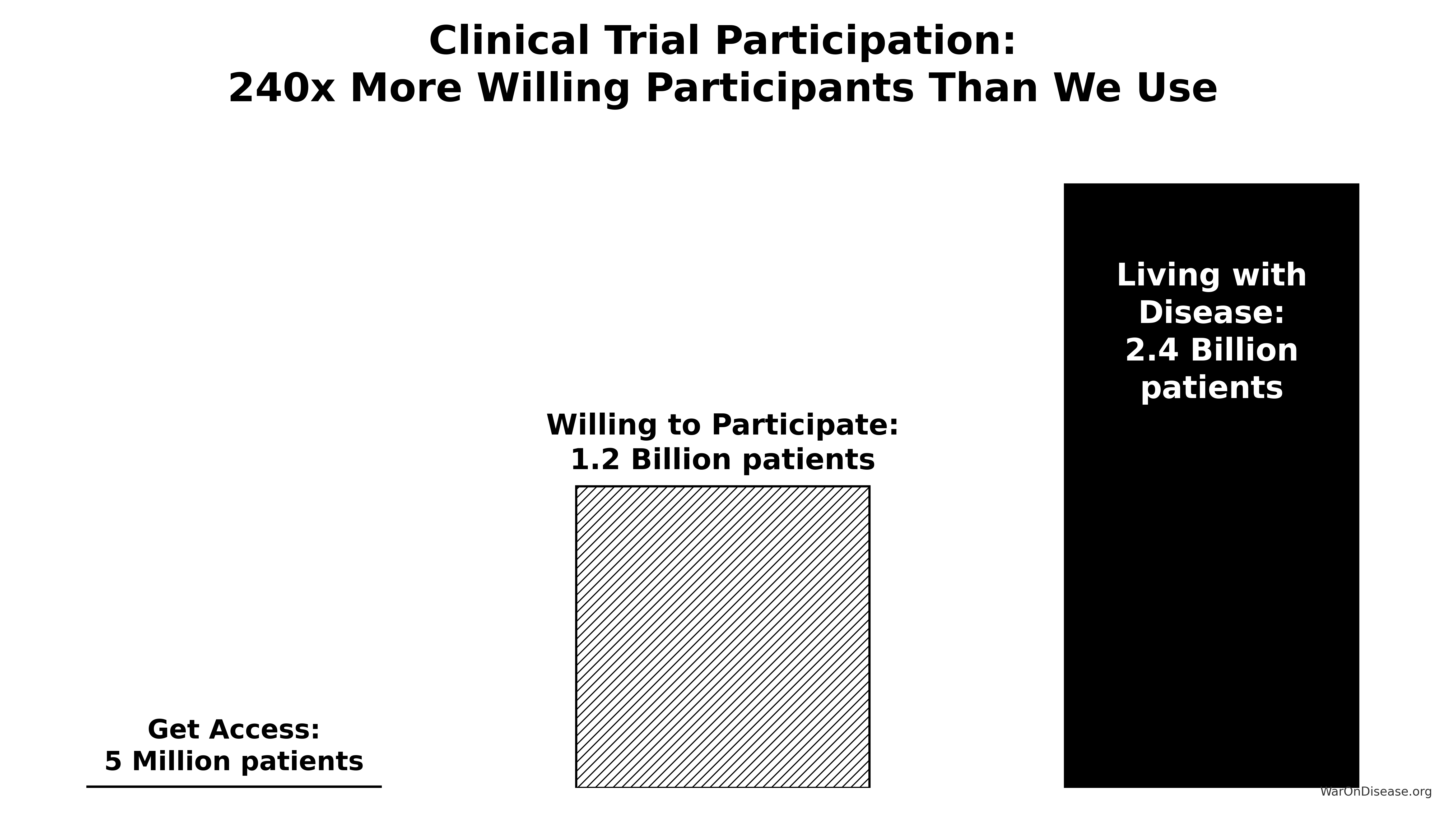
Disease extracts [\$400 trillion (90% CI: \$252 trillion-\$544 trillion)](../knowledge/appendix/parameters-and-calculations.llms.md#sec-global_disease_economic_burden_annual) from humanity annually in welfare losses ([2.88 billion](../knowledge/appendix/parameters-and-calculations.llms.md#sec-global_annual_daly_burden) avoidable DALYs at [\$150,000 (90% CI: \$100,384-\$198,679)](../knowledge/appendix/parameters-and-calculations.llms.md#sec-standard_economic_qaly_value_usd)/QALY). That includes 10 million cancer deaths per year and 2 billion people living with chronic diseases.
[](problem_files/figure-html/trial-access-disparity-chart-output-1.png)
If disease were a country, it would be the richest country on Earth by a factor of ten. Unfortunately, disease doesn’t have a flag or an army, so nobody invades it.
Out of [2.4 billion people (95% CI: 2 billion people-2.8 billion people)](../knowledge/appendix/parameters-and-calculations.llms.md#sec-current_disease_patients_global) suffering from chronic disease, only [1.9 million patients/year (95% CI: 1.5 million patients/year-2.3 million patients/year)](../knowledge/appendix/parameters-and-calculations.llms.md#sec-current_trial_slots_available) get to participate in clinical trials annually. That’s [0.0792% (90% CI: 0.0631%-0.0975%)](../knowledge/appendix/parameters-and-calculations.llms.md#sec-current_patient_participation_rate). Half would volunteer if asked. You’re turning away 99.6% of willing participants.
## On Democracy
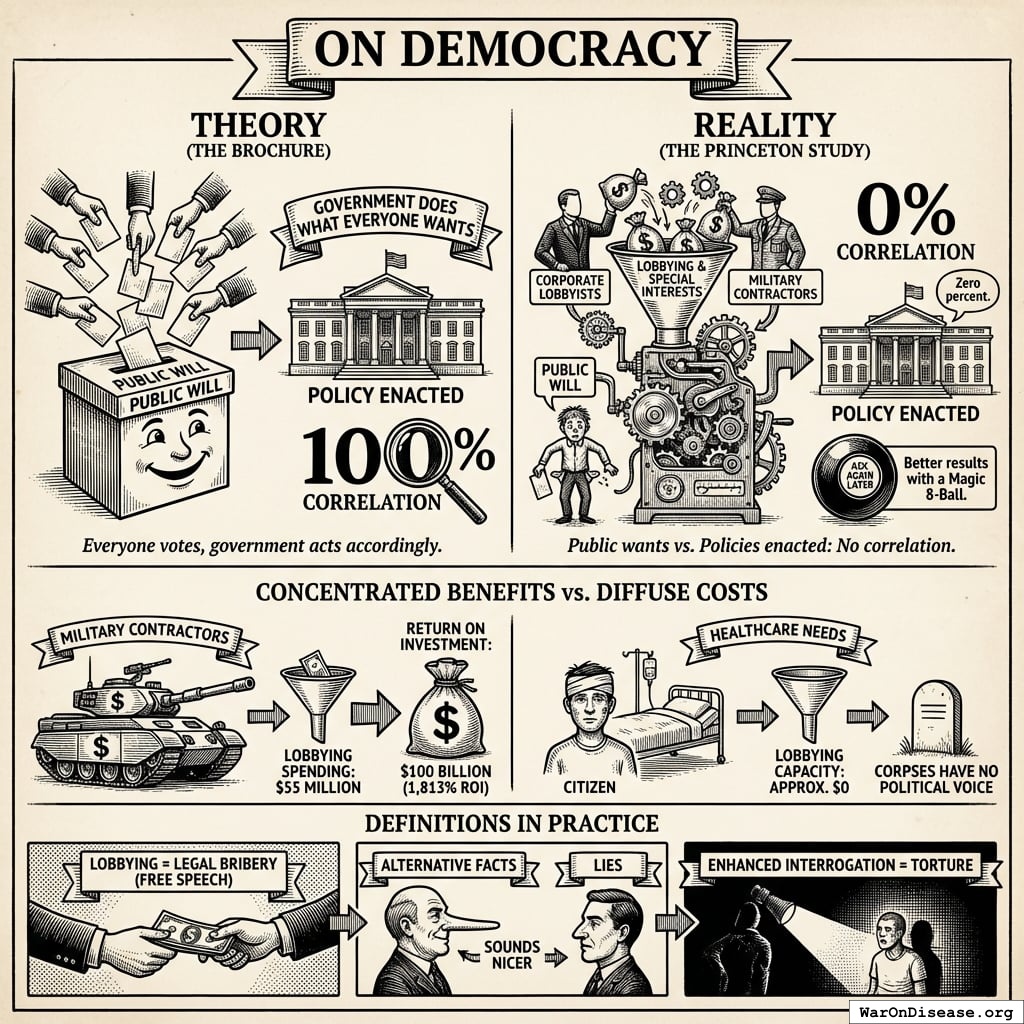
A Princeton study found [0% correlation](../knowledge/problem/unrepresentative-democracy.llms.md) between what the public wants and what policies get enacted. Zero. Not “low.” Not “disappointing.” Zero. Your democracy has the same correlation with your preferences as a coin flip has with your breakfast order.
[](../assets/images/problem/problem-section-on-democracy-bw-academic.jpg)
Military contractors spend \$250 million on lobbying and get \$850 billion in contracts. That’s a 340,000 percent return. You voted and got a sticker. Both are forms of civic participation.
When the humans you pay to make the killing things want \$100 billion, they spend \$55 million lobbying for it. That’s \$1,813 back for every dollar^([1](references.llms.md#ref-lobbying-roi-calc)). When you want healthcare, you have approximately zero dollars to lobby with. You spent it all on healthcare. Or you’re dead, which significantly reduces your lobbying capacity.
Meanwhile, the people who regulate industries used to work for those industries. They’ll work for them again after they’re done “regulating.” It’s called the [revolving door](../knowledge/problem/unrepresentative-democracy.llms.md), and it spins in one direction: toward money.
## On the Fixed Pie
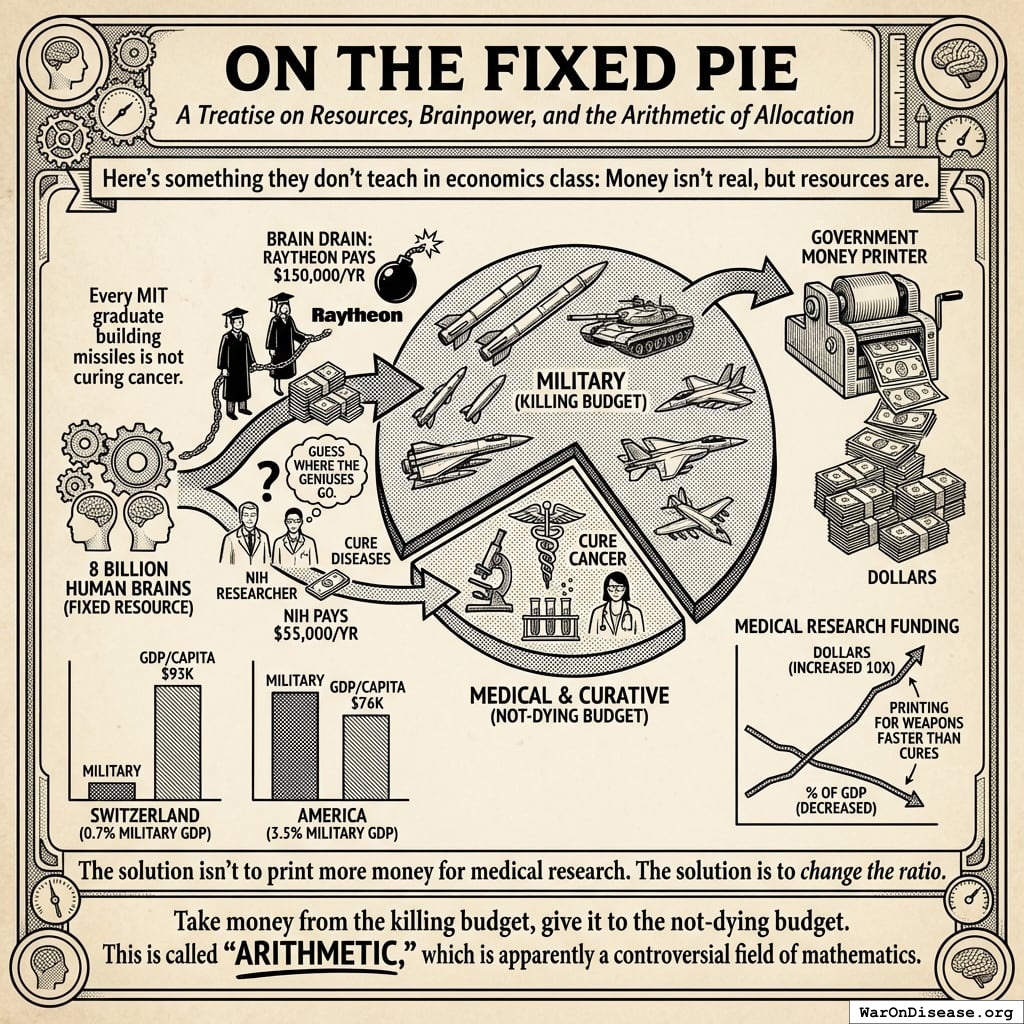
Money isn’t real, but resources are. Earth has 8 billion human brains. Every MIT graduate building missiles is not [curing cancer](../knowledge/economics/central-banks.llms.md). Every brilliant physicist designing warheads is not designing MRI machines. You have a fixed number of geniuses. You are using them to build things that kill other geniuses. Switzerland spends [0.7%](../knowledge/appendix/parameters-and-calculations.llms.md#sec-switzerland_defense_spending_pct) of GDP on military and has [\$93,000](../knowledge/appendix/parameters-and-calculations.llms.md#sec-switzerland_gdp_per_capita_k) GDP per capita. America spends [3.5%](../knowledge/appendix/parameters-and-calculations.llms.md#sec-us_military_spending_pct_gdp) and has \$76,000.
[](../assets/images/problem/problem-section-on-the-fixed-pie-bw-academic.jpg)
Switzerland pays doctors more than generals and has a higher GDP per capita than America. America pays generals more than doctors and has more aircraft carriers. Different priorities, different outcomes.
The solution isn’t to print more money for medical research. The solution is to change the ratio. Take money from the killing budget, give it to the not-dying budget. This is called “arithmetic,” which is apparently a controversial field of mathematics.
## What’s Next
The following chapters explain each problem in detail:
- [The NIH Spent \$1 Trillion Curing Nothing](../knowledge/problem/nih-fails-2-institute-health.llms.md): How 97% of medical research funding avoids testing drugs in humans
- [The FDA Is Unsafe and Ineffective](../knowledge/problem/fda-is-unsafe-and-ineffective.llms.md): How “safety” regulations make medicine more dangerous
- [Unrepresentative Democracy](../knowledge/problem/unrepresentative-democracy.llms.md): Why 0% of what you want becomes policy
- [You Are a Meat Robot](../knowledge/proof/body-as-repairable-machine.llms.md): Your body is a machine, and the parts are fixable
And if you don’t fix it, you are going to die from something that could have been cured. Personally. You. The person reading this. While the Pentagon loses another trillion dollars between the sofa cushions of its accounting department.
1\.
Responsible Statecraft. Lobbying ROI calculation (\$1,813 per \$1). *Responsible Statecraft* (2021).
2\.
Biotechnology Innovation Organization (BIO). BIO clinical development success rates 2011-2020. *Biotechnology Innovation Organization (BIO)* (2021)
*Phase I duration: 2.3 years average Total time to market (Phase I-III + approval): 10.5 years average Phase transition success rates: Phase I→II: 63.2%, Phase II→III: 30.7%, Phase III→Approval: 58.1% Overall probability of approval from Phase I: 12% Note: Largest publicly available study of clinical trial success rates. Efficacy lag = 10.5 - 2.3 = 8.2 years post-safety verification. Additional sources: https://go.bio.org/rs/490-EHZ-999/images/ClinicalDevelopmentSuccessRates2011_2020.pdf*
.
3\.
ScienceDaily. Global prevalence of chronic disease. *ScienceDaily: GBD 2015 Study* (2015)
*2.3 billion individuals had more than five ailments (2013) Chronic conditions caused 74% of all deaths worldwide (2019), up from 67% (2010) Approximately 1 in 3 adults suffer from multiple chronic conditions (MCCs) Risk factor exposures: 2B exposed to biomass fuel, 1B to air pollution, 1B smokers Projected economic cost: \$47 trillion by 2030 Note: 2.3B with 5+ ailments is more accurate than "2B with chronic disease." One-third of all adults globally have multiple chronic conditions Additional sources: https://www.sciencedaily.com/releases/2015/06/150608081753.htm \| https://pmc.ncbi.nlm.nih.gov/articles/PMC10830426/ \| https://pmc.ncbi.nlm.nih.gov/articles/PMC6214883/*
.
4\.
Tufts CSDD. Cost of drug development.
*Various estimates suggest \$1.0 - \$2.5 billion to bring a new drug from discovery through FDA approval, spread across 10 years. Tufts Center for the Study of Drug Development often cited for \$1.0 - \$2.6 billion/drug. Industry reports (IQVIA, Deloitte) also highlight \$2+ billion figures.*
5\.
Component country budgets. Global government medical research spending (\$67.5B, 2023–2024). *See component country budgets: NIH Budget* .
6\.
Applied Clinical Trials. Global government spending on interventional clinical trials: \$3-6 billion/year. *Applied Clinical Trials*
*Estimated range based on NIH ( \$0.8-5.6B), NIHR (\$1.6B total budget), and EU funding ( \$1.3B/year). Roughly 5-10% of global market. Additional sources: https://www.appliedclinicaltrialsonline.com/view/sizing-clinical-research-market \| https://www.thelancet.com/journals/langlo/article/PIIS2214-109X(20)30357-0/fulltext*
.
7\.
SIPRI. Global military spending (\$2.72T, 2024). *SIPRI* (2025).
8\.
IQVIA Report. Global trial capacity. *IQVIA Report: Clinical Trial Subjects Number Drops Due to Decline in COVID-19 Enrollment*
*1.9M participants annually (2022, post-COVID normalization from 4M peak in 2021) Additional sources: https://gmdpacademy.org/news/iqvia-report-clinical-trial-subjects-number-drops-due-to-decline-in-covid-19-enrollment/*
.
9\.
Institute for Health Metrics and Evaluation (IHME). IHME global burden of disease 2021 (2.88B DALYs, 1.13B YLD). *Institute for Health Metrics and Evaluation (IHME)* (2024)
*In 2021, global DALYs totaled approximately 2.88 billion, comprising 1.75 billion Years of Life Lost (YLL) and 1.13 billion Years Lived with Disability (YLD). This represents a 13% increase from 2019 (2.55B DALYs), largely attributable to COVID-19 deaths and aging populations. YLD accounts for approximately 39% of total DALYs, reflecting the substantial burden of non-fatal chronic conditions. Additional sources: https://vizhub.healthdata.org/gbd-results/ \| https://www.thelancet.com/journals/lancet/article/PIIS0140-6736(24)00757-8/fulltext \| https://www.healthdata.org/research-analysis/about-gbd*
.
10\.
NIH. NIH budget (FY 2025). *NIH* (2024)
*The budget total of \$47.7 billion also includes \$1.412 billion derived from PHS Evaluation financing... Additional sources: https://www.nih.gov/about-nih/organization/budget \| https://officeofbudget.od.nih.gov/*
.
11\.
Bentley et al. NIH spending on clinical trials: 3.3%. *Bentley et al.* (2023)
*NIH spent \$8.1 billion on clinical trials for approved drugs (2010-2019), representing 3.3% of relevant NIH spending. Additional sources: https://pmc.ncbi.nlm.nih.gov/articles/PMC10349341/ \| https://catalyst.harvard.edu/news/article/nih-spent-8-1b-for-phased-clinical-trials-of-drugs-approved-2010-19-10-of-reported-industry-spending/*
.
12\.
ICER. Value per QALY (standard economic value). *ICER* (2024)
*Standard economic value per QALY: \$100,000–\$150,000. This is the US and global standard willingness-to-pay threshold for interventions that add costs. Dominant interventions (those that save money while improving health) are favorable regardless of this threshold. Additional sources: https://icer.org/wp-content/uploads/2024/02/Reference-Case-4.3.25.pdf*
.
13\.
World Bank. Swiss military budget as percentage of GDP. *World Bank: Military Expenditure*
*2023: 0.70272% of GDP (World Bank) 2024: CHF 5.95 billion official military spending When including militia system costs: 1% GDP (CHF 8.75B) Comparison: Near bottom in Europe; only Ireland, Malta, Moldova spend less (excluding microstates with no armies) Additional sources: https://data.worldbank.org/indicator/MS.MIL.XPND.GD.ZS?locations=CH \| https://www.avenir-suisse.ch/en/blog-defence-spending-switzerland-is-in-better-shape-than-it-seems/ \| https://tradingeconomics.com/switzerland/military-expenditure-percent-of-gdp-wb-data.html*
.
14\.
World Bank. Switzerland vs. US GDP per capita comparison. *World Bank: Switzerland GDP Per Capita*
*2024 GDP per capita (PPP-adjusted): Switzerland \$93,819 vs United States \$75,492 Switzerland’s GDP per capita 24% higher than US when adjusted for purchasing power parity Nominal 2024: Switzerland \$103,670 vs US \$85,810 Additional sources: https://data.worldbank.org/indicator/NY.GDP.PCAP.CD?locations=CH \| https://tradingeconomics.com/switzerland/gdp-per-capita-ppp \| https://www.theglobaleconomy.com/USA/gdp_per_capita_ppp/*
.
15\.
Statista. US military budget as percentage of GDP. *Statista* (2024)
*U.S. military spending amounted to 3.5% of GDP in 2024. In 2024, the U.S. spent nearly \$1 trillion on its military budget, equal to 3.4% of GDP. Additional sources: https://www.statista.com/statistics/262742/countries-with-the-highest-military-spending/ \| https://www.sipri.org/sites/default/files/2025-04/2504_fs_milex_2024.pdf*
.
16\.
Federation of American Scientists. World nuclear forces. *Federation of American Scientists* (2024)
*As of early 2025, we estimate that the world’s nine nuclear-armed states possess a combined total of approximately 12,241 nuclear warheads. Additional sources: https://fas.org/issues/nuclear-weapons/status-world-nuclear-forces/*
.